Friday, January 24, 2014

First InGenious Competition for Schools: STEM


Are you a curious and innovative teacher? Have you creative students?  So InGenious is for you.

inGenious, the European platform in STEM education, is looking "for teachers from the European Union, FYROM, Switzerland and Turkey, and from all disciplines, to be rewarded."
You have some days left to enter the competition, 31 January 2014by presenting activities you have implemented in your class to help pupils understand the role played by STEM (Science, Technology, Engineering and Maths) in our lives and the career opportunities that STEM skills can open.


The inGenious competition aims to raise pupils’ awareness of STEM studies and careers, by exploring innovative sectors, breaking down stereotypes, addressing tomorrow's challenges, and understanding how we can make a difference. 

Where is is taking place:

This competition is for any and every motivated primary and secondary level teacher from either of the European member states, Israel and Turkey. 

What is it about: 

inGenious is looking for creative individuals that have a real passion to inspire and prepare students for innovative and highly recognized paths and careers in science, technology, engineering and maths.

Teachers are asked to help pupils find the link between their passions, such as mobile technologies, robotics or space exploration, and obtaining the necessary skills to reach career paths in these domains.

  • Teach and inspire by conducting thought-provoking lessons, activities in class, takling issues around false stereotypes, understanding which skills lead to which opportunities, and talking about the many attractions towards high level STEM sector jobs;   
  • Reach out and Discover by inviting experts, visiting a factory, testing industry practices, conducting role plays;
  • Show and tell by creating high quality materials and resources that can be shared in classrooms across borders, make the experience fun and interactive.
"Explain what you have done, and why other colleagues from across Europe may find it useful and should apply it in their class, and get rewarded: you will be invited in Brussels for the European Award ceremony award and a science workshop."
The competition was launched in September 2013 and the deadline is 31 January 2014. 
Important information: 
Only activities conducted between this time-frame will be considered eligible. However, teachers will still be able to submit their entries throughout the month of February.
How to apply:
Visit Guidelines, Terms and Conditions here
Important: Download the inGenious Competition Guidelines
To submit your entries go on My Entries here
In My entries, you will be able to access a private area to manage the submission of your competition entries! 

If you are looking for inspiration, check the inGenious resources. And now watch the video Ignite your Future below:


Ignite Your Future is a video with supporting lesson plan series that challenges pupils directly to think about a future in a science related career. Ignite Your Future makes powerful connections between the innovations pupils enjoy, their school studies and STEM careers. 

Why participate?

There are many reasons to participate in the inGenious competition
  • Earn the chance to be one of the 30 finalists to attend the Award Ceremony in Brussels 
  • Earn the chance to win an invitation for the Science disseminators workshop
  • Share and learn from like-minded teachers across Europe
Some thoughs:

I teach Humanities. And since 2000 I could understand the importance of technology in curricula. So I introduced ICT in my Languages lessons. It aimed to deliver high impact in building digital competences in Languages curricula. My students were very happy.

ICT enhanced learning in the classroom, formal education, and online, informal education.


It's interesting that I practiced fl
ipped classroom on the time, but we didn't name it like this. After all pedagogy doesn't change so much, only the wordsto name it.


Now, we are talking a lot about STEM (technology, maths, science...) but the curricula students must take outside of the major, is still part of every degree. That we call General Education.


Students need Humanities as they need Arts in School Education. And of course STEM as well. Not only STEM.


The time is for STEM. However, Humanities, Arts and STEM must continue stand up together for a complete education.


" I may still have a conflict of interest in that I want my children and grandchildren and my students' children to get not simply a degree, but a basic and substantive education. They are growing fast, and this rehabilitation is long past due."


J. W. Powell


You are a STEM educator? Go on and show your creativity with your students and apply to InGenious competition!

G-Souto


24.01.2014

Copyright © 2014G-Souto'sBlog, gsouto-digitalteacher.blogspot.com®

Licença Creative Commons
First InGenious Competition for Schools: STEM by G-Souto is licensed under a Creative Commons Attribution-NonCommercial-ShareAlike 3.0 Unported License.


Tuesday, January 21, 2014

Education: 100 years of Aviation, Interactive resource


Credits: The Guardian

To celebrate 100 years of aviation, passenger air travel, The Guardian publishes today stunning interactive uses live data In flight to show every one of the thousands of commercial planes currently in the air, charts the history of aviation since 1914, and asks what comes next for the industry.

Education:

It would be interesting if you explore the astonishing interactive resource in the classroom. Students can se every plane in the sky right now or the moment they will access

Curricula: Geography; History, Environment cross-curricula.

Ask students to use their tablets, iPhones, Androids, google The Guardian, and search In flight on Environment | Travel and transport. Then, click to launch.

The interactive map opens and students can see the planes in the sky at the moment and hear the voices over.


Credits: The Guardian
http://www.theguardian.com/

In flight is a four part interactive infographic documenting 100 years of air travel. 

Students must press play or click the map to explore.

All four parts of the project are preceded by guided animation and voice over to explain the point being made and the data that supports it. The students are free to explore the data before moving on.

The four parts to explore:
  • Mapping the skies: is a modern interpretation of Aaron Koblin’s Flight Patterns project, but computed from live data;
  • Birth of an industry: students travel to Tampa Bay, Florida to hear about the the beginnings of commercial air travel;
  • A century of growth: charts ticket sales and the reasons behind their staggering rise over the last 100 years;
  • Hitting the limits: looks at the projected growth of air travel and if the projected numbers are actually sustainable.

So interesting! I am sure that your students will love this new interactive resource! What an excitement! 

If you want, you can talk about Amelia Earhart and her courageous but fateful attempt to make a circumnavigational flight of the globe.

Find the best way to introduce this interactive tool according to the levels you teach. Improvisation makes  good teachers, believe me.

You will see ! You will have a wonderful lesson today ! Even you will love to explore it.

G-Souto

21.01.2014
Copyright © 2014G-Souto'sBlog, gsouto-digitalteacher.blogspot.com®

Licença Creative Commons

Education : 100 year of Aviation,interactive resource by G-Souto is licensed under a Creative Commons Attribution-NonCommercial-ShareAlike 3.0 Unported License.

Saturday, January 18, 2014

Education: Sciences on Mars


Mars rock
Credits NASA

Several missions are exploring Mars since 2004. But a  rock mysteriously “appeared” a few feet in front of the six wheeled rover a few days ago. Scientists scratch heads. 


Opportunity rover
Credits: NASA |JPL

The Opportunity rover which landed on Mars in 2004, hasn't moved in over a month as it waits for better weather on the red planet.


Still, no one knows for sure how it got there. The rover’s been parked at the same spot for weeks as it waits for better weather and a higher sun to help power it along its way. Sticking around the same spot allowed for nearly identical images to be taken on widely-separated Sols. Maybe a closer study of the rock in the coming days will tell us more about how it got there.


Before and now
Credits: NASA/JPL-Caltech

Left: a photo taken 3528 days after the Opportunity rover arrival to Mars. Right: the exact same spot 12 Mars days later. Notice the difference? 

JPL scientists did too: "It's about the size of a jelly doughnut. It was a total surprise, we were like 'wait a second, that wasn't there before, it can't be right. Oh my god! It wasn't there before!' We were absolutely startled."

The discovery was revealed by Mars Exploration Rover (MER) lead scientist Steve Squyres in a 10 years of Roving Mars keynote address at NASA’s Jet Propulsion Laboratory some days ago. MER scientists immediately named the new rock “Pinnacle Island”.

Scientists have two theories for the moment:
  • The rock "just landed there," ejected from a meteorite impact close to the area. 
  • The rover pushed it with one of the wheels that is now jammed.
The strange case of "Pinnacle Island" happens on the celebration of ten years, on 14 January 2004, Mars Express took its very first images of Mars in colour and in 3D.


Credits: ESA

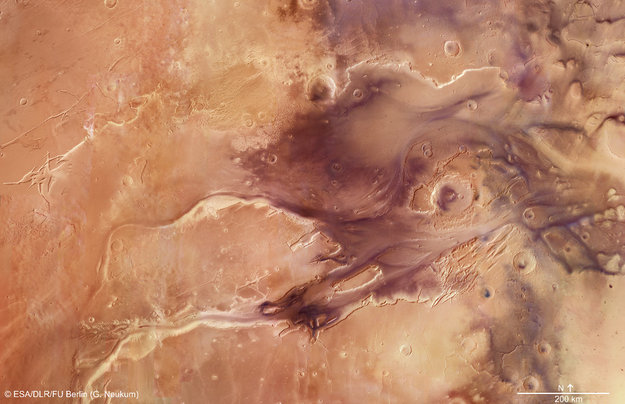
To mark the occasion, the team produced a fly-through movie of the ancient flood plain Kasei Valles. The movie is based on the 67-image mosaic released as part of the ten-years-since-launch celebrations in June 2013. Read more here

European Space Agency|ESA revealed the video below: 


Education:

Nothing more important to awake the curiosity of students, in Sciences curriculum, don't you think? Following live the event. What excitement !

And why not? Exploring possible new theories about the rock, after a deep research reading the news and watching the videos. Students are creative !

On ESA website there are some interesting resources:
  • ESA Kids
  • Teachers' Corner

You can also explore Inspiring the FutureESA Education is supporting this goal by using the fascination of its unique and pioneering space programme for the benefit of the younger generation. 

"To this end, ESA offers training programmes, numerous projects and hands-on activities designed to enthuse, inspire and support the education of young people in STEM disciplines (Science, Technology, Engineering and Mathematics), in order to enhance their scientific literacy and eventually help them to embark upon a STEM career, related to space in particular."

Oh! Applications open for Alpbach Summer School 2014. This year, the summer school will be held from 15 to 24 July and will focus on the theme “The geophysics of the terrestrial planets". 

Applications should be submitted before 31 March, 2014.

More informations here

About Mars: Resources

Robotic Exploration of Mars

3D Flash 'model'

Animation in 11 Languages


No longer is ‘space education’ limited to teaching astronomy, space sciences and related engineering subjects. Now, both in schools and universities, it can be and it is so much more.

“Space has an underused potential in supporting formal and informal STEM education across Europe."

G-Souto

18.01.2014
Copyright © 2014G-Souto'sBlog, gsouto-digitalteacher.blogspot.com®

Licença Creative Commons

Education : Sciences curriculum on Marst by G-Souto is licensed under a Creative Commons Attribution-NonCommercial-ShareAlike 3.0 Unported License.

Thursday, January 16, 2014

Schools : Dian Fossey, a great woman in the mist ! Resources


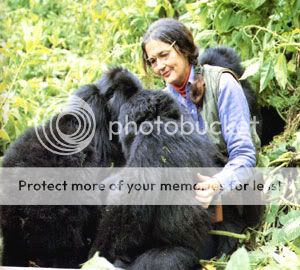
Dian Fossey
credits: Robert M. Campbell


Wow! Another great woman breaking gender barrier? Remember Amelia Earhart or Jane Goodall?

Dian Fossey was an American primatologist and conservationist known for undertaking an extensive study of mountain gorilla groups from 1966 until her murder in 1985.

Yes, great women who broke gender barrier following their dreams on dangerous careers. Women who deserve our respect!

Google is celebrating the 82nd birthday of the American zoologist Dian Fossey. The doodle features a group of gorillas, with one touching Dian Fossey’s hair while she takes notes.

  • Google Doodle:


Google doodle Dian Fossey's 82nd birthday

Here I am writing about a new Google Doodle! A pedagogical digital resource that we can't miss to include into our school lessons

Teachers can include it, just to surprise students with something different as a motivation to know more about a special woman they saw on Google homepage - you know students are the Google Gen - but don't have a clue. Or may be yes, they have. Who knows? We always have the smartest kids in our classroom, right?
So Google is celebrating the 82nd birthday of the American zoologist Dian Fossey. The doodle features a group of gorillas, with one touching Dian Fossey’s hair while she takes notes.
Another great woman breaking gender barrier! Yes, great women that broke gender barrier following their dreams on dangerous careers.


Gorillas in the Mist
Michael Apted, 1988
Teachers, do you know the film Gorillas in the Mist. The Story of Dian Fossey (1988) starring Sigourney Weaver as the naturalist Dian Fossey

A biopic of Dian Fossey, the scientist who came to Africa to study the vanishing mountain gorillas, and later fought to protect them.


It tells the true-life story of her work in Rwanda Mountain Gorillas. The movie was nominated for five Academy Awards


Gorillas in the Mist
Dian Fossey, 1983

Based on the book Gorillas in the Mist (1983) by Dian Fossey and the Hayes article. The book covers Fossey's scientific career in great detail. The extraordinary efforts of the primatologist Dian Fossey to ensure the future of the rain forest and its remaining mountain where gorillas are captured in her own words and in candid photographs of this fascinating endangered species. As only she could.


  • Some biographic information:

Dian Fossey an American zoologist studied gorillas living in the mountain forests of Rwanda, Africa, in great depth over a period of almost 20 years.

Her extensive research greatly enriched the scientific community’s understanding of mountain gorillas.

Among the most legendary scientists of our time, Dian Fossey went to Africa at the urging of famed anthropologist Louis Leakey and began her groundbreaking studies of gorilla behavior. She faced and overcame many obstacles and ultimately gave her life to gorilla protection. She was murdered in 1985 in Rwanda. Her body was found in her cabin on the morning of Dec. 27, 1985.


Dian Fossey
credits: Europe1.fr


According to the Dian Fossey Gorilla Fund International, dedicated to the conservation and protection of gorillas, Dian Fossey's early interest in animals and her childhood dream of becoming a veterinarian. 

After studying the subject at San Jose State College, she changed her major to occupational therapy. 

However, her love for animals never faltered, and she was at the same time becoming increasingly interested in Africa.


National Geographic magazine, 1970


Revealed in 1970 by National Geographic cover, which shows Fossey touching the hand of a wild gorilla, she obtained her Ph D. in Zoology from the University of Cambridge in 1974, aged 42. 

By 1966, she had won funding from the National Geographic Society and the Wilkie Brothers’ Foundation to begin a research project in the Congo.  She had to move the study to Rwanda due the political situation.

Fossey is considered as a reference in the defense of animal rights, and was one of the first Americans to settle in Africa, adapting to the lifestyle and local traditions.

In 1967, she founded the Karisoke Research Center in Rwanda's Parc National Des Volcans.


Sigourney Weaver | Dian Fossey
credits: Reuters
via Europe1.fr

Fossey died in 1985 when she was killed in her cabin in Karisoke. Theories about Dian Fossey’s murder are varied but have never been fully resolved.

The Digit Fund, which she created to finance her anti-poaching patrols (1978), was renamed the Dian Fossey Gorilla Fund International following her death. 

Thirty years later, Dian Fossey was laid to rest in the graveyard behind her cabin at Karisoke, among her gorilla friends and next to her beloved Digit.

Just three years after her death, her life story was made into the 1988 film Gorillas in the Mist starring Sigourney Weaver.


Education:

“When you realize the value of all life, you dwell less on what is past and concentrate on the preservation of the future.” 


Dian Fossey, Gorillas in the Mist

As my usual readers, teachers and parents, know, I plead for Environmental education in every school curriculum

My goal? Helping students to appreciate and understand the science of ecology, and subsequently gain the capacity to apply it to their lives becoming a new generation of environmentalists.

And here they are! The new generations fighting for climate change

Linking school success with individual student growth controls for factors outside the classroom that may affect an individual student’s ability to learn. I write about it since the beginning of this blog.


Dian Fossey

However, Dian Fossey is more than an ecologist. She was woman researcher (there are not many in the field) who gave her life to save gorillas.

She can be a good reference for girls at school. Later, in college, young women can become scientists and researchers in the fields of Ecology and Zoology and other fields in science.

This effort will translate into a citizenry that is more motivated, competent and confident to protect and improve the quality of the environment and wild animals.


Dian Fossey
credits: The Dian Fossey Gorilla Fund International
via National Geopgrahic/ Archive

My post celebrates Dian Fossey. I expect to help improve the understanding and appreciation of science, ecology and zoology in education.

As teachers, we can create a customized program that focuses on activities and research to enhance students enthusiasm and understanding for ecology and zoology.

The centerpiece is motivating students for the resources studies: documents, maps, newspaper articles, oral histories or photographs, videos, films, from which students are asked to gather, examine, analyze information, discuss and synthesize insights. 


Other resources: 

  • Video Dian Fossey& Bob Campbell (photographer)


Useful links:


Making Friends with Mountain Gorillas| National Geographic: In remote African highlands, a daring American woman studies some of man's closest nonhuman relatives in their aged-old environment.

https://www.nationalgeographic.com/magazine/1970/01/mountain-gorillas-study-dian-fossey-virunga/

Multimedia | Videos
https://gorillafund.org/video-vault/


A very early concept sketch
credits: doodler Mike Button

"One of the most amazing humans ever to have lived: Dian Fossey. I was incredibly honored to create a Google Doodle for her."

Mike Button

Fossey criticized touristic programs, often paid by international conservation organizations, because those programs interfere with both research and tranquility wild animals. 

I can't agree more! The last newon a safari at the Kruger National Park, South Africa, where an elephant was killed.

G-Souto
16.01.2014

update: 23.09.2022
Copyright © 2014G-Souto'sBlog, gsouto-digitalteacher.blogspot.com®
Licença Creative Commons
Schools : Dian Fossey, a great woman in the mist bG-Souto is licensed under a Creative Commons Attribution-NonCommercial-NoDerivatives 4.0 International License.