Showing posts with label science curriculum. Show all posts

Wednesday, April 26, 2017

Schools : Science : Cassini The Grand Finale + Resources


This artist's rendering shows NASA's Cassini spacecraft above Saturn's northern hemisphere, heading toward its first dive between Saturn and its rings on April 26, 2017
Credits: NASA/JPL-Caltech
https://saturn.jpl.nasa.gov/

After almost 20 years in space, NASA's Cassini spacecraft begins the final chapter of its remarkable story of exploration: its Grand Finale.

Cassini launched in October 1997 and arrived at Saturn in July 2004. The end of mission is set for September 15, 2017.
Between April and September 2017, Cassini will undertake a daring set of orbits that is, in many ways, like a whole new mission. 
Following a final close flyby of Saturn's moon Titan, Cassini will leap over the planet's icy rings and begin a series of 22 weekly dives between the planet and the rings.


Cassini will end its mission with 22 daring loops passing through the gap between Saturn and its rings
NASA/JPL-Caltech/Erick Sturm
http://www.esa.int/
No other mission has ever explored this unique region. What we learn from these final orbits will help to improve our understanding of how giant planets – and planetary systems everywhere – form and evolve.

It's always sad when a mission comes to an end. Cassini's finale plunge is a truly spectacular end for one of the most scientifically rich voyages yet undertaken in our solar system. 

From its launch in 1997 to the unique Grand Finale science of 2017, the Cassini-Huygens mission has racked up a remarkable list of achievements. 


Image credit: NASA/JPL-Caltech/Space Science Institute


On 22 April, Cassini successfully executed its 127th and final close flyby of Saturn's largest moon, Titan.

The image presented here is a raw image sent back to Earth yesterday, taken on Saturday at 18:42 GMT. It is one of many that can be found in the Cassini raw image archive.

The manoeuvre put the spacecraft onto its ’grand finale’ trajectory: a series of 22 orbits, each lasting about a week, drawing closer to Saturn and passing between the planet's innermost rings and its outer atmosphere. The first crossing of the ring plane will occur on 26 April.


credits: NASA

The Cassini spacecraft was launched by NASA on October 15, 1997. It reached Saturn's orbit in July, 2004 and has been studying the planet and its moons ever since.
The fly through Saturn's rings is part of the last phase of Cassini's mission. Dwindling fuel reserves mean NASA will crash the craft into the planet - rather than risking any biological contamination of Saturn's moons by depositing it there.
Diving between Saturn's rings will start today, April 26 and the little spaceship will be taking pictures of whatever it can as it passes through the giant sheets of icy debris.

Google Doodle:


Google Doodle: Cassini Spacecraft Dives Between Saturn & its Rings
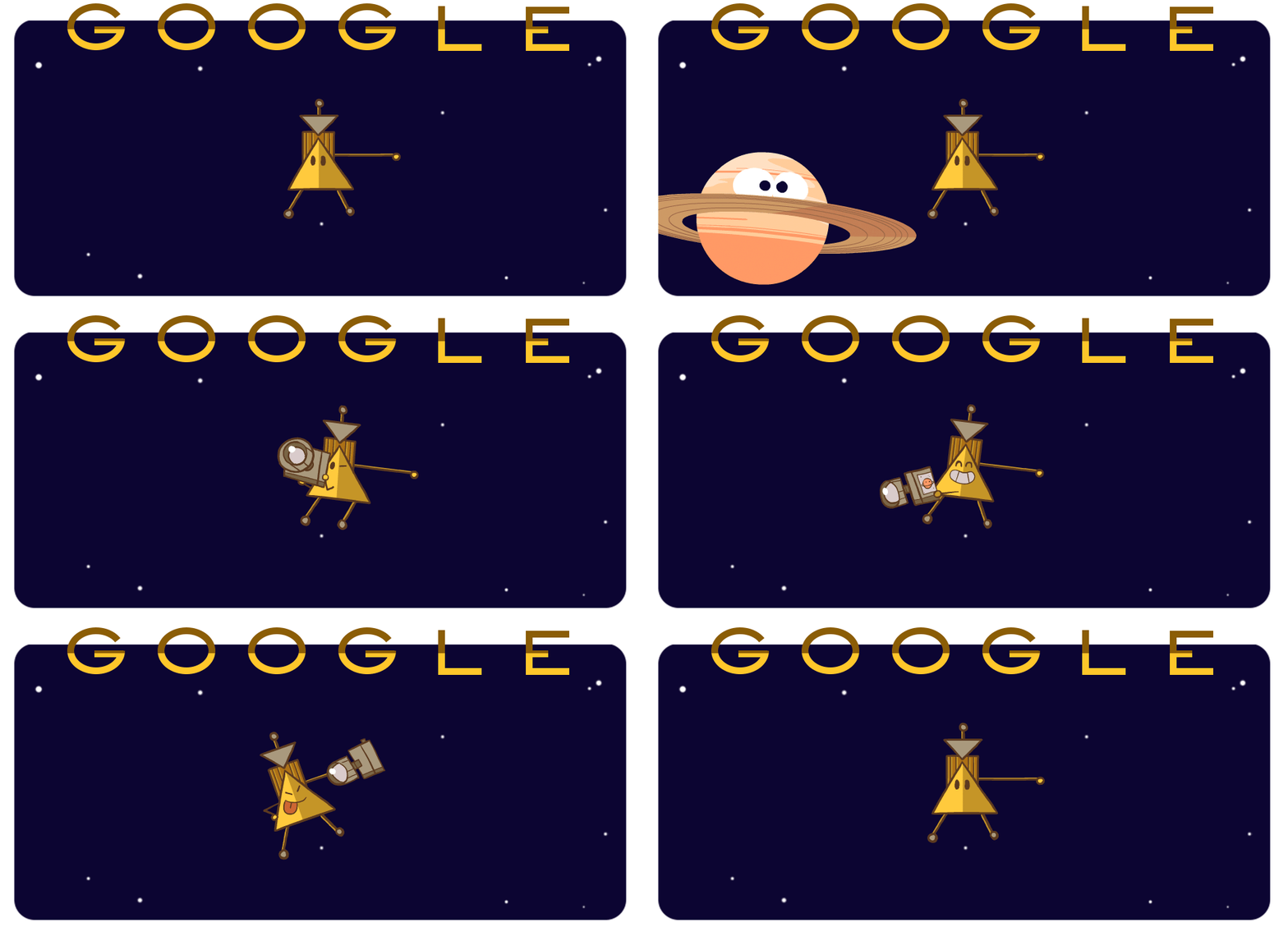

This dramatic manoeuvre has inspired a Google Doodle that will run on the world's most famous homepage on April 26, 2017.

The importance of Cassini in Science:
As Cassini plunges past Saturn, the spacecraft will collect some incredibly rich and valuable information that was too risky to obtain earlier in the mission:
  • The spacecraft will make detailed maps of Saturn's gravity and magnetic fields, revealing how the planet is arranged internally, and possibly helping to solve the irksome mystery of just how fast Saturn is rotating.
  • The final dives will vastly improve our knowledge of how much material is in the rings, bringing us closer to understanding their origins.
  • Cassini's particle detectors will sample icy ring particles being funneled into the atmosphere by Saturn's magnetic field.
  • Its cameras will take amazing, ultra-close images of Saturn's rings and clouds.


Artist's concept of Cassini diving between Saturn and its innermost ring
NASA/JPL-Caltech


Why End the Mission?
By 2017, Cassini will have spent 13 years in orbit around Saturn, following a seven-year journey from Earth. The spacecraft is running low on the rocket fuel used for adjusting its course. If left unchecked, this situation would eventually prevent mission operators from controlling the course of the spacecraft.
Two moons of Saturn, Enceladus and Titan, have captured news headlines over the past decade as Cassini data revealed their potential to contain habitable – or at least "prebiotic” – environments.
In order to avoid the unlikely possibility of Cassini someday colliding with one of these moons, NASA has chosen to safely dispose of the spacecraft in the atmosphere of Saturn. This will ensure that Cassini cannot contaminate any future studies of habitability and potential life on those moons.


Cassini by numbers
credit: NASA/JPL-Caltech


Education:

Since some of the last years we had the possibility to follow Cassini and its exploration.

The end is coming. And what a great event to follow with your students! Wow! And this time, students are all at school. No excuses. Propose your students this fantastic scientific event.

Most of us are excited about Cassini the Grand FinaleOf course, teachers and students, specially if you teach sciences and your students learn sciences, you will be even more excited

My usual readers know I don't teach sciences. I'm a Humanities specialistBut I'm a huge fan of science. Astronomy is my passion. Follow all these fantastic events that Jules Verne predicted in his books is amazing.


Graphics

credit: NASA
https://saturn.jpl.nasa.gov/

So don't miss this good live educational resource in the sky to enhance your Sciences lesson! Cassino Grand Finale

Students can access online to the the spacecraft Cassini and explore in detail all the resources made available by NASA.

You have a perfect and so complete real resource to include into your curriculum, in different moments.


Resources for students & teachers:

What we learn from these ultra-close passes over the planet could be some of the most exciting revelations ever returned by the long-lived spacecraft. 


This animated video tells the story of Cassini's final, daring assignment and looks back at what the mission has accomplished.
Join the Cassini orbiter in real time - or at any point during its epic mission. NASA's Eyes on the Solar System is a 3-D environment full of real NASA mission data. Explore the Saturnian system from your computer. Hop on a moon. Fly with Cassini. See the entire solar system moving in real time. It's up to you. You control space and time.


Cassini’s First Grand Finale Dive: Milestones


Where is Cassini now?
Students van follow Cassini here
Facts sheet: Cassini's Grand Finale
Graphics: Orbit Plot: Cassini Grand Finale (Artist's Concept)


Giovanni Domenico Cassini 
Italian mathematician & astronomer
Who was Giovanni Domenico Cassini?

Giovanni Domenico Cassini was an Italian mathematician and astronomer born in 1625.
He was the first person to notice the division of the rings of Saturn in 1675 and now, over 300 years later, a space probe bearing his name is orbiting the planet .

The Cassini spacecraft, launched in 1997, was named after him and became the fourth to visit Saturn and the first to orbit the planet.
Social media:

Facebook : NASACassini

Twitter: @CassiniSaturn

Google + : NASA


Hope you are enjoying Cassini the Grand Finale as much as I do. Admiring the beauty of this awesome event. 

G-Souto

26.04.2017
Copyright © 2017G-Souto'sBlog, gsouto-digitalteacher.blogspot.com®

Creative Commons License
Schools : Science : The Cassini Grand Finale + resources  by G-Souto is licensed under a Creative Commons Attribution-NonCommercial-NoDerivatives 4.0 International License.

Source: NASA/Cassini The Grand Finale

Sunday, January 3, 2016

Sciences curricula : Catch Some Falling Stars, the Quadrantids


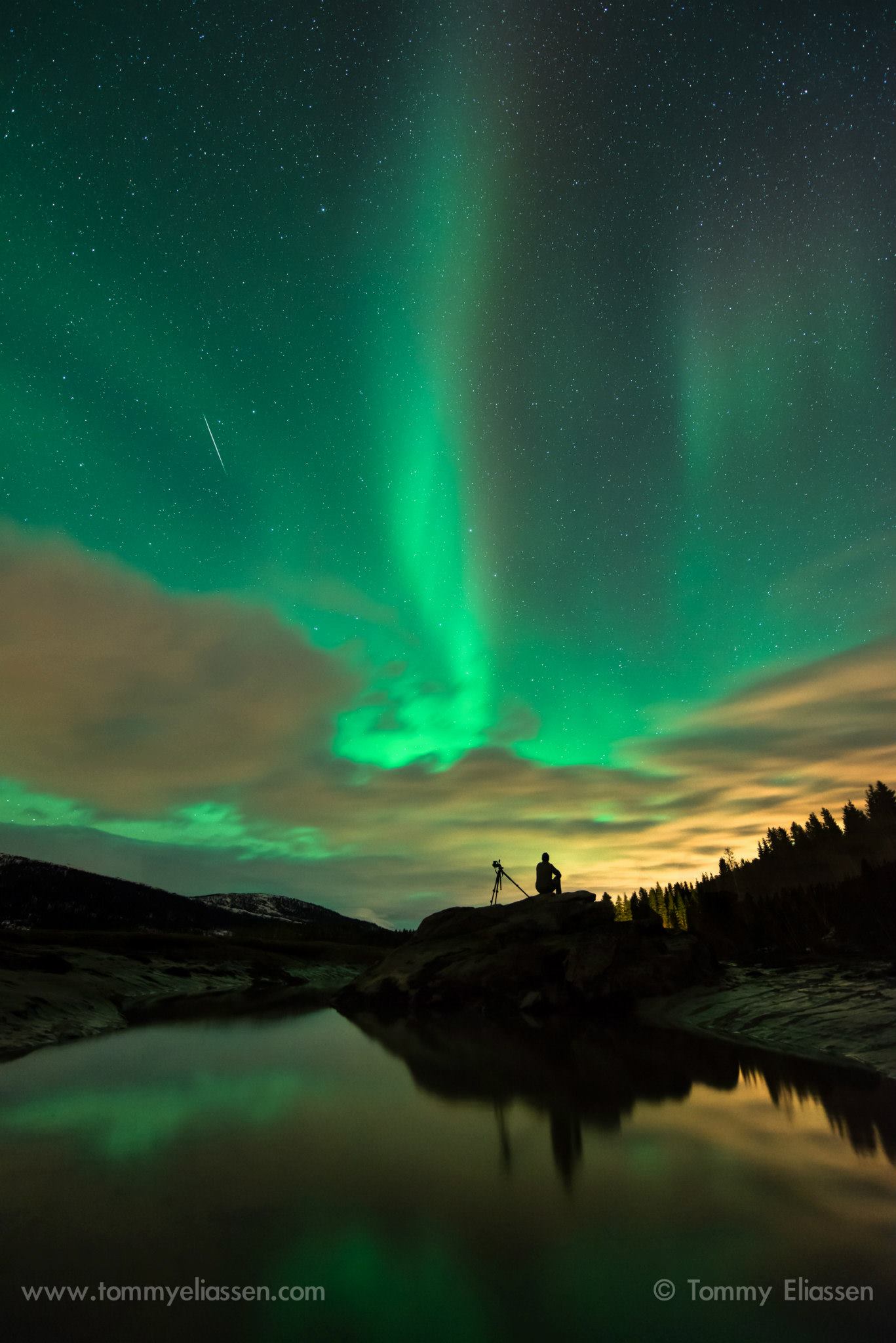
Meteor Quadrantids, 2014
credits: Tommy Eliassen


I start the New Year with the Quadrantids Meteor Shower. The first meteor display of 2016 – the Quadrantid meteor shower - will hit its peak early Monday morning (Jan. 4), with a strong display of "shooting stars" likely for Europe and North America.

Weather permitting, observers in the eastern regions of the United States and Canada will be in position for the maximum activity from the Quadrantid meteor shower, which is expected about 3 a.m. EST, when the radiant of the shower will be well up the dark northeastern sky. This is perfect timing – it falls right in our prime meteor-watching hours before dawn.
  
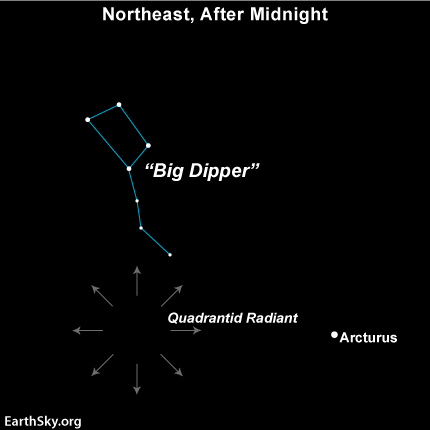
The meteors appear to radiate from a spot on the sky midway between the last handle star of the Big Dipper and the head of Draco, the Dragon. The radiant is actually located within the boundaries of the constellation of Boötes, the Herdsman, so we might expect them to be called the "Boötids." 


The Quadrantid meteor, 2012
credits: Roberto Porto

Meanwhile, the peak of the Quadrantid meteor shower lasts only a few hours. So you have to be on the right part of Earth, the part that’s in nighttime – preferably with the radiant high in your sky – during those few hours of the shower’s peak, in order to see the most Quadrantid meteors. 

In the pre-dawn hours of Monday, January 4, the first meteor shower of the year, the Quadrantids, reaches its maximum. 

The Quadrantid meteor shower is always the first meteor shower of every new year, and 2016 is no exception. 

The good news is that, in 2016, the waning crescent moon shouldn’t too greatly disrupt the shower. 

Now the not-so-good news. Although the Quadrantides put out 50 or more meteors in a dark sky, the Quadrantids’ peak is very narrow. The peaks of the Perseid shower or Geminid shower persist more or less for a day or more, allowing all time zones around the world to enjoy a good display of Perseids and Geminids


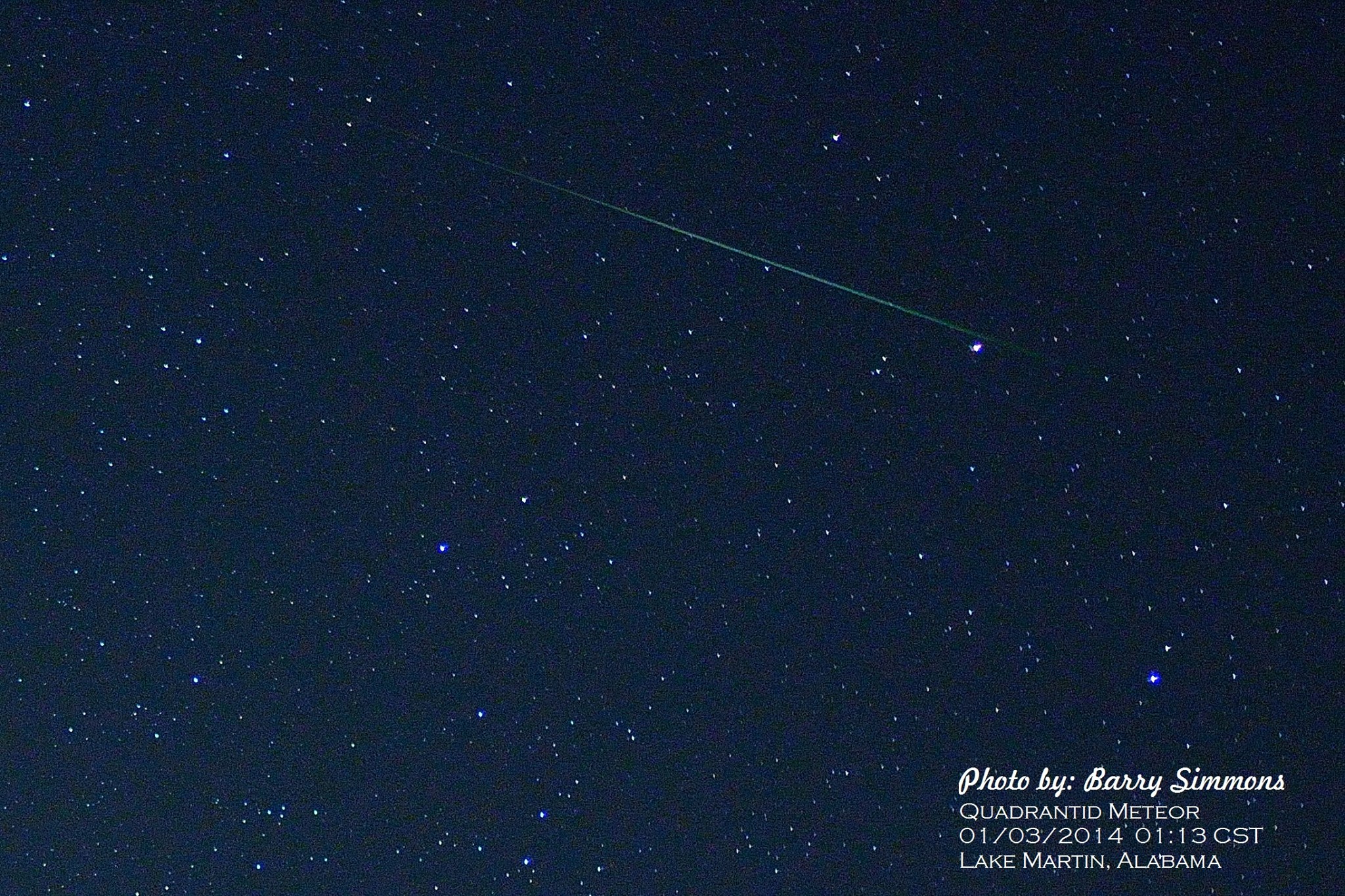
Quadrantid meteor, 2014
credits: Barry Simmons
https://en.es-static.us/


Why isn’t the Quadrantid shower as celebrated as the Perseid and Geminid showers? It’s because the Quadrantid shower has a narrow peak that lasts for only a few hours. If you miss the peak – which is easy to do – you won’t see many meteors.
The peak of the Quadrantid meteor shower lasts only a few hours. Peak rates this morning will range anywhere from 60 to 120 shooting stars per hour from a dark location. 

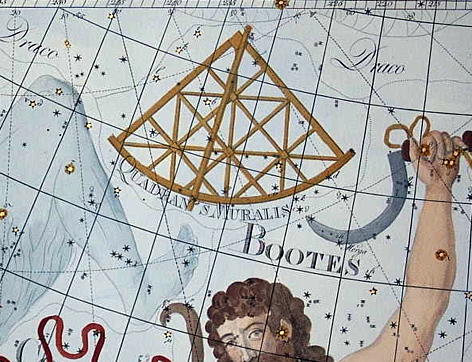
The meteors will appear to radiate from the northeast sky, just off the handle of the Big Dipper. This is the site of Quadrans Muralis, a constellation no longer recognized by astronomers but which gave the Quadrantids their name.


Quadrans Muralis


  • The Quadrantid? Origin of the name:

The name Quadrantids comes from the constellation Quadrans Muralis (Mural Quadrant), created by the French astronomer Jerome Lalande in 1795. This now-obsolete constellation was located between the constellations of Bootes the Herdsman and Draco the Dragon. Where did it go?

Most meteor showers are named for the constellations from which they appear to radiate. So it is with the Quadrantids. But the Quadrantids’ constellation no longer exists. 
To understand the history of the Quadrantids’ name, we have to go back to the earliest observations of this shower. In early January 1825, Antonio Brucalassi in Italy reported that “the atmosphere was traversed by a multitude of the luminous bodies known by the name of falling stars.” They appeared to radiate from Quadrans Muralis.


Adolphe_Quételet_
by Joseph-Arnold_Demannez

In 1839, Adolphe Quetelet of Brussels Observatory in Belgium and Edward C. Herrick in Connecticut independently made the suggestion that the Quadrantids are an annual shower.
But, in 1922, the International Astronomical Union devised a list 88 modern constellations. The list was agreed upon by the International Astronomical Union at its inaugural General Assembly held in Rome in May 1922. It did not include a constellation Quadrans Muralis. 

Today, this meteor shower retains the name Quadrantids, for the original and now obsolete constellation Quadrans Muralis.
The radiant point for the Quadrantids is now considered to be at the northern tip of Bootes, near the Big Dipper asterism in our sky, not far from Bootes’ brightest star Arcturus. It is very far north on the sky’s dome, which is why Southern Hemisphere observers probably won’t see many (if any) Quadrantid meteors. The meteors simply won’t make it above the horizon for Southern Hemisphere skywatchers.

  • What is the peak date for the Quadrantid shower in 2016? 
Different sources might give different dates and precise times for meteor shower peaks. Earth Sky relies on the Observer’s Handbook 2016 and the International Meteor Organization (IMO) to help us out. Both of these sources give the date of peak on January 4, and the time at 8:00 Universal Time.
If that prediction holds true, the peak will be 2 a.m. for the central United States on January 4. 
The shower favors the Northern Hemisphere because its radiant point is so far north on the sky’s dome.

  • What time should I watch the Quadrantid meteor shower in 2016? 
All other things being equal, for any meteor showers, you are likely to see the most meteors when the radiant is high in the sky. 
In the case of the Quadrantid shower, the radiant point is seen highest in the sky in the dark hour before dawn.
Unlike most meteor showers, we have to hope that the narrow peak of Quadrantid shower happens at or near the same hour that the radiant point resides highest in your sky. 
Here’s that peak time again, according to the International Meteor Organization: January 4 at 8:00 Universal TimeClick here to translate Universal Time to your time zone.


  • How to view:

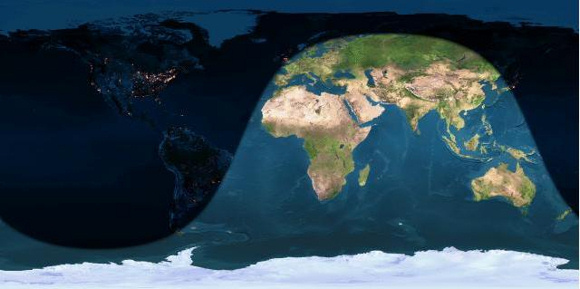
Day and night sides of Earth at the predicted peak of the Quadrantid meteor shower (2016 January 4 at 8 Universal Time). 

If the prediction holds – which is a big If - then northwestern Europe, northeastern North America and Greenland all have a shot at seeing the Quandrantid meteor shower at or near its peak in the dark hours before dawn January 4, 2016.

If the peak comes a few hours later than predicted, the advantage would go to North America. If the peak comes earlier than expected, the advantage shifts over to Europe. Only time will tell.

So you have to be on the right part of Earth, the part that’s in nighttime – preferably with the radiant high in your sky – during those few hours of the shower’s peak, in order to see the most Quadrantid meteors

Although the Quadrantids can produce over 100 meteors per hour, the sharp peak of this shower tends to last only a few hours, and doesn’t always come at an opportune time. 

In other words, you have to be in the right spot on Earth to view this meteor shower in all its splendor. The radiant point is in the part of the sky that used to be considered the constellation Quadrans Muralis the Mural Quadrant. 


credits: EarthSky


You’ll find this radiant near the famous Big Dipper asterism, in the north-northeastern sky after midnight and highest up before dawn. Because the radiant is fairly far to the north on the sky’s dome, meteor numbers will be greater at northerly latitudes in the Northern Hemisphere. 


Education:


Tomorrow, the 4 January 2016, we have the possibility to admire 13 the Quadantrids meteor shower.

Wow! Even on the first day of school time after the Christmas holidays. Our students will be happy with this new challenge.

The winter, cold temperatures contribute in making this shower neglected by the public, while it offer bright, very enjoyable meteors. 

Most of us are excited about the Quadrantid shower, specially if you teach sciences or are science students. Of course, skywatchers as well. 

My usual readers know I don't teach sciences, but humanities. But I'm a passionate of science and all the high technology near science.

Do you remember the Science education: Ready to watch the Geminids shower last 13 December, 2015? Just awesome! A sky full of stars. 

This time, the European teachers and students are in school. A good natural resource in the sky to enhance the first day of Sciences lesson! The Quadrantids.

You have a perfect lesson to start the science course 2016.


  • Activities: 

"The night sky tonight on any clear night offers an ever-changing display of fascinating objects you can see, from stars and constellations to bright planets, often the moon, and sometimes special events like meteor showers." 

Observing the night sky will enhance some experiences to understand science. If you and your students are extremely lucky – and at the right northerly location on the globe – perhaps you’ll see some Quadrantid meteors in the predawn hours on January 4.

During the Quadrantid shower skywatching, teachers and students can be skywatchers, and at the same time do some good shots, or videos with iphones, smartphones or tablets. 

The event will be discussed next lesson(s).


Videos:


Social media:

Facebook : Space.com ; NASA

Twitter: NASA solar system : hashtag #NASASolarSystem


Hope you will enjoy to be a sky watcher tonight, January 4th 2016 admiring the beauty of this interesting event.


G-Souto

03.01.2016

update 03.01-2025

Creative Commons License
Sciences curricula : Catch Some Falling Stars, the Quadrantids by G-Souto is licensed under a Creative Commons Attribution-NonCommercial-NoDerivatives 4.0 International License.

References: NASA / EarthSky