Showing posts with label school curriculum. Show all posts

Tuesday, October 1, 2019

Schools : Music Day : the value of music in public education ! Resources


Music Day | stamps
Musical instruments
Oh! What a special day! Today, October 1 is International Music Day!

As my usual readers know, I love music, I have a master degree in Music/Piano. I have been a piano teacher for years. It would be impossible not to write about Music Day. 

"Music is a higher revelation than all wisdom and philosophy."


Ludwig Von Beethoven

International Music Day is celebrated on 1 October each year. The day was established in 1975 by the International Music Council (IMC), which was founded by UNESCO in 1949. 
Music is essential to many of our lives and is a powerful platform that brings people together across cultures. 


Music Day | stamps
Musical instruments

Aim:
The main objectives of the Day are to celebrate the importance of music and musicians worldwide and to promote its value in society by building peace and understanding through a common language.


Music is a language that all people speak and that cuts across cultural, social, and economic barriers and enhances cultural appreciation and awareness.

Art provides opportunities for self-expression, bringing the inner world into the outer world of concrete reality. 

The Universal Declaration of Human Rights states that everyone has the right "to enjoy the arts", as they constitute an important vehicle for individuals and communities to develop and express their humanity. 

The vitality of artistic creativity is also necessary for the development of vibrant cultures, for the protection and promotion of cultural diversity across the world and for the smooth functioning of democratic societies.


Music Day | stamps
Brass

Education:

Many studies have emerged in recent years describing the cognitive, emotional, and behavioral benefits of music education for children. But given the tight budgets and questionable priorities of so many schools, a lot of kids don't begin formal music training until they enter high school and (only 2 years) or decide to join a band or chorus.
Children and young adults from all backgrounds should have the opportunity to learn a musical instrument, to make music with others, to learn to sing or to dance,  to have the opportunity to progress to the next level of excellence.


Music Day | stamps
Woodwinds

The Five Music Rights of IMC make important declarations about artistic rights and values in respect of music. In particular, the first three Rights articulate much of what is expressed above:

  • 1st IMC Music Right: 'For all children and adults to express themselves musically in all freedom'
  • 2nd IMC Music Right: 'For all children and adults to learn musical languages and skills'
  • 3rdIMC Music Right: 'For all children and adults to have access to musical involvement through participation, listening, creation and information'
Read the entire Statement here


Music Day | stamps
Percussion

Resources:

INPA issued three mini-sheets of twelve stamps to celebrate International Music Day on 1 October 2018. 

The stamps featuring Brass and Woodwinds, Strings and Percussion were designed by Sergio Baradat (United Nations).

An interesting resource to include into school curriculum to teach Music and its instruments hearing some musical excerpts chosen previously by teachers.


The Beatles on Abbey Road
credits: James Veysey/HUTTERSTOCK

And why not talk and include into school curriculum pop-rock music? That´s right! By the way, did you know that Abbey Road celebrated its 50th anniversary
last 26 September? Yes!


Don't forget the great digital resource on Voyager Google Earth! Beatlemania published on my blog May 2017.


Students from Bluffs Middle School | Nebraska
via StarHerald.com


Some thoughts:


"No truly cultural pursuit, involving the intellect and the emotions, is complete unless it can be regarded as both an end and a means."

Georges Duhamel, Académie Française


As my usual readers know, as a teacher I believe and pledge for the integration of Music in all schools, public and private.

Along the years I wrote often about Music as a fundamental subject in school. 

Music, a practical and active subject, must be taught as part of the curriculum in all year groups. 


The engagement of important and experienced musicians as Leonard Bernstein is central to achieving significant transformation, particularly to the lives of the most vulnerable children.

Bernstein manages this impressive feat of popular education, by dividing music into: Phonology (the study of sound); Syntax (the study of structure) and; Semantics (the study of meaning).


Of course this video is about Music education in Vocational Music Schools.


" I think music in itself is healing. It's an explosion expression of humanity. It's something we are all touched by. No matter what culture we're from, everyone loves music. "

Billy Joel, musician

G-Souto

01.10.2019
Copyright © 2019G-Souto'sBlog, gsouto-digitalteacher.blogspot.com®

Creative Commons License

Schools : Music Day : the value of music in public education ! Resources by G-Souto is licensed under a Creative Commons Attribution-NonCommercial-NoDerivatives 4.0 International License.

Monday, December 4, 2017

Schools : Celebrating 50 years of Kids Coding... coding !


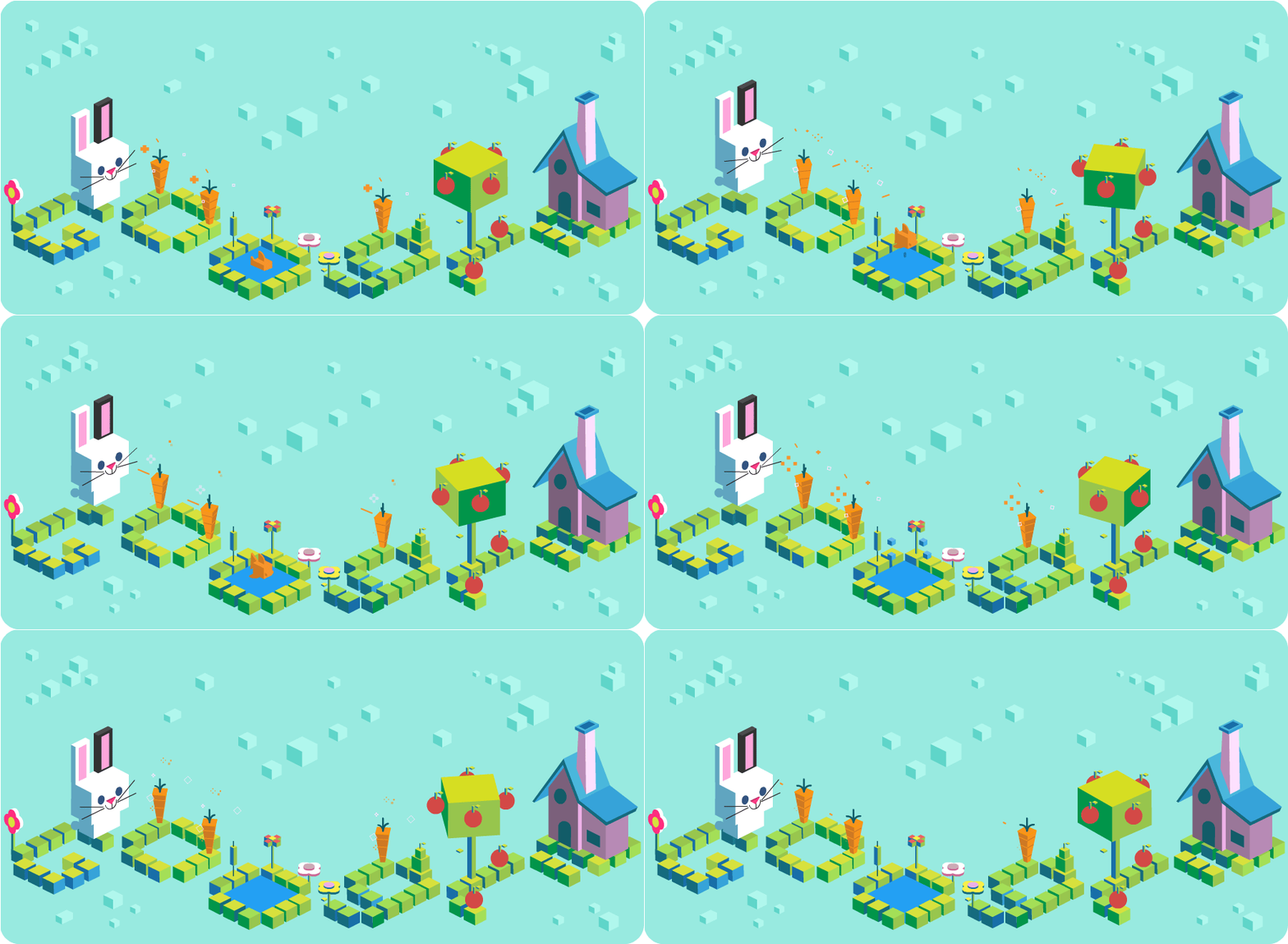
Google doodle 50 years of kids coding
doodlers:

As usual, Google doodle team continues the tradition of commemorating important dates and people.

Love doodles! My usual readers know how often use them including into school curriculum. And programming

And today, 4 December, Google is celebrating 50 years since children programming languages were introduced. 

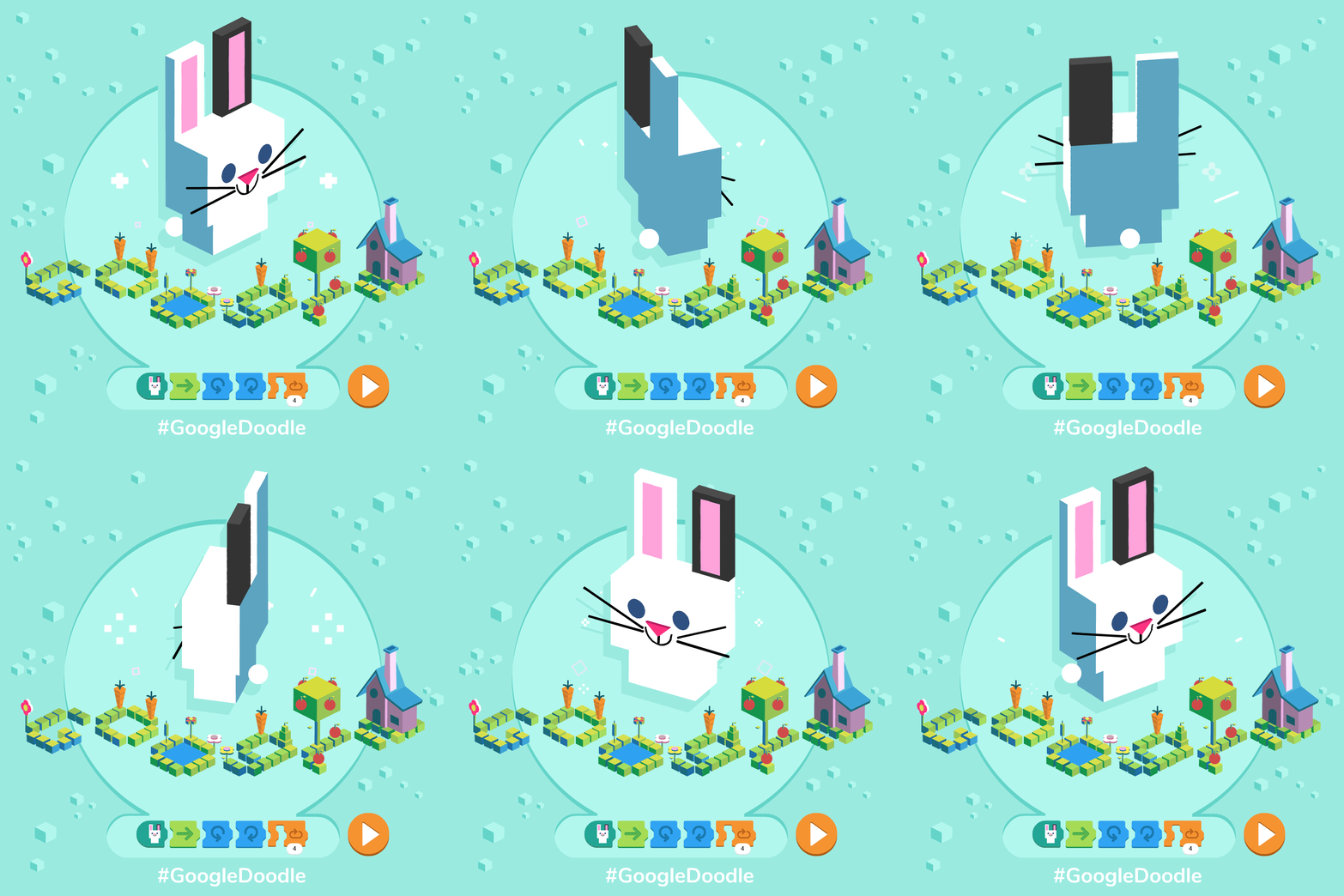
To mark this occasion, Google team, Google Blockly team, and researchers from MIT Scratch created the first ever coding doodle! Coding for Carrots. 


Google doodle 50 years of kids coding
doodlers:

It features a rabbit, and if kids/student click on the play button, the interactive doodle encourages students to create code blocks and help the furry animal cross six levels to reach and reach its favorite food. Acarrot.

"With today’s Doodle - the first coding Doodle ever - we celebrate fifty years of coding languages for kids by “Coding for Carrots.” In the interactive Doodle, you program and help a furry friend across 6 levels in a quest to gather its favorite food by snapping together coding blocks based on the Scratch programming language for kids."

Champika Fernando


Some historic facts:

The first coding language for kids, Logo, was developed and designed by Seymour Papert and researchers at MIT in the 1960s, long before personal computers were introduced. 

"Kids programming on computers must have sounded futuristic and impractical in the 1960’s when Logo was first created. In fact, even in the 1980’s when I wrote my first lines of code, my working-class parents questioned how coding would ever benefit their nine-year-old daughter."

Champika Fernando

Logo allowed for free children to program and control the movements of a turtle and also provided them with the opportunity to explore ideas in maths and science. 

Papert and his colleagues realized the potential of computers and how they could be an instrumental tool used by all children as a powerful tool for learning.

Papert and researchers at MIT saw "coding as a way for kids to develop confidence and fluency with a piece of powerful, modern, and one-day ubiquitous technology."


Google doodle 50 years of kids coding
doodlers:

The Coding Doodle into school curriculum:

Today, December 4 2017 also marks the beginning of the Computer Science Education Week that will continue till December 10. 

Google's Doodle teaches users how to draw up basic code with the help of Google's new furry friend.
The white rabbit, on his hunt for carrots, how kids/students how programming code can make the rabbit do an action.
By inputting the correct pattern kids can help the furry white rabbit on its quest to eat all of the carrots.
Kids can 'code' the movements for the rabbit which helps him get at the carrots.
This coding tool is based on the Scratch progamming language for kids. Little students can do it by using Scratch, the programming language, created by Lifelong Kindergarten Group (MIT), and putting together coding blocks. 
Scratch was developed at MIT and was designed to be less intimidating than typical programming languages, but just as powerful and expressive.


Education:
I often wrote about coding in different posts along the years: Code Week EU (since 2013) ; Are you ready to code with Dr Who ? ; The Google coding tool Oppia; Py, the app to code and other.
Coding was added to the UK's National Curriculum in 2014, Portugal's National Curriculum in 2015 (primary schools) and we are increasingly seeing kids using new words and skills that they are learning. 


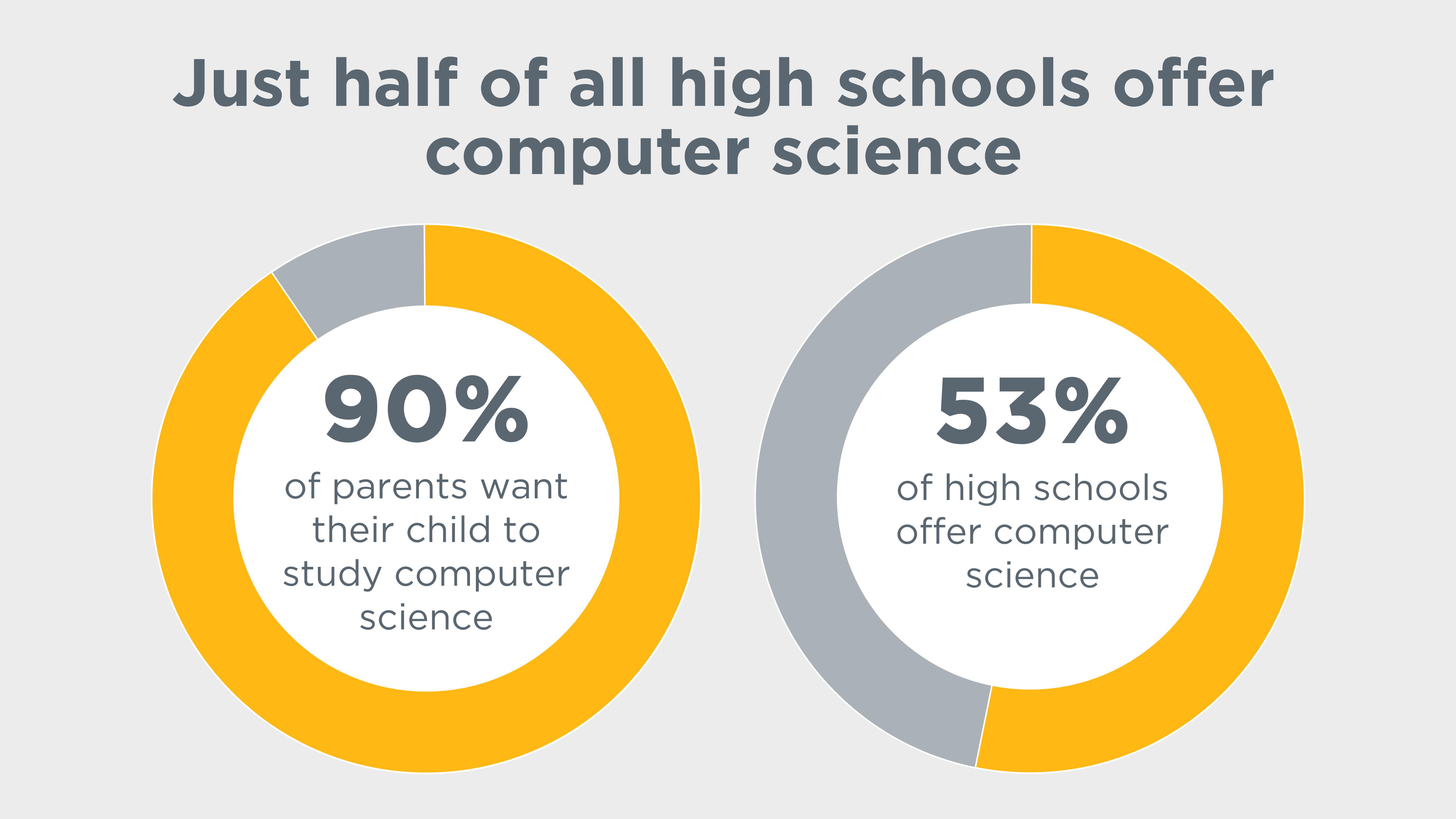
Hour of Code was launched for the first time in USA in 2013. The initial focus was on creating a database of all computer science classrooms in the United States. At the time, Hadi Partovi stated that about 90% of US schools don´t teach programming.
While over half the schools in the US don't currently offer a single course that teaches computer science, at today's event, states and school districts made pledges and announcements to address this issue in their own schools. 
Canada's National Curriculum was launched by Primer Minister Trudeau in 2016.


CSE week began in the US but is being celebrated around the world. It's an annual programme that's dedicated to inspiring school students to take an interest in Computer Science and Information Technology.
It's an opportunity for every student to try computer science for one hour. You can also teach the Hour of Code all year-round. Tutorials will work on browsers, tablets, smartphones, or "unplugged."
There's a wealth of tools at yours and your students' disposal to help them learn to code online and this Google Doodle is just the start. An a creative one.


Apple Hour of Code
via Imore

Resources:
Apple offers free hour of coding for kids. Join Apple for an Hour of Code from Dec. 4 to 10, and celebrate Computer Science Education Week. 

Whether you’re a kid or a teen student beginner or developer, students can master the basics, code with Swift, program robots—and turn an hour into a lifelong love of code.

Visit the Apple website and choose the best local activities. The store lesson might be better for the sole reason “there’s something about being at a table full of other kids working on their own projects that makes learning even more meaningful for kids.” It’s like school and they always pay attention in school. 


Infographic: Hour of Code
"This week, millions of people around the world can and will have their first experience with coding. It makes me happy to think of all of the nine-year-olds who will get their first coding experience playing with today’s Doodle. My hope is that people will find this first experience appealing and engaging, and they’ll be encouraged to go further. In some ways, it’s very different from my first coding experience many years ago, but I hope it will be just as inspiring and influential for them."

Champika Fernando, co-author of Doodle 50 years coding
Director of Communications, Scratch Team

Every student should have the opportunity to learn computer science. It helps nurture problem-solving skills, logic and creativity. By starting early, students will have a foundation for success in any 21st-century career path.

G-Souto

04.12.2017
Copyright © 2017G-Souto'sBlog, gsouto-digitalteacher.blogspot.com®

Creative Commons License
Schools : Celebrate 50 years of kids coding... coding by G-Souto is licensed under a Creative Commons Attribution-NonCommercial-NoDerivatives 4.0 International License.
Tuesday, September 26, 2017

Schools : EDL : Learning European Languages is Fun-Tastic !


European Day of Languages
https://www.facebook.com/EuropeanDayofLanguages/


"This year's European Day of Languages celebrates innovation in language learning and teaching.  This provides us with the perfect opportunity to highlight the huge value of Europe's cultural diversity."

Thorbjørn Jagland, Council of Europe Secretary General 

The European Day of Languages (EDL) was first celebrated in 2001 during the European Year of Languages. 


EYL 2001

At the end of this campaign the Council of Europe's Committee of Ministers decided to make EDL an annual event, to be celebrated each 26 September. 

Every year, millions of teachers and students organise or take part in activities to promote linguistic diversity and the ability to speak other languages.

"By pausing to celebrate the dozens of languages spoken across our communities we can send a powerful message: that Europe is a truly multilingual place where all backgrounds are welcome and where everyone can have an equal voice."

Hundreds of events are organised by schools, universities and cultural establishments to mark the day. 


At the initiative of the Council of Europe, Strasbourg, the European Day of Languages has been celebrated every year since 2001 on 26 September
On the occasion of the day, a range of events are organised across Europe: activities for and with children, television and radio programmes, language classes and conferences. 

To coordinate the activities organised at national level, the Council of Europe asks participating countries to nominate National Relay Persons for the day.


European Day of Languages


Education:

Throughout Europe, 800 million Europeans represented in the Council of Europe's 47 member  states are encouraged to learn more languages, at any age, in and out of school. Being convinced that linguistic diversity is a tool for achieving greater intercultural understanding and a key element in the rich cultural heritage of our continent, the Council of Europe promotes plurilingualism in the whole of Europe.

Studies have been showing that speaking several languages is one of the best exercises your brain can get. See?

On the occasion of the European Day of Languages, a range of events are organised across European schools.

26 September must be about having some fun together in different languages. 
Everything is permitted to motivate students to learn languages. There are so many languages in Europe!

In order to learn more about language diversity, students can take part in different activities proposed by their teachers or following a school project. 


Tongue Twisters


  • Activities:


Excited? Only some hours left until the European Day of Languages! Are you ready to twist tomorrow? 


Tongue Twisters:


  • Portuguese: "Três Tristes Tigres"

  • Swedish: ”Father, do sheep have sheep? No, sheep don't have sheep, sheep have lambs”.


From ‘Around the rugged rock, the ragged rascal ran’ to ‘red leather, yellow leather’, one aspect of mastering a language is being able to master its tongue twisters. They are always decidedly odd sentences. 

Invite your students to visit the web site and to inclue a tongue twister.


Play mode:

Play a game and test your knowledge: students may choose a sticker. And they will be asked to answer a Quiz about the language/sticker they have chosen.

They can choose a sticker only once. 


EDL world record attempt

Participate in the EDL world record attempt!

To add a little extra spice to the European Day of Languages this year, we are aiming to establish a EDL world record.

Encourage your classes or students to create a short video clip based on the phrase:

“I love [a language] because…”.


  • The video, using the above phrase, can be:
  • Recorded in any language and can be about any language(s). 
  • The clips may involve an individual, group or class 
  • It should be no longer than 10-20 seconds in length and filmed in landscape format. The more creative the video, the better!
  • Do not forget to turn on subtitles.

BE Active! BE Cre@tive!

Closing date : 30 September

Upload school or students videos here


  • News 2019: Resources: Schools/ students 


HandBook of Languages Challenges

This year EDL is inviting everyone to participate in a language challenge around the European Day of Languages! 
The 51 challenges contained within the handbook encourage learners to go a little outside their comfort zone and take advantage of the plentiful opportunities available to practice or learn more about a language beyond a classroom context.
Students can choose easy challenges that don’t involve much time – such as “count from 1-10 in 3 different languages within one minute” to ones that are a bit more demanding “ together with a friend, write the words to a song/rap in a foreign language”. 

There should be something for everyone and you may discover that you actually know more than you think about languages!

Download the HandBook in English here


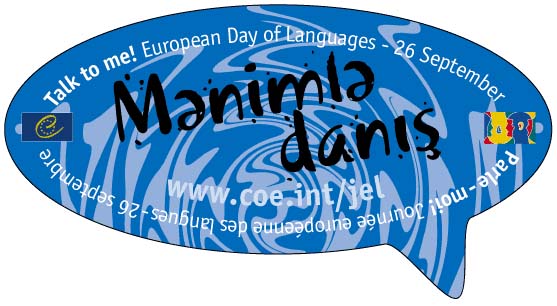
Which Language It Is?


Which Language It Is?

We all know this situation: on a bus, in a café, on the street we hear two people talking in a foreign language. And we wonder what language it is. Let's do some training here and next time this happens to you you will easily recognise it!


EDL T-Shirt Contest 2019

EDL T-Shirt Contest Winner 2019

The winner of the 2019 EDL T-shirt contest is EmilÄ— Å½andauskaitÄ— from Vilnius Abraomas Kulvietis Classical Gymnasium/ Lithuania. Congratulations!

EDL T-Shirt Contest 2020:

Send EDL your design/image/graphic and have your layout on the official 2020 EDL T-Shirt!


Resources+


  • Sign language game:
Country names in international sign language. Do you know the European country names in international sign language? 

Invite students to learn by selecting and clicking on a country on the map and then test themselves to see how many they can get right!

Whether large or small, don't forget: 

  • Have a good idea (an event, party, tournament, breakfast, flashmob at school;
  • Organise creative events with your students and promote on the EDL website here ;
  • Create promotional texts/flyers and distribute them at the school, at home;
  • Tell your school library about the event about the European Day of Languages and ask to make a presentation in different languages with students; 
  • Tell your national relay about your events. They may promote your initiative;
  • Enter the event into EDL database

Make it happen! 

There are so many activities! Teachers will find some teaching materials here


My Dream Job 2017:


Apply for your dream job in our 2017 European Day of Languages Competition and you could win a trip for your class! Reece Sheridan heard about the competition through Stein Study and made this video with their Erasmus+ intern Patrick Stegar to spread the word.


G-Souto

25.09.2014


updated : 25.09.2019
copyright © 2019G-Souto'sBlog, gsouto-digitalteacher.blogspot.com  


Creative Commons License
Schools : Learning European Languages is Fun-Tastic !  by G-Souto is licensed under a Creative Commons Attribution-NonCommercial-NoDerivatives 4.0 International License.