Showing posts with label ICT and curricula. Show all posts

Friday, January 16, 2015

Education : TELL Awards, submit your project !


"Most people on the planet would agree that educating young people is part of the greater good, something well worth supporting by society."
Our objective is to change the world, to better learning opportunities for young people. We are doing this because we aim for the future, for a better, more modern, education.
No doubt that Technology Enhanced Learning (TEL) has created enormous changes in schools, universities and in vocational learning. However, these innovations have tended to be unsustainable. Too often, initiatives need a high degree of effort to be sustained, and are consequently endangered when funding stops. 
However few educational institutions have taken these technologies up in a systematic way in order to include them in their learning strategy. In spite of a huge amount of technologies available for learning purposes, teachers and students are NOT taking them up and the real breakthrough of new teaching and learning methods with new technologies has not happened.
The European TELL US competition sponsored by the European Commission’s DG Connect is open for ALL participants from large companies, SMEs, innovators, formal education actors and students.

Objective:

To change the world, to better learning opportunities for young people. TELL Awards is doing this because it aim for the future, for a better, more modern, education.


The competition will be subdivided into the “formal educational environment” which is centred on the three following main market segments:
  • Schools
  • Vocational Education and Training
  • Higher Education (High Schools and Universities)
The competition is organized in two stages with correspondent services levels:

1. Regional competitions online: 16 winners will be selected for the Grand Final. Each one of them will receive a prize including internationalisation support (one showcase event), soft landing services in one of the cluster ecosystems, and advice on EU projects, among others.

2. The Grand Final at Futur en Seine which will take place on 15th June 2015 in Paris, in Paris, where the four winners will be selected by an international, high-level jury and the public.


The 4 Regions:

Visit here

Jury:

The European Jury composed from a selection of the stakeholders from EU countries will be judge both the Regional contests and the Grand Final.
Each regional and final competition will also have an exhibition element and will enable the general public to assess the entrants and vote for a special ‘people’s choice’ awards.
Criterias :
The contest criteria will be drawn from the following foundations i.e. what we are looking for are solutions that: 
  1. Meets the expected learning objectives
  2. Appearance
  3. Creativity
  4. Ease of use for the learner
  5. Interactivity
  6. Ease of updating and adding content
  7. Holds the learner's interest
  8. Potential impact of the course based upon category and potential audience.


Prizes

Prizes for each of the winners include 2,500 euros in cash, a 500 euros Amazon account to cover technological needs, Startup Profiling on EDUKWEST Europe along with social media promotion, HP equipment, and many other prizes.

Application:

Participants must enter their application online. 

Deadline : 

The submission deadline for the TELL US Awards ends on 31 January 2015.


The 4 finalists will be awarded cash prizes by an international, high-level jury and the public. 

They will receive a cheque, IT hadware, coaching for internationalization (meeting potential clients, investors, etc) and a strong international visibility. We are pleased to count among our sponsors today HP, Telefonica, Capita, Go-Xapi, etc.


Participants :


Please complete the application in in full online: This application will form the basis for selection of candidates to progress to the second stage of the Awards Competition. 

Further information: 

For any further information please contact Camille Vidaud


Education:

How many teachers gave up for interesting and pioneers projects because they haven't the money and support to develop or to continue their creative ideas on Education.

I am one of them. In 2002, I created the first e-learning project at Secondary education to enhance Langages curriculum with ICT but unfortunately after two years with an incredible effort, the project could not be developed because I hadn't no money to support it and to continue my creative ideas on Education. The project was very appreciated by innovators, teachers and educational networks in Europe, United States, Afirca.

Today the project is a prototype and take part of the Micro Innovators network at VISIR.

However, in 2004, I submitted Kidzlearn Lugares & Aprendizagens at Global Junior Challenge, Rome and my project was a finalist project among 647 projects from all over the world. 

See? Now there are TELL AwardsThis is your opportunity to share your project to enhance learning by using technology.

We are on the 21th century and there are a lot of teachers who feel not confortable using technology in the classroom. Don't ! Ask for help from trainers or teachers that use technology in the classroom for years to enhance learning and motivate students to school curriculum.

"TELL Awards' objective is to change the world, to better learning opportunities for young people. We are doing this because we aim for the future, for a better, more modern, education."


G-Souto

16.01.2015


Copyright © 2015G-Souto'sBlog, gsouto-digitalteacher.blogspot.com®

Creative Commons License

Education : TELL Awards, submit your project ! bG-Souto is licensed under a Creative Commons Attribution-NonCommercial-NoDerivatives 4.0 International License.

Wednesday, September 24, 2014

Let's talk European Languages : Languages matter !

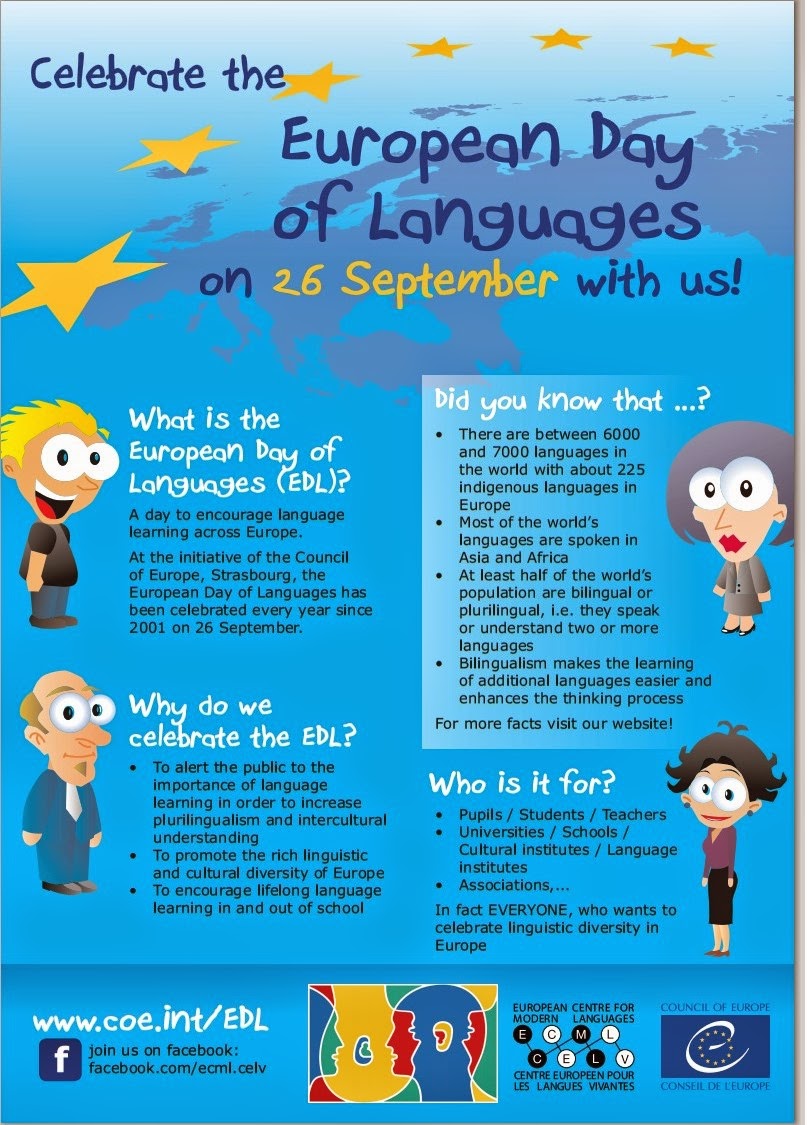
"A day to encourage language learning across Europe."
The European Day of Languages has been celebrated every year since 2001 on 26 September, as an initiative of the Council of Europe in Strasbourg.  

There are 24 official languages in the EU – as well as about 60 regional and minority languages Today is the best day to celebrate this diversity!


Throughout Europe, 800 million Europeans represented in the Council of Europe's 47 member states are encouraged to learn more languages, at any age, in and out of school. 

Being convinced that linguistic diversity is a tool for achieving greater intercultural understanding and a key element in the rich cultural heritage of our continent, the Council of Europe promotes plurilingualism in the whole of Europe.
The European Day of Languages continues, to raise public awareness of the languages used in Europe, and to promote cultural and linguistic diversity and to encourage people – schoolchildren and adults – to learn languages.


Aims:

Language skills are a necessity and a right for Everyone – that is one of the main messages of the European Day of Languages.

The overall objectives are to raise awareness of:

  • Europe’s rich linguistic diversity, which must be preserved and enhanced;
  • The need to diversify the range of languages people learn (to include less widely used languages), which results in plurilingualism;
  • The need for people to develop some degree of proficiency in two languages or more to be able to play their full part in democratic citizenship in Europe.
  • Promote the rich linguistic and cultural diversity of Europe;
  • Encourage lifelong language learning in and out of school.
In the EU28 in 2012, English was still the most commonly studied foreign language at lower secondary level1, with 97.1% of pupils learning it, far ahead of French (34.1%), German (22.1%) and Spanish (12.2%). The importance of English as a foreign language in the EU is also confirmed by its leadership in nearly all Member States.

Ok ! What about the other 25 languages? It's up to us, citizens, educators and students to promote our mother language in Europe. 

My students and I are Portuguese. So we care about our mother language on our blog in Portuguese.

But I teach French as well, so I have a blog in French language to enhance the skills of my students. 


26 September must be about having some fun together in different languages.
  • Check out the material for download and for order with your national relay ;
  • Watch the video "Countries names in international sign language". Students click on the map and will listen the name of each country in international sign language ;
  • A map showing the approximate distribution of indigenous languages in Europe (codes according to ISO 639-1 and ISO 639-2).

Credits: Wikimedia

Education:

On the occasion of the European Day of Languages, a range of events are organised across Europe. 

26 September must be about having some fun together in different languages, not only in English, French or Spanish.


Every year throughout Europe, events are organised to celebrate languages: shows, kids’ activities, music games, language courses, radio and TV programmes, conferences. 

Everything is permitted to motivate students to learn languages, all European languages.

In order to learn more about language diversity students can take part in different activities proposed by their teachers or following a school project. 

Whether large or small, don't forget: 

  • Have a good idea (an event such as a party, a tournament, a breakfast in school, a cultural presentation at the school library ;
  • Organise creative events with your students and promote on the EDL website here ;
  • Create promotional texts/flyers and distribute them at the school, at home;
  • Tell your school library about the event and about the European Day of Languages and ask to make a presentation to students and teachers on the importance to learn different languages.
  • Tell your national relay about your events, they may know of other ways of promoting your initiative ;

  • Enter the event into EDL database
Make it happen! 

But there is more ! Yes, something your students will love it ! A European Day of Languages Photo Contest !


DigiSkills network is promoting a photo contest. The European Day of Languages (EDL) Photo Contest 2014 is intended to illustrate language learning in action in different environments. 

Objectives :

The competition is open to persons of all ages living in all Council of Europe member states and observer states. The ECML will use the best photos for promotional purposes. 


Theme: Language learning in action

Important information:

  • Photos : The photo(s) should represent your experience of learning languages. Your upload needs to contain the following information: title, name of the contestant, email, age, country and place photo was taken.
  • Format : Images should be no smaller than 2000 pixels in width or height. No watermarks, signatures, or copyright notices may be added to images.
  • Submission period: Your photo(s) should be uploaded the between 14 September 2014 and 14 November 2014 on this page.
  • Voting period : Online voting will be from 15 November 2014 to 15 December 2014.
The winners will be announced on 18 December 2014.

  • Prizes: There will be prizes for first, second and third to be announced shortly. A small prize will be awarded for all photos that are subsequently used by the ECML.
For further information click here


#EDL
https://fbcdn-sphotos-a-a.akamaihd.net/

“On 26 September we celebrate Europe’s rich linguistic diversity. Let us take a moment to remember the words of Antoine de Saint-Exupery – that language is often the source of misunderstandings. Language can be used as a weapon, as an excuse to discriminate and humiliate. 

Together we can ensure that languages, rather than being the source of misunderstanding, become the key to intercultural dialogue and mutual respect. To do this, we must challenge existing mindsets and embrace diversity."

Thorbjorn Jagland, Secretary General of the Council of Europe


G-Souto

25.09.2014
copyright © 2014G-Souto'sBlog, gsouto-digitalteacher.blogspot.com  

Creative Commons License
Let's talk European Languages : Languages matter ! bG-Souto is licensed under a Creative Commons Attribution-NonCommercial-ShareAlike 3.0 Unported License.


Thursday, September 19, 2013

August roundown of the most-read posts


Credits: © GSouto
Sunset on Atlantic Ocean at Porto
Portugal

I know I know! Your saying August roundown of the most-read posts on September 19? Ok! You know I can explain!

First week of September, i was enjoying my summer holiday in Paris. It has been wonderful! Walking on the streets of Paris, all along the 'quais' de la Seine, traversing the beautiful bridgesvisiting Musée d'Orsay, Petit Palais Museum, Centre Pompidou, some monuments, the Bagatelles parc, attending two concerts. Oh! So nice. I had an incredible time!

Back home, I had the time to write just one post about MEDEA Awards before travelling again for two days.

This time, on work! I went to Lisbon to attend the Great Lisbon Conference on Games and TEL. Later, I will write my impressions about the conference.

But now, let's doing about August roundown. This is the five posts in my Summer Learning School Series of August. These are some posts with resources, tips and tools for you to try something  new or something you can take to your classroom now that we're all back to school. 

I added seven posts, on different subjects in August. Here my list of the 5 most-read of the month - presented in most reading order - together with a quote or two.

My frequent readers know that I write in three different languages: English, Français and Português.

And I am glad to see that the most-read post of August is Musique au collège: Debussy & Google doodle (en français). If you are my regular reader you know I am pledging for Music as a serious curriculum in shool education.

Google Doodle Debussy

Je ne pourrais pas perdre ça! Google Doodle rend hommage à Claude Debussy! Aujourd'hui, 22 août 2013, le compositeur français fait l'objet d'un Doodle mondial de la part de Google.

En effet, la célébration du 151ème anniversaire de la naissance de Claude Debussyest marquée par une animation sur la page d’accueil du géant de la recherche.
Éducation:

La Musique a toujours occupé une place particulière sur mon blog et dans mes cours de Langues. Selon moi, l'enseignement de la musique doit faire partie d'une éducation intégrale de tous les enfants, dès les premières années.

Apporter des connaissances sur la musique, développer des compétences pour écouter et produire la musique, doivent former les deux axes pédagogiques majeurs de l’éducation musicale dans l’enseignement scolaire. 

On connait bien ses bénéfices! La concentration, coordination, mémoire, auto-estime, joie, entre autres.

Pour l'instant, je vous propose juste de faire une belle motivation en introduisant le Doodle interatif 'free' dédié à Debussy dans l'une de vos leçons.

Disciplines: Langues; Musique; Arts (l'interdisciplinarité est bien venue)

Outils: Tablettes tactiles, smartphones, iphones.


La rentrée 2013. Allez! On y est depuis le 3 Septembre. Beaucoup de nouvelles réformes.

Ma pensée va aux 'nouveaux' jeunes enseignants! C'est tellement dur les premiers jours de cours! Et sans formation! Les rythmes,  les élèves - oh! ils ont le flair quand ils regardent les professeurs 'nouveaux' - et l'année sera difficile! Faut pas dire non.

Heureusement, il y a toujours des profs plus expérimentés qui vous soutiendront! N'hésitez pas d'appeler 'au secours' quand vous vous sentez paniquer!

Vacances, rythme scolaire, matières, évaluations... qu'est-ce qui va changer cette nouvelle année?

Certaines réformes seront mises en place, à commencer par celle des rythmes scolaires. 


Un meilleur accompagnement des jeunes professeurs


Ah! Voilà! On pense aux jeunes enseignants! La formation

Tout le monde sait que l'une des grosses difficultés des jeunes enseignants ces dernières années, c'était le manque de formation. Ils ne bénéficiaient plus d’une formation à la gestion d’une classe, et étaient catapultés directement dans les salles de cours, souvent dans des zones sensibles. 

Des écoles supérieures du professorat et de l’éducation (ESPE) seront créées dès la rentrée.  

Les professeurs y feront une formation pratique pour apprendre à enseigner, transmettre leur savoir, gérer mieux une classe agitée, savoir introduire les technologies. Pas si faciles que ça bien qu'ils appartiennent déjà tous à l'ère du numérique.
  

"In a handful of nations, virtually all children are learning to make complex arguments and solve problems they’ve never seen before. They are learning to think, in other words, and to thrive in the modern economy. What is it like to be a child in these new education superpowers?"

Parents and Teachers:The Smartest Kids in the World. Amanda Ripley's new book is on sale since August 13, 2013. It chronicles life inside the world's new education superpowers.

In the new book, The Smartest Kids in the World: And How They Got That Way, the journalist for Time and The Atlantic magazines, and author Amanda Ripley sets the scene for what is turning out to be battle for the soul of US Education.

Using PISA 2009 results as the backbone of her story, Ripley sets out to find out why it is that American students are falling behind their contemporaries in countries that aren’t as wealthy or innovative as the United States.

“PISA could not tell me how those countries got so smart, or what life was like for kids in those countries, day in and day out, compared to life in America,” 

Amanda Ripley's book 


Credits video: Amanda Ripley's website 

So, she followed three Americans embedded in these countries for one year. Kim, 15-year-old, moving from Oklahoma to Finland; Eric, 18-year-old, exchanging a high-achieving Minnesota suburb for a booming city in South Korea for a year; and Tom, 17, leaving a historic Pennsylvania village for a gritty city in Poland

According to Amanda Ripley, parents have a critical role to play - but not always in the way we think. Effective parents "let their children make mistakes and then get right back to work. They teach them good habits and give them autonomy," 


Perseid 2012
David Harpe, Boulder USA

"We have found that one meteor shower produces more fireballs than any other," (...) "It's the Perseid meteor shower, which peaks on August 12th and 13th."

Bill Cooke, NASA's Meteoroid Environment Office 

Catching the Falling Stars: Science curriculum. According to NASA research, the upcoming Perseid meteor shower produces more fireballs — bright meteors that streak across the sky — than any other annual shower, earning it the title of "fireball".


Of course, you must keep the idea of the beauty and the pedagogical watching of this marvelous summer falling stars shower.

Education:

Most of us were on vacation. But students could watch this exciting event of the summer with family or in campus summer.

Back to school, i you are a Sciences teacher you can do amazing lessons displaying this video or other to explain the Perseid show.

"The Perseid are the highlight of the astronomical calendar and a must see! They are ideal for those who want to see a meteor/ shooting star for the first time.


"Every child needs nature. Not just the ones with parents who appreciate nature. Not only those of a certain economic class or culture or gender or sexual identity or set of abilities. Every child."
Richard Louv

Education: Time for Vitamine 'N'. It is not the first time I write about the importance of Nature in Education. Children's Day: let's go outdoor; Environmental Education and outdoorWorld Environmental Day in School EducationIberian wolf as environmental education; are some of the publications on my blog. My regular readers know well.


So The Nature Principle and Last Child in the Woods by Richard Louv could be interesting for parents and for teachers, of course if they are new for you.

Education:

Research suggests that exposure to the natural world – including nearby nature in cities – helps improve human health, well-being, and intellectual capacity in ways that science is only recently beginning to understand.

What do we know about how human beings, particularly children and young people are affected by the absence of nature’s intrinsic benefits? 

And teachers! Believe it! Nature is also good for stimulating creativity. Research shows that children play more creatively in free, outside space and will be more creative in school activities.

Well, we all deserve some vacation after a good school year. And summer time is the most most enjoyable time of the year. Hoping you had a wonderful summer time break and you are back to school fresh and full of new ideas to share with your students in the classroom.

G-Souto

20.09.2013
Copyright © 2013G-Souto'sBlog, gsouto-digitalteacher.blogspot.com®

Licença Creative Commons
August rundown of the most-read posts bG-Souto is licensed under a Creative Commons Attribution-NonCommercial-ShareAlike 3.0 Unported License.