World Day Against Death Penalty
On 10 October 2018, the 16th World Day Against the Death Penalty aims at raising awareness on the inhumane living conditions of people sentenced to death.
UN
Theme 2018:
One of the observations made by the World Coalition while doing the preliminary work for this year’s World Day, is the isolation in which the people sentenced to death might live.


Every 10 October since 2003 the United Nations celebrates the World Day Against Death Penalty. The aim is to strengthen the international dimension of the fight against the death penalty.
Its ultimate objective is to obtain the universal abolition of the death penalty. To achieve its goal, the World Coalition advocates for a definitive end to death sentences and executions in those countries where the death penalty is in force. In some countries, it is seeking to obtain a reduction in the use of capital punishment as a first step towards abolition.
Theme 2018:
"Overcoming the isolation of the people sentenced to death and their relatives."

European Day Against Death Penalty
The 47-nation Council of Europe and the 28-member European Union have published a joint statement to mark the European and World Day against the Death Penalty on 10 October.
The statement underlines the two organisations’ firm opposition to capital punishment in any circumstances.
It also calls on countries still using the death penalty to commute any existing sentences and to introduce a moratorium on capital punishment as a first step towards abolition.
Through the European Convention on Human Rights, the Council of Europe has created a death penalty-free zone covering 47 countries and over 820 million people.
No executions have taken place in any Council of Europe member state for over 20 years.
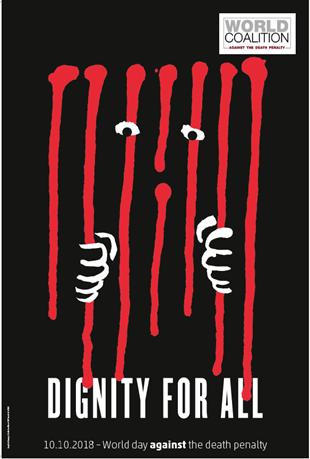
Dignity For All
Education:
Of course, schools, teachers and students will take part at the World Day Against Penalty talking, discussing and participate in different activities into school curriculum.
Citizenship curriculum is about Human Rights and their values. But Human Rights and values are a cross-curricular theme. So every teacher can include it into the curriculum they are teaching, no matter the grade.
To know more about the death penalty...
... all over the world: read the facts & figures
... and living conditions on death row: read the leaflet, the detailed factsheet
Students:
Things students can do to help to end the death penalty
1. Write to a prisoner on death row.
2. Send support messages to their relatives.
3. Organize a visit to prison following the World Coalition's guidelines.
4. Organize a school debate and a movie screening death penalty, or with families of people sentenced to death, exoneres, lawyers and experts. See mobilisation kit for useful tips!
5. Organize an art exhibition (of art work made by the people sentenced to death, of photographs of death row, of drawings or posters) or go to a theatre performance (movie or drama)
6. Join the events prepared for the abolition of the death penalty worldwide.
Schools:
Mobilize the media to raise awareness on the issue of the death penalty.
Participate in “Cities Against the Death Penalty/Cities for Life” on 30 November 2018.
This year, for the world day Cities for Life on 30 November, more than 1.850 cities around the world will light up to say "No To The Death Penalty". Has the impossible become possible?

About 80 cities participated in the first edition in 2002. More than 2,000 cities were listed to participate in 2015 in more than 90 countries on the five continents, including in countries that retain the death penalty.
The aim is to made use of symbolic monuments and squares to hold educational and artistic events aimed at raising public awareness. All cities taking part in the initiative make their major monuments available as “living logos”, which “speak” with the help of special illuminations, thus becoming symbols of a commitment to hold a dialogue with the population aimed at achieving a world without the death penalty.
 ~
~
Resources:
Livres
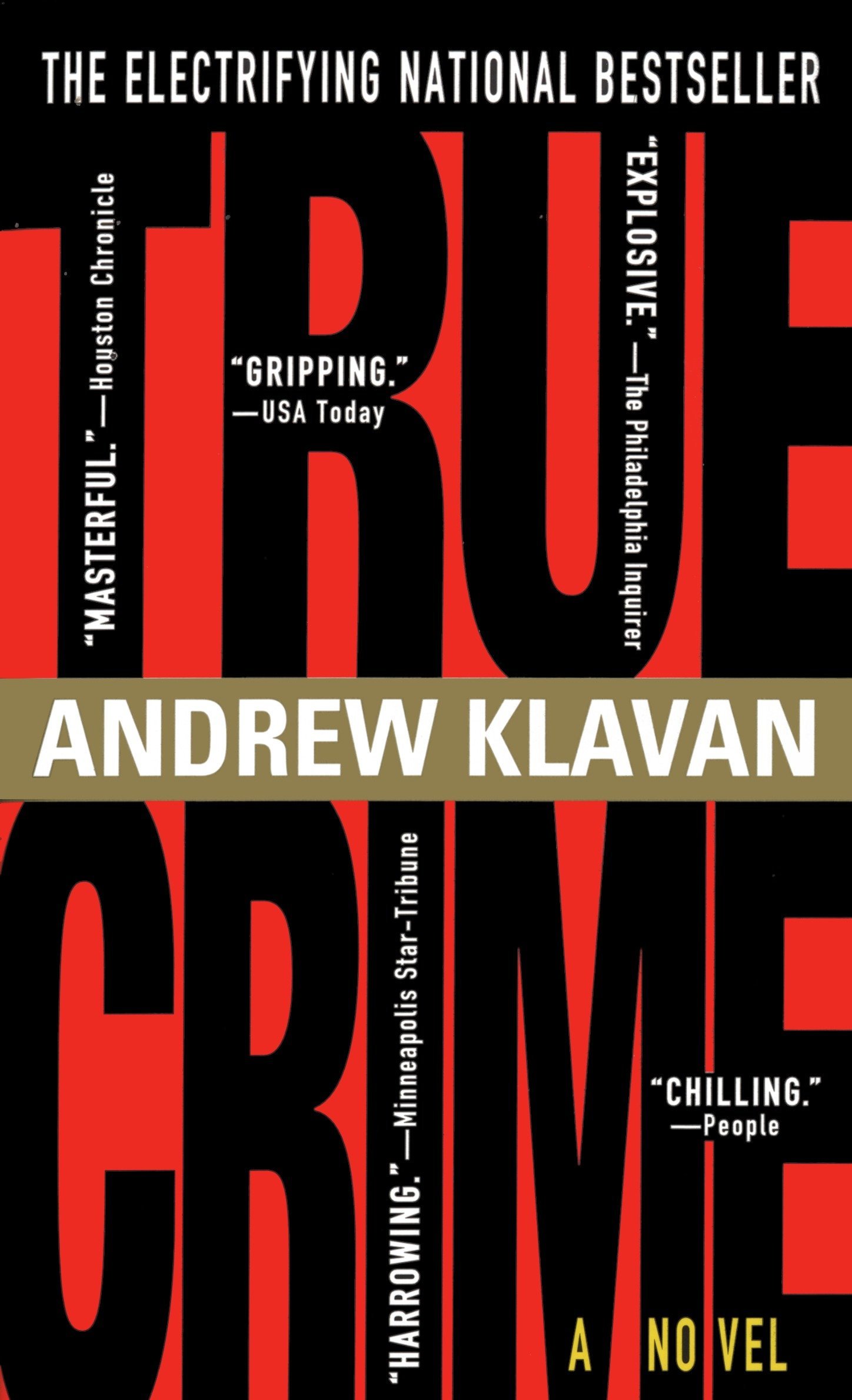
True Crime, Andrew Klavan, 1995
Le Dernier Jour d'un Condammé
Victor Hugo, 1826
Lire en ligne sur Gallica BnF
https://gallica.bnf.fr/essentiels/hugo/dernier-jour-condamne

Films:
Dead Man Walking/ Tim Robbins,1995 (up-16 year-old)
Based a true story: A nun, while comforting a convicted killer on death row, empathizes with both the killer and his victim's families.
The Life of David Gale/ Alan Parker, 2003 (up-14 years-old)
A man against capital punishment is accused of murdering a fellow activist and is sent to death row.
Links:
European Day Against Death Penalty
https://www.coe.int/en/web/portal/10-october-against-death-penalty
Amnesty International/ Death Penalty
https://www.amnesty.org/en/what-we-do/death-penalty/
5 Myths About the Death Penalty
https://deathpenalty.org/facts/5-myths-death-penalty/

About 80 cities participated in the first edition in 2002. More than 2,000 cities were listed to participate in 2015 in more than 90 countries on the five continents, including in countries that retain the death penalty.
The aim is to made use of symbolic monuments and squares to hold educational and artistic events aimed at raising public awareness. All cities taking part in the initiative make their major monuments available as “living logos”, which “speak” with the help of special illuminations, thus becoming symbols of a commitment to hold a dialogue with the population aimed at achieving a world without the death penalty.
~
Students against death penalty
Resources:
True Crime
Andrew Klavan, 1995
Livres
True Crime, Andrew Klavan, 1995
Le Dernier Jour d'un Condammé
Victor Hugo, 1826
Lire en ligne sur Gallica BnF
https://gallica.bnf.fr/essentiels/hugo/dernier-jour-condamne

Death Man Walking
Tim Robbins, 1995
Dead Man Walking/ Tim Robbins,1995 (up-16 year-old)
Based a true story: A nun, while comforting a convicted killer on death row, empathizes with both the killer and his victim's families.
The Life of David Gale/ Alan Parker, 2003 (up-14 years-old)
A man against capital punishment is accused of murdering a fellow activist and is sent to death row.
True Crime/ Clint Eastwood, 1999 (up-14-year-old)
Can an over-the-hill journalist uncover the evidence that can prove a death row inmate's innocence just hours before his execution? Based on the novel True Crime by Andrew Klavan, 1995
Links:
https://www.coe.int/en/web/portal/10-october-against-death-penalty
Amnesty International/ Death Penalty
https://www.amnesty.org/en/what-we-do/death-penalty/
5 Myths About the Death Penalty
https://deathpenalty.org/facts/5-myths-death-penalty/
http://www.worldcoalition.org/cities
"It is not 'progressive' to try to resolve problems by eliminating a human life."
Pope Francis
G-Souto
10.10.2018

Schools : World & European Day Against Death Penalty : resources by G-Souto is licensed under a Creative Commons Attribution-NonCommercial-NoDerivatives 4.0 International License.