Showing posts with label Kidzlearn Lugares et Aprendizagens project. Show all posts

Friday, January 16, 2015

Education : TELL Awards, submit your project !


"Most people on the planet would agree that educating young people is part of the greater good, something well worth supporting by society."
Our objective is to change the world, to better learning opportunities for young people. We are doing this because we aim for the future, for a better, more modern, education.
No doubt that Technology Enhanced Learning (TEL) has created enormous changes in schools, universities and in vocational learning. However, these innovations have tended to be unsustainable. Too often, initiatives need a high degree of effort to be sustained, and are consequently endangered when funding stops. 
However few educational institutions have taken these technologies up in a systematic way in order to include them in their learning strategy. In spite of a huge amount of technologies available for learning purposes, teachers and students are NOT taking them up and the real breakthrough of new teaching and learning methods with new technologies has not happened.
The European TELL US competition sponsored by the European Commission’s DG Connect is open for ALL participants from large companies, SMEs, innovators, formal education actors and students.

Objective:

To change the world, to better learning opportunities for young people. TELL Awards is doing this because it aim for the future, for a better, more modern, education.


The competition will be subdivided into the “formal educational environment” which is centred on the three following main market segments:
  • Schools
  • Vocational Education and Training
  • Higher Education (High Schools and Universities)
The competition is organized in two stages with correspondent services levels:

1. Regional competitions online: 16 winners will be selected for the Grand Final. Each one of them will receive a prize including internationalisation support (one showcase event), soft landing services in one of the cluster ecosystems, and advice on EU projects, among others.

2. The Grand Final at Futur en Seine which will take place on 15th June 2015 in Paris, in Paris, where the four winners will be selected by an international, high-level jury and the public.


The 4 Regions:

Visit here

Jury:

The European Jury composed from a selection of the stakeholders from EU countries will be judge both the Regional contests and the Grand Final.
Each regional and final competition will also have an exhibition element and will enable the general public to assess the entrants and vote for a special ‘people’s choice’ awards.
Criterias :
The contest criteria will be drawn from the following foundations i.e. what we are looking for are solutions that: 
  1. Meets the expected learning objectives
  2. Appearance
  3. Creativity
  4. Ease of use for the learner
  5. Interactivity
  6. Ease of updating and adding content
  7. Holds the learner's interest
  8. Potential impact of the course based upon category and potential audience.


Prizes

Prizes for each of the winners include 2,500 euros in cash, a 500 euros Amazon account to cover technological needs, Startup Profiling on EDUKWEST Europe along with social media promotion, HP equipment, and many other prizes.

Application:

Participants must enter their application online. 

Deadline : 

The submission deadline for the TELL US Awards ends on 31 January 2015.


The 4 finalists will be awarded cash prizes by an international, high-level jury and the public. 

They will receive a cheque, IT hadware, coaching for internationalization (meeting potential clients, investors, etc) and a strong international visibility. We are pleased to count among our sponsors today HP, Telefonica, Capita, Go-Xapi, etc.


Participants :


Please complete the application in in full online: This application will form the basis for selection of candidates to progress to the second stage of the Awards Competition. 

Further information: 

For any further information please contact Camille Vidaud


Education:

How many teachers gave up for interesting and pioneers projects because they haven't the money and support to develop or to continue their creative ideas on Education.

I am one of them. In 2002, I created the first e-learning project at Secondary education to enhance Langages curriculum with ICT but unfortunately after two years with an incredible effort, the project could not be developed because I hadn't no money to support it and to continue my creative ideas on Education. The project was very appreciated by innovators, teachers and educational networks in Europe, United States, Afirca.

Today the project is a prototype and take part of the Micro Innovators network at VISIR.

However, in 2004, I submitted Kidzlearn Lugares & Aprendizagens at Global Junior Challenge, Rome and my project was a finalist project among 647 projects from all over the world. 

See? Now there are TELL AwardsThis is your opportunity to share your project to enhance learning by using technology.

We are on the 21th century and there are a lot of teachers who feel not confortable using technology in the classroom. Don't ! Ask for help from trainers or teachers that use technology in the classroom for years to enhance learning and motivate students to school curriculum.

"TELL Awards' objective is to change the world, to better learning opportunities for young people. We are doing this because we aim for the future, for a better, more modern, education."


G-Souto

16.01.2015


Copyright © 2015G-Souto'sBlog, gsouto-digitalteacher.blogspot.com®

Creative Commons License

Education : TELL Awards, submit your project ! bG-Souto is licensed under a Creative Commons Attribution-NonCommercial-NoDerivatives 4.0 International License.

Saturday, July 28, 2012

6th edition of the Global Junior Challenge 2012


Video of the fifth edition of the Global Junior Challenge 2009
Credits: GJC

The Global Junior Challenge is the international competition that rewards the innovative use of technology for the education of 21st century and the social inclusion. 

Promoted by the Municipality of Rome the GJC is hosted every two years by the Fondazione Mondo Digitale under the High Patronage of the Italian Presidency and the sponsorship of the Italian Foreign Affairs Minister.


Rome, Campidoglio

The GJC is a unique opportunity to reflect on the importance of the challenges posed by 21st century education and the role of technology in didactic innovation, social innnovation, development and the reduction of world poverty.

This year there will also be other special categories, a novelty for the 2012 edition: “ICT for the integration of migrants and refugees” in collaboration with the United Nations Alliance Civilization (UNAOC), “ICT for sustainable environmental development” in partnership with Legambiente.


The Global Junior Challenge is an international competition rewarding the most innovative projects for the Education of 21st century and the Social Inclusion.

The competition, promoted by the City of Rome, and organized by the Fondazione Mondo Digitale, is held every two years.

The Global Junior Challenge takes place within the context of Italian Digital Agenda and Europe 2020. More precisely, the aim of the Global Junior Challenge is to encourage young generations and their teachers to use of the new technologies, exchange experiences and emulate successful initiatives. 


To me GJC was an important moment of my life as an innovative educator and author of Digital Open Resources to my students, in Secondary education (High Junior School).


In 2004, I participated at Global Junior Challenge and submitted my e-learning project Kidzlearn Lugares & Aprendizagens.


When I received an email from Silvia Celani, responsable of Global Junior Challenge telling me tha my e-learning project, Secondary education, Kidzlearn Lugares & Aprendizagens  was among the finalists projects. 

And she invited me behalf the Global Junior Challenge to go to Rome to present my project at the exhibition of the Finalist Projects at Palazzo dei Congressi in Rome to share my pedagogical and innovative experience with thousands of students and their teachers.


 Palazzo dei Congressi/ Roma
http://upload.wikimedia.org/wikipedia/


Kidzlearn Lugares & Aprendizagens was a finalist project on the category up-to 15 years old.


Stand 473: Gina Souto
Global Junior Challenge 2004
at Palazzo dei Congressi, Roma


Never forgot the stand 473Kidzlearn Lugares & Aprendizagens – PORTUGAL just in front of the great door that opened every day to thousands of Italian schools students and teachers to visit us.

They were absolutely amazing! Asking for details, testing the activities on Kidzlearn Lugares & Aprendizagens, asking, choosing, doing, laughing and learning languages online trough educational free open resources created for me to young students. 

Teachers was so curious, asking me how my students work online in the classroom or after school time, at home. They were surprised and so motivated.

At the final ceremony,  I was very proud of my work! You can read my chronicle here (Portuguese language). 


elearning project | Secondary Education
Gina Souto, Author


Kidzlearn Lugares & Aprendizagens was the first project for Secondary Education using ICT to enhance Languages curriculum, Portuguese, French foreign language.


You want yo know how it started? Read the entire experience on "Le défi d'un apprentissage pris à coeur" on  ÉduFLE.net an educational network in French. You can also read on my blog (French Language).


The first online learning experience for my students used in formal and informal learning, complementing the school curricula in a blended learning process.


Later, a lot of French teachers or educators teaching French and Portuguese as foreign languages use Kidzlearn Lugares & Aprendizagens in their lessons

 with success. They wrote me telling me their good experiences.


Kidzlearn Lugares&Aprendizagens


"Kidzlearn Lugares&Aprendizagens offre agli studenti la libertà di scegliere l’attività o le attività a seconda dei loro interessi o ritmi di apprendimento, indipendentemente dal luogo, dalle ore e dal momento. 

Nel dopo scuola o senza andare a scuola, nel contesto di un corso di francese or portoghese o semplicemente per piacere, gli studenti più giovani possono apprendere una lingua divertendosi o anche per superare le difficoltà che incontrano durante i corsi ufficiali. 

Nello stesso tempo, non sono soli, ma in contatto con l’insegnante in classe. Se non si tratta di miei studenti, possono contattarmi per e-mail o attraverso Messenger (gli orari sono elencati nel mio sito web). 

Come ho avuto modo di scrivere nell’editoriale, abbiamo dato luogo ad una pedagogia comprensiva per questi studenti che hanno problemi di apprendimento e, senza volerlo, siamo arrivati a praticare questo tipo di metodologia in relazione agli studenti che presentano un ritmo di apprendimento molto rapido. 

Inoltre, ho introdotto una motivazione allo studio della letteratura, presentando dei testi e degli autori a questa fascia d’età. 


Kidzlearn Lugares&Aprendizagens | FrançaisLE

Kidzlearn Lugares&Aprendizagens si deve totalmente al mio coinvolgimento e alla mia passione per l’insegnamento e anche alla mia creatività e volontà di avvicinare maggiormente i miei studenti. 

Il mio progetto è nato dall’osservazione diretta in classe, che spesso vede la concomitanza di lingua madre e lingua straniera, all’interno della quale gli studenti superdotati si vedono spesso obbligati a seguire i ritmi di apprendimento di studenti con problemi. 


Kidzlearn Lugares&Aprendizagens | Portuguese
Cartoon: Cristina Sampaio

Senza pensarci, si è partiti da una nuova pedagogia, questa volta esclusiva. Questi studenti hanno un ritmo di apprendimento molto più rapido rispetto al gruppo o alla classe. Ho dedotto che dovessi occuparmi di questo problema, e che dovessi occuparmi di loro proprio nei momenti in cui si vedevano un po’ messi da parte mentre dedicavo maggiore attenzione agli studenti in difficoltà. 

Da qui, l’idea di concretizzare delle attività complementari ai corsi di lingua madre prima, e poi dal 2001, di lingua francese

Posso proporre delle attività in classe ad uno o due studenti, mentre gli altri lavorano in maniera diversa, secondo la specificità del loro livello di apprendimento o le loro difficoltà. Quindi, ognuno dei miei allievi lavora secondo il proprio ritmo o gusto. 

Kidzlearn Lugares&Aprendizagens presenta un ulteriore vantaggio: gli allievi possono seguire delle attività nel dopo-scuola, a loro scelta e inviarle per e-mail. Allo stesso tempo, possiamo lavorare con Messenger (gli orari sono elencati sul mio sito), a seconda delle capacità o delle difficoltà, avendo indicazioni e suggerimenti, e potendo contare sulla correzione della pronuncia in rete (conversazione in diretta) ."

So, as you see, you must not lost this incredible opportunity to show your educational project to the world.
Education:

The 6th edition of the Global Junior Challenge is a unique opportunity for teachers and students to reflect on the significance of digital literacy, whilst exposing them with to the vast range of high quality solutions proposed by other youth from around the world.

The GJC competition is open to everyone: associations, public and private institutions, cooperatives, schools, universities, companies and individuals of any age from all around the world.

Registration:

Registration has been extended to July 31, 2012. You can enter your project here 


Rules:

All projects that were still in operation as of December 31, 2011 and addressed to youth up to 29 years of age and which use new ICT technology for education and training.

Read more here

Award Ceremony:

The programme for the 6th edition of the Global Junior Challenge, the international competition that rewards the innovative use of technology for 21st century education and digital inclusion.

It will take place in Rome, 17-19 October 2012. 

Program can be read here


«Les langues sont comme la mer, elles oscillent sans cesse.»


Victor Hugo


G-Souto

28.07.2012
Copyright © 2012G-Souto'sBlog, gsouto-digitalteacher.blogspot.com®

Licença Creative Commons
6th edition of the Global Junior Challenge by G-Souto is licensed under a Creative Commons Attribution-NonCommercial-ShareAlike 3.0 Unported License.


Monday, June 13, 2011

Schools : Let's celebrate & read Fernando Pessoa ! Resources


Fernando Pessoa
heteronimous
credits: Ademir Pascale


Fernando Pessoa 1888-1935
credits: Casa Fernando Pessoa

"Fernando Pessoa only lived to see the publication of a small part of his extensive work, which began to be published in various book forms from 1942 onwards. He left more than 25 thousand sheets of paper covered with texts that he had written, and these are now kept at the Biblioteca Nacional de Portugal. The long time that it took to decipher and organise these papers explains the lengthy interval before Fernando Pessoa’s work began to be published."

in Casa Fernando Pessoa


Fernando Pessoa
by Norberto Nunes


Google Doodle:

Today, June 13 Google celebrates with a Doodle the 123rd Anniversary of Fernando Pessoa, the great Portuguese writer of the XX century and one of Portugal’s most beloved authors.


Google Doodle Fernando Pessoa 123rd Birthday
doodler: Sophia Foster-Dimino

The Doodle references? The iconic portrait by José Sobral de Almada Negreiros: "
For this doodle celebrating one of Portugal’s most beloved novelists and poets, I referenced an iconic portrait by José Sobral de Almada Negreiros."


Fernando Pessoa
by Almada-Negreiros, 1954

"Pessoa, the author of many styles and pseudonyms, but his writing was characterized overall by a profound vividness which I hope I’ve captured in this depiction of him."


Sophia Foster-Dimino, doodler


Fernando Pessoa in Lisbon
credits: Casa Fernando Pessoa

  • Some biographical notes:

Fernando Pessoa was born in Lisbon on June 13th 1888. Following the death of his father in 1893, his mother remarried Commander João Miguel Rosa in 1895, who was the Consul of Portugal in Durban, Natal, where Fernando Pessoa was raised. 

Aged thirteen, Pessoa returned to Portugal for a year-long visit, and returned there permanently in 1905. After his seventeenth birthday, he returned to Lisbon to enroll in the university-level course of Arts and Letters, but dropped out after two years without having sat for any exams. 


He preferred to study on his own at the National Library, where he systematically read major works of philosophy, history, sociology and literature (especially Portuguese) in order to complement and extend the traditional English education he had received in South Africa.


And began to publish criticism, prose, and poetry soon thereafter while working as a commercial translator. 


Fernando Pessoa, 20 (1908)
credits: Fotobiografias do Século XX: Fernando Pessoa, p. 60

He was awarded the Queen Victoria prize for English at the University of the Cape of Good Hope in 1903, for his achievement in an exam at the age of 15.

"Profession: The most correct designation would be “translator”, the most exact would be “foreign commercial correspondent”. His poetry and writing were not his profession but his vocation."

Fernando Pessoa was many writers in one. He attributed his prolific writings to a wide range of alternate selves, each of which had a distinct biography, ideology, and horoscope. 

  • Bibliography:

His production of poetry and prose in English during this period was intense, and by 1910 he was also writing extensively in Portuguese. He published his first essay in literary criticism in 1912, his first piece of creative prose (a passage from The Book of Disquiet) in 1913, and his first poems as an adult in 1914.


Fernando Pessoa and his heteronyms
credits: Costa Pinheiro, 1978

  • Heteronyms:

“This tendency to create around me another world, just like this one but with other people, has never left my imagination.”

Fernando Pessoa in a letter to Adolfo Casais Monteiro about the genesis of the Heteronyms, dated 13 January 1935


Fernando Pessoa : Heterónimo
António Costa Pinheiro, 1978

Writing obsessively in French, English, and Portuguese, Fernando Pessoa left a prodigious body of work, much of it under heteronyms fully fleshed alter egos with startlingly different styles and points of view.

He called his most important personasheteronyms’, endowing them with their own biographies, physiques, personalities, political views, religious attitudes, and literary pursuits. Some of Pessoa’s most memorable work in Portuguese was attributed to the three main poetic heteronyms – Alberto Caeiro, Ricardo Reis and Álvaro de Campos – and to the ‘semiheteronym’ called Bernardo Soares.


English Poems
Fernando Pessoa

During his life, most of Pessoa’s considerable creative output appeared only in journals, and he published just three collections of poetry in English -Antinous (1918), Sonnets (1918), and English Poems (1921) - and an epic poem in Portuguese, Mensagem (1933).


Fernando Pessoa
by Júlio Pomar, 1983

“He was a thin man, tenuous and frail, of medium stature, 1,73 m tall, slightly curved back. His chest was not well built; in fact it was quite sunken, despite the Swedish gymnastics he was practicing. He had long legs, not very muscular and his hands were slender and inexpressive. His awkward stride and fast pace, although irregular, denounced him at a distance."

He usually wore dark suits, grey, blue or black, at times short. He also wore a hat, normally wrinkled, and slightly tilted to the right. 

“His face was long and dry. Behind his small round glasses, of misty thick lenses, small brown eyes were hidden. His stare, when fixed on someone, was observant and sometimes even mysterious. He had a small mouth and thin lips, which were almost always shut. He had an “American” moustache which conferred him a special charm." (...)

Until his death, he did not abandon any of these different facets. Together with poetry, he wrote essays, plays, various letters and detective stories, and also devoted himself to astrology, besides being an inventor, a literary critic and a copywriter. 

Pessoa was convinced of his own genius, however, and he lived for the sake of his writing. Although he was in no hurry to publish, he had grandiose plans for Portuguese and English editions of his complete works, and he seems to have held on to most of what he wrote.

Fernando Pessoa, the great writer died on 30 November 1935.

Today, more than seventy-five years after Pessoa’s death, his vast written world has still not been completely charted by researchers, and a significant part of his prose writings are still waiting to be published.


Fernando Pessoa
Júlio Pomar, 1953

Education:

We are very honored knowing that international high-schools and well-known colleges all over the world include Fernando Pessoa into their most well known curricula Portuguese Literature and Portuguese language.

Some months ago, I suggested in my post Languages matter different activities to include Pessoa poetry into school curriculum (high-junior school)


Casa Fernando Pessoa, Lisbon

"With today's technology every corner of the world is linked together. The  new generations are globalized."

Irina Bokova, Director-General of UNESCO
Message for "International Mother Day 2011

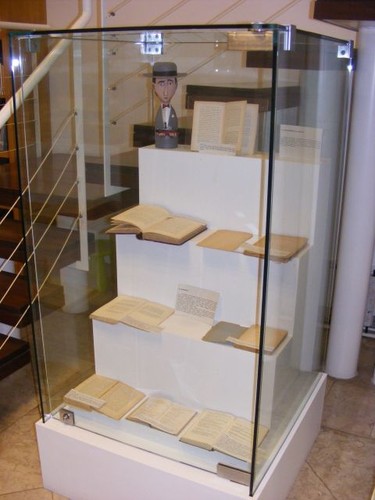
Teaching Pessoa poetry is easier now. Just link on the website Casa Fernando and your students will find different pedagogical digital resources completely free in Portuguese and English about the poet and writer.


Casa Fernando Pessoa
credits: Casa Fernando Pessoa
https://www.casafernandopessoa.pt/en/


Resources:

Casa Fernando Pessoa offers important free 
bibliographic digital resources aboutout his works which belonged to the personal collection of the poet, books, and notes by Pessoa himself.

Due the importance and rarity of these works, they are normally inaccessible to the general public. 

But now, according to the criteria of conservation and preservation, these literary writings can be consulted on digital format

The Libraries of Casa Fernando Pessoa, are an open space to read and study. It has three basic sections:

  • Fernando Pessoa personal library (with around 1 200 books), acquired from the poet’s family here;
  • The active and passive Pessoa library, containing virtually everything written by and about Pessoa here;
  • Portuguese and foreign poetry collection

Special arrangements can be made for those researching into Fernando Pessoa work.

The Library is a member: 


Fernando Pessoa illustration, with crow (Lisbon symbol)
The Learning Programme of Casa Fernando Pessoa has as main objective to promote the knowledge of author’s life and work. Daily, it works with schools and other educational institutions, developing programs, workshops, book reading projectsand visits for different age groups and focusing on multiple perspectives of Pessoa life and work. 


Casa Fernando Pessoa
créditos: Casa Fernando Pessoa


Children's poetry:


Fernando Pessoa has an unknown side of his poetry! He wrote poems for children. We can't miss those poems. We must include children's poetry by Pessoa into school curriculum (elementary schools). 

Read aloud and invite your students to read too to learn children's poetry by Pessoa. His poems are lovely! 

"Less than a quart of all languages in the world are used in education and in cyber space."

Irina Bokova, Director-General of UNESCO
Message for "International Mother Day 2011

Children's Poems:

Here two different poems of Fernando Pessoa that children should read in Portuguese language:


As Fadas

Do seu longínquo reino cor-de-rosa, 
Voando pela noite silenciosa,
 A fada das crianças vem luzindo. 
Papoulas a coroam, e, cobrindo 
Seu corpo todo, a tornam misteriosa.
 
À criança que dorme chega leve, 
E, pondo-lhe na fronte a mão de neve, 
Os seus cabelos de ouro acaricia – 
E sonhos lindos, como ninguém teve, 
A sentir a criança principia. 

Em coisas vivas, e um cortejo formam: 
Cavalos e soldados e bonecas, 
Ursos e pretos, que vêm, vão e tornam, 
E palhaços que tocam em rabecas...
 
E há figuras pequenas e engraçadas... 
Que brincam e dão saltos e passadas... 
Mas vem o dia, e, leve e graciosa, 
Pé ante pé, volta a melhor das fadas 
Ao seu longínquo reino cor-de-rosa.

Fernando Pessoa, Poesias Inéditas


Cristina Sampaio, cartoonist
http://www.cristinasampaio.com/


Liberdade


Ai que prazer
Não cumprir um dever,
Ter um livro para ler
E não o fazer!
Ler é maçada,
Estudar é nada.
O sol doira
Sem literatura.

O rio corre, bem ou mal,
Sem edição original.
E a brisa, essa,
De tão naturalmente matinal,
Como tem tempo não tem pressa...

Livros são papéis pintados com tinta.
Estudar é uma coisa em que está indistinta
A distinção entre nada e coisa nenhuma.

Quanto é melhor, quando há bruma,
Esperar por D. Sebastião,
Quer venha ou não!

Grande é a poesia, a bondade e as danças...
Mas o melhor do mundo são as crianças,
Flores, música, o luar, e o sol, que peca
Só quando, em vez de criar, seca.

O mais do que isto
É Jesus Cristo,
Que não sabia nada de finanças
Nem consta que tivesse biblioteca... 


Fernando Pessoa, Liberdade


"Multilingualism opens fabulous opportunities for the dialogue that is necessary to understanding and cooperation."

Irina Bokova, Director-General of UNESCO
Message for "International Mother Day 2011


Sostiene Pereira
Marcello Mastroianni
Roberto Faenza, 1995


Films:

  • Sostiene Pereira

Based on Afirma Pereira, a book by Antonio Tabbuchi, Professor at University of Palermo, and writer.One of the most important researchers of Pessoa.


Sostiene Pereira
Antonio Tabucchi


Sostiene Pereira
Antonio Tabucchi
comics

The story follows Pereira, a journalist for the culture column of a small Lisbon newspaper, as he struggles with his conscience and the restrictions of the regime of Salazar. Antonio Tabucchi won the Premio CampielloViareggio Prize and Premio Scanno in 1994 for the novel.


Filme do Desassossego
João Botelho,2010

  • Filme do Desassossego

This film is based on The Book of Disquiet, the posthumous work of the Portuguese writer Fernando Pessoa. It portrays the solitude of man through picturesque images and dramatic effects.


The Book of Disquiet
Fernando Pessoa

Published for the first time some fifty years after his death, this unique collection of short, aphoristic paragraphs comprises the "autobiography" of Bernardo Soares, one of Pessoa's alternate selves. Part intimate diary, part prose poetry, part descriptive narrative, captivatingly translated by Richard Zenith, The Book of Disquiet is one of the greatest works of the twentieth century.


  • Videos:


Curricula:

  • Portuguese as second language in primary and elementary schools;
  • Portuguese as foreign language in High Junior School;
  • Portuguese Literature studies in foreign Universities.

In fact Pessoa work was a kind of open-sesame, insofar as it alerted the rest of the world to the rich literature being produced in a small country situated on southwestern Europe’s fringe - Portugal.


G-Souto

13.06.2011

update: 13.06.2019
Copyright © 2019G-Souto'sBlog, gsouto-digitalteacher.blogspot.com®

Creative Commons License
Schools : Let's celebrate & read Fernando Pessoa ! Resources bG-Souto is licensed under a Creative Commons Attribution-NonCommercial-NoDerivatives 4.0 International License.

References:

Casa Fernando Pessoa/  Poetry Foundation/ Europeana/ Fernando Pessoa