Showing posts with label Albert Einstein. Show all posts

Saturday, March 14, 2026

Schools : Pi Day ! Let's learn & have fun ? Resources & thematic activities !


Google Doodle Pi Day 2026

https://doodles.google/doodle/


Today marks National Pi Day in the United States and around the world. The holiday commemorates a timeless symbol beloved by many in mathematical and scientific communities, while making the most of the opportunities it allows for humorous wordplay, dessert and "teachable moments," as some experts have said.

The date today resembles 3.14159, the common approximation of the mathematical constant Pi, orπ.


Archimedes
Ancient Greek Mathematician, Physicist, and Inventor, Known for His Contributions to Geometry, Calculus, and Mechanics


The Doodle Pi Day 2026 celebrates the numerical constant pi (π), highlighting the foundational geometry used to calculate its limits in ancient times. Long before modern technology, the Greek mathematician Archimedes popularized an innovative approach: he approximated the value of pi by sandwiching a circle between two 96-sided polygons to determine its precise upper and lower bounds. Today, we honor this mathematical legacy as enthusiasts worldwide celebrate with pi-reciting contests and slices of pie.


Pi Day is celebrated annually on March 14, since the date written numerically corresponds with the first three digits of π . (Pi Day was particularly momentous in 2015, when the numerical date corresponded with  up to five digits: 3.1415.) It is also coincidentally the birthday of Albert Einstein.


Google Doodle Albert Einstein's 124th Birthday (2003)


Dividing any circle’s circumference by its diameter gives you an answer of pi, which is usually rounded to 3.14. Because pi is an irrational number, its decimal representation goes on forever and never repeats. 


In 2022, mathematician Simon Plouffe discovered the formula to calculate any single digit of pi. In the same year, teams around the world used cloud computing technology to calculate pi to 100 trillion digits. But you might be surprised to learn that for space exploration, NASA uses far fewer digits of pi.


via Science Sparks


  • What is pi?

Pi is a special number — so special, in fact, that most laypeople are probably aware of it, even if only as a relic of bygone classroom lectures or geometry textbooks. Represented in abbreviated form by the somewhat familiar sequence 3.14, pi, or the Greek letter π, is an iconic symbol seen in mathematical equations and, in more recent decades, merchandise like T-shirts, sweatshirts and coffee mugs.


William Jones. mathematician

credits :  Steven Wynn/ Getty Images

https://fr.wikipedia.org/


The symbol for Pi was first introduced by a Welsh mathematician called William Jones in 1706.

Anglesey-born William Jones as i told before was the first person to use the Greek letter  for the ratio of a circle’s circumference to its diameter. But who was this little-known figure?

William Jones a Welsh mathematician whose pioneering work left a mark on the world of mathematics and introduced a symbol that has become synonymous with the field, π, died on this day in 1749.

He would go on to make significant contributions to mathematics, particularly in the realm of trigonometry.

He introduced the use of π (pi) as a symbol for the mathematical constant representing the ratio of a circle's circumference to its diameter. Yet, it hurts my head, too.


Leonhard Euler, mathematician


Jones' use of π as the symbol for pi was adopted by Swiss mathematician Leonhard Euler in the 18th century. It has since become universally recognised and is essential in various mathematical and scientific disciplines.


It is thought that he chose π either because it is first letter of the word for periphery (περιφέρεια) or because it is the first letter of the word for perimeter (περίμετρος). (Or because of both).


Palmarioriu mathesos 
William Jones
Photograph: Gareth Roberts
via The Guardian


On the back of his experience, he published his first book in 1702 on the mathematics of navigation as a practical guide for sailing. On his return to Britain he began to teach mathematics in London, possibly starting by holding classes in coffee shops for a small fee. Shortly afterwards he published Synopsis palmariorum matheseos, a book written in English, despite the Latin title.


Jones' work laid the foundation for a deeper understanding of trigonometry and the principles that underpin it. His contributions revolutionised mathematical notation and paved the way for countless mathematical discoveries.


Remember ! Teaching or having fun...

"Understanding Pi is essential if you want to make calculations for circles, cylinders, spheres, and anything circular, even an ellipse. Pi is the ratio of the circumference of a circle to its diameter. It doesn't matter how big or small the circle is - the ratio stays the same. Properties like this that stay the same when you change other attributes are called constants."


The Nobel Prize,
@NobelPrize


via Google Images Archive


  • Why is pi important ?


The ratio is beloved by math and science enthusiasts for a reason: Pi serves critical functions in many of the most basic and the most complex equations. It's necessary to calculate the area and the volume of everything circular and spherical, and it allows humans to measure the sizes of tiny things, like molecules, in a similar way it allows them to estimate the sizes of massive things, like Earth, the moon, other planets and the sun. Pi helps NASA engineers build spacecraft just as it helps scientists study newly discovered worlds. It's also fundamentally related to gravity.


Manil Suri, a mathematics and statistics professor at the University of Maryland, Baltimore County, said pi helps people understand more about the world, the universe and how they work.


via Google Images Archives

  • How to celebrate Pi Day : Some thematic activities


  • Eating pie, baking pie and perhaps observing the mathematical principles of pi using a pie are some thematic activities to enjoy. Pizza pies and dessert pies are both appropriate variations. 


  • A play on traditional "pie contests," pi contests are common on Pi Day and often involve competitions to recite as many digits of π as possible from memory.


  • But there are no right or wrong ways to celebrate Pi Day. For people around the world excited by the mathematical significance of pi and the broad potential for honorary puns related to it, there are plenty of ways to pay homage. 


The same goes for educators and students, although math and science experts do generally recommend using Pi Day festivities as opportunities to make learning more fun. 


G-souto

14.03.2026

copyright © 2026G-Souto'sBlog, gsouto-digitalteacher.blogspot.com


Schools : Pi Day ! Let's learn & have fun ? Resources & thematic activities by GinaSouto is licensed under a Creative Commons Attribution-NonCommercial-NoDerivatives 4.0 International License.


sources: NASA/ The Guardian / CBS News / Wikipedia / Google Doodles/

some images : Google Images Archive


Thursday, April 11, 2019

Schools : Women in STEM : Katie Bouman & the Black Hole !


Dr Katie Bouman
We saw that ring, a swirl of light and substance revealing the shadow of an unseable mass, on Wednesday, the 10 April, when a team of more than 200 researchers presented a picture of the black hole lying at the center of the Messier 87 (M87) galaxy. Among other things, the announcement marked the moment when Katie Bouman could finally share the secret work with the world.
“It’s been really hard to keep our lips sealed” (...) “I hadn’t even told my family about the picture.”
Dr Katie Bouman


Black Hole
credits: MIT

The first photo of a black hole was released to the public, giving validation to one of the most consequential theories in physics - Einstein's Theory of Relativity.


Albert Einstein
Photo from the Nobel Foundation archive

Albert EinsteinNobel Prize in Physics 1921in his theory of general relativity, predicted the existence of black holes, in the form of infinitely dense, compact regions in space, where gravity is so extreme that nothing, not even light, can escape from within. 
By definition, black holes are invisible. But if a black hole is surrounded by light-emitting material such as plasma, Einstein’s equations predict that some of this material should create a “shadow,” or an outline of the black hole and its boundary, also known as its event horizon.

Dr Katie Bouman

But behind every scientific discovery, big or small, is the story of those dedicating their lives to discovery.
This time, a female graduate is leading the charge. Katie Bouman, a young scientist, 29 years-old, who created the algorithm that that led to the production of the first-ever image of a black holepermitted taking the photography.
Bouman was among a team of 200 researchers who contributed to the breakthrough, but on Wednesday, a picture of her triumphantly beaming as the image of the black hole materialised on her computer screen went viral, with many determined that Bouman’s indispensable role was not written out of history, as so often has been the case for female scientists and researchers.


Google Doodle celebrating the first image of a black hole
doodler : Nate Swinehart


  • Google Doodle:

An adorable Google Doodle created by Nate Swinehart was unveiled today, April 10, celebrating the historic first black hole picture with cosmic flair. 
"Got sucked in by the incredible photo enough to bust out an animated honoring the achievement ✨⚫️✨ Insane congrats to everyone involved, I am so in awe!"
Nate SwinehartTwitter


Google Doodle Sketches

(Also my extremely pro concept sketches drawn in the car on the way to work when I found out I was doing this)

Nate Swinehart, Twitter

In the animated cartoon, an undeveloped Polaroid snapshot appears amid a field of stars and the iconic Google logo
As the image develops, the Event Horizon Telescope's image of the supermassive black hole at the center of the distant galaxy M87 comes into view. But if not even light can escape a black hole, Google's doodle doesn't stand a chance.
Once the image becomes clear (or as clear as a supermassive black hole 55 million light-years away like the one in M87 can be), its gravitational pull draws in the Doodle's stars, then Google logo itself, leaving only a brief flash behind as it collapsing in on itself. 
Wow! It's one of the shortest and sweetest depiction of a black hole that we've ever seen. Congratulations Nate Swinehart!


Dr Katie Bouman
via Facebook

  • Kate Bouman, the scientist & programmer:

Just three years ago as a graduate researcher at Massachusetts Institute of Technology (MIT), Dr Katie Bouman led the development of the algorithm that would lead to the production of the first-ever image of a black hole.

Dr Bouman could not hide her delight. Her profile picture on Facebook was captioned: "Watching in disbelief as the first image ever made of a black hole was in the process of being reconstructed."


Dr Katie Bouman

Excitedly bracing herself for the groundbreaking moment, Dr Bouman was pictured loading the image on her laptop.

She pointed out that "no one algorithm or person made this [black hole] image".
She started making the algorithm three years ago while she was a graduate student at the Massachusetts Institute of Technology (MIT).
There, she led the project, assisted by a team from MIT's Computer Science and Artificial Intelligence Laboratory, the Harvard-Smithsonian Center for Astrophysics and the MIT Haystack Observatory.

"It required the amazing talent of a team of scientists from around the globe and years of hard work to develop the instrument, data processing, imaging methods, and analysis techniques that were necessary to pull off this seemingly impossible feat," 

Katie Bouman


Dr Margaret Hamilton/ NASA
Apollo software Engineer
credits: NASA

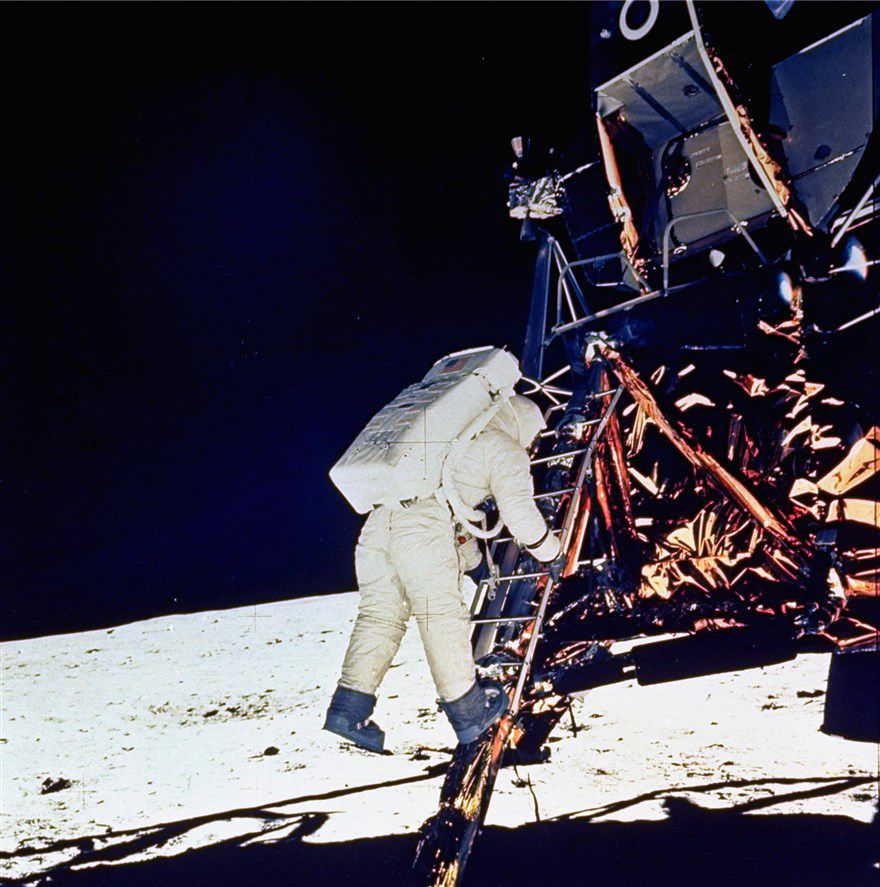
Many are comparing her feat on social media to that of Margaret Hamilton, who's code was instrumental in launching the Apollo mission into orbit in 1969 and into the next decade. Not only was Hamilton's work highly significant for the lunar landings, but also paved the way for women in science and technology.


Apollo mission
First man in the moon
créditos: NASA


Dr Bouman told MIT News that taking the image of a black hole is "equivalent to taking an image of a grapefruit on the moon, but with a radio telescope".

The image was collated by Event Horizon Telescopes located throughout the globe, from Chile to Antartica, while a team of scientists had to wait for just the right conditions to take the shot.


The black hole was first theorised by Albert Einstein to explain areas in space of dense matter, where even light itself cannot escape. The now near century-old theory has been puzzling scientists for decades. 

Over the years, physicists and engineers had seen orbits, galaxies and move in a slingshot whirling motion around what many thought could be a black hole. 

Now, scientists can prove that Einstein was correct all along.

Dr Bouman has been praised widely on social media, with the likes of Democratic Senator Alexandria Ocasio-Cortez weighing in, with this female scientist and her team adding their names to the list of the most unforgettable discoveries.


credits: via UC Davis


Education:

Once more a woman in STEM makes history. Time to show your students, girls are always welcome in science!

How many women in science I wrote about on my blog! Ada Lovelace, Katherine Johnson, Maria Gaetana, Dorothy Hodgkin, Caroline Herschel, Hedwig Kohn, Beatrice Tinsley or Anna Atkins among other.


On this day, Dr Katie Bouman must be inspirational for girls to study STEM. Speaking in a 2016 TED talk, Bouman said:

“I’d like to encourage all of you to go out and help push the boundaries of science, even if it may at first seem as mysterious to you as a black hole.”

Promoting the work of women in science and encouraging girls to enter the sciences is important for achieving the Global Goals for Sustainable Development.

More girls are in school today than ever before, but they do not always have the same opportunities as boys to complete and benefit from an education of their choice. They are particularly under-represented in science, technology, engineering and mathematics (STEM) education, and consequently in STEM careers.


Girls in science
via Google images


Girls do as well as boys in science and maths at school but many more boys go on to further study science, technology and engineering.

According to the UNESCO groundbreaking report Cracking the code: Girls’ and women’s education in STEM, only 35% of STEM students in higher education globally are women, and differences are observed within STEM disciplines. 

Science and gender equality are both vital for the achievement of the internationally agreed development goals, including the 2030 Agenda for Sustainable Development

The Sustainable Development Goals (SDGs) to a great degree need a strong science base, and this cannot be achieved at any level unless girls and women have an incentive, such as recognition and the example of role models, to have in front of them.

So, we must empower young girls in school to enter STEM fields of study and careers, and stay the course. 

"We're a melting pot of astronomers, physicists, mathematicians and engineers, and that's what it took to achieve something once thought impossible," 

Dr Katie Bouman


G-Souto

11.04.2019
Copyright © 2019G-Souto'sBlog, gsouto-digitalteacher.blogspot.com®

Creative Commons License

Schools : Women in STEM : Katie Bouman & the Black Hole ! bG-Souto is licensed under a Creative Commons Attribution-NonCommercial-NoDerivatives 4.0 International License.


References: 

credits videos : Euronews/ TED talkings

EuroNews/ MIT News