My thoughts about Education Humanities, Technology and Digital Culture. Interested on social media tools in educational contexts and
gamification in education.
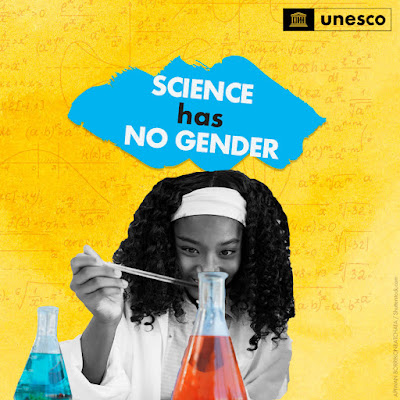
The 11 February every year since 2015, we celebrate #WomenInScience because gender equality and women’s empowerment are pre-conditions 4 sustainable development.
More girls are in school today than ever before, but they do not always have the same opportunities as boys to complete and benefit from an education of their choice.
Too many girls and women are held back by biases, social norms and expectations influencing the quality of the education they receive and the subjects they study.
Over the past decades, the global community has made a lot of effort in inspiring and engaging women and girls in science. Yet women and girls continue to be excluded from participating fully in science.
According to the UNESCO groundbreaking report Cracking the code: Girls’ and women’s education in STEM, only 35% of STEM students in higher education globally are women, and differences are observed within STEM disciplines.
Education:
"We must put the principle of equality into action so that science works for women, because it works against them all too often – for example, when algorithms perpetuate the biases of their programmers.”
Audrey Azoulay, Director-General of UNESCO message
The gap of girls and young women in science and technology in the 21st century is still a big problem. We must motivate the young girls to pursuit Science studies.
Girls do as well as boys in science and math at school but many more boys go on to further study science, technology and engineering.
As you read below statistics show that there is a noticeable gender gap, with much fewer girls choosing to study for STEM degrees. So the need for change is becoming increasingly urgent.
February 11 is celebrated globally in different ways, big and small. Your action will add to the collective voices on Equality in Science.
“Of the graduate students that I have had during the last twelve years I have had no one that was as capable and independent in research as Miss Stevens.”
Thomas Hunt Morgan, in Science journal
Nettie Stevens was an American geneticist born the 7 July 1861 n Vermont and grew up in Westford, MA as a fifth generation New Englander and the daughter of a carpenter.
Nettie Stevens was one of the first American women to have her work recognized as a solid contribution to science.
On July 7 2016, Google celebrated what would have been the Stevens' 155thbirthday.
This brought her name out of obscurity. Like so many female scientists, perhaps most famously Rosalind Franklin she had virtually been erased from scientific history.
Building on research by Edmund Beecher Wilson and Thomas Hunt Morgan at Bryn Mawr, Nettie Stevens discovered the connection between chromosomes and physicality. Her breakthrough evolved into the XY sex-determination system, now taught in classrooms around the world.
Nettie Stevens
credits: unknown
via Alta Sciences
Some biographic facts:
After graduating in 1880, Nettie Maria Stevens moved to Lebanon, New Hampshire to teach high school zoology, physiology, mathematics, English, and Latin. After three years, she returned to Vermont to continue her studies.
She continued her education at Westfield Normal School, now Westfield State University. She completed the four-year course in two years and graduated with the highest scores in her class.
The role of DNA in chromosomes was unknown in Stevens’ time
via Famous Scientists
Nettie Stevens went back to school at 35 and finally, at age 39, she started working as a research scientist and was fascinated by the process ofsex determination. Her studies focused on mealworms where she discovered that the females produced only Xchromosomesthe males had reproductive cells with both X and Y. She concluded that sex is inherited as a chromosomal factor and that males determine the gender of the offspring. This work was published in 1905.
Unfortunately for Nettie, another researcher Edmund Wilson made a similar discovery at about the same time and received the majority of the praise by the scientific community. But Stevens is generally considered to have made the larger theoretical leap, which was ultimately proven correct.
Why did she not get credit for her work? Was it the lack of a permanent position and lab of her own? Or was it a case of gender discrimination?Some arguethat Wilson was given credit not due to primacy of results, but the substance of his entire body of research. While it can't correct this historical oversight, we will acknowledge the contributions of Nettie Stevens in genetic.
Though her lifespan was short, she died in 1912, Nettie Stevens was so incredibly accomplished, publishing nearly 40 papers among numerous other achievements. She truly changed the field of science and genetics with her discovery.
Stevens’ time in the spotlight would not arrive until after her death, when progress in science would be followed by progress in the way we recognize revolutionary women.
Promote Science studies for girls in school and university. Nettie Stevens is a very good example to share with your students, young girls or young women.
Encourage young girls to ponder the world and the daily ins and outs of their lives.
Women in Sciencehighlights the contributions of fifty notable women to the fields of science, technology, engineering, and mathematics (STEM) from the ancient to the modern world.
celebrates the achievements of the intrepid women who have paved the way for the next generation of female engineers, biologists, mathematicians, doctors, astronauts, physicists, and more!
This fascinating collection also contains infographics about relevant topics such as lab equipment, rates of women currently working in STEM fields, and an illustrated scientific glossary.
The trailblazing women profiled include well-known figures like primatologist Jane Goodall, as well as lesser-known pioneers such as Katherine Johnson, the African-American physicist and mathematician who calculated the trajectory of the 1969 Apollo 11 mission to the moon.
We saw that ring, a swirl of light and substance revealing the shadow of an unseable mass, on Wednesday, the 10 April, when a team of more than 200 researchers presented a picture of the black hole lying at the center of the Messier 87 (M87) galaxy. Among other things, the announcement marked the moment when Katie Boumancould finally share the secret work with the world.
“It’s been really hard to keep our lips sealed” (...) “I hadn’t even told my family about the picture.”
The first photo of a black hole was released to the public, giving validation to one of the most consequential theories in physics - Einstein's Theory of Relativity.
Albert Einstein, Nobel Prize in Physics 1921, in his theory of general relativity, predicted the existence of black holes, in the form of infinitely dense, compact regions in space, where gravity is so extreme that nothing, not even light, can escape from within.
By definition, black holes are invisible. But if a black hole is surrounded by light-emitting material such as plasma, Einstein’s equations predict that some of this material should create a “shadow,” or an outline of the black hole and its boundary, also known as its event horizon.
But behind every scientific discovery, big or small, is the story of those dedicating their lives to discovery.
This time, a female graduate is leading the charge. Katie Bouman, a young scientist, 29 years-old, who created the algorithm that that led to the production of the first-ever image of a black holepermitted taking the photography.
Bouman was among a team of 200 researchers who contributed to the breakthrough, but on Wednesday, a picture of her triumphantly beaming as the image of the black hole materialised on her computer screen went viral, with many determined that Bouman’s indispensable role was not written out of history, as so often has been the case for female scientists and researchers.
Google Doodle celebrating the first image of a black hole
An adorable Google Doodle created by Nate Swinehart was unveiled today, April 10, celebrating the historic first black hole picture with cosmic flair.
"Got sucked in by the incredible #EHTBlackHole photo enough to bust out an animated #GoogleDoodle honoring the achievement Insane congrats to everyone involved, I am so in awe!"
Once the image becomes clear (or as clear as a supermassive black hole 55 million light-years away like the one in M87 can be), its gravitational pull draws in the Doodle's stars, then Google logo itself, leaving only a brief flash behind as it collapsing in on itself.
Wow! It's one of the shortest and sweetest depiction of a black hole that we've ever seen. Congratulations Nate Swinehart!
Dr Katie Bouman
via Facebook
Kate Bouman, the scientist & programmer:
Just three years ago as a graduate researcher at Massachusetts Institute of Technology (MIT), Dr Katie Bouman led the development of the algorithm that would lead to the production of the first-ever image of a black hole.
Dr Bouman could not hide her delight. Her profile picture on Facebook was captioned: "Watching in disbelief as the first image ever made of a black hole was in the process of being reconstructed."
Excitedly bracing herself for the groundbreaking moment, Dr Bouman was pictured loading the image on her laptop.
She pointed out that "no one algorithm or person made this [black hole] image".
She started making the algorithm three years ago while she was a graduate student at the Massachusetts Institute of Technology (MIT).
There, she led the project, assisted by a team from MIT's Computer Science and Artificial Intelligence Laboratory, the Harvard-Smithsonian Center for Astrophysics and the MIT Haystack Observatory.
"It required the amazing talent of a team of scientists from around the globe and years of hard work to develop the instrument, data processing, imaging methods, and analysis techniques that were necessary to pull off this seemingly impossible feat,"
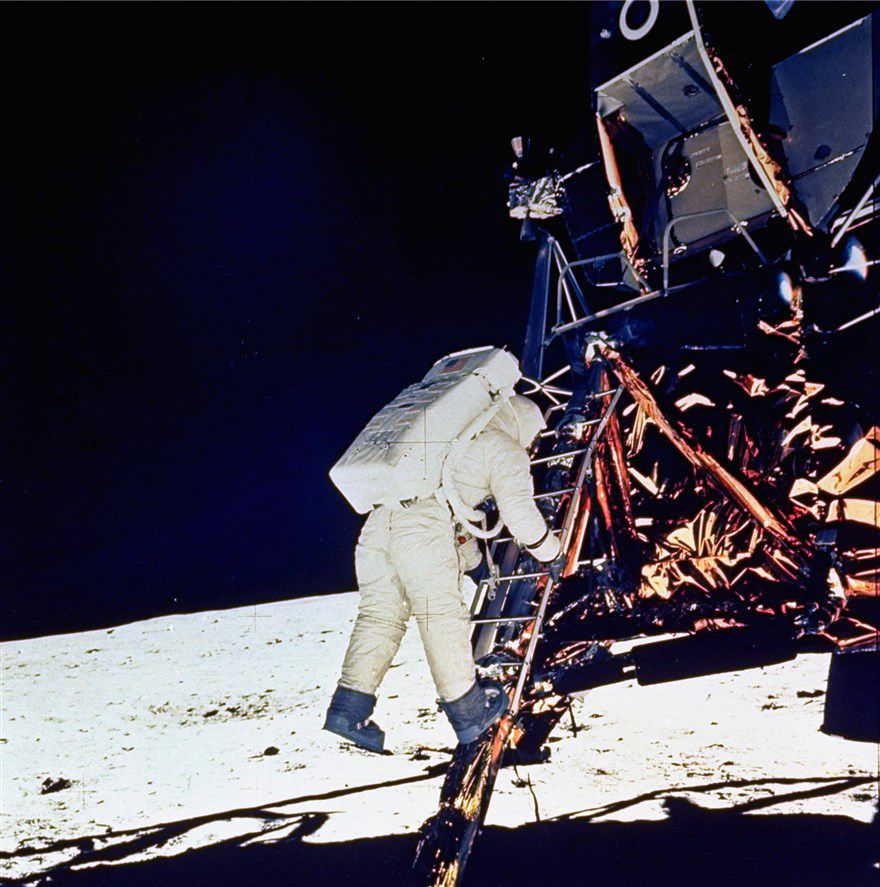
Many are comparing her feat on social media to that of Margaret Hamilton, who's code was instrumental in launching the Apollo mission into orbit in 1969 and into the next decade. Not only was Hamilton's work highly significant for the lunar landings, but also paved the way for women in science and technology.
Dr Bouman told MIT News that taking the image of a black hole is "equivalent to taking an image of a grapefruit on the moon, but with a radio telescope".
The image was collated by Event Horizon Telescopes located throughout the globe, from Chile to Antartica, while a team of scientists had to wait for just the right conditions to take the shot.
The black hole was first theorised by Albert Einstein to explain areas in space of dense matter, where even light itself cannot escape. The now near century-old theory has been puzzling scientists for decades.
Over the years, physicists and engineers had seen orbits, galaxies and move in a slingshot whirling motion around what many thought could be a black hole.
Now, scientists can prove that Einstein was correct all along.
Dr Bouman has been praised widely on social media, with the likes of Democratic Senator Alexandria Ocasio-Cortez weighing in, with this female scientist and her team adding their names to the list of the most unforgettable discoveries.
On this day, Dr Katie Boumanmust be inspirational for girls to study STEM.Speaking in a 2016 TED talk, Bouman said:
“I’d like to encourage all of you to go out and help push the boundaries of science, even if it may at first seem as mysterious to you as a black hole.”
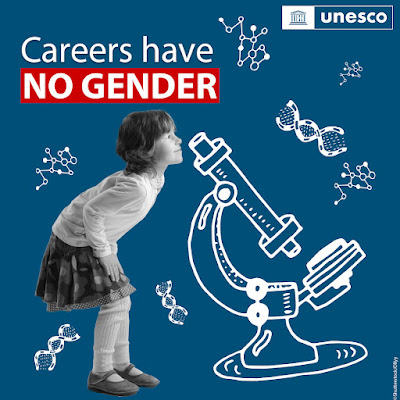
Promoting the work ofwomen in scienceand encouraginggirls to enter the sciencesis important for achieving the Global Goals for Sustainable Development. More girls are in school today than ever before, but they do not always have the same opportunities as boys to complete and benefit from an education of their choice. They are particularly under-represented in science, technology, engineering and mathematics (STEM) education, and consequently in STEM careers.
Girls in science
via Google images
Girls do as well as boys in science and maths at school but many more boys go on to further study science, technology and engineering. According to the UNESCO groundbreaking report Cracking the code: Girls’ and women’s education in STEM, only 35% of STEM students in higher education globally are women, and differences are observed within STEM disciplines.
Science and gender equality are both vital for the achievement of the internationally agreed development goals, including the 2030 Agenda for Sustainable Development.
The Sustainable Development Goals (SDGs) to a great degree need a strong science base, and this cannot be achieved at any level unless girls and women have an incentive, such as recognition and the example of role models, to have in front of them. So, we must empower young girls in school toenter STEM fields of study and careers, and stay the course.
"We're a melting pot of astronomers, physicists, mathematicians and engineers, and that's what it took to achieve something once thought impossible,"





.jpg)