Showing posts with label secondary education. Show all posts

Thursday, June 2, 2016

Arts Education : Lotte Reiniger, the pioneer of animation : resources


Lotte Reiniger
credits: Keystone Press
via Alamy

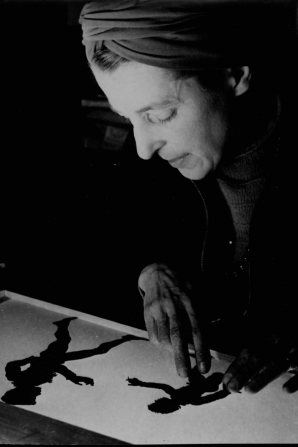
Lotte Reiniger working on her 1953 animated film, “The Magic Horse,” with hand-cut silhouette figures.

Before Pixar, even DisneyLotte Reiniger told fanciful stories in animated films with her hand-cut paper silhouettes.

Credit...Credit..Keystone Press, via Alamy


The Adventures of Prince Achmed
Lotte Reiniger’s film, 1926
Photograph: YouTube/ Doodle 
via The Guardian

"A decade before Walt Disney Productions came into existence, making its name synonymous with animated films, there was another pioneer of the art form— Lotte Reiniger."

Devi Lockwood, NYT

In the 2010 film, Harry Potter and the Deathly Hallows – Part 1, animator Ben Hibon used Reiniger's style of animation in the short film titled "The Tale of the Three Brothers".

Google Doodle:

What a lovely interactive Doodle! The Google's team Olivia Huynh (animation) and Silas Hite (original music) honor Lotte Reiniger with a creative Doodle.

Nearly a century before Pixar was founded, and more than a decade before Walt Disney would start there was Lotte Reiniger — the subject of today's Doodle.


Charlotte 'Lotte' Reiniger was born 117 years ago, on 2 June 1899 in the Charlottenburg, district of Berlin. As a child, she was fascinated with the Chinese art of silhouette puppetry. She built her own puppet theatre, so that she could put on shows for her family and friends.

"The silhouettes were very much praised, and I cut out silhouettes for all the birthdays in the family. Did anyone warn me as to where this path would lead? Not in the least; I was encouraged to continue."

Lotte Reiniger

Hans Christian Andersen had the same passion: Chinese art of silhouette puppetry and he have wonderful works.


The Art of Lott Reiniger


Reiniger is known to have worked on—or contributed silhouette sequences to—at least another seven films in the silent era, and a further nine in the sound era. Additionally, there is evidence of her involvement in a number of film projects that remained at conceptual or pre-production stages.

She created visually stunning and fantastical films using black cardboard, scissors, and boundless imagination. 

Reiniger pioneered a style of animation that relied on thousands of photos of paper cut-out silhouettes arranged to tell a story. It was a painstaking process that involved moving paper characters ever so slightly and snapping a photo of each movement. 


She made one of the world’s first animated features, a whirlwind of a fantasy film called The Adventures of Prince Achmed (1926). 

Reiniger’s filmmaking career spanned 60 years, during which she created more than 70 silhouette animation films, including versions of Cinderella, (1922), Puss in Boots (1936) and “Hansel and Gretel (1955).

She’s perhaps best known for her 1926 silent film The Adventures of Prince Achmed, a fantastical adaptation of “The Arabian Nights” that was among the first full-length animated features ever made.

Reiniger made more than 40 films over her career, all using her invention.


Lotte Reiniger

Some information:

Films were Reiniger’s passion: as a child she was delighted by the trick films of Georges Méliès, and later the dreamy horrors of Paul Wegener. 

George Méliès, was considered the best film director in the world. The point to be named for Charlie Chaplin's "The Light Alchemist".

In addition to be considered the "Father of Special Effects", Mélièrs made more than 400 films and built the first film studio in Europe.

It was also the first filmmaker to use drawings of production and storyboards to design your scenes.


Lotte Reiniger

As a young woman and keen to work with Wegener, Lotte found a job designing silhouettes for the intertitles in his films. 

Her first step into animation proper was on his film The Pied Piper of Hamelin (1918). Wegener found he could not control live rats (or even guinea pigs) on set, so Reiniger was tasked with animating wooden rodents, stop-motion style.


Lotte Reiniger's animation


“The projection was a triumph,” Reiniger remembered. “Those rats really moved as erratically as you would expected panicky rats would and they followed the Piper all right.”

In the 1960s, Reiniger stopped working and lived in London. But by the 70s her work was being revived and she toured the world talking about her career. In 1979 she made the gorgeous The Rose and the Ring, from a Thackeray story, before dying in 1981, back home in Germany.
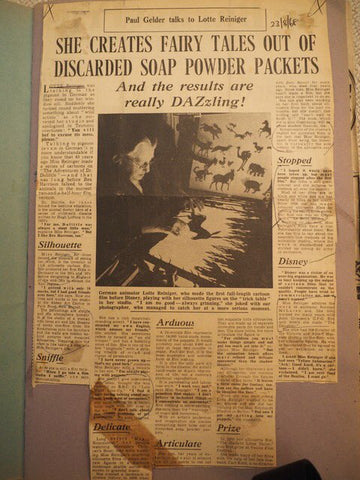


British newspaper article about Lotte Reiniger

"One of the most touching things was a British newspaper article talking about how Lotte created puppets from discarded laundry soap boxes. She scavenged cardboard and paper where she could — anything to continue her art."

Susan Stone

Reiniger was awarded the Filmband in Gold of the Deutscher Filmpreis in 1972; in 1979 she received the Great Cross of the Order of Merit of the Federal Republic of Germany

She died in Dettenhausen, Germany, on 19 June 1981, at the age of 82.


Education:


Animated movies offer teachers and students a awesome motivating push to learn differently. Let your students have an incredible adventure exploring animation films to learn about novels and the Narrative text.

Displaying movies in a lesson is an important method to help students learn about animation and the Narrative text.
  
Students will create better storytelling, including good plots, characters and narrative points of view, the crucial elements of the Narrative text.

Lotte Reininger will be a reference and an inspiration to the students who will study Animation and Cinema on Higher Education.


Resources:

"I believe in the truth od fairy tales more than I believe in the truth in the newspaper."

Lotte Reiniger

Videos:


  • Behind the Doodle: Lotte Reiniger (video above) - students of Arts
  • George Méliès, was considered the best film director in the world. He was named by Charlie Chaplin's "The Light Alchemist". In addition to being considered the "Father of Special Effects", made more than 500 films and built the first film studio in Europe.


A collection of the Reininger's short tales complete with wonderful soundtracks and charming narration. The films screened in this programme are: The Frog Prince, The Gallant Little Tailor, The Sleeping Beauty, Snow White and Rose Red, Cinderella, Puss in Boots.

Today’s Google Doodle commemorating Reiniger’s work shows the artist inside one of her films, moving from her desk through a succession of fairytale scenarios surrounded by the fruit of her imagination.


G-Souto

02.06.2016
Copyright © 2016G-Souto'sBlog, gsouto-digitalteacher.blogspot.com®
Creative Commons License
Arts Education : Lotte Reiniger, the pioneer of animation : resources bG-Souto is licensed under a Creative Commons Attribution-NonCommercial-NoDerivatives 4.0 International License.

Friday, January 8, 2016

Apps for Education : Art Legacy, bringing Art to Life


screenshot: Art Legacy

Speaking on Arts in Education, here a new tool ! An app for students of Arts.

Art Legacy: Bringing Art to Life.  What if paintings were not static? What if we could sense their depth?

Aims:

Art Legacy is an original and immersive way to see a painting. It’s also part magic.

Art Legacy creates a sense of depth inside each painting, bringing realism and vitality to over 100 of the world’s famous masterpieces


Each artwork is given a social and historical description, and several interesting details and curious facts, making Art Legacy a valuable tool in the study and understanding of Art.

Release on the 9th December 2015 by Landka.


Features:

  • Over 100 famous masterpieces covering 6 centuries of Art;
  • Great masters such as Botticelli, Da Vinci, Michelangelo, Van Gogh, Renoir, Rousseau, other;
  • Several art periods: Early Renaissance, Renaissance, Baroque, Romantic, Impressionism other;
  • Each painting is smoothly animated with up to 40 layers of depth
  • Author's timeline and full description for each masterpiece
  • Detailed information about different elements in each painting
  • Available in 6 languages
  • Music by the award-winning composer, Rodrigo Leão
  • No internet connection required


screenshot: Art Legacy

Education:
Art is a cultural legacy for humanity. A fundamental part of our history that should be kept safe for future generations.
Art Legacy is a new app for teachers and students of Arts. We can enjoy an artwork or love the story behind an object. 

Teachers and students can discover all the beautiful artworks, more than 100 of the world’s famous masterpieces. Interact with the paintings and explore a one-of-a-kind repository.


he students can interact with a painting and actually see it in motion with a sense of perspective. Art becomes closer and alive.

From the earliest times to the latest modern paintings, works are displayed chronologically, with a contextual timeline about the artist’s life. 

Art Legacy is perfect not only for Art students and connaisseurs, but also for anyone who wishes to explore the fascinating history of the Fine Arts.

Art is a cultural legacy for humanity. A fundamental part of our history that should be kept safe for future generations.


screenshot: Art Legacy

Target: 
Arts: Secondary Education; 
Arts courses: Higher Education; Vocational Education.

Available: 
iPad; iPhone; iPod touch.

Languages: 
Available in 6 languages: English, Spanish, Portuguese, Italian, French and Chinese.


Price: $7.99 ; €10.72.


Art Legacy é uma aplicação (app) da empresa portuguesa Landka que "dá vida" a obras de arte de referência.


Características:

Art Legacy apresenta mais de 100 obras de arte famosasAs obras são acompanhadas de uma descrição, e incluídas numa linha cronológica para que seja mais fácil perceber a que período pertence cada obra de arte.

As obras de arte têm ainda pequenas chamadas de atenção incorporadas que permitem conhecer e/ou aprofundar factos ligados à sua criação.


screenshot: Art Legacy

Ensino:

Art Legacy é uma app de cultura com um grande sentido de aprendizagem.  O segredo do ensino está no grau de envolvimento dos alunos e na criatividade dos recursos que lhes propomos para o desenvolvimento das aprendizagens.

A Art Legacy permite que os estudantes tenham acesso a mais de cem obras de arte, mas que são apresentadas num formato (app) mais apelativo.

As imagens apresentam um sentido de profundidade que permite perceber as diferentes fases de cada criação.

Disponível: 

iPad; iPhone; iPod touch sistema operativo iOS

Línguas:

Disponível em 6 línguas: Português, Inglês, Francês, Espanhol, Italiano, e Chinês.

Preço: $7.99 ; €10.72.


screenshot: Art Legacy


Some thoughts:
In recent years  teachers and stake holders have begun to re-examine what education means for students and there has been a growing emphasis on the importance of all kinds of learning (apps; games)

The world is changing faster than ever. New technology delivers new ideas, gigabytes of information, news of art and resources shared by social media.

Arts  have an an important impact in education. Students can love and appreciates Arts even they are not studying Arts a a main subject.

There is nothing to stop any student enjoying Arts. Its benefit is remarkable in a complete education.

“Painting is poetry that is seen rather than felt, and poetry is painting that is felt rather than seen.” 

Leonardo da Vinci


G-Souto

08.01.2016
Copyright © 2016G-Souto'sBlog, gsouto-digitalteacher.blogspot.com®
Information:  The educational digital resources and tools published on this blog are my own choice. I don't do endorsements or advertising.


Apps for Education : Art Legacy, bringing Art to Life bG-Souto is licensed under a Creative Commons Attribution-NonCommercial-NoDerivatives 4.0 International License.

Wednesday, June 10, 2015

Children's rights and social justice? Let's end Child Labour and Slavery


World Day Against Child Labour


NO to child labour – YES to quality education!


"120 million children between the ages of 5 and 14 are involved in child labour, with boys and girls in this age group almost equally affected."

United Nations

Today is World Day Against Child LabourJune 12th is intended to serve as a catalyst for the growing worldwide movement against child labourto highlight the plight of child labourers and what can be done to help them.


The International Labour Organization (ILO) released World Report on Child Labour 2015: Paving the way to decent work for young people.

The report came two days ahead of World Day Against Child Labor, June 12.

More than 168 million children are trapped in child labour. More than half of them, 85 million, are in hazardous work. This persistence of child labour is rooted in poverty and lack of decent work for adults, lack of social protection, and a failure to ensure that all children are attending school through to the legal minimum age for admission to employment.

The International Labour Organization (ILO) launched the first World Day Against Child Labour in 2002 to highlight the plight of these children. 


Child labor includes children who are forced to take part in armed conflict, such as child soldiers and girls taken as "wives" for soldiers and militia members.

According to Anti-Slavery International
, there are around 300,000 child soldiers involved in over 30 areas of conflict around the world.

Child labor among girls fell by 40 percent since 2000, compared with 25 percent for boys.

26% of all forced labourers are children, the majority found in Asia and the Pacific, and Africa, but every country and region of the world is affected by child slavery.

Hundreds of millions of young people, girls and boys throughout the world, are engaged in work that deprives them of "adequate education, health, leisure and basic freedoms", violating their rights. 


Among these children more than half is exposed to the worst forms of child labour such as work in hazardous environments, slavery, or other forms of forced labour, illicit activities such as drug trafficking and prostitution, as well as involvement in armed conflict.

Social protection is both a human right and makes sound economic and social sense. Social protection enables access to education, health care and nutrition and plays a critical role in the fight against child labour.

The World Day Against Child Labour this year will focus particularly on the importance of quality education as a key step in tackling child labour. 

It is very timely to do so, as in 2015 the international community will be reviewing reasons for the failure to reach development targets on education and will be setting new goals and strategies.


On this year’s World Day Against Child Labour ILO call for:

  • free, compulsory and quality education for all children at least to the minimum age for admission to employment and action to reach those presently in child labour;

  • new efforts to ensure that national policies on child labour and education are consistent and effective;

  • policies that ensure access to quality education and investment in the teaching profession.


credits: FAO

Education:

"Children whose education is denied or impeded by child labor enter adolescence much less likely to have the competencies and skills needed for securing decent work, and much more likely to be vulnerable to joblessness or low paid, or insecure work in hazardous conditions. Their vulnerability is frequently exacerbated by related factors such as health problems stemming from their premature involvement in work. The poor job prospects of former child laborers can continue into adulthood, making it more likely that their work experience as adults will be characterized by low earnings, insecurity, and unemployment spells," 

ILO

Some days ago, I wrote about Enfants victimes d'exclusion sociale. Reading the numbers of UNICEF Report in France, realized once more how important is to draw attention to situations such as children and young adolescents boys and girls who live far from school education, in real conditions against their human rights.


Schools and other educational institutions make a special effort to inform children of their rights according to the Declaration of the Rights of the Child and the Convention on the Rights of the Child

Teachers and students worldwide are speaking out against child labour in the classroom and taking action to raise further awareness of this issue out school. 

They are spreading knowledge among their peers, acting as a voice for those children whose rights are not respected and calling on decision-makers to act urgently to protect children in danger. 

Teachers have a crucial role on the alert of poverty or child labour cases among their students.

Numerous tools and initiatives exist to inspire and motivate students of all ages, from primary school through to university, on the subject of child labour.


Activities :

Display the video above in the classroom and some photos on the theme and invite the students to talk about what they are watching;

Ask students to search on child labour in your own country, comparing with other countries;

  • Choose a wall in the classroom or another space in the school - school library is a good place - where students in a cross-curricular can can display their depictions of child labour through works of art, photos, storytelling;
  • Organize an exhibition of photos or drawings on child labour in your classroom, school library, other spaces at school;
  • Ask students to set up information stands on the internet, social media (radio, television) or social networks (Twitter, Facebook, Instagram) to raise school awareness on the issue;
  • Prepare a play to perform at the school library. Invite parents, teachers, the maire and students from another school;
  • Present a film on this theme in the classroom or at the school library, and invite teachers, parents, and other students to a round table discussion;
  • Students can prepare brochures, flyers to hand out to other students, teachers, school and community;
  • Make a film joining authentic documents (photos) and texts written by the students and publish it on YouTube;

Other resources:


On the website ILO you will have some good material and you can find activities from all around the world.


Some thoughts:

Of course this event is not for a day. As a teacher you will prepare the activity for 3-4 days, explaining your students the symbology of special days.

And what about the teacher role? We will facilitate the activities in the classroom. Teachers will organize the activities for 3-4 days and ask the collaboration of the students.

We will answer to questions, guide students with special needs, work with small groups, guiding the learning of the class and each student individually.
  
Since the role of the teacher has changed, more as a tutor or facilitator than a deliverer of content, you and I have the privilege of observe how students interact among classmates.

As we have time to roam around the class, we notice the students are developing their own collaborative work.  Students are helping each other learn instead of relying on the teacher as the sole disseminator of knowledge. 
It is magical to observe that ! And at the end you will have some creative activities all them elaborated by the students.

When we respect our students in this way, they usually meet expectations. They realize - it takes time - that we are there to guide them in their learning instead of being a classical educator.

It is important they are able to handle devices : tablets, smartphones, other.

Our students will participate actively in the World Day Against Child Labour  for sure, and they will become engaged young citizens.

They will understand how lucky they are to come to school every day. 

"Children are not little adults," (...) "Hazardous work cannot be acceptable for children because of basic biology… they are physically and mentally different."

ILO

I believe NO child should be forced to work and striped of their childhood! Join the call to fight child labour with quality education.


G-Souto

12.06.2015

update 24.06.2024
Copyright © 2015G-Souto'sBlog, gsouto-digitalteacher.blogspot.com®

Creative Commons License