Showing posts with label childrens rights. Show all posts

Sunday, November 20, 2016

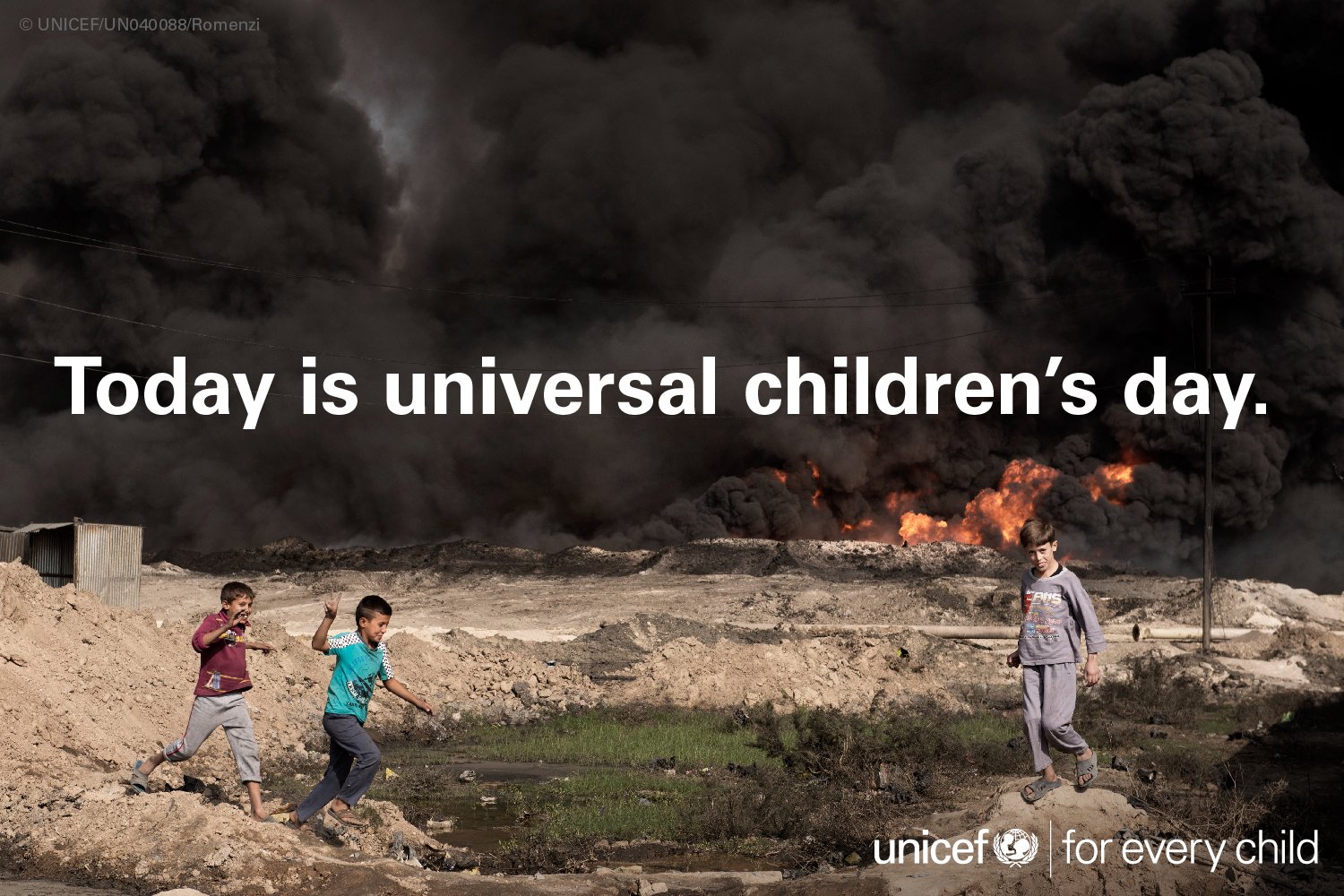
Schools : Universal Children's Day


credits: UNICEF
https://www.unicef.org/

"Every child has the right to grow up healthy and strong, to be educated and protected, and to have a fair chance in life."

United Nations Universal Children’s Day was established in 1954 and is celebrated on November 20th each year to promote international togetherness, awareness among children worldwide, and improving children's welfare.
November 20th is an important date as it is the date in 1959 when the UN General Assembly adopted the Declaration of the Rights of the Child. It is also the date in 1989 when the UN General assembly adopted the Convention on the Rights of the Child.
Since 1990, Universal Children's Day also marks the anniversary of the date that the UN General Assembly adopted both the declaration and the convention on children's rights.
"Mothers and fathers, teachers, nurses and doctors, government leaders and civil society activists, religious and community elders, corporate moguls and media professionals as well as young people and children themselves can play an important part in making Universal Children's Day relevant for their societies, communities and nations."

United Nations
Universal Children's Day offers each of us an inspirational entry-point to advocate, promote and celebrate children's rights, translating into dialogues and actions that will build a better world for Children.


Google Doodle Children's Day
credits: Anvita Prashant Telang 
of Vibgyor High School in Balewadi, Pune

"In the current stressful times, greatest joys of life are often hidden in simple things, thus I would like to teach everyone to take time to enjoy every moment of life and appreciate the simple things around us."

Anvita Prashant Telang

Google is marking the day with a Doodle in its search engines around multiple countriesthe UN children's body, Unicef, launched a short stories week to celebrate the day and to mark the agency's 70th anniversary.  

More than 200 prominent writers penned "tiny stories" - each around seven lines long - to highlight Children’s Day and the challenges many of the world's poorest and most disadvantaged children still face. 


Michelle Nkamankeng, South Africa
https://www.unicef.org/tinystories/
“As writers we are able to advocate through the simplicity of storytelling. With this worthy and necessary campaign, we advocate for the protection of the rights of precious children all over the world,” 
Nigerian author Chimamanda Adichie

“It is shocking to see that the lives of many children are still so heavily impacted by the horror of conflict, inequality, poverty and discrimination. I hope these Tiny Stories can remind the world that we must sustain our commitment to all of these children whose lives and futures are at stake,” 
Paloma Escudero, Unicef 


A boy tracking on railway tracks to cross 
from the Former Yugoslav Republic of Macedonia into Serbia 
credits: UNICEF/NYHQ2015-2203/Georgiev
Some 50 million children have been uprooted from home, more than half by conflict, the UN Children's Fund, UNICEF, said in September 2016.
In a new report on the global challenge, the agency highlights that children and youngsters make up a growing proportion of those seeking shelter outside their countries of origin.
UNICEF Executive Director Anthony Lake said Universal Children’s Day was "an annual opportunity to recommit ourselves to protecting the rights of every child".   
"These children are the future leaders of their societies. The future engines of their national economies. The future parents and protectors of the next generation. 
“When we protect their rights, we are not only preventing their suffering. We are not only safeguarding their lives. We are protecting our common future.”


Education:
"We must confront the truth that around the world the rights of millions of children are being violated"
@UNICEF

In many developed countries, children have never had it so good, with access to education, health care, the internet and much more.
But millions more are facing unprecedented upheaval. More than 50 million children have been uprooted from their homes due to conflict, poverty and climate change while millions more face violence in their communities. According to the UN, around 263 million children do not attend school and last year nearly six million children under five died from mostly preventable diseases.

Children in Syria
credits: REUTERS
https://img.washingtonpost.com/
Children in Syria are living in fear every day. The relentless bombardment forced schools in east Aleppo to close "for the safety of students and teachers, after the barbarous aerial strikes", 
Ali al-Za'atari, humanitarian coordinator for Syria  & Kevin Kennedy, regional humanitarian coordinator


Children evacuated from a Syrian school
credits: Getty Images
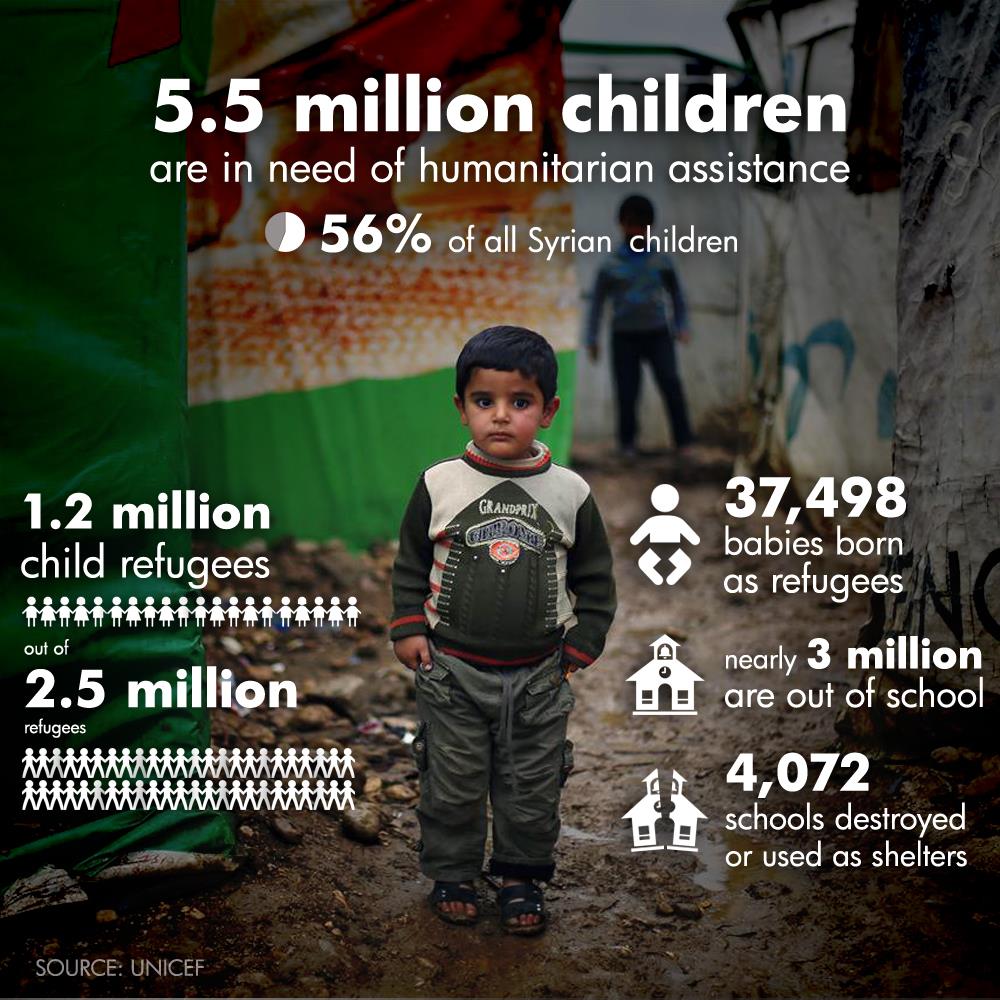
Inside Syria, more than 2 million children and adolescents aren’t in school, while 600,000 school-age refugees don’t have access to learning, according to UNICEF.
The situation is particularly precarious inside the war zone where there’s a shortage of teachers and textbooks, and school buildings are fair game for battle. Last year alone, at least 160 children were killed in attacks on Syrian schools, according to UNICEF.
“They’re being violated around the world, in every country, wherever children are the victims of violence, abuse and exploitation,"  

Even today, seven children were killed as Aleppo hospital – where kids were being treated for a brutal gas attack – is blown to pieces by Syrian warplanes.
"On this Children’s Day, we must confront the uncomfortable truth that around the world, the rights of millions of children are being violated every day," Anthony Lake, Unicef Executive Director, said. 
  • Schools:
Schools and teachers use the day to tell students about their rights as kids. Students are encouraged to think about the differences between themselves and others as well as children in other countries who are less fortunate. And so many die.

credits:  UNICEF/UN019996/Gilbertson VII Photo
Some words from the UNICEF report:
In rich and poor countries around the globe, education has long served as a great leveller of opportunity because it helps people realize their potential and contribute to their communities and the world. Good education increases knowledge, sparks innovation, builds skills that drive growth and prosperity, and fosters inclusive societies. 
For generations, quality and equitable education has provided children with a pathway out of deprivation. What has been true for the prospects of individual children has also held true for the future of nations. And yet, millions of children around the world are still denied their right to education because of factors they do not control – factors such as poverty, gender, ethnicity, disability or geographical location. 
Extreme poverty, armed conflict, natural disasters and the impacts of climate change also deprive children of the chance to go to school and learn.


Infographic: Syria Children's of War
credits: Jerome Delay / AP Images for NBC News
source: UNICEF
Some thoughts:
Teachers in their own countries have a crucial role on the alert of poverty cases among their students.


Many schools and other educational institutions make a special effort to inform children of their rights according to the Declaration of the Rights of the Child and the Convention on the Rights of the Child. 
Teachers alert their students to armed conflict countries, natural disasters and the impacts of climate change which deprive children of the chance to go to school and learn. 
The evidence is all around us. All this affect children disproportionately, and the most disadvantaged and vulnerable children most of all.
"Children who do not have the opportunity to develop the skills they will need to compete as adults can neither break these vicious cycles in their own lives nor give their children a chance to fulfil their potential. Their societies, too, are deprived of the full contribution they might have made."


Resources:
Tiny Stories: Writers Unite for Children's Rights
https://www.unicef.org/tinystories/
For Every Child, Hope
Unicef 70: 1946-2016
https://www.unicef.org/publications/index_93308.html
UNICEF on YouTube
https://www.youtube.com/user/unicef

“It does not matter how slowly you go as long as you do not stop.” 
Confucius


G-Souto

20.11.2016
Copyright © 2016G-Souto'sBlog, gsouto-digitalteacher.blogspot.com®

Creative Commons License
Schools : Universal Children's Day bG-Souto is licensed under a Creative Commons Attribution-NonCommercial-NoDerivatives 4.0 International License. 

Wednesday, December 30, 2015

The Most-Read Blog Posts of 2015 : semester #1


Looking back at 2015 I've come up with a roundup of what's been most-read on my blog G-Souto's Blog

Below you’ll see the top posts along the first semester 2015 containing several themes: edtech, languages, 
arts, science, history, environment, literature, e-safety, sports, dance, children's rights among other.

The selection is based on page views but also based on pedagogical relevance of the most-read posts.

I kept the order of the most viewed, but eliminated the posts that seemed less relevant. The main reason is that sometimes certain posts acquire too much visibility, not for their value but for the keywords that the search engines "like" indexing.


Je suis ravie de partager avec vous le Top des posts les plus lus du 1er semestre 2015. Vous êtes de plus en plus nombreux à me suivre au quotidien. Je me rends compte que les étudiants aussi me visitent.

Je vous remercie, chers enseignants, chers lecteurs, de votre intérêt et m’efforce d’être toujours au plus proche des événements concernant des idées pédagogiques pour vous présenter les dernières ressources éducatives , numériques et pas numériqueses. Le numérique prend de plus en plus la place. Les technologies donnent aux jeunes et à leurs professeurs des possibilités que les générations précédentes ne pouvaient pas avoir au même âge.


Des ressources aux grandes thématiques historiques, linguistiques, culturelles et sociales, des ressources en ligne, et de nombreuses observations personnelles sur la pédagogie et la pratique éducative de façon à faciliter Ã  tous des chances de réussite.

Here are the 1st semester's most-read Blog posts of 2015 :

Le Top des posts du 1er semestre 2015 :


School Curricula: Valentine's Day 

Education : International Year of Light 2015 

Schools: Gerardus Mercator the carthographer of world atlas 

Schools : Alessandro Volta 270th anniversary 

Intl Children's Book Day in School

Escolas : Leituras em Língua Portuguesa, Manuel A. Pina 

Talking about Freedom of Expression in school 

Et voilà le Bac: on bachotte?

Education: Solar Eclipse, Supermoon, Spring equinox?

Teaching the Holocaust : digital resources 

Education: Let's celebrate Poetry Day 

Applis éducation: on visite la Tour Eiffel? 

Intl Day of Sport for Development & Peace 

Éducation: Rimbaud pour les ados ? 

Education: Anna Atkins, botannist and the 1st woman photographer 

Schools: Explore Google Street Art

On parle Angoulême 2015? 

Apps in Education. Depth a game to explore the oceans 

Education: It's Earth Day 2015 

Education: Bartolomeo Cristofori, the piano inventor 

Children's rights & social justice? Let's end child labour & slavery!

Apprendre les langues: et voilà Larousse & Petit Robert 2016 

Education: Asteroid to Fly By Earth Safely

Education: It's Earth Day 2015 

Intl Missing Children's Day: The Captive, explore the film 

Schools: Safer Internet Day 2015 

La Fête du Muguet au collège?

Education: Don't miss Venus & Jupiter tonight!

Games in school: Treme-treme, learning about seismic risk 

Nepal: talking science & solidarity in schools 

Parlons d'enfants victimes d'exclusion sociale

Artes & Educação: Visitas de Estudo 

Music at school: app for students with visual disabilities  

Intl Mother Language Day: Languages matter!


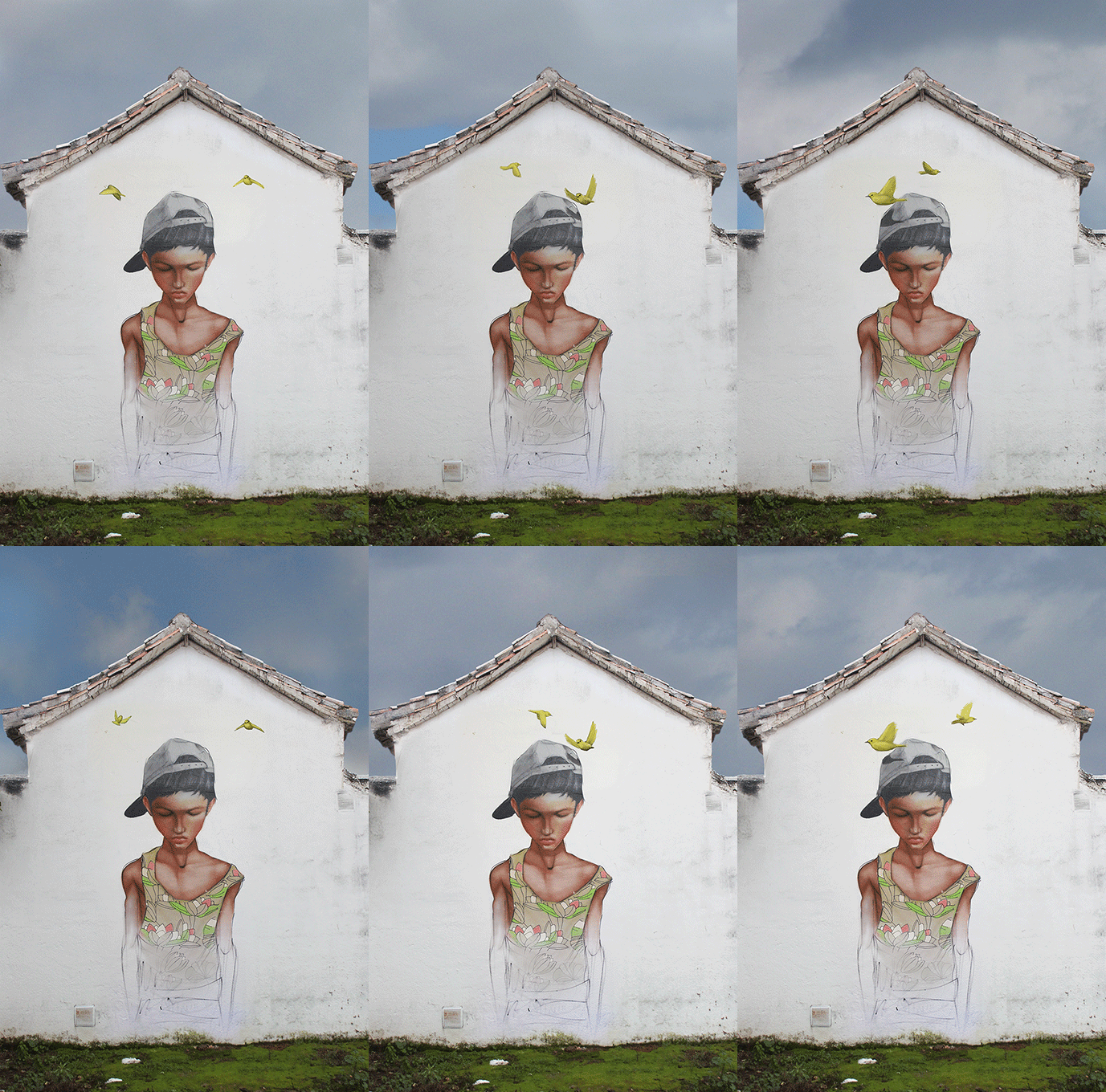
Circling Birdies by Cheko, Granada Spain
My crush of the #1st semester? Schools: Explore Google Street ArtAbsolutely! 
Google Street Art added 5,000 images of street art in June 2014, and last March 17, 2015 has announced that it will doubling the number of street artworks available in high resolution to over 10.000, working in tandem with 86 art organizations from 34 countries.

Hoping to have inspired you in your lessons all over the year.

May 2016 be a successful year for all those educators who love teach. Preparing learners for the future should therefore be a prime function of all us.

G-Souto

30.12.2015
Copyright © 2015G-Souto'sBlog, gsouto-digitalteacher.blogspot.com®

Creative Commons License
The Most-Read Blog Posts of 2015 : semester #1 bG-Souto is licensed under a Creative Commons Attribution-NonCommercial-NoDerivatives 4.0 International License.

Wednesday, June 10, 2015

Children's rights and social justice? Let's end Child Labour and Slavery


World Day Against Child Labour


NO to child labour – YES to quality education!


"120 million children between the ages of 5 and 14 are involved in child labour, with boys and girls in this age group almost equally affected."

United Nations

Today is World Day Against Child LabourJune 12th is intended to serve as a catalyst for the growing worldwide movement against child labourto highlight the plight of child labourers and what can be done to help them.


The International Labour Organization (ILO) released World Report on Child Labour 2015: Paving the way to decent work for young people.

The report came two days ahead of World Day Against Child Labor, June 12.

More than 168 million children are trapped in child labour. More than half of them, 85 million, are in hazardous work. This persistence of child labour is rooted in poverty and lack of decent work for adults, lack of social protection, and a failure to ensure that all children are attending school through to the legal minimum age for admission to employment.

The International Labour Organization (ILO) launched the first World Day Against Child Labour in 2002 to highlight the plight of these children. 


Child labor includes children who are forced to take part in armed conflict, such as child soldiers and girls taken as "wives" for soldiers and militia members.

According to Anti-Slavery International
, there are around 300,000 child soldiers involved in over 30 areas of conflict around the world.

Child labor among girls fell by 40 percent since 2000, compared with 25 percent for boys.

26% of all forced labourers are children, the majority found in Asia and the Pacific, and Africa, but every country and region of the world is affected by child slavery.

Hundreds of millions of young people, girls and boys throughout the world, are engaged in work that deprives them of "adequate education, health, leisure and basic freedoms", violating their rights. 


Among these children more than half is exposed to the worst forms of child labour such as work in hazardous environments, slavery, or other forms of forced labour, illicit activities such as drug trafficking and prostitution, as well as involvement in armed conflict.

Social protection is both a human right and makes sound economic and social sense. Social protection enables access to education, health care and nutrition and plays a critical role in the fight against child labour.

The World Day Against Child Labour this year will focus particularly on the importance of quality education as a key step in tackling child labour. 

It is very timely to do so, as in 2015 the international community will be reviewing reasons for the failure to reach development targets on education and will be setting new goals and strategies.


On this year’s World Day Against Child Labour ILO call for:

  • free, compulsory and quality education for all children at least to the minimum age for admission to employment and action to reach those presently in child labour;

  • new efforts to ensure that national policies on child labour and education are consistent and effective;

  • policies that ensure access to quality education and investment in the teaching profession.


credits: FAO

Education:

"Children whose education is denied or impeded by child labor enter adolescence much less likely to have the competencies and skills needed for securing decent work, and much more likely to be vulnerable to joblessness or low paid, or insecure work in hazardous conditions. Their vulnerability is frequently exacerbated by related factors such as health problems stemming from their premature involvement in work. The poor job prospects of former child laborers can continue into adulthood, making it more likely that their work experience as adults will be characterized by low earnings, insecurity, and unemployment spells," 

ILO

Some days ago, I wrote about Enfants victimes d'exclusion sociale. Reading the numbers of UNICEF Report in France, realized once more how important is to draw attention to situations such as children and young adolescents boys and girls who live far from school education, in real conditions against their human rights.


Schools and other educational institutions make a special effort to inform children of their rights according to the Declaration of the Rights of the Child and the Convention on the Rights of the Child

Teachers and students worldwide are speaking out against child labour in the classroom and taking action to raise further awareness of this issue out school. 

They are spreading knowledge among their peers, acting as a voice for those children whose rights are not respected and calling on decision-makers to act urgently to protect children in danger. 

Teachers have a crucial role on the alert of poverty or child labour cases among their students.

Numerous tools and initiatives exist to inspire and motivate students of all ages, from primary school through to university, on the subject of child labour.


Activities :

Display the video above in the classroom and some photos on the theme and invite the students to talk about what they are watching;

Ask students to search on child labour in your own country, comparing with other countries;

  • Choose a wall in the classroom or another space in the school - school library is a good place - where students in a cross-curricular can can display their depictions of child labour through works of art, photos, storytelling;
  • Organize an exhibition of photos or drawings on child labour in your classroom, school library, other spaces at school;
  • Ask students to set up information stands on the internet, social media (radio, television) or social networks (Twitter, Facebook, Instagram) to raise school awareness on the issue;
  • Prepare a play to perform at the school library. Invite parents, teachers, the maire and students from another school;
  • Present a film on this theme in the classroom or at the school library, and invite teachers, parents, and other students to a round table discussion;
  • Students can prepare brochures, flyers to hand out to other students, teachers, school and community;
  • Make a film joining authentic documents (photos) and texts written by the students and publish it on YouTube;

Other resources:


On the website ILO you will have some good material and you can find activities from all around the world.


Some thoughts:

Of course this event is not for a day. As a teacher you will prepare the activity for 3-4 days, explaining your students the symbology of special days.

And what about the teacher role? We will facilitate the activities in the classroom. Teachers will organize the activities for 3-4 days and ask the collaboration of the students.

We will answer to questions, guide students with special needs, work with small groups, guiding the learning of the class and each student individually.
  
Since the role of the teacher has changed, more as a tutor or facilitator than a deliverer of content, you and I have the privilege of observe how students interact among classmates.

As we have time to roam around the class, we notice the students are developing their own collaborative work.  Students are helping each other learn instead of relying on the teacher as the sole disseminator of knowledge. 
It is magical to observe that ! And at the end you will have some creative activities all them elaborated by the students.

When we respect our students in this way, they usually meet expectations. They realize - it takes time - that we are there to guide them in their learning instead of being a classical educator.

It is important they are able to handle devices : tablets, smartphones, other.

Our students will participate actively in the World Day Against Child Labour  for sure, and they will become engaged young citizens.

They will understand how lucky they are to come to school every day. 

"Children are not little adults," (...) "Hazardous work cannot be acceptable for children because of basic biology… they are physically and mentally different."

ILO

I believe NO child should be forced to work and striped of their childhood! Join the call to fight child labour with quality education.


G-Souto

12.06.2015

update 24.06.2024
Copyright © 2015G-Souto'sBlog, gsouto-digitalteacher.blogspot.com®

Creative Commons License