Showing posts with label Arts curriculum. Show all posts

Monday, March 27, 2017

Schools : World Theatre Day : Go to the theater !


World Theater Day
credits: ITI


"So, here we are once more. Gathered again in Spring, 55 years since our inaugural meeting, to celebrate World Theatre Day. Just one day, 24 hours, is dedicated to celebrating theatre around the world.

(...)

Speaking here I am not myself, I am not an actress, I am just one of the many people that theatre uses as a conduit to exist, and it is my duty to be receptive to this - or, in other words, we do not make theatre exist, it is rather thanks to theatre that we exist. The theatre is very strong. It resists and survives everything, wars, censors, penury. 

It is enough to say that “the stage is a naked scene from an indeterminate time” – all’s it needs is an actor.

Isabelle Huppert, message 2017


World Theatre Day
credits: Nicolas Sridi

World Theatre Day was initiated in 1961 by the International Theatre Institute (ITI). It is celebrated annually on the 27th March by ITI Centres and the international theatre community. 

Various national and international theatre events are organized to mark this occasion. 

One of the most important of these is the circulation of the World Theatre Day is International Message through which at the invitation of ITI, a figure of world stature shares "his or her reflections on the theme of Theatre and a Culture of Peace". 


Jean Cocteau
credits: Jean Cocteau official site

The first World Theatre Day International Message was written by Jean Cocteau (France) in 1962. 


  • Goals of WTD:
To promote theatre in all its forms across the world.
  • To make people aware of the value of theatre in all its forms.

  • To enable theatre communities to promote their work on a broad scale so that governments and opinion leaders are aware of the value and importance of dance in all its forms and support it.
  • To enjoy theatre in all its forms for its own sake.

  • To share the joy for theatre with others.

The actor of the World Theatre Day Message 2017 is the French actress Isabelle Huppert.


Isabelle Huppert
credits: ©Sylvie Lancrenon. 
Picture is copyrighted and may be used 
for World Theatre Day issues only by ITI Centres 


International performances that are part of the programmer include Allassane Sidibe, a storyteller from Togo, a performance with Zhang Jun (UNESCO Artist for peace, Kunqu opera) and an excerpt of the performance The French (based on the novel Ultimatum by Fernando Pessoa/ Álvaro de Campos, directed by Krzysztof Warlikowski (message author 2015)


World Day of Theatre for Children and Young People
http://www.assitej-international.org/


Education:

A story well-told on stage doubtless captivates the children in the audience and somehow transforms them. Leaving the theater after a show, the world seems different: it has been touched by a performance that allows members of the audience to see beyond the surface.

(...)


The tale comes to life beyond our imagination and somehow, transforms us into protagonists, because we entrust the characters with our emotions and fears, our desires and frustrations. Once they are staged, fiction, music, dance, song, poetry, games, magic, and juggling are all harmonically assembled, along with the resources typical of the theatrical arts: wardrobe, lights, scenery, makeup, props. 

The contributions made to our cultural heritage –with an emphasis on literature and theater– invariably lead to children exercising their imaginations and finding greater meaning in life."

Francisco Hinojosa, message 2017, World Day Theater for Children & Young People


Pinocchio/ Tout à Trac
credits: Jérémie Battaglia

On the 27th March 2017, the schools are still working. Easter season is near, but for the moments students are at school

Theatre in education is used to encourage effective learning in schools. It calls for careful consideration of the audience's age and requirements in order to engage them and get the message across. 

It complements school curriculum and illustrate the dynamic relationship between the performing arts and literature, history, science and world cultures. 


Nous Sommes Mille en Équilibre Fragile
Dynamo Théâtre
credits. Pierre-Luc Schetagne
The idea of a high impact performance for a specifically targeted school audience became very popular. Because the audiences are small, students can be encouraged to participate through work in role and through debate. 
Projects can be supported with resource materials and training or support for the teachers.


Ligne de Bus/ Théâtre I.N.E
credits: Eugene Holtz
Teachers may invite an actor/ actress to have a conversation with the students. And why not exciting workshops for young theater enthusiasts. 
The workshops will not only provide instruction on acting and theatre, but will help students build their public speaking skills and confidence by using more nontraditional, artistic teaching methods."
Go to the theatre next the school in your city with your students! Best lesson you can share with you students about theatre.

If you are teaching at a Vocational school of Theatre, of course you will talk a lot and have special actvities to celebrate the day.
Level: All levels

Curriculum: Cross-curricular.


Ondin/ L'Illusion
Théâtre des Marionnettes
credits: Michel Pinault

Resources:

  • Video


  • How to celebrate World Theatre Day : 

Students may be invited to search of celebrations to find out more about the different events organized for WTD 2017 all over the world.

Of course at school there are interesting activities to include into the curriculum. Teachers must prepare the activites thinking the level they are teaching.

Most of all! Go to the theater with your students!


Isabelle Huppert, invited actress WTD 2017
credits: Nicolas Sridi
https://www.world-theatre-day.org/

"Theatre is for me represents the other it is dialogue, and it is the absence of hatred. ‘Friendship between peoples’ – now, I do not know too much about what this means, but I believe in community, in friendship between spectators and actors, in the lasting union between all the peoples theatre brings together – translators, educators, costume designers, stage artists, academics, practitioners and audiences. Theatre protects us; it shelters us…I believe that theatre loves us…as much as we love it… 

I remember an old-fashioned stage director I worked for, who, before the nightly raising of the curtain would yell, with full-throated firmness ‘Make way for theatre!’ – and these shall be my last words tonight. "

Isabelle Huppert, message 2017

G-Souto

27.03.2017
Copyright © 2017G-Souto'sBlog, gsouto-digitalteacher.blogspot.com®

Creative Commons License
Schools . World Theater Day : Go to the theater ! by G-Souto is licensed under a Creative Commons Attribution-NonCommercial-NoDerivatives 4.0 International License.

Thursday, June 2, 2016

Arts Education : Lotte Reiniger, the pioneer of animation : resources


Lotte Reiniger
credits: Keystone Press
via Alamy

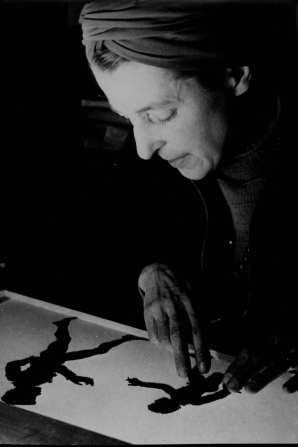
Lotte Reiniger working on her 1953 animated film, “The Magic Horse,” with hand-cut silhouette figures.

Before Pixar, even Disney, Lotte Reiniger told fanciful stories in animated films with her hand-cut paper silhouettes.

Credit...Credit..Keystone Press, via Alamy


The Adventures of Prince Achmed
Lotte Reiniger’s film, 1926
Photograph: YouTube/ Doodle 
via The Guardian

"A decade before Walt Disney Productions came into existence, making its name synonymous with animated films, there was another pioneer of the art form— Lotte Reiniger."

Devi Lockwood, NYT

In the 2010 film, Harry Potter and the Deathly Hallows – Part 1, animator Ben Hibon used Reiniger's style of animation in the short film titled "The Tale of the Three Brothers".

Google Doodle:

What a lovely interactive Doodle! The Google's team Olivia Huynh (animation) and Silas Hite (original music) honor Lotte Reiniger with a creative Doodle.

Nearly a century before Pixar was founded, and more than a decade before Walt Disney would start there was Lotte Reiniger — the subject of today's Doodle.


Charlotte 'Lotte' Reiniger was born 117 years ago, on 2 June 1899 in the Charlottenburg, district of Berlin. As a child, she was fascinated with the Chinese art of silhouette puppetry. She built her own puppet theatre, so that she could put on shows for her family and friends.

"The silhouettes were very much praised, and I cut out silhouettes for all the birthdays in the family. Did anyone warn me as to where this path would lead? Not in the least; I was encouraged to continue."

Lotte Reiniger

Hans Christian Andersen had the same passion: Chinese art of silhouette puppetry and he have wonderful works.


The Art of Lott Reiniger


Reiniger is known to have worked on—or contributed silhouette sequences to—at least another seven films in the silent era, and a further nine in the sound era. Additionally, there is evidence of her involvement in a number of film projects that remained at conceptual or pre-production stages.

She created visually stunning and fantastical films using black cardboard, scissors, and boundless imagination. 

Reiniger pioneered a style of animation that relied on thousands of photos of paper cut-out silhouettes arranged to tell a story. It was a painstaking process that involved moving paper characters ever so slightly and snapping a photo of each movement. 


She made one of the world’s first animated features, a whirlwind of a fantasy film called The Adventures of Prince Achmed (1926). 

Reiniger’s filmmaking career spanned 60 years, during which she created more than 70 silhouette animation films, including versions of Cinderella, (1922), Puss in Boots (1936) and “Hansel and Gretel (1955).

She’s perhaps best known for her 1926 silent film The Adventures of Prince Achmed, a fantastical adaptation of “The Arabian Nights” that was among the first full-length animated features ever made.

Reiniger made more than 40 films over her career, all using her invention.


Lotte Reiniger

Some information:

Films were Reiniger’s passion: as a child she was delighted by the trick films of Georges Méliès, and later the dreamy horrors of Paul Wegener. 

George Méliès, was considered the best film director in the world. The point to be named for Charlie Chaplin's "The Light Alchemist".

In addition to be considered the "Father of Special Effects", Mélièrs made more than 400 films and built the first film studio in Europe.

It was also the first filmmaker to use drawings of production and storyboards to design your scenes.


Lotte Reiniger

As a young woman and keen to work with Wegener, Lotte found a job designing silhouettes for the intertitles in his films. 

Her first step into animation proper was on his film The Pied Piper of Hamelin (1918). Wegener found he could not control live rats (or even guinea pigs) on set, so Reiniger was tasked with animating wooden rodents, stop-motion style.


Lotte Reiniger's animation


“The projection was a triumph,” Reiniger remembered. “Those rats really moved as erratically as you would expected panicky rats would and they followed the Piper all right.”

In the 1960s, Reiniger stopped working and lived in London. But by the 70s her work was being revived and she toured the world talking about her career. In 1979 she made the gorgeous The Rose and the Ring, from a Thackeray story, before dying in 1981, back home in Germany.


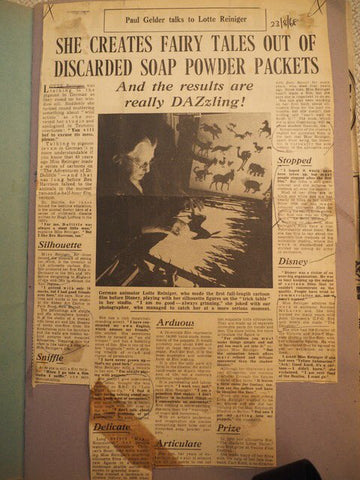
British newspaper article about Lotte Reiniger

"One of the most touching things was a British newspaper article talking about how Lotte created puppets from discarded laundry soap boxes. She scavenged cardboard and paper where she could — anything to continue her art."

Susan Stone

Reiniger was awarded the Filmband in Gold of the Deutscher Filmpreis in 1972; in 1979 she received the Great Cross of the Order of Merit of the Federal Republic of Germany. 

She died in Dettenhausen, Germany, on 19 June 1981, at the age of 82.


Education:


Animated movies offer teachers and students a awesome motivating push to learn differently. Let your students have an incredible adventure exploring animation films to learn about novels and the Narrative text.

Displaying movies in a lesson is an important method to help students learn about animation and the Narrative text.
  
Students will create better storytelling, including good plots, characters and narrative points of view, the crucial elements of the Narrative text.

Lotte Reininger will be a reference and an inspiration to the students who will study Animation and Cinema on Higher Education.


Resources:

"I believe in the truth od fairy tales more than I believe in the truth in the newspaper."

Lotte Reiniger

Videos:


  • Behind the Doodle: Lotte Reiniger (video above) - students of Arts
  • George Méliès, was considered the best film director in the world. He was named by Charlie Chaplin's "The Light Alchemist". In addition to being considered the "Father of Special Effects", made more than 500 films and built the first film studio in Europe.


A collection of the Reininger's short tales complete with wonderful soundtracks and charming narration. The films screened in this programme are: The Frog Prince, The Gallant Little Tailor, The Sleeping Beauty, Snow White and Rose Red, Cinderella, Puss in Boots.

Today’s Google Doodle commemorating Reiniger’s work shows the artist inside one of her films, moving from her desk through a succession of fairytale scenarios surrounded by the fruit of her imagination.


G-Souto

02.06.2016
Copyright © 2016G-Souto'sBlog, gsouto-digitalteacher.blogspot.com®
Creative Commons License
Arts Education : Lotte Reiniger, the pioneer of animation : resources by G-Souto is licensed under a Creative Commons Attribution-NonCommercial-NoDerivatives 4.0 International License.