Showing posts with label learning and teaching science. Show all posts

Wednesday, August 12, 2015

Education & science : Catching the Falling Stars, the Perseids


credit: Jimmy Westlake

Well, just few days to my summer break. But I couldn't miss the falling stars.

So here I am writing a new post about the Perseids this August 12-13, 2015.

Perseids are also known for their fireballs. Fireballs are larger explosions of light and color that can persist longer than an average meteor streak. This is due to the fact that fireballs originate from larger particles of cometary material. Fireballs are also brighter, with magnitudes brighter than -3.

A good number of meteors have beeen visible near Perseus every night from late JuneJuly through August 24. However, you'll see fewer meteors before and after the peak. 

Look towards the familiar constellations Cassiopeia and Perseus in the northeast. They rise soon after sunset, but you'll want to wait til they are higher in the sky to see the most meteors. 

The best meteor watching hour is 4 a.m. Eastern or 1 a.m. Pacific time on the morning of August 13, when up to 100 meteors per hour may be visible from a dark sky.


According to NASA research, the upcoming Perseid meteor shower produces more fireballs — bright meteors that streak across the sky — than any other annual shower, earning it the title of "fireball".

According to scientists at NASA's Jet Propulsion Laboratory, this year's Perseids display could spawn up to 100 meteors per hour under the most optimum observing conditions (clear dark skies well away from any intereference from city lights). 

What is the Perseid meteor shower?

The Perseid meteor shower happens every August. 
The Earth plows into debris left behind from Comet Swift-Tuttle, which last passed close to Earth in 1992.

The Perseid meteor shower occurs annually when debris left behind from the comet Swift-Tuttle ignites in the Earth’satmosphere.The material comes off the comet and forms a tail and stays in space, Every year the Earth passes through the debris from the comet and forms shootings stars, or meteors.

With very fast and bright meteors, Perseids frequently leave long "wakes" of light and color behind them as they streak through the Earth's atmosphere. 

The Perseids are one of the most plentiful showers (50-100 meteors seen per hour) and occurs with warm summer nighttime weather, allowing sky watchers to easily view the shower.


credits : science@NASA

Where Do Meteors Come From?

Meteors come from leftover comet particles and bits from broken asteroids. When comets come around the sun, they leave a dusty trail behind them. Every year the Earth passes through these debris trails, which allows the bits to collide with our atmosphere where they disintegrate to create fiery and colorful streaks in the sky.

When happens in 2015:

The annual Perseid meteor shower will reach its peak early next Wenesday, August 12 and 13 2015, all night, and skywatchers in the world are flocking to their nation's national parks, where pristine, dark skies are ideal for watching what is typically the most dazzling fireball display of the year.

The best meteor shower of the year will light up the night skies tonight, and a dimmer moon means it will be more visible than in recent years. 

“So the sky will be good and dark, and it will be much easier to see meteors because of that.” 

To view the Perseids, look up and try to find the constellation Perseus, the shower’s radiant.

The best meteor watching hour is 4 a.m. Eastern or 1 a.m. Pacific time on the morning of August 13, when up to 100 meteors per hour may be visible from a dark sky.


Education:

This year’s Perseid meteor shower peaks on August 12th and 13th,” says Bill Cooke of NASA’s Meteoroid Environment Office.  “The Moon will be nearly new, setting the stage for a great display.”

Of course most of us are enjoying summer break, teachers and students. But students can watch this exciting event of the summer with family or at summers camps.

Sciences teachers can snap some amazing videos or photos to explain the Perseid show in a lesson, after school summer holiday... if  they are lucky.

Last year, I shared an interesting guide written by Phil Plait with a little adaption). Please find it on my Perseids post 2014 here

What to do?

Some teachers are in touch with students via Facebook, Twitter, Google + even educational blogs, or school email accounts.

  • Ask students to snap some shots or videos with their smartphones, tablets, to explore in Sciences curriculum next school year, not so far from some of you.
  • Invite the students to join some skywatchers at national observatories of Astronomy, or go out with family observing the Perseids shower August 12, 2015.
Resources:

Videos


You will find excellent videos on NASA website and BBC Science : Perseids: Meteor light show set to dazzle

Websites:


Apps:

Meteor counter app for Android

Social media:


Twitter: Join in with the worldwide #meteorwatch


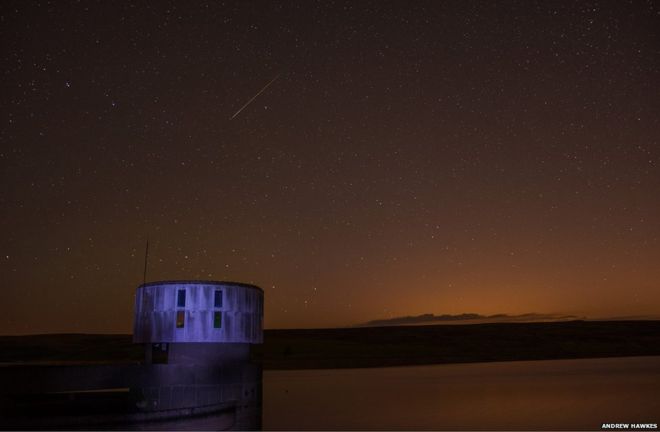
credits: Andrew Hawkes 
at Grimwith Reservoir, Yorkshire Dales, 2015

Some night sky enthusiasts have already reported Perseid sightings, but the meteor shower is expected to peak overnight Wenesday 12, 2015. For most people, meteor showers are best viewed with the naked eye. Experts advise finding a dark location away from artificial light and an unobstructed view of the sky.
Reclining chairs or blankets are best for looking up at the sky in comfort.

Hope you will enjoy to be a skywatcher tonight, August 12th admiring the beauty of this awesome event.

The following night the planets should be visible as well - their positions will just be slightly different.

Hope I get lucky too!

G-Souto

11.08.2015
Copyright © 2015G-Souto'sBlog, gsouto-digitalteacher.blogspot.com®

Creative Commons License
Education & science : Catching the Falling Stars, the Perseids bG-Souto is licensed under a Creative Commons Attribution-NonCommercial-NoDerivatives 4.0 International License.

Tuesday, June 30, 2015

Education : Don't miss Venus & Jupiter tonight !


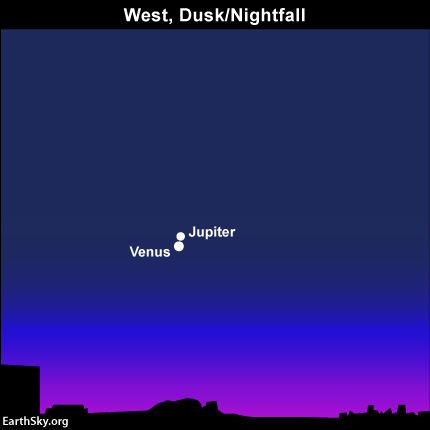
credits: EarthSky

Today, tuesday 30 June 2015, Venus will come neck-and-neck with Jupiter. Anyone who pays even cursory attention to the evening sky has surely noticed that the two brightest planets, Venus and Jupiter, have been drawing closer together in the west in the evening twilight. 
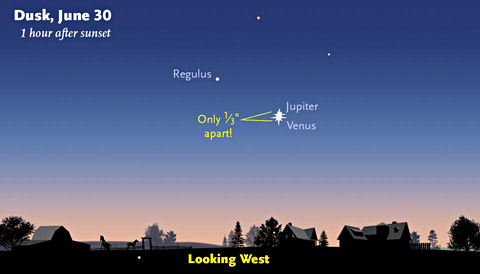
Tonight, at 2:17 pm Universal Time or 10:17 am E.T., the two planets will be at their closest. We can see this unusual sight, known as a conjunction, from just about anywhere in the world.
This spectacle must be some kind of omen. Well, yes, it's a sign from the heavens to get outside and look! As my S&T colleague Alan MacRobert points out, "a spectacular conjunction like this often gets people started in our wonderful pastime."


credits : EarthSky

Some information:
At the beginning of June, the two planets were 20° apart in the sky, about twice the width of your fist held at arm's length. 
Week by week, Jupiter and the stars behind it have gradually slipped lower in the evening twilight. But Venus, due to its rapid orbital motion around the Sun, has stayed high up. 
The conjunction of the two planets has been building during the month of June and will culminate in a spectacular display on June 30. 
“Every night in June, the separation between Venus and Jupiter will visibly shrink,” 
NASA
A conjunction is when two or more objects appear very close together on the sky.


Where to look for it ?

The optimal viewing location, according to Jackie Faherty, an astrophysicist at the American Museum of Natural History in New York, is one where w the sun sets just as the planets approach one another. Complete darkness is not necessary to see these bright objects, but it helps.

Pat Hartigan, an astronomer at Rice University, says "the conjunction on June 30 is the best one we will have for over a decade, rivaled only by one on March 1, 2023, which will not be not quite as close."


Education:

 Wow ! Can't miss it!

The last event was Summer solstice, last 21 June 2015. Some students were lucky and could join people all over the world.

Now, schools are closed in the most part of the world. It's summer break for students and some teachers.

However, teachers are in touch with students via Facebook or Twitter school email accounts, or even on blogs or educational websites (school or individual).


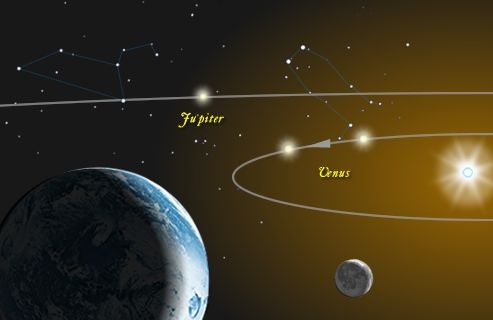
Chart via Jay Ryan at ClassicalAstronomy.com

via : EarthSky


So they can invite the students to join some skywatchers at national observatories of Astronomy, or go out with family observing the Venus & Jupiter tonight.

Ask students to make some shots or videos with their smartphones, tablets or
iphones to explore in Sciences curriculum after Summer holiday.

Hope you will enjoy to be a skywatcher tonight, June 30th and admiring the beauty of this awesome scientific event.

The following night the planets should be visible as well - their positions will just be slightly different.

"You’re not going to watch them speed past; it’s a slow-moving process," 

Dr. Faherty.

Hope I get lucky too!

G-Souto

30.06.2015
Copyright © 2015G-Souto'sBlog, gsouto-digitalteacher.blogspot.com®

Creative Commons License
Education: Don't miss Venus & Jupiter tonight bG-Souto is licensed under a Creative Commons Attribution-NonCommercial-NoDerivatives 4.0 International License.
References : 
EarthSky

Saturday, July 12, 2014

Science Education : Summer Supermoons 2014


Supermoon 
credits : NASA

"If you thought one supermoon was bright, how about three….? The full Moons of summer 2014—July 12th, August 10th, and Sept. 9th - will all be supermoons."

NASAScience

The moon will appear unusually large and bright this Saturday evening, in the first of three so-called ‘Supermoon’ events that will take place this summer.

The so-called "supermoon" occurs when the Moon reaches its closest point to Earth, known as a perigee full moon.

The summer of 2014 will be bathed in moonlight as three perigee "supermoons" occur in consecutive months: July, August, September. Oh, my ! So good for all of us ! And the students, of course.


The scientific term for the phenomenon is "perigee moon." Full Moons vary in size because of the oval shape of the Moon's orbit. The Moon follows an elliptical path around Earth with one side ("perigee") about 50,000 km closer than the other ("apogee").  Full Moons that occur on the perigee side of the Moon's orbit seem extra big and bright.
This coincidence happens three times in 2014.  On July 12th and Sept 9th the Moon becomes full on the same day as perigee.  On August 10th it becomes full during the same hour as perigee—arguably making it an extra-super Moon."
Stargazers will be able to catch the moon appearing to be strangely luminous at 11:25 (GMT) tonight, when it will be 222,611 miles away and in what is known as its perigee.

Tonight’s Supermoon full moon peak time is different than last year. LALATE has been covering the Supermoon since 2011. That year was the first time in which a “perigee full moon” occurrence got a new name as a “Supermoon”. The confusion stems from the name. We have always experienced on earth a “perigee full moon” roughly 13 months and 18 days. But only starting in 2011 did we start to give the evening a new name as a “Supermoon”. 

This year, because there are three Supermoons, NASA is reminding fans that we can now even use three different names:
  • the Buck Moon Supermoon; 
  • the Sturgeon Moon Supermoon; 
  • the Corn Moon Supermoon.

For more information, visit NASA website here


Perigee diagram
credits: NASA

Full moons vary in size because of the oval shape of its orbit and its elliptical path around Earth.

When in perigee, the moon is around 50,000 km closer than when it is furthest away, or in apogee.

On 12 July and at 01:38 (GMT) on 9 September, it will become full on the same day it is in perigree, and appear in the sky as an enormous, glowing orb. 


Perigee diagram
credits: NASA

But true astronomical buffs are most excited by 10 August, when the moon will be 863 miles closer than on Saturday, and will become full on the same hour as perigree and will appear at its brightest in 2014.

Unlike solar eclipses and other celestial treats, supermoons occur every 13 months and 18 days, Geoff Chester of US Naval Observatory told NASA Science. However, these events are not always noticed, as they can be masked by clouds and poor weather.

In fact there are two further perigree moons on the astronomical calendar this year, but these are not visible from Earth.


Wat's up for August 2014
Credits : NASA

Go outside to see Venus and Jupiter at dawn, Saturn and Mars at dusk. No telescope required! Plus the annual Perseid meteor shower is in full swing now through the 17th. 
The shower peaks the night of August 12-13, but the bright moon that night will likely interfere with viewing some of the fainter meteors. The Perseid shower occurs each year when Earth travels through a trail of dusty particles left behind by comet 109P/Swift-Tuttle.

NASA

Education :

Three Supermoon in a Row ! Wow !

The last time a supermoon made headlines was in June last year, when it appeared to be 14 per cent bigger and 30 per cent brighter. You can read my post Super moon in Science education

Schools are closed in the most part of the world. It's summer break for students and teachers.

However, teachers are in touch with students via Facebook or Twitter school email accounts, or even on blogs or educational websites (school or individual).

So they can invite th students to join some skywatchers at national observatories of Astronomy, or go out with family observing the supermoon of tonight and the next one on August 10th.

Ask students to make some shots or videos with their smartphones, tablets or
iphones to explore in Sciences curriculum after Summer holiday.

And of course, compare the supermoon on September, 9th 2014.

After the three supermoons 2014, teachers and students will exchange their experience and debate the interesting Science case.

In practice, it's not always easy to tell the difference between a supermoon and an ordinary full Moon. A 30% difference in brightness can easily be masked by clouds and haze.  Also, there are no rulers floating in the sky to measure lunar diameters. Hanging high overhead with no reference points to provide a sense of scale, one full Moon looks about the same size as any other.

 “The ‘Moon Illusion’  is probably what will make people remember this coming set of Full Moons, more than the actual view of the Moon itself,” 

"There's a part of me that wishes that this 'super-Moon' moniker would just dry up and blow away, like the 'Blood-Moon' that accompanied the most recent lunar eclipse, because it tends to promulgate a lot of mis-information," (...) "However, if it gets people out and looking at the night sky and maybe hooks them into astronomy, then it's a good thing."

Geoff Chester of the US Naval Observatory

Hope you will enjoy to be a skywatcher tonight, July 12th, August 12th and September 9th admiring the beauty of this awesome scientific event.


Spiritual side:

Oh ! By the way, are you ready to attract your heartfelt longings by doing a moon ritual focused on manifestation? 

The dark side of the moon, with its mysterious unseen forces, offers a nurturing environment where our intentions can establish roots before their miraculous manifestations begin to sprout and reach out to the stars.


For those who are lucky, stay 'Up all Night' to watch the Supermoon ! And for spiritual people, prepare yourself a sacred space where your will perform the ceremony when the new moon arrives. 
Namaste !
G-Souto
12.07.2014
Copyright © 2014G-Souto'sBlog, gsouto-digitalteacher.blogspot.com®
Creative Commons License
Science Education: Summer Supermoons 2014 bG-Souto is licensed under a Creative Commons Attribution-NonCommercial-NoDerivatives 4.0 International License.
References : 
NASAScience | ScienceNews

* Note: Update on August 2, 2014 (NASA new videol)

Tuesday, October 15, 2013

Ada Lovelace Day in Education: Girls & STEM


Ada Lovelace | Photo: Getty

Today, October 15 is Ada Lovelace Day. I already wrote about Ada Lovelace: Girls in Science, last year. Remember?

But I think it is very important to write about this pioneering scientist woman in STEM subjects.

"Whatever Ada’s role in the history of programming, she grasped the importance of Babbage’s inventions and understood that math was only part of it: she theorized, for instance, that the Analytical Engine might be used to write music. That was a pretty profound thing to realize in the 1840s, many decades before anyone successfully built a computer, let alone one that could compose a tune."

The annual Ada Lovelace day, which this year falls on 15 October, aims to raise the profile of women working in STEM subjects across the globe. 

Ada Lovelace Day celebrates  the achievements of women in science, technology, engineering and maths around the world
Three years ago, the world celebrated the pioneering scientist by introducing Ada Lovelace Day. 

The 24th of March last year was the first Ada Lovelace Day, when more than 1,200 people wrote about the women they admire who work with technology.
The day has become renowned for sharing inspirational stories about women in science that inspire people.

The annual celebration of inspiring women in science and technology is in its fourth year, and bigger than ever.

This year, the day was intertwined with a Wikipedia event to help spread the word about pioneering female scientists, from the 19th century right up until the present day.
Researchers, students and members of the public are gathering just across the street from the University of Oxford's science buildings to change scientific history. Rather than test tubes or computer models, however, they are armed with stacks of reference material, ready to square up to the online Goliath that is Wikipedia.


"The Royal Society’s Wikipedia edit-a-thanwhere volunteers (most of them women) will edit entries of important women scientists in history, who have either been overlooked or shrunk to a few thin lines, was set up to help promote women in science."

The event is open to anyone who wishes to help preserve women's science history. Female editors are particularly encouraged to attend.


Photograph: Greg Smolonski/Photovibe
Daria Cybulska, events organiser at Wikimedia UK, said at the time: "If a female scientist does not have an article on Wikipedia often it’s difficult to learn about her – hence she cannot serve as a role model for others.
"So, the idea is to spread the stories about them, and at the same time inspire more women to get involved, not only with Wikipedia, but in maths, science, technology and engineering."
She added: "I was aware that a lot is being done within the movement to increase female participation, but during the course of working on the event I have realised quite how much enthusiasm and collaboration there is to get women editing. Linking up with the Finding Ada movement has been very inspiring too, and we are now connected to many more women that want to support Wikipedia.
The main effort of the event is to run the editing session focused on creating articles about women in science, particularly Royal Society Fellows. 


Finding Ada


Finding Ada: what is that?
The Finding Ada website is encouraging women to add their views, stories and thoughts of other women in science – whether engineers, scientists, technologists or mathematicians — who have inspired you to become who you are today.
"The aim is to create new role models for girls and women in these male-dominated fields by raising the profile of other women in science, technology, engineering and maths," the site says.

Education:

Ada Lovelace is widely held to have been the first computer programmer, and Ada Lovelace Day aims to raise the profile of women in science, technology, engineering and maths (STEM) by encouraging people around the world to talk about the women whose work they admire

The discussion of new discoveries and a better understanding of the role of the girls and young women (Higher Education) dimension in many different STEM areas of study, and how these findings can lead to new ideas and new markets for girls and women in science knowledge are some of the aims of Ada Lovelace Day.

This begins early in school where girls must be encouraged to access to science and technology

The aim is to encourage creativity in the field of science and new technologies and highlight the importance of developing innovative skills at an early age.

"That brain of mine is something more than merely mortal; as time will show."

Ada Lovelace


G-Souto

15.10.2013
Copyright © 2013G-Souto'sBlog, gsouto-digitalteacher.blogspot.com®

Licença Creative Commons
Ada Lovelace Day in Education: Girls & STEM bG-Souto is licensed under a Creative Commons Attribution-NonCommercial-ShareAlike 3.0 Unported License.

Resources:

Finding Ada