Showing posts with label in-person learning. Show all posts

Friday, August 31, 2018

Schools : Portuguese 28 Tram Anniversary : resources


Lisbon tram, line 28
credits: Getty Images

The delightful tram date from the 1930s. Trams are housed in a museum. In Lisbon trams are an integral part of the public transports. These historic trams are still in use, as the 28 line is completely unsuitable for modern trams due to its numerous tight turns and steep gradients. But there it is! 


Rewind Cities Lisbon (app)

Yes! Do you know Lisbon? Remember Hello Lisbon in AR? Did you and your students visited Lisbon? If not, teachers  think about a school visit to Lisbon, a beautiful city, enter on the most known tram, line 28, to visit Lisbon in AR. Wow! A great adventure in a famous city.

Well, the 28 line celebrates today its 117th birthday!


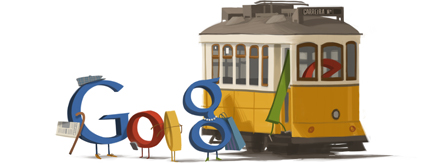
Lisbon Tram 110th Anniversary 2011 hp Doodle: 110º Aniversário da Inauguração da Primeira Linha de Carros Elétricos em Portugal


110th Anniversary of the Lisbon Tram
https://www.google.com/doodles/


  • Google Doodle:

Google celebrated on the 31 August 2011, the 110th anniversary of the first Portuguese tramway line, between Cais do Sodré and Algés, in Lisbon, Portugal, with a colorful Doodle.

How nice! The word Google enters letter by letter in the Portuguese tramway! It could be an interesting digital resource to include into school curricula: new countries, other cultures and different languages. An old but always 'fancy' transport in some big cities.


Tramway line 28 | Lisbon
credits: unknown
https://lisbonlisboaportugal.com/lisbon-transport/

Education:

So, let's start with some tips on cultural traditions as a brief introduction to learn about different cities in the world. In this case, Lisbon, Portugal.


Tram 28 in Lisbon, cartoon
credits: Sam Bosma

  • The tramway

The tramway is an urban transport from the 19th century. And it's still working in some European countries, and other different continents: United States, South America, Australia or New Zealand.

In Porto, Portugal, there is thTramway Museum! The Tramway Museum of Porto is open to tourists and to schools.


Museu Carro Eléctrico, Porto, Portugal


  • Activities:

- General information: Ask your students to make some research about trams in Portugal.

They can use their smartphones, or tablets if you are teaching in a 'lucky' class.

- Culture: After the first information, teachers will ask the students to continue the research activity but now to find countries that are using the tramway as an usual public transport in our days and in which cities.

After a good individual research about cities that are using trams as a public transport, invite students to join in different groups.

Each group will choose a different city and will develop a project. For example, exploring a touristic tour.

Note: The fair way to distribute cities' names among students is the raffle.

Each group will prepare a little video on YouTube, using school account to present different cities to the classroom. Established a time presentation, 3-5 minutes, and time to finish the activity, 3-4 days. Take a week at least for younger students.


Urban Sketch : Lisbon, Belém Jerónimos
water color by Elena Petrova Gancheva


Discussion:

Each group of students learned about a city in the world that is using trams. So, they will share their urban cultural knowledge with their classmates.

Teachers and students are asked to make some questions about each city: history, geography, language, culture, traditions.


Tramway model
In Porto, there is an interesting Museum. The Tramway Museum! The Tramway Museum of Porto is open to tourists and to schools.

The Museum has an impressive collection of antique trams. The museum is well prepared to do different activities with students (different class levels). 

Any group, teacher and his class can rent an old tram to do a touristic tour.


Resources:

Back to the 28 line in Lisbon, teachers and students can get some useful information on Google Maps to know the circuit of the 28 line.

Finally, invite your students to watch the videos on this post about the most famous tram line in Lisbon. Tram 28! They will love to take a tour... like a roller coaster! Wow! Amazing!


I hope you and your students will enjoy this little tramway tour and the activities in two Portuguese cities, Lisbon and Porto.

Don't forget to complete the touristic tour in Lisbon with the app Rewind Cities Lisbon in AR.


Have a nice cultural school visit to Lisbon after a very good lesson!


G-Souto

31.08.2011
update: 31.08.2018
copyright © 2018G-Souto'sBlog, gsouto-digitalteacher.blogspot.com®

Licença Creative Commons

Schools : Portuguese 28 Tram Anniversary : resources by G-Souto is licensed under a Creative Commons Attribution-NonCommercial-NoDerivatives 4.0 International License.

Tuesday, January 3, 2012

Talking about Music in public schools


Sir George Martin
credits: Richard Saker/Rex/Shutterstock


"Music should be a very solid part of the education of young children."

Sir George Martin


I defend Music in schools as a serious matter! I wrote about it on several publications.

A DJ in the orchestra: what a Music lesson could be or Grand Finale: dreams come true! are only two examples. But you will find several others if you search on the blog.

Sir George Martin was the first person to receive an honorary doctorate from Lund University's Faculty of Fine and Performing Arts and the Malmö Academy of Music (2010).

In this short interview ( the video is disabled), he was talking about the importance of Music curriculum in public schools (elementary and secondary education). He was speaking about the minor role of Music teaching in public schools in UK. 

But the picture is not different in public schools in other European countries.

The importance of Music as social inclusion for kids has a recognized value in some countries. 

Today, I read on Time US an interesting article about an initiative in Los Angeles that tell us how Music is changing young lives. 


Conductor Gustavo Dudamel
credits: Dudamel Foundation

The YOLA initiative is inspired by the program known as El Sistema, which has taught classical music to hundreds of thousands of under-privileged Venezuelan children for more than three decades. 

"El Sistema's most famous product is L.A. Phil director Gustavo Dudamel himself."

The program offers instruction as many as four days a week to some 500 under-privileged kids in underserved areas of the city, most of them Latino or African American.

"Mozart vs the Gangsta's: how classical music is changing young lives" 


A fantastic initiative that proves how important Music is for changing kids behavior, keeping them away from gangs in underserved areas of the city .

The program teaches children more than just music, but also responsibility and how to be models in the community. And this is the good point about inclusiveness. 

"So now our children can make friends with kids who are musicians and not street kids."

YOLA annually provides for free a quarter million children with free musical instruments and music instruction so that they may play in youth orchestras throughout their country.


Education:


The holistic immersive approach of Music (rock, pop, classical) and the engagement of important and experencied musicians is central to achieving significant transformation, particularly to the lives of the most vulnerable children.

For Music Teachers:

The L.A. Phil announced a new project called "Take A Stand," which will set up a Master's program to educate music teachers to teach kids based on the Sistema model.


"Music is the movement of sound to reach the soul for the education of its virtue."

Plato


G-Souto

03.01.2012
Copyright © 2012G-Souto'sBlog, gsouto-digitalteacher.blogspot.com®

Licença Creative Commons
Talking about Music in public schools by G-Souto is licensed under a Creative Commons Attribution-NonCommercial-NoDerivatives 4.0 International License.

Monday, December 12, 2011

Environmental Education in curricula : European Green Cities !


Hamburg
European Green City 2011


"Europe is an urban society, with many environmental challenges to face.  The European Commission has long recognized the important role that local authorities play in improving the environment, and their high level of commitment to genuine progress."


European Green Capital / European Green Leaf


💚The European Green Capital Award has been conceived as an initiative to  promote and reward these efforts.
The award aims to provide an incentive for cities to inspire each other and share best practices, while at the same time engaging in friendly competition. In other words, the cities become role models for each other.


Hamburg


So, after Stockholm 2010, Hamburg is the current European Green Capital, chosen between 34 cities from 17 different European countries that applied for the title.
"Green Capital 2011, Hamburg is a learning city, seeking out best-practices from fellow European cities promoting sustainable development.  Mutual learning, the exchange of problems and solutions and themes of the future are essential to promoting greater sustainability in cities."


👩👨Education:

"Our planet, our home is being neglected. Climate change continues unabated. It seems there's a new ecological disaster happening almost daily." 

Schools have an important role promoting environmental education as a Civics value.

I have already publish different posts about environment and education. Earth Day 2008; Environmental education and outdoorEarth Hour 2011: It's time to go beyond the hour; Fate of the World: a SG in school; Green Actions for Earth Day 2011Earth Day 2011; Earth Day 2011: a Story about the Forest,

For years, I shared my green ideas with the students. Today, I know that they are young citizens who care about Environment. And some of them are involved as volunteers in different NGO's.

👉Level: All levels;

💚Curricula: Environment | Civics is a cross-curricula;


Educators can provide resources for students educating for a sustainable future.

And students will evolve in creative green projects  that they will share with families and friends.

Among different past activities and projects, a group of Portuguese students (higher junior school, up 12), published a green blog in 2008. Now, only a small volunteer group, is continuing to update the blog and has already published a post (Portuguese language) about Hamburg Green European Capital 2011.


Hamburg European Green City 2011


Hamburg, a 2ª cidade alemã, foi escolhida a Capital Verde Europeia de 2011. A estrutura de transportes e a meta ambiciosa de redução nas emissões de carbono foram factores importantes que motivaram a escolha.


O condado, localizado no norte da Alemanha, pretende reduzir em 40% as suas  emissões até 2020 e em 80% até 2050, comparado à quantidade que era emitida em 1990. Actualmente a cidade já alcançou níveis respeitáveis, com a redução de 15%.
A cidade utiliza dois autocarros híbridos e outros oito estão em fase de testes. Outro transporte colectivo de destaque é o S-Bahn, espécie de comboio eléctrico alemão, que tem como fonte energética a hidro-energia.


Hamburg


"Hamburg is one of Europe’s greenest cities. Parks, green spaces and trees shape the look of the city and promote a high quality of life. Hamburg’s nature enthusiasts enjoy a diverse array of green spaces located within the city center and throughout Hamburg’s outer region such as the National Wadden Sea national park."

A cidade também é exemplo na preservação das áreas verdes, que ocupam 28% de seu território. As terras cultivadas, parques e áreas verdes públicas compõem 41% da área municipal, que possui 240 mil árvores. Todos esses factores colaboram para que a qualidade do ar seja considerada muito boa.

O local é um alvo bastante escolhido por cientistas e pesquisadores para os estudos climáticos. A Universidade de Hamburgo abriga actualmente mais de 450 cientistas no Centro de Ciências Marinhas e Atmosféricas, que também é conhecido como campus do clima.


Vitoria-Gasteiz, Green Capital 2012


The next "European Green Capital" will be Vitoria-Gasteiz 2012 (Spain), next Nantes 2013 (France).


Nantes, Green Capital 2013


✅Some thoughts :

So, it's time for European educators motivate their students in different curriculum to explore environmental resources and involve the schools in "green" activities for the next European Green Capitals.


Green Cities


Europe Green Cities


The short video below shows why Hamburg is the current "European Green Capital", and examines the benefits of being a "European Green Capital". 

So don't miss out! Get your city involved to be the next "European Green Capital " in 2014


"Your choices make a world of difference. Do you want to live life to the full while respecting nature? Then Generation Awake is for you. 

It's all about opening our eyes to our consumer choices and the consequences they have on the earth's natural resources. When you're part of Generation Awake, you're aware that your choices not only change your world, but also the planet."


👉Note: "Generation Awake" was a European Commission environmental awareness campaign implemented between 2011 and 2015. It was designed to help consumers recognize the hidden costs of everyday consumption, encouraging people to save natural resources, reduce food and water waste, and view rubbish as a valuable resource rather than just throwing it away.


G-Souto

12.12.2011

update 24.05,2026
Copyright © 2011G-Souto'sBlog, gsouto-digitalteacher.blogspot.com®

Licença Creative Commons
Environmental Education in curricula : European Green Cities by G-Souto is licensed under a Creative Commons Attribution-NonCommercial-ShareAlike 3.0 Unported License.

References :

European Green Capital/ European Commission|Environment