Wednesday, May 21, 2014

World Day for Culture Diversity, for Dialogue and Development


"Our cultural diversity is the common heritage of humanity. It is a source of renewal of ideas and societies, through which we open up to others and craft new ways of thinking. This diversity provides opportunities for peace and sustainable development."

Irina Bokova, Director-General of UNESCO


The year 2002 was the United Nations Year for Cultural Heritage. At the end of that year, on December 20, 2002, the General Assembly of the United Nations declared May 21 to be the World Day for Cultural Diversity for Dialogue and Development. The General Assembly emphasized links between the protection of cultural diversity and the importance of dialogue between civilizations in the modern world. The World Day for Cultural Diversity for Dialogue and Development was first observed in 2003.

The day provides us with an opportunity to deepen our understanding of the values of cultural diversity and to learn to live together better.
On 5 May 2014, the UN General Assembly held a day-long debate on “Culture and sustainable development in the post 2015 development agenda.” 
Speakers underscored through country level testimonies and global data how culture, in its manifold expressions ranging from cultural heritage to creative industries, from sustainable tourism to cultural infrastructure, drives and enables the social, environmental and economic pillars of sustainable development.
"In the final push to achieve the Millennium Development Goals, UNESCO is continuing to strengthen its advocacy and action in favour of the link between culture and sustainable development."

Celebrations to create greater awareness of cultural values and the need to preserve them are welcome on these special days.

It's important to organize educational programs for children an young adults. After all, schools have the most important role on this matter.


via Google Images

Education:

The World Day for Cultural Diversity for Dialogue and Development tends to be marked in countries that embraced their varied cultural history and acknowledged the importance of embracing it.

The students are curious about other cultures and traditions and love to learn about it. They are also so creative that we can not forget to push this creativity for dialogue and development.

Activities
  • Learn another language with a native speaker and practice it with him/her regularly! Becoming pen-pals with students from different geographic and religious backgrounds through social media to discuss their experiences, differences and things they have in common (email, Twitter, Facebook, other);
  • Visit an art exhibition or a museum dedicated to other cultures;
  • Listen to a musical tradition from a different culture;
  • Learn about traditional celebrations from other cultures; 
  • Plan a school exhibition to help the students and other teachers understand the history of various cultural groups and the influence on their own identities;
  • Invite foreign artists who lived in your country, city, to give a live interview (via Skype, Facebook, Google + hangout), explaining the positive influence their “hosting” culture has had on their work and artistic evolution;
  • Play a sport related to a different culture (Karate, Cricket, Pétanque, Jogo do pau, Capoeira, other)
  • If you and your school are going on educational field trips, during the visit to a new country, go off the beaten track, mingle with the locals and discover things about their culture that the tour-guide is ignorant of!
  • Dedicate a class on how cultures have influenced one another: a Chinese proverb can also be found in the Arabic tradition; backgammon is also played in Iran and Greece and tattoos are used in South America and Africa.

Parents :

Parents, showcase the traditional stories from your culture and use them as bed-time stories to enchant your children.


The film illustrates through motion graphics and photographs how the International Fund for Cultural Diversity (IFCD) invests in creativity to transform societies. 

Established under the 2005 UNESCO Convention on the Protection and Promotion of the Diversity of Cultural Expressions, the IFCD is the international cultural cooperation platform that supports over 70 projects on entrepreneurship and business development, new technologies and innovation, empowering individuals and social groups.


Creativity & Young Creative Adults:


The film encourages creative young adults to make contribution to the IFCD in order to invest in creativity in developing countries and transform societies towards achieving sustainable development.  

UNESCO will support your creative projects. Go ahead !

"Our cultural diversity is a stimulator of creativity. Investing in this creativity can transform societies. It is our responsibility to develop education and intercultural skills in young people to sustain the diversity of our world and to learn to live together in the diversity of our languages, cultures and religions, to bring about change."
Irina Bokova, 2014 message

"People of different religions and cultures live side by side in almost every part of the world, and most of us have overlapping identities which unite us with very different groups. We can love what we are, without hating what – and who – we are not. We can thrive in our own tradition, even as we learn from others, and come to respect their teachings."

Kofi Annan, Former Secretary-General of the United Nations

G-Souto

21.05.2014

Copyright © 2014-Souto'sBlog, gsouto-digitalteacher.blogspot.com®

Creative Commons License
Education : World Day for Culture Diversity, for Dialogue and Development  bG-Souto is licensed under a Creative Commons Attribution-NonCommercial-NoDerivatives 4.0 International License.

Saturday, May 17, 2014

Education : Let's talk about Museums


On May 18th, Museums of the world are celebrating International Museum Day with free admission and other special activities. 


The International Council of Museums (ICOM) established International Museum Day in 1977 to encourage public awareness of the role of museums in the development of society.


Each year, International Museum Day gathers more museums from all around the world. In 2013, 35,000 museums from 143 countries on five continents participate to International Museum Day.


Traditionally, International Museum Day is organised around 18 May. Activities can last a day, a weekend or a whole week

Each year, the ICOM Advisory Committee proposes a theme. The suggested theme for 2014 is Museum collections make connections.


© Patrick Bouchain, 2011 | Cercles et Carrées
Centre Pompidou

This theme demonstrates how museum exhibitions have the ability not only to tell a story, but to also engage with the community through shared memory.

"The museum is an institution that preserves and communicates the past, yet it is grounded in the present. It is a link between the generations, as it allows present and future generations to better comprehend their origins and history."

It also encourages public awareness of the role of museums in the development of society and promotes the connection that exists between different types of collections and their audiences. 

2014 theme reminds us that museums are living institutions that help create bonds between visitors, generations and cultures around the world.


Since 2011, ICOM has been sponsoring the European Night of Museums, which is held every year on the Saturday closest to the International Museum Day. 

The European Night of Museums was created in 2005 by the French Ministry of Culture and Communication. On this occasion, the closing time of the museums is postponed to approximately one in the morning, which allows the public to visit the participating museums by night, for free. 

Pour sa dixième édition, la Nuit des musées nous propose une multitude d'événements ce samedi 17 mai.

La Nuit des Musées a lieu ce soir, le 17 mai. 


Les musées sont d'étonnants laboratoires où s'élaborent en continu des médiations pour le jeune public. D'où, sans doute, le succès immédiat de « La classe, l’œuvre! », un dispositif éducatif lancé l'année dernière par le ministère de la Culture et de la Communication et le ministère de l’Éducation nationale dans le cadre de la Nuit des musées. 

Education:

“Museums are an important means of cultural exchange, enrichment of cultures and development of mutual understanding, cooperation and peace among peoples”.

Teachers have the weekend, of course, but also an entire week to celebrate Museums in schools 

So Check out some pedagogical ideas to explore and support museums with your students:

  • Visit museums with your students. Please read Uma Aula no Museu  (Portuguese language) an interesting pedagogical activity to develop writing skills through Paula Rego's paintings (cross-curricula Languages, Arts, History, ICT).
  • Watching different paintings the students get inspiration to write stories or draw some interesting works.
  • Introduce your students to museum-sponsored events. Tell your students about this weekend’s "Teen Night Out" with you or their family.
  • Write a postcard. Ask the students to download the postcard here. They can write to pen-pals from other schools. 

    If you have an international school project, the students can chose the language of the classmates.

    This could be an interesting writing activity in mother language our foreign language.
  • Explore museum galleries online. Invite your students to spend some time enjoying Google Art Project, or visiting online exhibitions from local and international museums. So your students can watch works by incredible artists and debate their experiences in the classroom next week (cross-curricula).
  • Another activity could be a #selfie at the Museum. During a visit to the Museum, invite the students to snap selfies with an artefact of their choice.

    And now play on and share around the theme 2014 "Museum collections make connections"!

International Museum Day in Finland


On International Museum Day, over 100 museums will organise event, museum tours, and other activities all over the world. Here is a glimpse of what will be offered in some participating regions and countries. 

Please find the detailed programme on http://imd.icom.museum/ 


Well, let us enjoy then adventure to go at Museums for free. Believe me your students will have wonderful activities for all over the world.

Museums prepared carefully to this big night !


G-Souto

17.05.2014

Friday, May 16, 2014

Women in Science : Maria Gaetana Agnesi & Dorothy Hodgkin


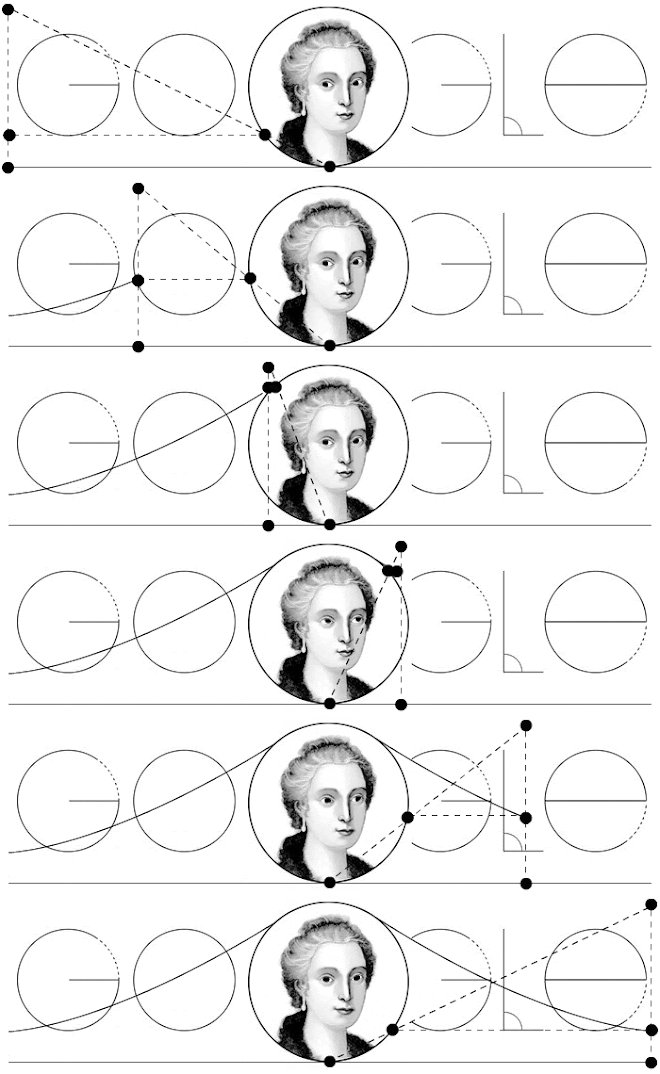
Google Doodle Maria Gaetana Agnesi's 296th birtday


Four days afteDorothy Hodgkin, a British chemist, Google's doodle, celebrates the 296th birthday of the Italian mathematician and philosopher Maria Gaetana Agnesi. The Doodle showsthe Witch of Agnesi curve. 
The mathematical curve named after her is achieved by drawing a line from the source through the circle of radius.


Maria Gaetana Agnesi
credits: Alamy Stock Photo

Their real-life uses were only fully recognised in the late 20th and early 21st centuries, by physicists and mathematicians working with x-rays, optical lines, and electrical circuits.

Maria Gaetana Agnesi:

Gaetana Agnesi, born on 16 May 1718, to a wealthy and literate Milanese silk merchant, Agnesi was recognised as a child prodigy and became interested in mathematics and several modern languages, as well as Latin, Greek, Hebrew.

Propositiones philosophicae or “Propositions of Philosophy”, a series of essays on natural philosophy and history based on her discussions before such gatherings, was published in 1738.


Maria Gaetana Agnesi

At an early age she composed and delivered an hour-long speech in Latin to some of the most distinguished intellectuals of the time on the subject of women’s right to be educated. Wow ! That's interesting if we think she lived in the 18th century.


Some decades before Leopold Mozart dragged his young son Wolfgang Mozartto any prince or archbishop who had half a chance of offering a decent appointment, a Milanese girl with a genius intellect was made the center of an ongoing academic circus routine by her status-hunting father.


Maria Gaetana Agnesi
Library of Congress, Washington, D.C. (digital file no. 3b09774)

Agnesi is believed to be the first woman in the west to gain recognition as a mathematician, at a time when most Europeans did not see the value of education for women.

Maria Gaetana Agnesi, remembered today only for a curve, the Witch of Agnesi, which shows up in the margins of introductory calculus texts from time to time, and which she didn’t actually discover.


Maria Gaetana Agnesi

Agnesi best-known work, Instituzioni analitiche ad uso della gioventù italiana, or the Analytical Institutions for the Use of Italian Youth, explored algebra and analysis (two volumes). In it she discusses the algebraic curve, now known as the witch of Agnesi.

After her father’s death, she apparently lost all interest in scientific work and turned to religion and devoted the last four decades of her life to studying theology and to charitable work, taking charge of a home for the poor and infirm in 1771.


Maria Gaetana Agnesi stamp
Italia, 2018
For the remaining fifty years of her life, she gave comfort to the mentally ill and elderly from 1771, and hunted the streets for children to be brought to her catechism class. The woman who had been regarded as one of the greatest minds of Italy, consulted from every corner of Europe for her advice on matters mathematical and philosophical, died unremarked on 9 January 1799.


Dorothy Hodgkin:


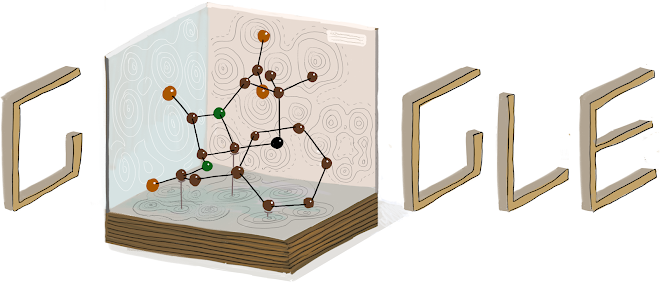
Google Doodle Dorothy Hogkin's 104th birthday
On Monday, 12th May, Google Doodle celebrated Dorothy Hodgkin's 104th birthday, the British chemist.


Dorothy Hodgkin
credits: : Harold Clements / Freelancer


Hodgkin was the third woman to be awarded the Nobel Prize in Chemistry (1964) which she won for her discovery of the structure of vitamin B12 in 1964.


Dorothy Hodgkin and her husband Thomas at the Nobel ball in 1964 
© The Hodgkin Family
She is the only British woman to have won the prize to date. Born in Cairo on May 12, 1910 to English parents, Hodgkin went on to study chemistry at the University of Oxford's Somerville College, before going on to earn her PhD at the University of Cambridge.


Dorothy Crowfoot Hodgkin honored  postage stamp 
The biochemist was best known as a pioneer in the advancement of the technique of X-ray crystallography, a method used to determine the three-dimensional structure of biomolecules.


Dorothy Hodgkin
Hodgkin's love of her work was clear, and she was quoted as saying: 

"I was captured for life by chemistry and by crystals".
She was also know for her contribution to the discovery of the structure of insulin and penicillin.
She returned to Oxford in 1934 and in 1936 was appointed Somerville's first fellow and tutor in chemistry – a post which she held until 1977.


Dorothy Hodgkin a life
by Georgina Ferry

She was the chair of the Pugwash Conference from 1976 to 1988, an organization inspired by a manifesto by Albert Einstein and Bertrand Russell that works to reduce harm and conflict caused by scientific discoveries (like nuclear weapons.)


Girls in science
credits: unknown

Education:

No doubt! Google loves women in science. Ada Lovelace, Rosalind Franklin, Marie Curie, Grace HoperDorothy Hodgkin and today Gaetana Agnesi. And of course, women in Humanities as Hannah Arendt, Catherine Mansfield, Simone de Beauvoir among others.

The discussion of a better understanding of the role of the girls and young women dimension in many different STEM areas of study, and how these findings can lead to new ideas and new markets for girls and women in science knowledge is on the news every day.

This must begin early in school where girls must be encouraged to access to science and technology


Girls in Science
via Cambridge Assessment

The aim is to encourage creativity in the field of science and new technologies and highlight the importance of developing innovative skills at an early age.

However I read on The Guardian, this week, an interesting article : Women in technology : no progress on inequality for 10 years says:

" A report by the research firm Gartner on chief information officers (CIOs) and the challenges they face in the industry has shown that the percentage of women taking the role has remained largely static at 14% since 2004, when the firm started gender analysis.
The situation in the EU is also worse than developing nations and the US, where the proportion of women in leadership roles is higher. Gartner’s data showed women occupied 11.2% of technology leadership roles in Europe, the Middle East and Africa compared with 18.1% in North America, 13.4% in Latin America and 11.5% in Asia."

Samuel Gibbs, Technology

Some thoughts:
All the initiatives trying to change this situation are welcome. And teachers have an important role on it by fighting inequality for girls in science.
You can begin to include Doodles of women in science into school curriculum to motivate girls. 

G-S 
16.05.2014
Copyright © 2014G-Souto'sBlog, gsouto-digitalteacher.blogspot.com®
Creative Commons License
Women in Science : Google doodles at school bG-Souto is licensed under a Creative Commons Attribution-NonCommercial-NoDerivatives 4.0 International License.