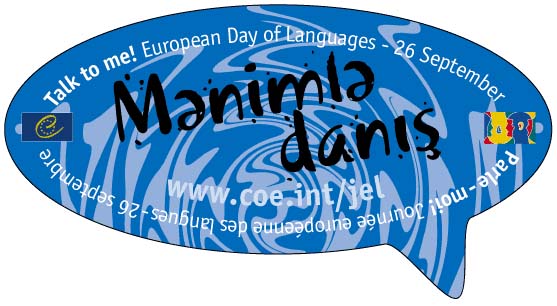
“Indigenous peoples have always expressed their desire for education in their own languages, as set out in the United Nations Declaration on the Rights of Indigenous Peoples."
Each year on the 21 February, UNESCO invites all of us to recognize and celebrate mother languages on International Mother Language Day (IMLD).
International Mother Language Day has been observed every year since February 2000 to promote linguistic and cultural diversity and multilingualism.
The date represents the day in 1952 when students demonstrating for recognition of their language, Bangla, as one of the two national languages of the then Pakistan, were shot and killed by police in Dhaka, the capital of what is now Bangladesh.

credits: UNESCO
Theme 2019: "Indigenous languages as a factor in development, peace and reconciliation."
Since 2019 is the International Year of Indigenous Languages, the theme of this year’s International Mother Language Day will be indigenous languages as a factor in development, peace and reconciliation.
"Indigenous peoples number some 370 million and their languages account for the majority of the approximately 7,000 living languages on Earth. Many indigenous peoples continue to suffer from marginalization, discrimination and extreme poverty, and are the victims of human-rights violations. "
Audrey Azoulay, Director-General of UNESCO

credits: unknown
via Google images
Some information:
Languages, with their complex implications for identity, communication, social integration, education and development, are of strategic importance for people and planet. Yet, due to globalization processes, they are increasingly under threat, or disappearing altogether. When languages fade, so does the world's rich tapestry of cultural diversity. Opportunities, traditions, memory, unique modes of thinking and expression — valuable resources for ensuring a better future — are also lost.
At least 43% of the estimated 6000 languages spoken in the world are endangered. Only a few hundred languages have genuinely been given a place in education systems and the public domain, and less than a hundred are used in the digital world.

credits: unknown
via Google images
Linguistic diversity is increasingly threatened as more and more languages disappear.
Globally 40 per cent of the population does not have access to an education in a language they speak or understand. Nevertheless, progress is being made in mother tongue-based multilingual education with growing understanding of its importance, particularly in early schooling, and more commitment to its development in public life.

Students in a classroom at the Jabalia refugee camp
in northern Gaza Strip
UN Photo/Eskinder Debebe
Languages are the most powerful instruments of preserving and developing our tangible and intangible heritage. All moves to promote the dissemination of mother tongues will serve not only to encourage linguistic diversity and multilingual education but also to develop fuller awareness of linguistic and cultural traditions throughout the world and to inspire solidarity based on understanding, tolerance and dialogue.
Multilingual and multicultural societies exist through their languages which transmit and preserve traditional knowledge and cultures in a sustainable way.

In 2016, the United Nations General Assembly adopted a resolution proclaiming 2019 as the International Year of Indigenous Languages, based on a recommendation by the Permanent Forum on Indigenous Issues.
At the time, the Forum said that 40 per cent of the estimated 6,700 languages spoken around the world were in danger of disappearing. The fact that most of these are indigenous languages puts the cultures and knowledge systems to which they belong at risk.

credits: UNESCO
The celebration is also expected to
strengthen and reinforce the many standard-setting tools adopted by the
international community which include specific provisions to promote and
protect languages.

credits: UNESCO
Education:
Education in the mother language is an essential part of achieving these goals, to facilitate learning and to bolster skills in reading, writing and mathematics.
It requires a sharper focus on:
It requires a sharper focus on:
- Teaching training
- Revisions of academic programmes
- Creation of suitable learning environments.
Quality education should be delivered in the language spoken at home. However, this minimum standard is not met for hundreds of millions, limiting their ability to develop foundations for learning.
Increasingly, information and knowledge are key determinants of wealth creation, social transformation and human development.
Literacy programmes and methodologies are most relevant and respond to the needs of learners when they are context-related, bilingual and support intercultural understanding within the framework of lifelong learning.
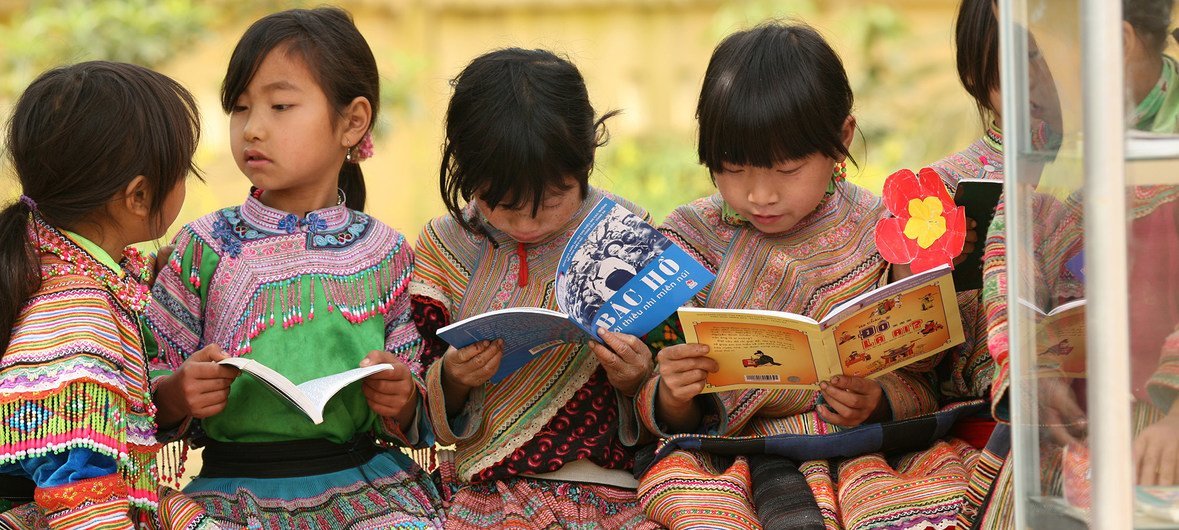
credits: UN
"Multilingual education based on the mother tongue (s) in the early years of schooling plays a key role in fostering respect for diversity and a sense of interconnectedness between countries and populations, which are core values at the heart of global citizenship. As such, it contributes to the fostering of learning to live together."
Indigenous Languages provide a unique understanding of perspectives of people from all around the world. Losing them means losing the knowledge & beauty they add to our lives.
Let’s act together to protect the rich diversity & value of native languages!
Activities:
- UN invite students to share a favorite proverb in your mother tongue:
To celebrate International Mother Language Day 2019, the Office of the United Nations Ombudsman and Mediation Services invites you to send your favorite proverb in your mother tongue on the following topics:
Peace, harmony, conflict resolution/competence to deal with conflict, mindfulness, resilience, well-being.
The proverbs will be compiled, and the most appropriate ones will be selected to be published on our website and other digital communication tools.
Proverbs:
Invite your students to send proverbs in mother language on one or two pf these topics. I'm sure they will be very happy to participate on this challenge.
Peace, harmony, conflict resolution/competence to deal with conflict, mindfulness, resilience, well-being.
The proverbs will be compiled, and the most appropriate ones will be selected to be published on our website and other digital communication tools.
Proverbs:
Invite your students to send proverbs in mother language on one or two pf these topics. I'm sure they will be very happy to participate on this challenge.

credits: UNESCO
Other Activities:
- Propose your students to tweet in mother Language on this day, February 21 on the theme: Why it's important to learn in mother language. Of course you must prepare the tweets before being published on Twitter;
- Join to each tweet a translation on a different language (foreign languages of the school curriculum) so that more people could read their messages;
- Add a hashtag #MotherLanguageDay to tweets;
- Following the hashtag #MotherLanguageDay students will read messages from around the world in different languages and paying attention to indigenous languages and retweet some of them (foreign languages of school curriculum) to help amplify every messages they read;
- Wherever in the world you may be, and whatever language you speak, ask your students to record a small video (each class, one short video) with students saying som small expression in mother language to share with a school from another country, and different language;
- Ask foreign schoolmates to do the same for a school linguistic exchange project.
Visiting the official site IYIL2019, ask for help to contact a indigenous school to share some activities. It would be very interesting! And students would love it!
When we lose a language, we lose a cultural heritage, the special ways different people express their relationships, their families, and the world that they see.
Language acquisition and mother tongue literacy should ideally be supported by written resources such as - but not limited to - books, primers and textbooks, to support oral activities. Written materials in mother language reinforce learners’ literacy acquisition and build strong foundations for learning.
Technology is allowing many languages to increase audience by establishing a presence on YouTube, social media as Facebook, Twitter, Instagram and of course by texting on smartphones.
Technology is allowing many languages to increase audience by establishing a presence on YouTube, social media as Facebook, Twitter, Instagram and of course by texting on smartphones.
"Opportunities, traditions, memory, unique modes of thinking and expression — valuable resources for ensuring a better future — are important.".
G-Souto
21.02.2019
Copyright © 2019-Souto'sBlog, gsouto-digitalteacher.blogspot.com®

Schools : Intl Mother Language Day & Intl Year Indigenous Languages 2019 ! by G-Souto is licensed under a Creative Commons Attribution-NonCommercial-NoDerivatives 4.0 International License