My thoughts about Education Humanities, Technology and Digital Culture. Interested on social media tools in educational contexts and
gamification in education.
"Harry Potter fans have been sent into a frenzy of excitement after the creator of their favourite wizard, JK Rowling, launched a mysterious new website"
The project was unveiled when Rowlingset fans some clues yesterday, June 16, asking them to enter 10 sets of coordinates into a site called secretstreetview.com. A letter could be found at each location, spelling out thePottermore name.
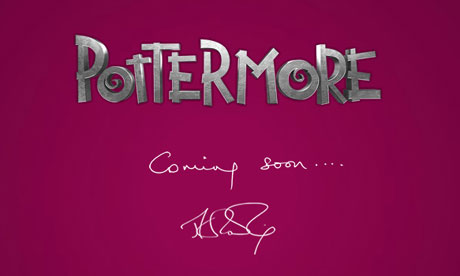
The website, Pottermore.comshows the word 'Pottermore' on a pink background, with a message 'coming soon...' and Rowling's famous signature.
A Twitter account, @Pottermore, has also been set up on June 16 too and already has almost 44,000 followers.
Some readers are praying that the news might be a new Potter book, although Rowling has previously said it is "highly unlikely" that she would write more Harry Potter novels.
"I've got enough story for seven books and I never planned to carry the story beyond the end of book seven. I might do an eighth book for charity, a kind of encyclopedia of the world so that I could use all the extra material that's not in the books ... we'll see!"
J.K.Rowling
However, she did tell Oprah Winfreyin an interview last yearthat she could "definitely write an eighth, ninth [and] 10th book", adding "I think I am done but you never know".
It is rumoured that the interactive site will be a meeting place for fans offering games, a Harry Potter encyclopaedia, readings by Stephen Fryand competitions. Fans will also be able to buy the books.
Go to J.K. Rowling's Annoucement onYoutubeWow! Gorgeous don't you think?
The moon will rise in Earth's shadow this evening in a rare lunar eclipse that could turn our natural satellite a deep shade of red.
With clear skies, the celestial spectacle will be visible across many countries, as soon as the moon rises after sunset.
"A total lunar eclipse happens when the moon, Earth and sun line up, and our home planet casts a vast shadow that engulfs the moon.
When the moon moves into the darkest part of the Earth's shadow, the umbra, it will turn a slate grey or brick red colour.
The moon changes colour because blue light - and other short wavelengths - scatter more in the Earth's atmosphere, with more red light getting through."
The eclipse, if visible, could be a spectacular opportunity for photographers and skywatchers.
The moon will remain low in the night sky, so observers will need a clear horizon and cloudless skies to see it well. Unlike solar eclipses, a lunar eclipse is safe to watch with the naked eye.
The event will be visible in Australasia, southern Japan, a large area of Asia, India, Africa, Europe and the eastern part of South America.
In Portugal the lunar eclipse will be visible in almost all the country. From the six lunar eclipses of this year, this is the only one that can be visible in Portugal, Azores and Madeira islands.
The Observatório Português de Astronomia, in Lisbon, will open the doors at 20:30. Several telescopes and other tools for observation will be available for those who want to observe the total eclipse of the moon while the astronomers will explain the conditions under wich eclipse occur.
The total eclipse ends at 22.03pm, when the Moon starts to leave the darkest part of the umbra.
In the final stage of the eclipse, the moon moves into the lighter part of Earth's shadow, the penumbra, and will likely take on a yellowish hue.
Education:
The students can be invited to join astronomers and skywatchers at national observaries of Astronomy, observing the lunar eclipse and making some photos or little videos with their smartphones to explore in Science classroom.
An open debate on the subject with colleagues and tutoring by educators will be an interesting course for all.
The best photo or video should be voted by students.
"Fernando Pessoa only lived to see the publication of a small part of his extensive work, which began to be published in various book forms from 1942 onwards. He left more than 25 thousand sheets of paper covered with texts that he had written, and these are now kept at the Biblioteca Nacional de Portugal. The long time that it took to decipher and organise these papers explains the lengthy interval before Fernando Pessoa’s work began to be published."
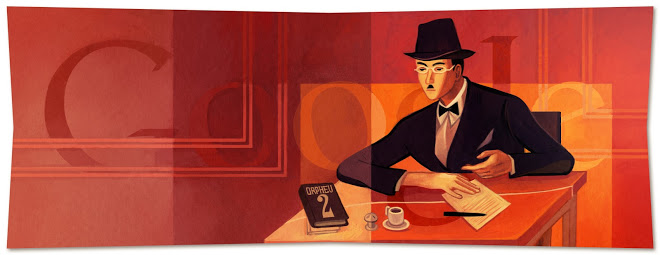
Today, June 13 Google celebrates with a Doodlethe 123rd Anniversary ofFernando Pessoa, the great Portuguese writer of the XX century and one of Portugal’s most beloved authors.
The Doodle references? The iconic portrait by José Sobral de Almada Negreiros: "For this doodle celebrating one of Portugal’s most beloved novelists and poets, I referenced an iconic portrait by José Sobral de Almada Negreiros."
"Pessoa, the author of many styles and pseudonyms, but his writing was characterized overall by a profound vividness which I hope I’ve captured in this depiction of him."
Sophia Foster-Dimino, doodler
Fernando Pessoa in Lisbon credits: Casa Fernando Pessoa
Fernando Pessoa was born in Lisbon on June 13th 1888. Following the death of his father in 1893, his mother remarried Commander João Miguel Rosa in 1895, who was the Consul of Portugal in Durban, Natal, where Fernando Pessoa was raised. Aged thirteen, Pessoa returned to Portugal for a year-long visit, and returned there permanently in 1905. After his seventeenth birthday, he returned to Lisbon to enroll in the university-level course of Arts and Letters, but dropped out after two years without having sat for any exams. He preferred to study on his own at the National Library, where he systematically read major works of philosophy, history, sociology and literature (especially Portuguese) in order to complement and extend the traditional English education he had received in South Africa. And began to publish criticism, prose, and poetry soon thereafter while working as a commercial translator.
Fernando Pessoa, 20 (1908)
credits: Fotobiografias do Século XX: Fernando Pessoa, p. 60
He was awarded the Queen Victoria prize for English at the University of the Cape of Good Hope in 1903, for his achievement in an exam at the age of 15.
"Profession: The most correct designation would be “translator”, the most exact would be “foreign commercial correspondent”. His poetry and writing were not his profession but his vocation." Fernando Pessoa was many writers in one. He attributed his prolific writings to a wide range of alternate selves, each of which had a distinct biography, ideology, and horoscope.
Bibliography:
His production of poetry and prose in English during this period was intense, and by 1910 he was also writing extensively in Portuguese. He published his first essay in literary criticism in 1912, his first piece of creative prose (a passage from The Book of Disquiet) in 1913, and his first poems as an adult in 1914.
Writing obsessively in French, English, and Portuguese, Fernando Pessoa left a prodigious body of work, much of it under heteronyms fully fleshed alter egos with startlingly different styles and points of view.
He called his most important personas ‘heteronyms’, endowing them with their own biographies, physiques, personalities, political views, religious attitudes, and literary pursuits. Some of Pessoa’s most memorable work in Portuguese was attributed to the three main poetic heteronyms – Alberto Caeiro, Ricardo Reis and Álvaro de Campos – and to the ‘semiheteronym’ called Bernardo Soares.
During his life, most of Pessoa’s considerable creative output appeared only in journals, and he published just three collections of poetry in English -Antinous (1918), Sonnets (1918), and English Poems (1921) - and an epic poem in Portuguese, Mensagem(1933).
“He was a thin man, tenuous and frail, of medium stature, 1,73 m tall, slightly curved back. His chest was not well built; in fact it was quite sunken, despite the Swedish gymnastics he was practicing. He had long legs, not very muscular and his hands were slender and inexpressive. His awkward stride and fast pace, although irregular, denounced him at a distance."
He usually wore dark suits, grey, blue or black, at times short. He also wore a hat, normally wrinkled, and slightly tilted to the right.
“His face was long and dry. Behind his small round glasses, of misty thick lenses, small brown eyes were hidden. His stare, when fixed on someone, was observant and sometimes even mysterious. He had a small mouth and thin lips, which were almost always shut. He had an “American” moustache which conferred him a special charm." (...)
Until his death, he did not abandon any of these different facets. Together with poetry, he wrote essays, plays, various letters and detective stories, and also devoted himself to astrology, besides being an inventor, a literary critic and a copywriter.
Pessoa was convinced of his own genius, however, and he lived for the sake of his writing. Although he was in no hurry to publish, he had grandiose plans for Portuguese and English editions of his complete works, and he seems to have held on to most of what he wrote.
Fernando Pessoa, the great writer died on 30 November1935.
Today, more than seventy-five years after Pessoa’s death, his vast written world has still not been completely charted by researchers, and a significant part of his prose writings are still waiting to be published.
We are very honored knowing that international high-schools and well-known colleges all over the world include Fernando Pessoa into their most well known curricula Portuguese Literature and Portuguese language.
Some months ago, I suggested in my post Languages matterdifferent activities to include Pessoa poetry into school curriculum (high-junior school).
"With today's technology every corner of the world is linked together. The new generations are globalized."
Irina Bokova, Director-General of UNESCO
Message for "International Mother Day 2011
Teaching Pessoa poetry is easier now. Just link on the website Casa Fernando and your students will find different pedagogical digital resources completely free in Portuguese and English about the poet and writer.
Fernando Pessoa has an unknown side of his poetry! He wrote poems for children. We can't miss those poems. We must include children's poetry by Pessoa into school curriculum (elementary schools). Read aloud and invite your students to read too to learn children's poetry by Pessoa. His poems are lovely!
"Less than a quart of all languages in the world are used in education and in cyber space."
Irina Bokova, Director-General of UNESCO
Message for "International Mother Day 2011
Children's Poems:
Here two different poems of Fernando Pessoa that children should read in Portuguese language:
As Fadas
Do seu longínquo reino cor-de-rosa,
Voando pela noite silenciosa,A fada das crianças vem luzindo.
Papoulas a coroam, e, cobrindo
Seu corpo todo, a tornam misteriosa. À criança que dorme chega leve,
E, pondo-lhe na fronte a mão de neve,
Os seus cabelos de ouro acaricia –
E sonhos lindos, como ninguém teve,A sentir a criança principia.
Em coisas vivas, e um cortejo formam:
Cavalos e soldados e bonecas,
Ursos e pretos, que vêm, vão e tornam,
E palhaços que tocam em rabecas... E há figuras pequenas e engraçadas...
Que brincam e dão saltos e passadas...
Mas vem o dia, e, leve e graciosa,
Pé ante pé, volta a melhor das fadas
Ao seu longínquo reino cor-de-rosa.
Ai que prazer
Não cumprir um dever,
Ter um livro para ler
E não o fazer!
Ler é maçada,
Estudar é nada.
O sol doira
Sem literatura.
O rio corre, bem ou mal,
Sem edição original.
E a brisa, essa,
De tão naturalmente matinal,
Como tem tempo não tem pressa...
Livros são papéis pintados com tinta.
Estudar é uma coisa em que está indistinta
A distinção entre nada e coisa nenhuma.
Quanto é melhor, quando há bruma,
Esperar por D. Sebastião,
Quer venha ou não!
Grande é a poesia, a bondade e as danças...
Mas o melhor do mundo são as crianças,
Flores, música, o luar, e o sol, que peca
Só quando, em vez de criar, seca.
O mais do que isto
É Jesus Cristo,
Que não sabia nada de finanças
Nem consta que tivesse biblioteca...
Fernando Pessoa, Liberdade
"Multilingualism opens fabulous opportunities for the dialogue that is necessary to understanding and cooperation."
The story follows Pereira, a journalist for the culture column of a small Lisbon newspaper, as he struggles with his conscience and the restrictions of the regime of Salazar. Antonio Tabucchi won the Premio Campiello, ViareggioPrize and Premio Scanno in 1994 for the novel.
This film is based on The Book of Disquiet, the posthumous work of the Portuguese writer Fernando Pessoa. It portrays the solitude of man through picturesque images and dramatic effects.
Published for the first time some fifty years after his death, this unique collection of short, aphoristic paragraphs comprises the "autobiography" of Bernardo Soares, one of Pessoa's alternate selves. Part intimate diary, part prose poetry, part descriptive narrative, captivatingly translated by Richard Zenith, The Book of Disquiet is one of the greatest works of the twentieth century.
Videos:
Curricula:
Portuguese as second language in primary and elementary schools;
Portuguese as foreign language in High Junior School;
Portuguese Literature studies in foreign Universities.
In fact Pessoa work was a kind of open-sesame, insofar as it alerted the rest of the world to the rich literature being produced in a small country situated on southwestern Europe’s fringe - Portugal.