Showing posts with label total lunar eclipse. Show all posts

Tuesday, May 25, 2021

Science : Super Blood Moon & Total Lunar Eclipse ? Wow ! Let's enjoy the cosmic show !


credits: The Old Farmer's Almanac

The first total lunar eclipse in more than two years coincides with a supermoon this week, on Wednesday, May 26, for quite a cosmic show.

This full Moon will be the closest full Moon of the year, making it the second of two supermoons—don’t miss it! And it will be the first total eclipse since January 2019. The eclipse will occur as the Moon gets closer to the Earth during its orbit.

Compared to other Full Moons in 2021, the Flower Moon will have the nearest approach to Earth, making it appear as the closet and largest Full Moon of the year.

Plus, it will coincide with a total lunar eclipse in some areas. Here’s everything you should know, including how it came to be called the Flower Moon, says Farmer's Almanac.


credits: NASA

This super “blood” moon will be visible on Wednesday across the Pacific – offering the best viewing – as well as the western half of North America, the bottom of South America and eastern Asia.

“Hawaii has the best seat in the house and then short of that will be California and the Pacific north-west,” said Nasa’s Noah Petro, the project scientist for the Lunar Reconnaissance Orbiter. New Zealand and Australia also will have prime viewing.

Why it called the Flower Moon?

The full Moon names used by The Old Farmer’s Almanac come from a number of places, including Native American, Colonial American, and European sources. Traditionally, each full Moon name was applied to the entire lunar month in which it occurred, not solely to the full Moon.


credits: The Old Farmer's Almanac

"May’s Flower Moon name should be no surprise; flowers spring forth across North America in abundance this month!"

But if you hear anyone calling this a super blood moon, that’s because the moon will also line up in its closest approach to our planet, an event some call a supermoon.

If you live in a country where the cosmic show isn't visible, visit Virtual Telescope  live streaming.


Education: 

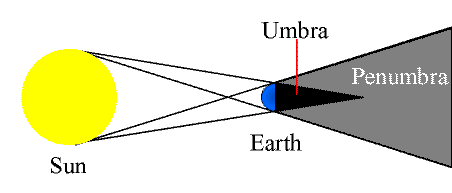
Lunar eclipses occur when our planet comes between its two major heavenly companions, the sun and moon. Moonglow is actually reflected sunlight and so the lunar surface gradually darkens as the moon falls into Earth’s long shadow.

The total eclipse will last about 15 minutes as Earth passes directly between the moon and the sun. But the entire show will last five hours, as Earth’s shadow gradually covers the moon, then starts to ebb. The reddish-orange color is the result of all the sunrises and sunsets in Earth’s atmosphere projected on to the surface of the eclipsed moon.

The next total lunar eclipse will be May 2022. 

“It’s quite a spectacle to behold,” said Madhulika Guhathakurta, an astrophysicist at NASA’s Goddard Spaceflight Center in Greenbelt, Md.


credits: Georg Hochmuth/Agence France-Presse/ Getty Images
via NYT Science

Teacher may visit NASA : How to Watch a Total Lunar Eclipse and Get Students Observing the Moon

There’s no better time to learn about the Moon than during a lunar eclipse. Here’s how to get students watching and exploring more.

You might read my post of the last total eclipse 2019: Science : Super Blood Wolf Moon Eclipse ? Wow ! Let's talk!

There are some interesting pedagogical resources to include into your in-person lesson.

A full moon is always a good reason to go outside and look up, but a total or partial lunar eclipse is an awe-inspiring sight that gives students a great opportunity to engage in practical sky watching. 

“Tonight I’ll be looking at the blood moon and maybe I’ll think of you. But maybe I won’t and I probably won’t, but I guess that’s a chance you had to take.”

Dominic Riccitello

G-Souto

25.05.2025

Copyright © 2021-Souto'sBlog, gsouto-digitalteacher.blogspot.com® 


Science : Super Blood & Total Lunar Eclipse ? Wow ! Let's enjoy the cosmic show ! bG-Souto is licensed under a Creative Commons Attribution-NonCommercial-NoDerivatives 4.0 International License.

sources: NASA/ Farmer's Almanac

Tuesday, January 30, 2018

Science : Super Blue Moon & Lunar eclipse ? Wow ! Let's talk !


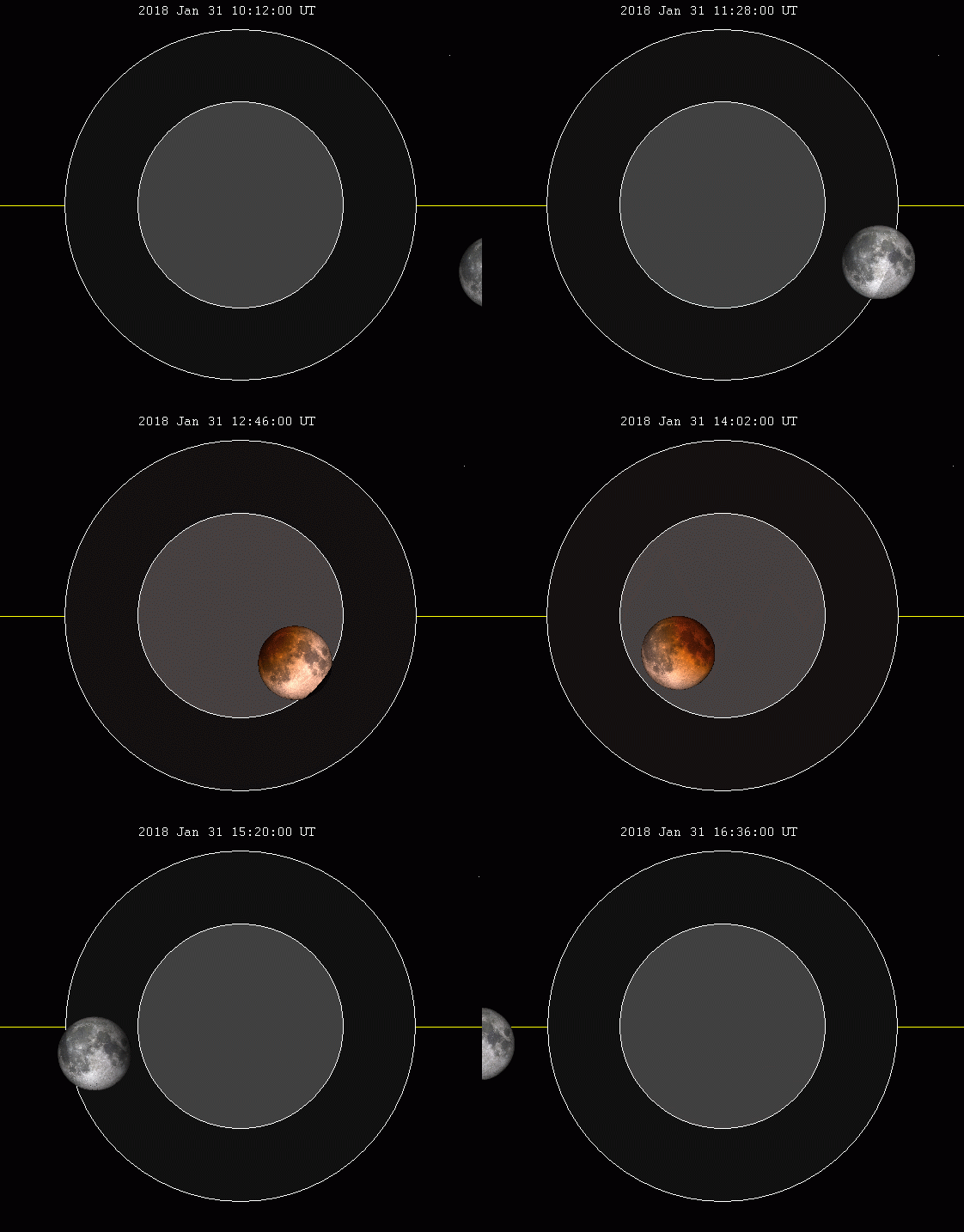
The Blue Moon – second of two full moons in one calendar month – will pass through the Earth’s shadow on January 31, 2018, to give us a total lunar eclipse. 

The last time that we had a Blue Moon total lunar eclipse, reckoning in world time (UTC, or GMT), was December 30, 1982.

No, this time I will not sing Blue Moon! But the song is on my mind while I'm writing about the moon-blue.


credits: Astronomy Ohio 

Totality, when the moon will be entirely inside the Earth’s dark umbral shadow, will last a bit more than one-and-a-quarter hours. 

The January 31 2018 much of the world will have the opportunity to observe a Blue Moon: A somewhat rare occurrence that doesn't have anything to do with the moon's color.

Full moon is also the third in a series of three straight full moon supermoons – that is, super-close full moons. 


credits: EarthSky

It’s the first of two Blue Moons in 2018. So it’s not just a total lunar eclipse, or a Blue Moon, or a supermoon. It’s all three … a super Blue Moon total eclipse!

It’s not just a total lunar eclipse, or a Blue Moon, or a super moon. It’s all three! A super Blue Moon total eclipse!

A lunar trio will be visible in the sky tomorrow before dawn:
🌕Supermoon – When the Moon is at/near its closest point to Earth 🔵Blue Moon – The 2nd full moon in a month 🔴Blood Moon – The red tint Earth’s shadow casts on the Moon during a lunar eclipse

NASA

Is it the first Blue Moon total eclipse in 150 years, as some social media memes are now claiming? Yes, it is, if you’re not considering the whole world, but only the Americas. 


credits: Eclipse computer 

It’s a Blue Moon by the monthly definition of the term: the second of two full moons to fall within a single calendar month. The first Blue Moon comes on January 31, 2018, and the second on March 31, 2018.

The full moon happens at the same instant worldwide, the hour differs by time zone.


credits: NASA


Who can watch?


Visible in the USA and India, this blue moon total eclipse will be entirely observed  in French Polynesia, Nouvelle-Calédonie and La Réunion,
In Europe, Africa and a large part in South America in the morning.


credits: NASA 
This NASA chart shows the lunar eclipse times for the US
https://www.nasa.gov/

Why Blue Moon?


For the longest time nobody knew exactly why the second full Moon of a calendar month was designated as a Blue Moon
One explanation connects it with the word belewe from the Old English, meaning, “to betray.” Perhaps, then, the Moon was “belewe” because it betrayed the usual perception of one full Moon per month.
However, in March 1999 issue of Sky & Telescope magazine, Phillip Hiscock revealed one somewhat confusing origin of this term. 
It seems that the modern custom of naming the second full Moon of a month “blue,” came from an article published in March 1946 Sky & Telescope magazine. 
The article was “Once in a Blue Moon,” written by James Hugh Pruett. In this article, Pruett interpreted what he read in a publication known as the Maine Farmers’ Almanac, and declared that a second full Moon in a calendar month is a “Blue Moon.” 

in Farmer's Almanac


The Harvest Moon
artist: George Hemming Mason, 1872

Education:
So, the Jan. 31 full moon is special for three reasons: it’s the third in a series of “supermoons,” when the Moon is closer to Earth in its orbit - known as perigee -- and about 14 % brighter than usual. 

It’s also the second full moon of the month, commonly known as a “blue moon.” If you live in North America, Alaska, or Hawaii, a lunar eclipse will be visible before sunrise on Jan. 31. 

For those in the Middle East, Asia, eastern Russia, Australia and New Zealand, the “super blue blood moon” can be seen during moon rise in the morning on the 31st.

If your local weather is calling for clouds this morning, you can still see the super blue blood moon. 


NASA TV's live feed will probably be your best chance to see it live if there's bad viewing weather in your location. 

The Griffith Observatory in Los Angeles is also doing a live feed at the lunar eclipse.


Oh, my ! It should offer some pretty photo opportunities for sky watchers. Ask students to take some photos if they are lucky or do small videos (some seconds) with their smartphones and tablets to explore in Science classroom next tomorrow or during the week.

Remember! No matter what has come in or out of our lives in the past few years, once in a while we are given the chance to have everything we’ve always wanted. We just have to make the choice now to not let it go. Because certain chances only come around once in a blue moon.


Hope you will enjoy the beauty of this awesome scientific event. And of course with an open mind to the magic of the moment not only in the sky, also into our life.


I could not resist. Here I am singing Blue Moon by Chris Isaak!


Blue moon!
Blue moon you saw me standing alone
Without a dream in my heart
Without a love of my own
Blue moon, you knew just what I was there for
You heard me saying a prayer for 
Someone I really could care for
And then there suddenly appeared before me
The only one my arms will ever hold.

Lyrics Hart, Lorenz / Rodgers, Richard


G-Souto
30.01.2018
Sources:
NASA/ EarthSky/ Farmer's Almanac
Creative Commons License
Science : Super Blue Moon eclipse ? Wow ! Let's talk ! bG-Souto is licensed under a Creative Commons Attribution-NonCommercial-NoDerivatives 4.0 International License.

Wednesday, June 15, 2011

Lunar Eclipse tonight


Planetário Porto | Portugal

The moon will rise in Earth's shadow this evening in a rare lunar eclipse that could turn our natural satellite a deep shade of red.

With clear skies, the celestial spectacle will be visible across many countries, as soon as the moon rises after sunset.


"A total lunar eclipse happens when the moon, Earth and sun line up, and our home planet casts a vast shadow that engulfs the moon.

When the moon moves into the darkest part of the Earth's shadow, the umbra, it will turn a slate grey or brick red colour.

The moon changes colour because blue light - and other short wavelengths - scatter more in the Earth's atmosphere, with more red light getting through."

The eclipse, if visible, could be a spectacular opportunity for photographers and skywatchers. 

The moon will remain low in the night sky, so observers will need a clear horizon and cloudless skies to see it well. Unlike solar eclipses, a lunar eclipse is safe to watch with the naked eye.

The event will be visible in Australasia, southern Japan, a large area of Asia, India, Africa, Europe and the eastern part of South America.

In Portugal the lunar eclipse will be visible in almost all the country. From the six  lunar eclipses of this year, this is the only one that can be visible in Portugal, Azores and Madeira islands. 

The Observatório Português de Astronomia, in Lisbon, will open the doors at 20:30. Several telescopes and other tools for observation will be available for those who want to observe the total eclipse of the moon while the astronomers will explain the conditions under wich eclipse occur.

The total eclipse ends at 22.03pm, when the Moon starts to leave the darkest part of the umbra. 

In the final stage of the eclipse, the moon moves into the lighter part of Earth's shadow, the penumbra, and will likely take on a yellowish hue. 

Education:

The students can be invited to join astronomers and skywatchers at national observaries of Astronomy, observing the lunar eclipse and making some photos or little videos with their smartphones to explore in Science classroom.

An open debate on the subject with colleagues and tutoring by educators will be  an interesting course for all.

The best photo or video should be voted by students.


G-Souto

15.06.2011
Copyright © 2010G-Souto'sBlog, gsouto-digitalteacher.blogspot.com®


Credits: video NASA

References:

The Guardian | Science
http://www.guardian.co.uk


Observatório Astronómico de Lisboa
http://www.oal.ul.pt