Mary Fairfax Greig Somerville
Oil on canvas by Thomas Phillips, 1834
via Wikipedia
On the 2 February 1826, one of Somerville’s experimental physics papers was read by the Royal Society of London, the UK’s National Science Academy.
It became the first paper by a female author to be published in the prestigious Philosophical Transactions, the world’s oldest science publication, which is still active today.
Google Doodle :

Google Doodle Celebrating Mary Somerville
Doodler: Doodler Alyssa Winans
"I was especially inspired by how many books she wrote in a time when being a female writer was a challenge. I tried to sneak that into the art as well."
Alyssa Winans
The Doodle celebrated Mary Shelley last 2 February. It includes a nod to Somerville’s contribution to Neptune’s discovery, as well as the Somerville Crater.
"When we think of history’s great scientists, names such as Isaac Newton, Galileo Galilei, or Nicolaus Copernicus likely come to mind. The funny thing is that the term “scientist” wasn’t coined until 1834 - well after these men had died - and it was a woman named Mary Somerville who brought it into being in the first place.
Biography facts:
Mary Fairfax was born in 1790. Brought up in the Scottish Borders with a strong passion for the sea and the outdoors, she lacked any formal education.
Mary Somerville was an almost entirely self-taught polymath whose areas of study included math, astronomy, and geology.
Born in Jedburgh, Scotland, on December 26th, 1790, into a distinguished family of humble means, Sommerville spent her early years helping her mother with chores around the house and enjoying nature in the family garden.

Mary Somerville
Wikiart/Somerville College, University of Oxford Supplied by The Public Catalogue Foundation
At the age of 10, her father returned from overseas and decided to send her to a boarding school for a proper education. Miss Primrose’s Boarding School for a single year where she learnt just enough maths to be able to keep accounts.
It was at boarding school that her art teacher explained how the fundamentals of painting could be traced back to Euclid’s Elements of Geometry.

Mary Sommerville
Wikimedia Commons/ATI Composite
After acquiring a copy of the classic book, Somerville delved into teaching herself astronomy and mathematics. Following years of independent learning and research, she went on to publish her own scientific papers and books.
Her parents tried to stop her studying because they thought it would kill her. Her sister had died and they thought studying was to blame.
But Mary ploughed on and carried out detailed and highly-accurate studies of the solar system.
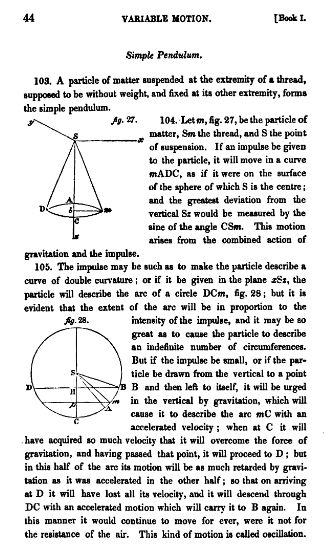
Page 44 from Mechanism of the Heavens
Mary SomervilleWikipedia Commons

Page 157 from Mechanism of the Heavens
Wikipedia Commons
Wikipedia Commons
She was so accurate that she noticed a wobble in the orbit of Uranus and suggested there could be another planet out there.
In 1831, Somerville’s The Mechanism of the Heavens revolutionized the existing understanding of the solar system. This highly-praised essay laid the groundwork for her breakthrough book, The Connection of the Physical Sciences (1834), which became among the best selling science books of the 19th century. Its third edition in 1836 provided the clues astronomer John Couch Adams needed to discover Neptune.

The Connection of the Physical Sciences (1834)
Mary Sommerville
Somerville racked up a bevy of memberships and titles among the scientific elite. In 1834, for example, Somerville gained honorary membership into the Society of Physics and Natural History of Geneva and to the Royal Irish Academy.
A year later she was voted into the Royal Astronomical Society. Somerville was one of the first two women, along with Caroline Herschel, to be admitted to the Royal Astronomical Society; by 1870 she had also been inducted into the American Geographical and Statistical Society, the American Philosophical Society, and the Italian Geographical Society.
Mary Somerville continued reading and educating herself until the day she died in 1872, at almost 92 years old.
When she died in 1872, The Morning Post declared in her obituary that "Whatever difficulty we might experience in the middle of the nineteenth century in choosing a king of science, there could be no question whatever as to the queen of science"
Seven years after her death, the University of Oxford’s counterpart to Girton College was created and named after ‘the Queen of Science’, as she was heralded upon her death.
It was a final recognition of what she had strived to achieve during her lifetime; the dispensation of scientific knowledge to a wider audience and especially the education of women.

Self portrait Mary Somerville (undated)
from the Somerville College Collection
She was not just a mathematician, astronomer, or physicist; she possessed the intellectual acumen to weave these concepts together seamlessly.
Not one to be pigeonholed, Somerville was also a vocal advocate for equal rights and the first person to sign the 1866 women’s suffrage petition.
In 2016, the Institute of Physics celebrated Sommerville’s innovative thinking, which paved the way for the ever-increasing number of women in STEM fields, by introducing the Mary Somerville Medal and Prize for scientists who engage the public through their work.

Education:
"The 19th century’s “Queen of Science” will surely inspire new generations in her homeland. But the legacy of self-taught mathematician Mary Fairfax Somerville reaches way beyond Scotland: she was a brilliant translator of science for the public and a passionate advocate for women’s education."
In Burntisland she started teaching herself Latin. For the most part she kept quiet about this – one of her aunts had told her in no uncertain terms to stop reading Shakespeare and spend her time on needlework.

However, Mary told her uncle, Thomas Somerville, about her studies. He was delighted and started giving her Latin lessons every day before breakfast.
See? As you know, I am not a woman of Sciences. I am a woman of Humanities who included IT a long time ago into mu school curricula.
However, both Sciences and Humanities can be a important part of a global education.

As an educator, I recognize the great value of women in science as Mary Somerville to inspire girls and young women to achieve their goals in science, cosmology, astronomy or STEM. And completing science study with Latin and Philosophy and modern languages.
Invite students to meet Mary Queen of Science on Google Arts & Culture. Find out how her expertise led her to become the joint first female member of the Royal Astronomical Society.
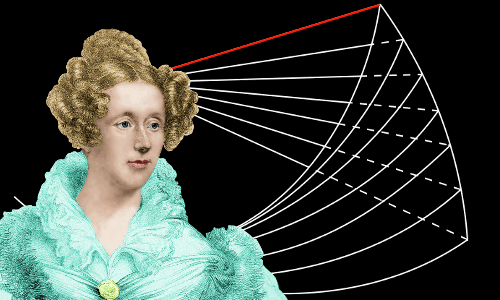
Have no access to learn something that we truly love? Then read books about it or ask others to teach you on it! There are many ways to learn about something, and women can learn about anything! Right?
Education:
"The 19th century’s “Queen of Science” will surely inspire new generations in her homeland. But the legacy of self-taught mathematician Mary Fairfax Somerville reaches way beyond Scotland: she was a brilliant translator of science for the public and a passionate advocate for women’s education."
In Burntisland she started teaching herself Latin. For the most part she kept quiet about this – one of her aunts had told her in no uncertain terms to stop reading Shakespeare and spend her time on needlework.

Mary Somerville
credits: NYPL/ Science source/ Getty Images
See? As you know, I am not a woman of Sciences. I am a woman of Humanities who included IT a long time ago into mu school curricula.
However, both Sciences and Humanities can be a important part of a global education.
via James Madison University
As an educator, I recognize the great value of women in science as Mary Somerville to inspire girls and young women to achieve their goals in science, cosmology, astronomy or STEM. And completing science study with Latin and Philosophy and modern languages.
- Resources: Google Arts & Culture
Invite students to meet Mary Queen of Science on Google Arts & Culture. Find out how her expertise led her to become the joint first female member of the Royal Astronomical Society.
Mary Somerville
via Famous Scientists
Mary Somerville inspired us that we should strive for our passions and dreams, even though there are a lot of obstacles along the way. Have no access to learn something that we truly love? Then read books about it or ask others to teach you on it! There are many ways to learn about something, and women can learn about anything! Right?
"Her grasp of scientific truth in all branches of knowledge, combined with an exceptional power of exposition, made her the most remarkable woman of her generation."
G-Souto
05.02.2020
Copyright © 2020G-Souto'sBlog, gsouto-digitalteacher.blogspot.com®

Schools : Meet the Scotish scientist Mary Somerville, the queen of 19th Century Science ! by G-Souto is licensed under a Creative Commons Attribution-NonCommercial-NoDerivatives 4.0 International License.