My thoughts about Education Humanities, Technology and Digital Culture. Interested on social media tools in educational contexts and
gamification in education.
Good morning from G-Souto's Blog, in chilled and cloudy Porto, Portugal. How chilled is it? On Christmas night, rainy and windy. That complicated family reunion. But at the end all the family was close.
I hope that everyone is enjoying a little time-out. Judging by the numbers of "page views" on G-Souto's Blog, many of you are using some vacation time to explore resources to use in your classroom in 2014. But if you've ignored school-related things during vacation week, that's great too. We all need some free time to do different activities.
On this post I'm re-running the most popular posts of the 1st semester 2013.The selection is based on page views but also based on pedagogical relevance of the most read post.
I kept the order of the most viewed, but eliminated the posts that seemed less relevant. The main reason is that sometimes certain posts acquire too much visibility, not for their value but for the keywords that the search engines "like" indexing.
Je suis ravie de partager avec vous le Top des posts les plus lus du 1er semestre 2013. Vous êtes de plus en plus nombreux à me suivre au quotidien. Je vous remercie, chers enseignants, chers lecteurs, pour votre intérêt et m’efforce d’être toujours au plus proche des événements concernant des idées pédagogiques pour vous offrir les dernières actualités.
My crush of the 1st semester? Paperman. Absolutely!
Surtout, n’hésitez pas à me faire part de vos commentaires, ou questions. Ce blog a pour but de favoriser les échanges et provoquer le débat. Alors, à bientôt j’espère sur le blogG-Souto's Blog!
Above all, do not hesitate to share your comments or send me your questions. This blog aims to promote communication, and induce some good debate about Education & ICT. So, I hope to see you soon again on G-Souto's Blog.
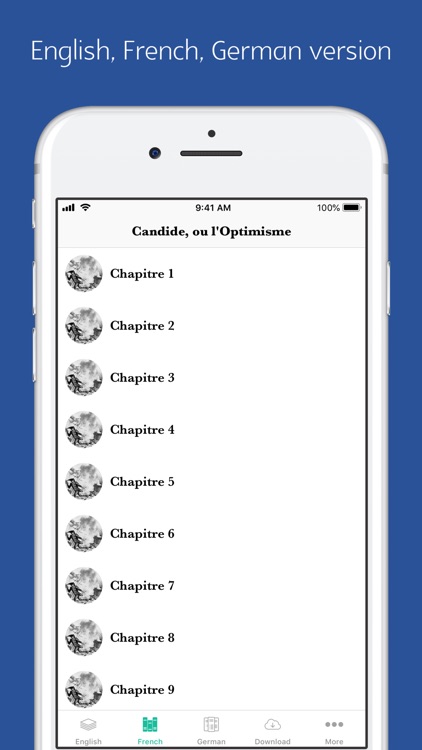
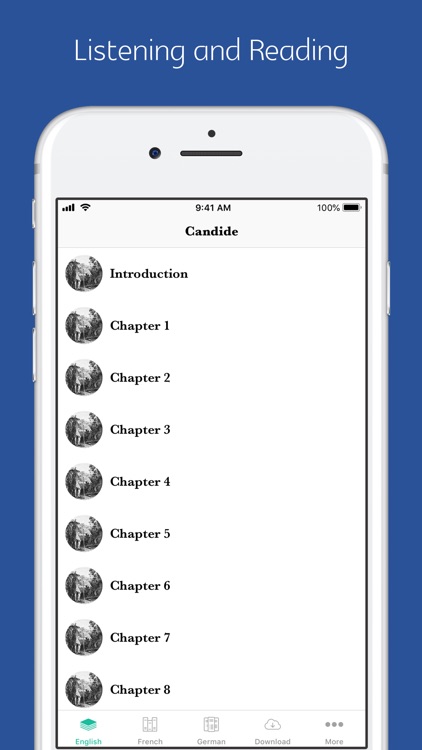
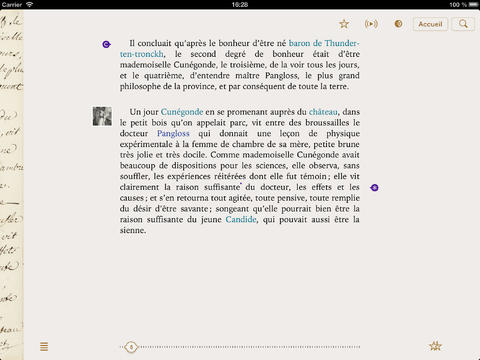
The app combines Candide (1759) by French philosopher Voltaire with professional human narration. The app offers the book in 3 languages: English, French and German.
This free app for iPad and iPhoneis available: download oniTunes (last update July 2018) and now available to download on GooglePay (update July 2020).
Watch the video below about the French novel (French language):
Education:
"Why do bad things happen to good people? Well, why not? The handsome young Candide, having been taught that this is the best of all possible worlds, quickly learns that is far from true. (...) we must surely conclude that we can still profit by the example of lucidity, the acumen, the intellectual honesty, and the moral courage of Voltaire's Candide." Voltaire,Candide et l'Optimisme
Candide ou l'Optimisme
by Voltaire
Frontispiece and first page of chapter one of an early English translation by T. Smollett et al of Voltaire's Candide, printed by John Newbery, 1762
First publication in 1759, the satirical novel follows the adventures of a young man, Candide, and his mentor, the philosopher Pangloss. Candide has become Voltaire's most celebrated work.
Published simultaneously in Geneva, Paris and Amsterdam in January 1759. That year no fewer than three English translations appeared, shortly followed by the early version that is now most often read, by Tobias Smollett.
"C'est pour se distraire que Voltaire se lance dans le conte philosophique. Publié anonymement à Genève, Candide connait un succès fulgurant : «Queste coglionerie se vendent mieux qu'un bon ouvrage.»
Le roman d'apprentissage du jeune homme à la poursuite de sa chère Cunégonde, à travers une Europe dévastée, permet à Voltaire de donner libre cours à sa verve satirique. (...)
Teachersand students have now the opportunity to rediscover one of the major literary classics, always read in Humanities curricula at school and college. Voltaire’s Candide, a new app.
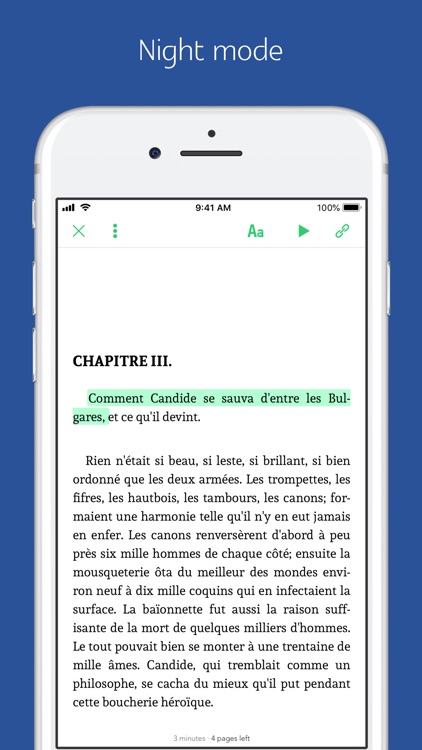
The app innovatively redefines the scope of a literary masterpiece and help us rediscover this important French classical book, in new and engaging ways as you could watched on the video. The enhanced e-book includes the original Voltaire manuscript preserved at the Bibliothèque Nationale de France and further exclusive content.
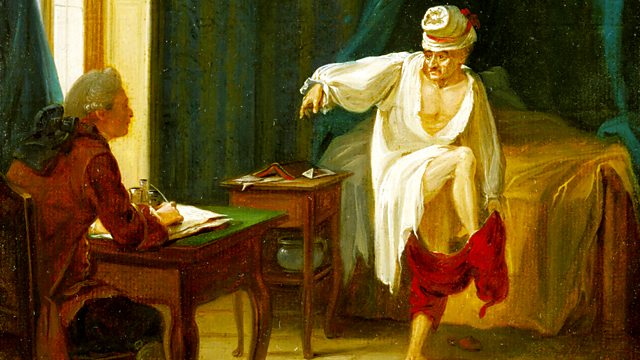
Book :To provide an optimal reading experience, the appcan simultaneously display the text and the BnF's manuscript. We can also hear a personable interpretation of Candide by major French actor Denis Podalydes. With one touch, the reader can make use of the enhanced reading mode which facilitates access to the work: definitions, variants of the critical edition as established by the Voltaire Foundation, character sheets, place, concepts, illustrations of the text by 18th century engravers but also by Paul Klee.
World : A map allows the reader to chart Candide’s journey while offering opportunities to further in-depth study thanks to interviews, a bibliography, and an iconographical library.Michel Le Bris, Alain Finkielkraut, Martine Reid and Georges Vigarello all shed new light on such themes as "Women in the 18th century", "El Dorado", "Cultivating you own garden", and "The image of the other".
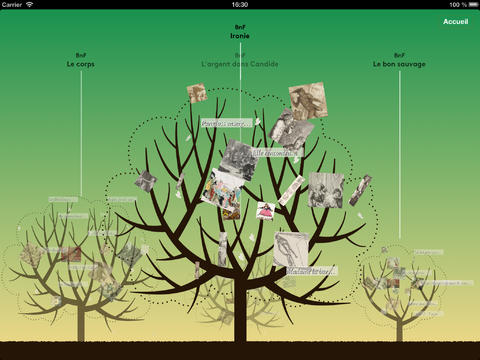
Garden : A collaborative space facilitating discussions on Candide.The gardenallows each reader the opportunity to organise and publish a notebook made up of their own comments and their favourite analyses as a book visible to everyone. Each notebook appears in the garden as knowledge trees, which grow as the reader enriches them.
This is a book for those desiring to contemplate life. It tells the story of Candide, who gets kicked out of the castle, forced to serve on a boat, shipwrecked, robbed, tortured, and on and on, without losing his desire to continue forward in life.
This part will be an important educational tool for schools: Teachers can create their own presentation (notebooks) in the garden and invite their students to contribute to the activity from the website (feature availability: since 2013).
Candide is a timeless and universal text. The creation of Candide app was designed to make Voltaire’s masterpiece accessible to the widest audience possible.
It's exciting! This new digital resourceis free, beautiful, accessible, and in no way inferior to the most erudite of editions.
The two levels of annotations, ‘discovery’ and ‘research’, solve the limitations of a paper edition by making it a useful tool for both academics and students.
Voltaire was one of the wisest, funniest and cleverest people of the 18th century. He continues to have lots to teach us about toleration, modesty and kindness.
As a specialist of Humanities & IT, I'm really happy! Voltaire's Candide app iPad iPhone and now Androidis a marvelous tool!! This will be an exciting teaching and learning digital resources to academics and students. Classical Literature lessons will be creative and contagious.
*Other important digital resources for teachers and students:
Video:
An interesting presentation of Voltaire and his ideas:
Voltaire was one of the wisest, funniest and cleverest people of the 18th century. He continues to have lots to teach us about toleration, modesty and kindness.
He was one of the first authors to become renowned and commercially successful internationally. He was an outspoken advocate of civil liberties, and he was at constant risk from the strict censorship laws of the Catholic French monarchy.
His polemics witheringly satirized intolerance, religious dogma, and the French institutions of his day.
De son vrai nom François-Marie Arouet, il connait la célébrité dès l’âge de 24 ans avec sa pièce de théâtre Œdipe. Poète, historien, philosophe, il est l’intellectuel qui incarne le mieux le siècle des Lumières.
An interesting and complete discussion about Candide with David Wootton Anniversary, Professor of History at the University of York; Nicholas Cronk, Professor of French Literature and Director of the Voltaire Foundation at the University of Oxford; Caroline Warman, Lecturer in French and Fellow of Jesus College at the University of Oxford.