Tuesday, November 7, 2017

Schools & science : Marie Curie, the Nobel Prize : resources


Marie Curie
illustration: Lizzy Stewart

We celebrate the 150th anniversary of the birth of  Marie Skłodowska-Curie, on the 7th November 2017.

As we all know, the pioneer scientist that became the first woman to win the Nobel Prize.

Marie Curie was a Nobel Laureate of many firsts: the first woman to be awarded a Nobel Prize, the first person to be awarded the Prize twice and still the only person to receive the Prize in two different scientific fields.

She received the news that she was to be awarded her second Nobel Prize on her 44th birthday - a special present for a very impressive scientist.


Marie Curie 150 Years
Nobel Prize


Some bio notes:

Born in Warsaw, Poland, on the 7th November 1867, Maria Sklodowska (later  better known by her married, Marie Curie) was the youngest of five children born of a secondary school teacher

Her father, Wladyslaw, was a math and physics teacher who would greatly influence Curie’s career in science. Tragically, her mother, Bronislawa, died of tuberculosis when Marie was just ten years old.


Despite her obvious talent in school (being consistently the top performing student in her year) Curie would not be able attend the University of Warsaw. At the time, universities would not accept female students. How far we are now!
Moving to France in 1891 with her sister, Marie Curie was finally able to attain the formal education she desired at The University of Paris, the Sorbonne where she obtained Licenciateships in Physics and the Mathematical Sciences.
She met Pierre Curie, Professor in the School of Physics in 1894 and in the following year they were married. 


Marie & Pierre Curie, 1904
The Curies began investigating radioactivity together in Paris, building on the work of physicists Wilhelm Roentgen and Henri Becquerel. 
In 1898, the Curies announced the discovery of not one but two new chemical elements: polonium and radium. In 1903 the Curies and Becquerel would jointly be awarded the Nobel Prize for Physics, making Marie Curie the first woman to win a Nobel Prize.
She succeeded her husband as Head of the Physics Laboratory at the Sorbonne, gained her Doctor of Science degree in 1903, and following the tragic death of Pierre Curie in 1906, she took his place as Professor of General Physics in the Faculty of Sciences. The first time a woman had held this position.


Marie Curie with her daughter, Irène, & other researchers
 in her laboratory at the Edith Cavell Hospital in 1914
When World War I broke out in 1914, Curie committed herself to the cause, developing mobile radiography units, which were known as Petites Curies, to help treat inured soldiers in the field. 
She became the director of the Red Cross Radiology Service and set up France’s first military radiology center. She facilitated the installation of 20 of her “Little Curies” and another 200 radiological units at field hospitals in the first year of the war, and it's estimated that over a million wounded soldiers were treated with her X-ray units.


Marie curie book notes
Tragically, since long-term effects of ionizing radiation were unknown, she took no precautions when working with her radioactive materials, and she is believed to have perished from a disease that resulted from the long-term exposure.

Marie Curie died of leukemia on 4 July 1934, as result of years of exposure to radiation through her work. Even today, her laboratory notebook from 1899-1902, is radioactive and will be for 1,500 years.
Marie Curie discovered radium and polonium, and she is remembered for her huge contribution to research into cancer. Her work continues to inspire research in the field to support people living with terminal illness, including terminal cancer.
Marie Curie is one of the most famous scientists of all time, her work having been crucial in the advancement of the fight against cancer, and is considered to be the “most inspirational woman in science”.


Education: 
Marie Curie is the best example to young girls to study sciences at school and later as young women to continue their studies at college and research at university.
Marie Curie is the real proof that women must not be feared to choose scientific studies if they love science and will create a stunning career.

There are a good number of young women scientists doing research in scientific centers in many universities in the world.


Resources:

  • Books:


Marie Curie Radioactivity
Connie Colwell Miller
illustrator: Scott Larson

Marie Curie Radioactivity, a graphic novel that tells the story of Marie Curie's discovery of radium and radioactivity. 
Written in graphic novel format, this book follows the trail of discovery that led to important advances in medicine, but also the creation of the atomic bomb. 
Experienced teachers know that the amount of reading their students does will have a direct and positive impact on his reading fluency and vocabulary development. 
That is why graphic novels though once relegated to the category of lowbrow reading, are now experiencing a surge in popularity.
If one or two of your students are reluctant readers, graphic novels i introduce new vocabulary via contextual clues, making great classics in Literature be  accessible to more children. 
The interesting pictures and snappy dialogue, with little-to-no narration to bog the reader down, will encourage independent reading and learning. As the students' competence and confidence grow, so will his joy of literacy. 
Students also will learn how the Curies' work led to their deaths through exposure to radiation. 

Includes additional facts, glossary, appropriate Internet sites, recommended books and bibliography.


Marie Curie
Elizabeth MacLeod
illustrations: John Mantha, 2009

The story of her discoveries, including the metals polonium and radium, and her contribution to the study of radiation is told "in level-appropriate language and detailed illustrations". 
This Level 3 reader contains longer, more complex stories and sentences, more challenging vocabulary, language play and minimal repetition.
Interesting books to invite students to read by including into Languages and Sciences curricula at school.

  • Film:

Marie Curie
The Courage of Knowledge
Marie Noëlle, 2016

The film, a biopic follows the famous physicist and chemist Marie Curie and her struggle for recognition in the male-dominated science community in early 20th century France.
Marie Noëlle's portrait of the trailblazing Polish-French physicist and chemist emerges as an odd blend of, well, formulae, following a starchy biopic pattern one minute and giving in to impressionistic abstraction the next.


That her love life is rather more engagingly presented is perhaps inevitable, though having fought hard to be judged by male peers on her work rather than her womanhood, Curie wouldn’t be thrilled to hear it.
 Guy Lodge, in Variety
Language: German
We all know that a film is always a personal view of a director even based on true stories and lives.
Films are always strong digital resources to include into school curricula. Students love biopics and a little romance in the air. 


The Madame Curie Complex
The Hidden History of Women in Science
Julie des Jardins
https://www.amazon.com/
Why are the fields of science and technology still considered to be predominantly male professions? The Madame Curie Complex moves beyond the most common explanations - limited access to professional training, lack of resources, exclusion from social networks of men - to give historical context and unexpected revelations about women's contributions to the sciences.
"Recent years have seen this idealized version of Curie challenged by less-celebratory interpretations. In Julie Des Jardins’s The Madame Curie Complex: The Hidden History of Women in Science, Curie is described as “a superhuman anomaly,” one who causes female scientists frustration by establishing unrealistic expectations of scientific accomplishment, rather than inspiring them to excel."
It's a different vision. But I know a good number of young women that are doing wonders in the field of scientific research.


Marie Curie
Famous Scientists


Other resources:
Google Doodle:
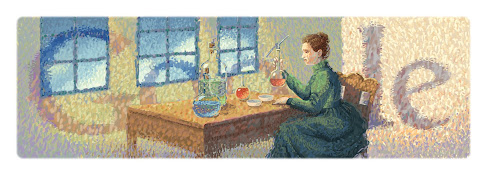

Mary Curie 144th Birthday (2011)

"Her life's work earned her two Nobel Prizes and solidified her place in history as an icon in physics and chemistry."

Google team
  • Video (animation) : 


The UNESCO Courier (1967) : Marie Curie here
Marie Curie/ Famous Scientists here 
I realize that scientific discoveries are never due to just one person, but Marie Curie played a huge role in the discovery of radium and deserves a great recognition. 
Curie is so inspirational, and not just to young women. The history of radium is an interesting one, especially since an element that was/is so dangerous and detrimental to living things was used so widely when first discovered.
"This work continues to inspire our charity's mission to support people living with terminal illness, including terminal cancer."
G-Souto 
07.11.2017
Copyright © 2017G-Souto'sBlog, gsouto-digitalteacher.blogspot.com®
Creative Commons License
Schools & science : Marie Curie, the Nobel Prize : resources bG-Souto is licensed under a Creative Commons Attribution-NonCommercial-NoDerivatives 4.0 International License.

Sunday, November 5, 2017

October in review & 2017 UNESCO Creative Cities : Portugal


Amarante, Portugal
Creative Cities Network Music
credits: Getty Images

On the 31 October 2017, 64 new cities from 44 countries have been designated as UNESCO Creative Cities by Director-General, Irina Bokova. 

"They join a Network at the frontline of UNESCO’s efforts to foster innovation and creativity as key drivers for a more sustainable and inclusive urban development. This network attracts growing interest from local authorities."

Since 2004, the UNESCO Creative Cities Network highlights its members’ creativity within seven fields:  Crafts and Folk Art, Design, Film, Gastronomy, Literature, Media Arts and Music. It now counts a total of 180 cities in 72 countries.


Barcelos, Portugal
Creative Cities Network Crafts and Folk Art

There are three Portuguese cities among the list: Amarante, Barcelos, Braga, Portugal. 

Creative Cities Network highlights Music in Amarante, Crafts and Folk Art in Barcelos and Media Arts in Braga.


I am very proud of the to see three Portuguese cities included into UNESCO Creative Cities Network 2017.
    And now, it's time to the review of the most popular posts of October:


    Here are the most popular posts of the last month:


Hope you enjoyed my pedagocical proposals published in October. I know you loved because there is a wonderful number of readers. Not only in October. All along the years. How nice of you!

Thanks all the educators from around the world that kindly read my blog every day. 

Have a nice time wherever you are! Here, Autumn is wonderful!

G-Souto

05.11.2017
Copyright © 2017G-Souto'sBlog, gsouto-digitalteacher.blogspot.com®

Creative Commons License


October in review in review 2017 UNESCO Creative Cities : Portugal bG-Souto is licensed under a Creative Commons Attribution-NonCommercial-NoDerivatives 4.0 International License.


Wednesday, November 1, 2017

Schools : Let's talk about women in the Arts : Hannah Höch & Dada Movement


Hannah Höch, 1933
portrait: Chris Lebeau
Drents Museun, Assen NL


"I wish to blur the firm boundaries which we self-certain people tend to delineate around all we can achieve."

Hannah Höch

Höch was not only a rare female practicing prominently in the arts in the early part of the 20th century - near unique as a female active in the Dada movement that coalesced in her time.

Hannah Höch went down in history as a 'Dada icon'. Above all, she is known for her photo collages critically examining the political and social environment. Yet her work also reveals the autonomous artistic statement of an extraordinary personality.

She was born on 1st November 1930. In 1904, her family made her leave school to take care of her younger sister, thus postponing the art studies she had intended to follow. Instead, she practiced water colours and drawing, using the surrounding countryside and family members as models. 


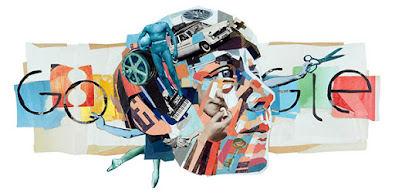
Hannah Höchs's 128th Birthday
artist doodler : Patrick Bremer

  • Google Doodle:

"If a picture is worth a thousand words, Hannah Höch’s pioneering photomontages speak volumes about gender stereotypes and politics, especially during the Weimar Republic era."

Google doodlers team

Do you know Hannah Höch? Today, the 1st November, Google celebrates with a colourful Doodle the German artist Hannah Höch's 128th birthday pioneered an edgy style of photomontage.

Once again Google doodler team is honoring women in Art. The last were the Swiss artist Sophie Taeuber-Arp (2016), the Brazilian Lygia Clark (2015) and the French Niki de Saint Phalle (2014).


Hannah Höchs's 128th Birthday
artist doodler : Patrick Bremer


Created by Berlin-based collage artist Patrick Bremer, today’s Doodle uses "photomontage imagery and the feeling of brushstrokes to capture Höch’s likeness as one of her own collage characters."

The term photomontage is a term coined by the Berlin Dadaists that translates as a piecing together of photographic and typographic sources. 

The only woman in the absurdist Dada art movement of the 1910s. Höch and the Dadaists were the first to embrace and develop the photograph as the dominant medium of the montage.


Hannah Höst
In the 1910s, German artist and feminist Hannah Höch was the lone woman among Berlin’s avant-garde Dada movement, the raucous group responsible for naming a men’s urinal Fountain and turning it into one of the most influential artworks of the last century. 

Though she hung out with art stars like Piet Mondrian, they never quite saw her as an equal–artist Hans Richter once smugly dismissed her as “the girl who procured sandwiches, beer, and coffee, on a limited budget.”


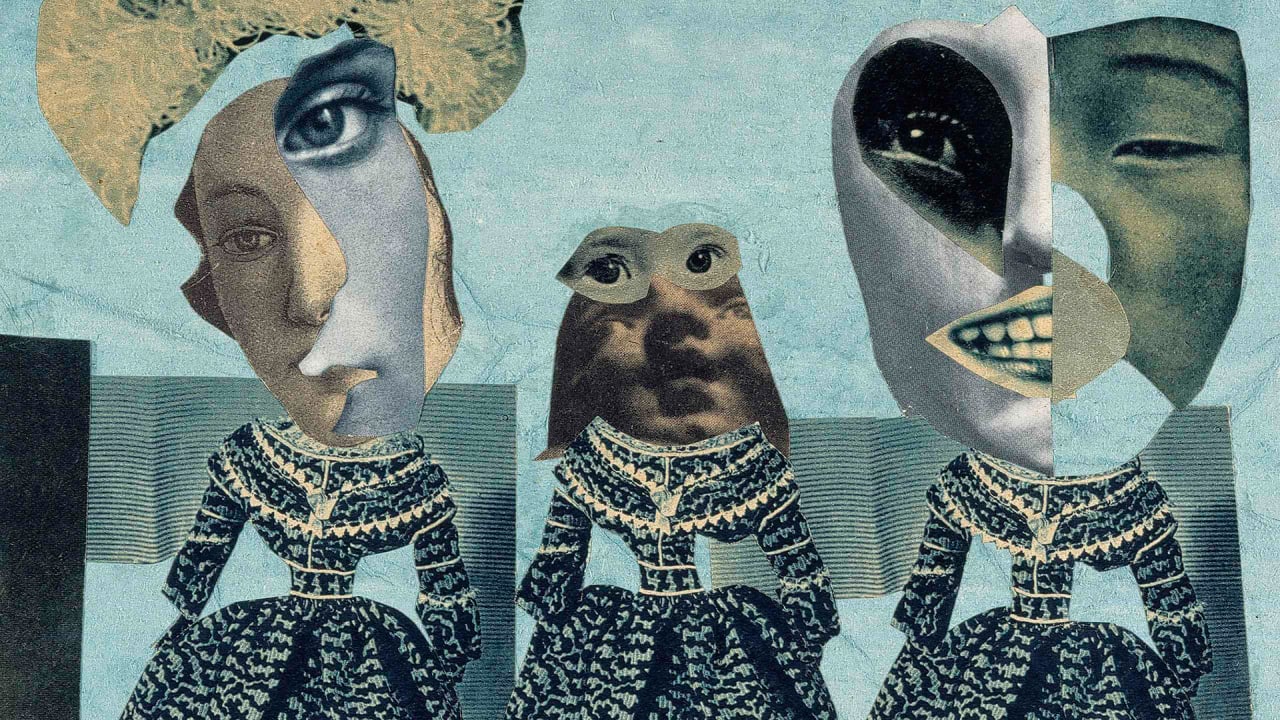
Hannah Höch and her Dada dolls, 1925
courtesy Berlinische Galerie
Höch's darkly playful Dada Dolls are quite distinct from any work created by the others in the Berlin group of Dada artists with which she was affiliated early on. 
Given that the Berlin chapter of Dadaists only formed in 1917, these small-scale sculptural works suggest her awareness of Dada ideas more generally from its inception in 1916 in Zurich.


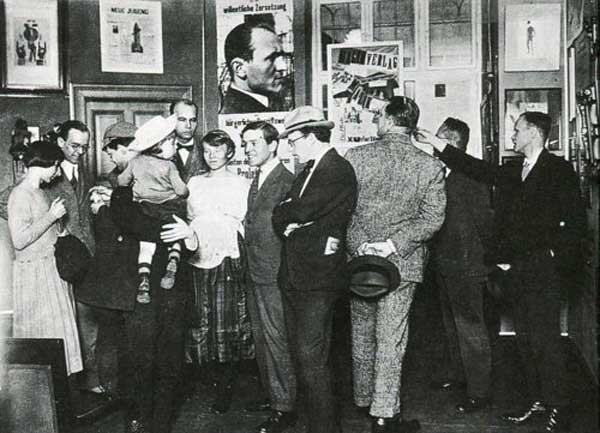
Hannah Höch and her puppets,
Berlin, 1st International Dada Fair, 1920 
Archives

Flash-forward a century and this sandwich-procurer’s Hannah Höch is longer than yours, and her radical legacy was honored in a major new exhibition at London’s Whitechapel Gallery (2013-2014). 


 Fashion Show, 1925-35 
Hannah Höch
Berlinnische Galerie/ LandesMuseum für Moderne Kunst
Fotografie und Architektur, Berlin
It showcased over 100 works from major international collections, the exhibition included collages, photomontages, watercolours and woodcuts, spanning six decades from the 1910s until her death at age 88, in 1978.


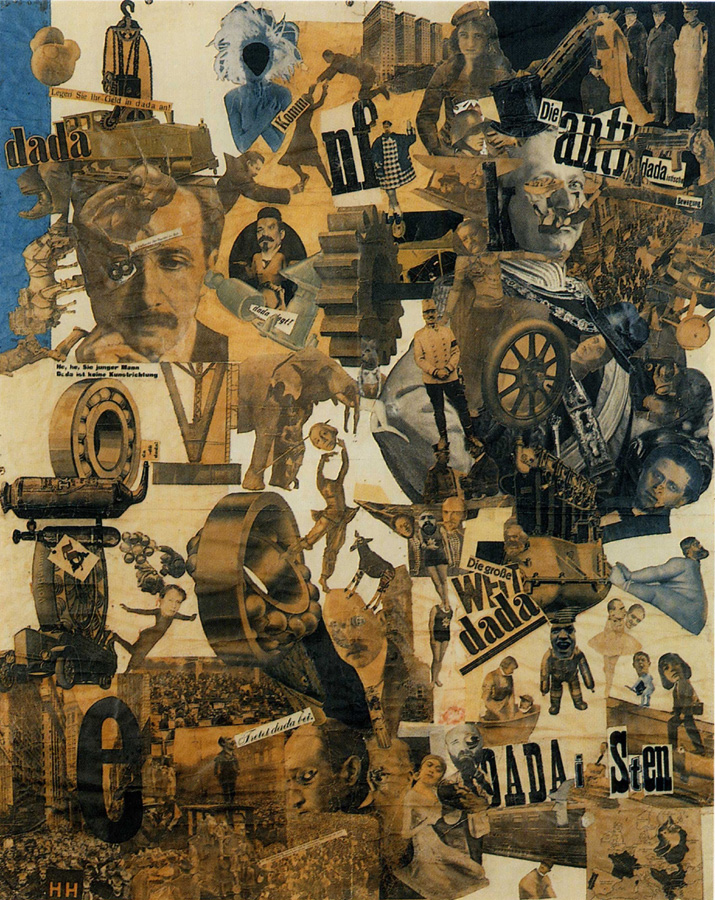
Hannah Höch, Cut with the Kitchen Knife Dada through the Beer-Belly of the Weimar Republic, 1919
 Staatliche Museen, Berlin

Höch showed her most famous photomontage, Cut with the Dada Kitchen Knife through the Last Weimar Beer-Belly Cultural Epoch in Germany, at the 1st International Dada Fair in 1920. 

"Art is dead. Long live the machine art of Tatlin."

Dada Art Movement


First International Dada Fair, Berlin, 1920 
Hannah Höch Collection, Berlinische Galerie

Juxtaposing fragmented images culled from newspapers and magazines, including bits and pieces of movie star Pola Negri, philosopher Karl Marx, and a map of European countries where women could vote, "this large-scale piece conveyed her stance on women’s roles in society, art-world misogyny, and current affairs."

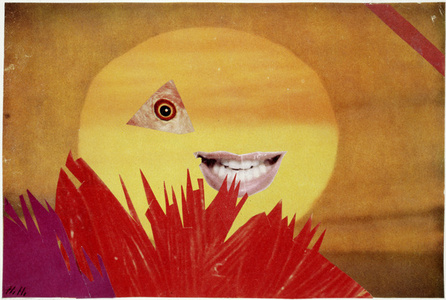
Höch remained in Germany during World War II and retreated to a house just outside Berlin. Entering a period of lyrical abstraction that explores the materials and possibilities of a newly developing consumer culture.


Höch has been called art’s first punk–her strikingly contemporary-looking photomontage style wouldn’t seem out of place on rock album covers.

Looking to this Hoch's collage, don't you think on some Pink Floyd's covers

She is one of the most influential artists in the reconfiguration of mass media images.

Höch remained in Germany during World War II and retreated to a house just outside Berlin. Entering a period of lyrical abstraction that explores the materials and possibilities of a newly developing consumer culture.


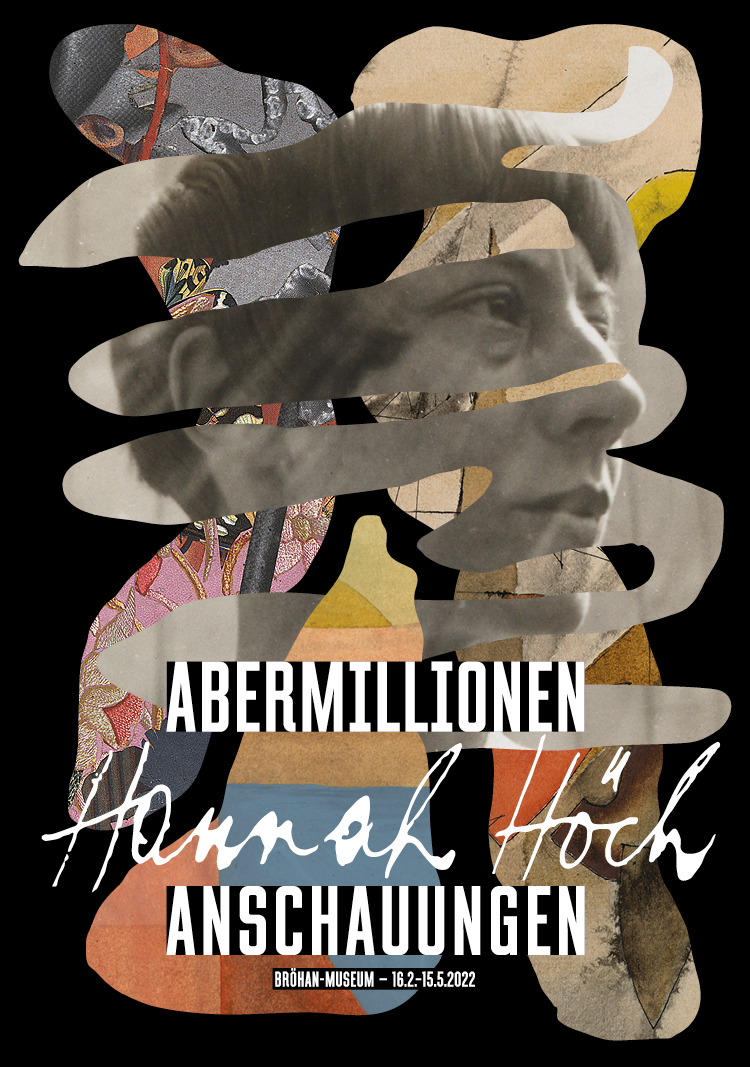
Hannah Höch. Millions Views
Bröhan-Museum, Berlin

  • Exhibition: Hannah Höch. Millions of View

In 2022, the Bröhan-Museum in Berlin presents an exhibition Hannah Höch. Millions of Views from 16 February to 15 April. With over 120 works – some of which have not been shown for a long time or ever before – representing all creative areas and periods, this exhibition illuminates the entire spectrum of an oeuvre that is as versatile as it is contradictory. The works on loan come from prominent international and national museums, institutions, and private collections.

If you teach in Berlin or near by include this event into your Art or Literature curricula. Museums  and exhibitions are awesome life resources that students appreciate very much.

“Millions and millions of views” – as Höch put it in a poem – was the aim of her art.


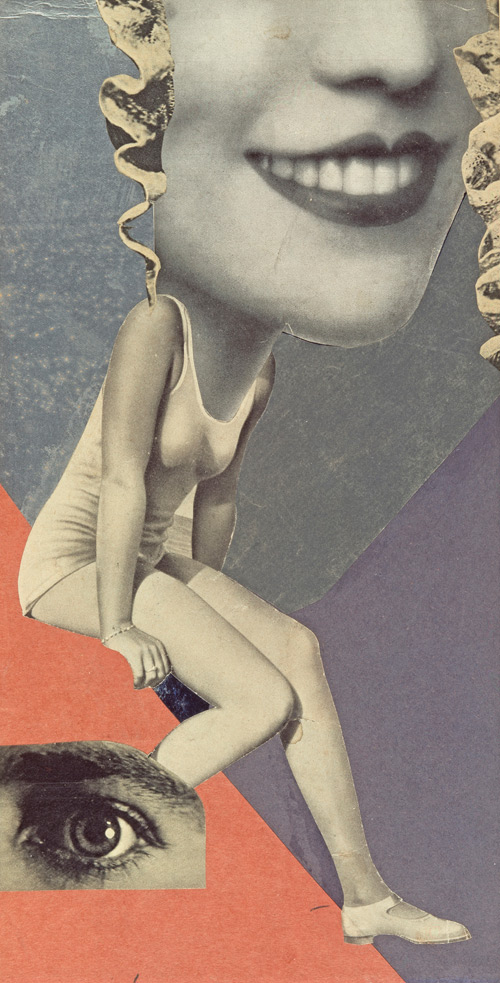
Für ein Fest gemacht (Made for a Party), 1936
Hannah Höch
Collection of IFA, Stuttgart

Education:


“Most of our male colleagues continued for a long while to look upon us as charming and gifted amateurs, denying us implicitly any real professional status.”

Hannah Höch

As I often wrote, Arts are absolutely necessary to a complete and better education of children and young people. 

I was lucky studying Humanities and Arts. All my life has been so full of good moments as a teacher sharing my literary and artistic thoughts and actions on young people's education along the years 
Discovering Arts in school education, some students can pick their inner path on Arts and later they will choose Art colleges and Higher Schools of Arts to develop their aptitude by a real leaning of Arts.

In our days, digital culture is well-come into the the school curriculum as an important tool to tackle the world's toughest problems creating bridges and establish a truly intercultural world, where diversity can be celebrated, a world where different cultures not only coexist but value each other for their contributions and potential.


Hannah Höch, Roma, 1925
 © Berlinische Galerie – Landesmuseum für Moderne, Kunst, 
Fotografie und Architektur © VG Bild-Kunst, Bonn 2016 © ADAGP, Paris

Level: All levels. 
  • Focus on Arts (Vocational Education) ; School of Arts (Higher Education.
  • Secondary education: cross-curricular Literature & Arts.

Curricula: Arts ; Literature ; Design ; Digital Arts.


"I would like to show the world today as an ant sees it and tomorrow as the moon sees it."

Hannah Höch

G-Souto

01.11.2017
Copyright © 2017G-Souto'sBlog, gsouto-digitalteacher.blogspot.com®

Creative Commons License
Schools : Let's talk about women in the Arts : Hannah Höch & Dada Movement bG-Souto is licensed under a Creative Commons Attribution-NonCommercial-NoDerivatives 4.0 International License.

Resources for teachers & students:

National Museum of Women in the Arts

The Art Story/ Hannah Höch