Tuesday, October 1, 2013

Education: Let's talk about International Music Day


Oh! What a special day! Today, October 1 is International Music Day!

As you already know me well as my usual readers, it would be impossible to me not to write about Music Day.

"No truly cultural pursuit, involving the intellect and the emotions, is complete unless it can be regarded as both an end and a means. It is an end in itself so far as it moves the aesthetic sense, gives immediate pleasure and becomes a part of our being. It is a means in the sense that it should raise us to a higher level, make us capable of going further to accomplish other, more difficult, more pregnant acts of cognition-in short, of developing our own powers and helping to develop those of the community."

Georges Duhamel, Académie Française

Education:

"Music has the potential to achieve social and psychological transformation of children and young people. Their sensibility will be accurate. We must never waste such an opportunity as teachers! Captivating the major interests of our students about Music."

GSouto

Music, as you can read on several posts on my blog, is fundamental in Education of children and young people.

I think music should be taught in all schools, from primary to secondary education as a serious curriculum.


The aim is not to form not only professional musicians, but to develop the appreciation, taste and critical judgment of the listener from his earliest youth, so as to train him and enable him to appreciate the beauty and wealth of musical masterpieces. 

Watch the video below and listen Einar Soulbu, Dean of the Faculty of Performing Arts at the Oslo National Academy of the Arts, talking about Music and Education and the importance of preparing the next generation for being the masters of their own lives and supporters of the lives of the others. 


What is needed to ensure a vibrant, diverse future for the many different forms of music and music activity on the planet.

And what about special needs students? Yesterday, I read a fantastic article on FastCompany website: How to write Music in color! Absolutely! Agree!

The article is about the sound-artist|designer Yuri Suzuki ! As a dyslexic kid he learned music not through sheet music but through “Color Chaser".

Since debuting it in 2010, the Color Chaser has proven popular with children in Suzuki’s workshops


Yuri Suzuki

And what is Color Chaser? Color Chaser (2010) is a small, wheeled robotic box that is programmed to follow a black line drawn on a piece of paper. 

Perpendicular scribbles across this line in turn relate to different musical notes, depending on the color. 

Yuri explains that this project was "all about inventing new ways of visually understanding melodies, or “the physical representation of the music;” 

When he was a young boy, his dyslexia made reading traditional sheet music almost impossible (something that proved problematic during his early years in a ska band).

“My band members were trying to be professional at that time and they wanted me to read the score. They told me: if you can’t read the score we have to fire you.” 

Yuri Suzuki

The Color Chaser project was about finding a way around that. Color Chaser has two Arduino boards:
  • one to read and follow the black ink track 
  • other to chirp different sounds for each color. 
“Looks Like Music” has five varieties of cutely shaped Color Chasers, each chirping different tunes for the appropriate colors. Watch the video below:


Credits: Yuri Suzuki

Unsurprisingly, the Color Chaser has proven popular with the children in the educational workshops Yuri is involved in. 

“It’s quite helpful” he says, “because even though they don’t have any real knowledge about music, they can still understand the principle.” 

“Modern technology is like magic. People rarely understand what’s actually happening inside."
Yuri Suzuki

It’s this combination of innovative educational ideas and a sense of playfulness that encourages and also rewards interaction with a Suzuki design. 

I was completely fan about Yuri Suzuki's idea, thinking about Music curriculum for special needs students in School.

Some thoughts:

"Music, like all the arts, has the happy property of making the good lovable through beauty. It can open hearts and awaken an interest in certain subjects to which children would otherwise be indifferent. 

It can lend attraction to ideas which the minds of children are not yet capable of grasping in the form of abstract truths."

L. Gelber, Directress, Musical Education Secretariat, Malines, Belgium 

If music is thus integrated into general education, it becomes a useful auxiliary to the other subjects of School Education. 

It will have a great impact in students' adult life. I can say it ! I have a Music degree among other degrees. I feel thankful to my parents who knew the importance of Music in my entire life.


"The man that hath no music in himself, 
Nor is not moved with concord of sweet sounds, 
Is fit for treason, stratagems and spoils. 
The motions of his spirit are dull as night 
And his affections as Erebus. 
Let no such men be trusted." (...)

Shakespeare, The Merchant of Venice, excerpt

Have a wonderful Music Day!

G-Souto

01.10.2013
Copyright © 2013G-Souto'sBlog, gsouto-digitalteacher.blogspot.com®

Licença Creative Commons
Education: Let's talk about International Music Day ! bG-Souto is licensed under a Creative Commons Attribution-NonCommercial-ShareAlike 3.0 Unported License.


Wednesday, September 25, 2013

Great Lx International Conference 2013


"How can we bring attention of policy makers to the significant potential of games? This  issue will be addressed by the GREAT Lisbon Conference on Games & TEL."

Claudio Dondi


The Great Lx International Conference on Games and TEL took place in Lisbon, Portugal last 15-16 September 2013 at ISCTE-IUL.

The GREAT LX International Conference on Games & TEL (technology enhanced learning) was promoted by Portuguese Association of People Management (APG) partnership with ISCTE and European partnership project supported by the European Leonardo da Vinci.

The Organizing Committee Claudio Dondi, Edeberto Costa, Maja Pivec and Ana Passos joined all the speakers and participants for a full and interesting day for the future of learning in Europe


Great LX | Auditorium

Interesting opportunity to participate, listen and share the last concepts about the current paradigms and evolution of Games in Education (GBL) Training (SG) and Technology Enchanced Learninig (TEL).

The Great Lx started, on September 15th with a Social Play - Porto de Honra followed by a dinner.

The main conference began on September 16th 2013 at 9:00. The conference themes were:

Theme 1: Games

  • Serious Game
  • GBL-Games based learning
  • Gaming

Theme 2: Technology Enhanced Learning:

  • E-learning
  • Social and inclusive learning
  • ICT Contexts
  • Environments for learning
  • Collaborative Virtual Environments


Claudio Dondi

Claudio Dondi, a policy maker and influent learning thinker about European issues gave the participants guidance and experienced learning processes. EFQUEL, Menon, Scienter some references of his work.

At the Great Auditorium (Grande Auditório), the conference started with "E&T 2020 strategy powered by networks and partnerships."

Over the past years the EU has gained more and more influence in the field of lifelong learning. 

The central points for dialogues on the round table were the relevance of joining forces from various sources in a common field of battle by learning interests with eyes on the future. 

  • Networks are one of the agents for change. 
  • The paradigm shift in learning is an opportunity to blow the collaborative work of thematic networks in lifelong learning.
  • Games in Learning; Game Based Learning; Serious Games; Gaming - Findings and appreciations from recent researches The IPTS / JRC European Commission (March 2013), emphasized the importance of learning through play.

Great Lx Conference | Maja Pivec
photo: GSouto

"Game-based learning has been considered a significant approach to increase motivation of learners for a long time, and ICT has brought a lot of new options to broaden the range of learning objectives that can be addressed by games."

Claudio Dondi

"Gaming; Game Based Learning; Serious Games, Gaming: Findings and appreciations from recent researches" were at the top of dialogues at this Round Table at 11: 30,moderated by Edelberto Costa.

Maja Pivec presented a research project based in focus group and an online survey. Also presented several specific games that can be used in the learning process. 

I knew the work of Maja Pivec because we participated in 2010 at the ENGAGE Quality Awards 2010 as members of the Jury for evaluation.

Petridis Panagiotis from the Serious Games Institute (SGI), presented several games related to Health; Paul Pivec highlighted the characteristics of the games that a game designer need to considerer; Leonel Morgado introduced the new ways of learning and teaching – games change the process and the way we learn.


Great Lx Conference

After lunch and continuing at the Great Auditorium the round table "ICT for learning in the EU 2020: Findings and appreciations from recent researches" began.

I was very interested on key note speaker Claudio Dondi analysis about the role of ICT in learning moving the change on E&T and bringing a great challenge for the shift on paradigm in Europe. 

I know Claudio Dondi from different international conferences. The last one, in Brussels, at the European Forum on Learning Futures and Innovationwhere I had a presentation at VISIR workshop on the 19th March, 2013 with Giordano Koch and Jan Pawlowski.

Claudio Dondi is one of best European researcher and expert and his thoughts are always very important.

Claudio Dondi made a splendid evaluation with remarkable key notes and items that I have the chance to hear.


Great Lx Conference | Final session

Some considerations or a possible report:


For one long day, speakers, researchers, practitioners, producers, skate holders and participants shared  interesting ideas and experiences.

I joined key speakers and round tables at the Great Auditorium. I am an independent researcher on TEL and I was very curious to hear about the new ideas.

Games, TEL and MOOCs were on my best interests

I knew the work of Maja Pivec. We worked together at the ENGAGE Quality Awards 2010 as members of the Jury for Evaluation.

As an expert on Social Media Tools in Education and  trainer teachers, I am an educator and practitioner of the integration of games in school. I really know the importance of gaming to change teaching and learning in Secondary Education.

I would like to hear something new. However, it was interesting to hear the questions of some participants in the room. 

Some teachers talked about their fears and demotivation to introduce games and ICT tools in the classroom. This is not new. 

Younger teachers who teach in schools now are the ones who reveal more Informatic skills but the domain of a simple technique does not guarantee that teachers uses it easily, with clearance and with critical thinking.

Teachers must not be afraid to introduce ICT and games in Secondary Education.

I think it is a question of changing mentalities and most important, training teachers, helping them to develop a high-attuned sense of technique in the classroom.

A good final session. The speakers and the participants presented an overview about their own ideas and interests, trying to contribute to better inclusion and excellent innovation technologies in Education.

Finally the team Rapporteurs leader's communication comments and questions selected from audience and internet addressed to representatives.

I special appreciated Claudio Dondi (Scienter) evaluation on TEL and António Teixeira (EDEN) on MOOCs.

It is very important to understand the new challenges until 2020. As the final rapporteur pointed:
  • We have to work harder on the issues above. 
  • MOOCs are not inclusive. 
  • Less focus on thecnology and more in people.

Really liked a testimony of a college student talking about MOOCs. He feel more engaged on academy face to face learning and social experience between peers than online learning.

Of course there were interesting parallel sessions as The MOOC experience : "The Bright and the Dark Sides" by António Teixeira - EDEN; Natural User Interfaces: "Devices as smartphones and tablets brought several sensors into our daily life" by Antão Almada - Ydreams; "Technology Enhanced Learning: where are we heading to?" by Patrick Belpaire - European Training and Developement Federation; "The Social Learning Revolution: Knowledge workers uses social tools to work and learn" by Jane Hart - C4LPT.co.uk | Sara Brito - Global Estratégias and other.


Tuna Universidade Europeia | Great Lx

Break coffee and lunch were animated by Tuna Universidade Europeia (Academic Music) that cheered the network. As an ancient college student, I loved it!


Poster | Great Lx


On the lobby for launch and break coffee, the participants could read the different posters displayed on the corners as follow the last tweets about the sessions displayed on a big wall as a giant Twitter network. Great participation !

The event was broadcast live by Sapo and offered the possibility to interact with participants on Twitter, Facebook, Linkedin group and Google +


Lobby | Great Lx

A fruitful and instructive conference! The "Great Lx" was an excellent opportunity for an active participation, by sharing ideas building and exchanging visions. 

A great work from all the volunteer team!

G-Souto

25.09.2013
Copyright © 2013G-Souto'sBlog, gsouto-digitalteacher.blogspot.com®

Licença Creative Commons
Great Lisbon International Conference 2013 bG-Souto is licensed under a Creative Commons Attribution-NonCommercial-ShareAlike 3.0 Unported License.

Credits: Photos The Great Lisbon International Conference & GSouto

Friday, September 20, 2013

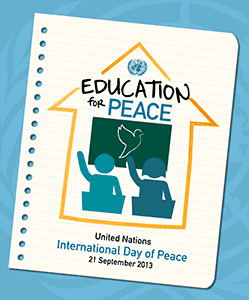
Education for Peace: International Day of Peace


Credits: UNESCO

"On this International Day of Peace, let us pledge to teach our children the value of tolerance and mutual respect.  Let us invest in the schools and teachers that will build a fair and inclusive world that embraces diversity.  Let us fight for peace and defend it with all our might."
UN Secretary-General Ban Ki-moon 
International Day of Peace is celebrated on 21 September every year. This year, 2013 idevoted to peace education.

The International Day of Peace was established in 1981 by resolution 36/67PDF document of the United Nations General Assembly to coincide with its opening session, which was held annually on the third Tuesday of September. 

The first Peace Day was observed in September 1982. Since wars begin in the minds of women and men, it in the minds of women and men that the defences of peace must be constructed. 

"Education is the foundation of any lasting peace. It is the driving force behind freedom and tolerance. It stems the tide of ignorance and mutual misunderstanding, the means by which disagreements all too often degenerate into violence. Education fosters the culture of dialogue that is necessary to resolve conflicts."

Irina Bokova, message


Credits: UN

UNESCO campaigns for quality education for all going further than the basics of reading and writing. 


Education must encompass the teaching of human rights, living together and respect for others

Peace education is one of its key components. Every child in the world should know their rights, and learn their own history and that of other peoples, so as to be able to understand the equal dignity of cultures and draw lessons from the crimes and violence of the past.

The key to tolerant citizenship in a globalized world requires a widespread effort to train teachers and design suitable school curricula. 

These principles inspire UNESCO’s work, in particular through the International Decade for the Rapprochement of Cultures (2013-2022), adopted by UNESCO’s General Conference and the United Nations General Assembly.


Credits: Peter H. Reynolds


Education:


Of course celebrating International Day of Peace is only a start to motivate students to practice a peace behaviour in the school and along adult life. So, we can develop this theme every moment of the curriculum we teach.


There's a new young generation of peace minds, believe me!

Ideas for activities with your students:

1. Designate a webpage on the website of the school to build a digital pledge on peace education;

2. A wall in the classroom or a space in the school - school library for  example - where students from different curricula can display their depictions of peace through works of art, photos, storytellings;

3. Organize exhibits of photos or drawings or texts/poems/news about peace in school or other public spaces near the school;

4. Set up information stands on Internet, social media (radio, television) or social networks (Twitter, Facebook, Google +) to raise school awareness on the issue;

5. Ask students to search on their tablets, smartphones about human rights in your country;
6. Ask students to choose a little theater piece to perform in the school library and invite parents, teachers, the maire, and students from another school;
7. Present a film on this theme in the classroom or in the school library, and invite teachers, parents, and other students to a round table discussion;

8. Make a film (if the school have a YouTube account) joining authentic documents (photos) and texts written by students, personal testimonies of violence and publish it;
9. Ask students to prepare information brochures, flyers, pins, to distribute in your school and community.


Credits: Vision of Humanity

Impressive this video about Global Peace in 2013!

We must not forget Peace One Day movementThroughout the years, millions of people have been active on Peace Day in every country of the world, and hundreds of organisations have carried out life-saving activities in areas of conflict. Peace One Day’s Campaigns and activities in Education, Music, Film, Sport, Dance, Art and Online have proved that the day works.


If you are preparing some activities, fill out the short form here and Peace One Day will share your inspiring ideas and plans for the day with its worldwide community of supporters, and multiply the impact of your important work.

In a world in complete change, young people have a relevant voice to demonstrate their critical thinking and creative ideas about a new intercultural dialogue, interconnectedness, capacity building, in order to innovate the society and build a different world  through important values as Peace and Culture.

"We must give to future generations a culture of dialogue and build, through education, a world that is not only more connected, but also more compassionate."

Irina Bokova, message

G-Souto

20.09.2013
Copyright © 2013G-Souto'sBlog, gsouto-digitalteacher.blogspot.com®

Education for Peace Resources:

Education for Peace | UN

http://www.un.org/en/events/peaceday/2013/resources.shtml
Resources for Culture of Peace and Non-Violence | UNESCO
http://www.unesco.org/new/en/bureau-of-strategic-planning/themes/culture-of-peace-and-non-violence/selected-references/education-and-peace/

Education Resources | Peace One Day
http://peaceoneday.org/resources/

Licença Creative Commons
Education for Peace: International Day of Peace bG-Souto is licensed under a Creative Commons Attribution-NonCommercial-ShareAlike 3.0 Unported License.