Showing posts with label European Union. Show all posts

Monday, May 9, 2016

Schools : Let's talk about Europe Day ! Resources & activities


Europe Day / May 9

Today May 9 is Europe Day ! In May each year, the European Institutions celebrate the anniversary of the funding of the European Union.

This is an opportunity for citizens to learn about the day-to-day work of the institutions, as well as the broader issues, challenges and benefits of the European Union for its 508 million citizens.
On Saturday 28 May 2016, from 10 am to 6 pm, various locations in Brussels (from the Schuman Roundabout down Rue Belliard to the Place du Luxembourg) will be open doors.


EU Founders


Europe Day is celebrated since 1985 to honor the the architect of the European integration project, Robert Schuman.

The statesman Robert Schuman, a qualified lawyer and French foreign minister between 1948 and 1952, is regarded as one of the founding fathers of European unity.

In cooperation with Jean Monnet he drew up the internationally renowned Schuman Plan, which he published on 9 May 1950, the date now regarded as the birth of the European Union. 

Every year has a different theme. The theme for the 2016 edition of this event will be the European Union motto "United in diversity"


Europe is a multi-faceted melting-pot of languages, cultures, religions and political opinions, and this diverse identity is reflected in its fundamental values and governing institutions.


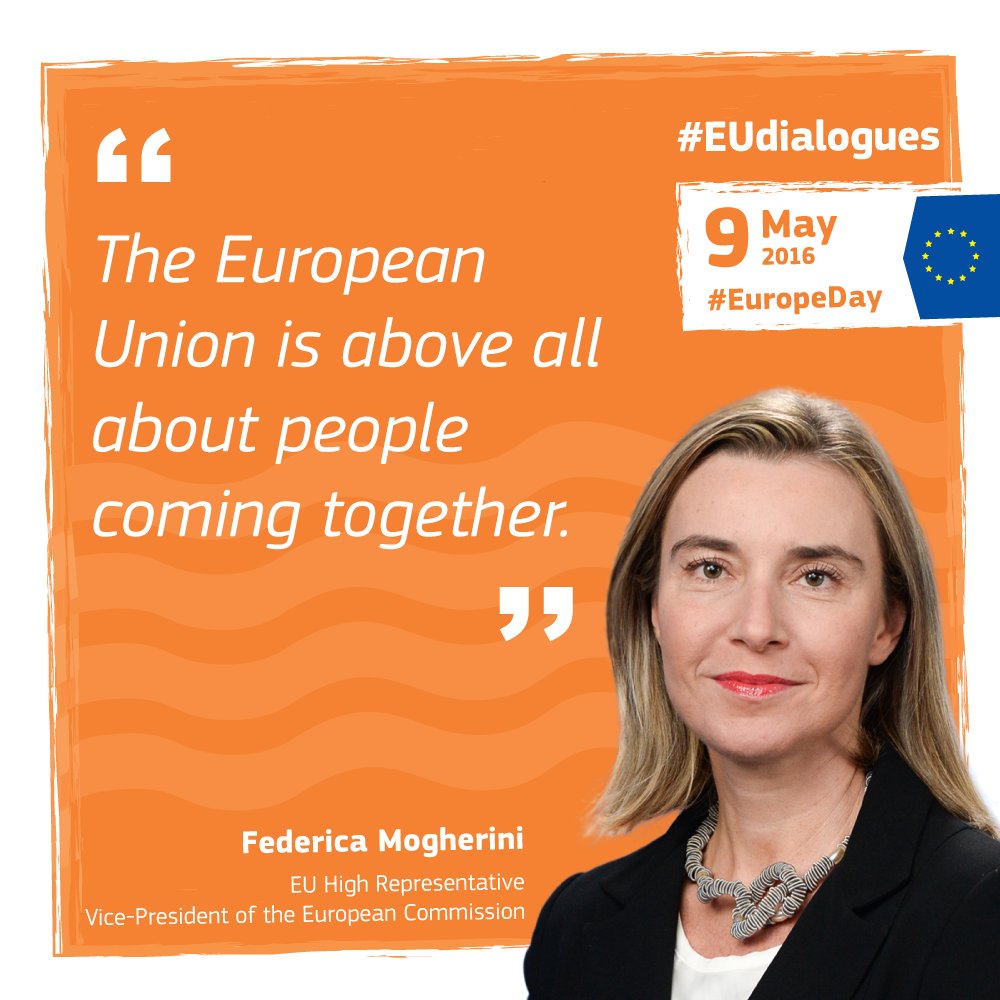
On #EuropeDay, a public debate with EU High Representative for Foreign Affairs and Vice-President Federica Mogherini and former President of Italy Giorgio Napolitano! 

Live streaming of the dialogue with interpretation to English: europa.eu/!Jv99xX 

*Take part in the online debate using #EUdialogues!


EU Symbols


Education:

Twenty eight European countries are members of the European Union. Schools across Europe are invited to participate by organizing debates, concerts, exhibitions, interactive activities (different schools from different European countries) around these issues on 9 May, Europe Day.

The EU was not always as big as it is today. When European countries started to cooperate economically in 1951, only Belgium, Germany, France, Italy, Luxembourg and the Netherlands participated.

Over time, more and more countries decided to joinPortugal is a member since 1986.

The union reached its current size of 28 member countries with the accession of Croatia on 1 July 2013.


Europe Day 2016


Every yearEurope Day is celebrated on May 9. For many Europeans it is not well known, but since 1985, Europe has its own day to celebrate the specific character of Europe. The unique European mix of numerous different languages, countries, regions, food, music; all in a rather small geographical location; that constitutes Europe.

Entertaining, informative activities are organised throughout Europe and beyond.Site visits, information stands, interactive activities, debates, concerts, exhibitions, other. Find more here

Of course all the European teachers will include Europe Day into the school curriculum. 

Curriculum : Cross-curricular.

Level : All levels. 


Some Activities :

  • Let the students explore all the links about European Union to be well informed about it.
  • Ask on a debate about the "pros & cons" to be a member of the EU or to become a new member of the EU.

Students must practice the critical thinking about a subject that is not consensual nowadays when Europe is experiencing a severe financial crisis and the UK want to leave the EU.

The austerity measures and social spending cuts extended the child poverty and child deprivation in the world’s advanced economies, a report revealed by UNICEF in 2015.

Children are affected by poverty in rich countries too. Today, there are 26 million children at risk of poverty or social exclusion in the EU.


Kids of the recession


If you teach young students, you will include into your lessons different activities to motivate kids to learn about the EU. 

Don't forget children's poverty in their own countries.

Resources:
  • The EU in slides : The page contains visual material (slide presentations) illustrating various aspects of the EU.
These slides may be a useful tool for teachers, speakers on EU issues, students and anyone interested in giving a presentation about the EU.
  • Learning corner : Information about the EU for young people, kids, teens and teachers.
  • Celebrating Europe Day 2016Building tours, concerts, exhibitions, conferences, tastings, activities for all ages: take your pick of the 164 activities planned to mark the anniversary of the European Union.

You have the time because the EU activities goes around May 28 Brussels #opendoors

"A great time to visit the EU institutions in Brussels on Saturday 28 May plenty of activities for all ages and discover how the institutions work ! "

European Commission


G-Souto

09.05.2016

update 09.05.2024
Copyright © 2016G-Souto'sBlog, gsouto-digitalteacher.blogspot.com®

Creative Commons License
Schools : Let's talk about Europe Day ! Resources & activities bG-Souto is licensed under a Creative Commons Attribution-NonCommercial-NoDerivatives 4.0 International License.


Friday, May 9, 2014

Education : Europe Day 2014


Today May 9 is Europe Day ! Europe Day is celebrated since 1985 to honor the the architect of the European integration project, Robert Schuman.

The statesman Robert Schuman, a qualified lawyer and French foreign minister between 1948 and 1952, is regarded as one of the founding fathers of European unity.

In cooperation with Jean Monnet he drew up the internationally renowned Schuman Plan, which he published on 9 May 1950, the date now regarded as the birth of the European Union. 


The visionary leaders inspired the creation of the European Union we live in today. Without their energy and motivation we would not be living in the sphere of peace and stability that we take for granted. From resistance fighters to lawyers, the founding fathers were a diverse group of people who held the same ideals: a peaceful, united and prosperous Europe. Beyond the founding fathers described below, many others have worked tirelessly towards and inspired the European project. 

Every year, Europe Day is celebrated on May 9. For many Europeans it is not yet well known, but since 1985, Europe has its own day to celebrate the specific character of Europe. The unique European mix of numerous different languages, countries, regions, food, music; all in a rather small geographical location; that constitutes Europe.
  • There is an interactive map. a list of the countries that you can observe here


Each year has a different theme. The theme for 2014 is #EUopendoors. 

To celebrate Europe Day the EU institutions will open their doors to the public in Brussels, Luxembourg and Strasbourg. Local EU offices in Europe and all over the world will organise a variety of activities and events for all ages.


Lisbon | Miradouro da Senhora do Monte
Credits : Jeroen Paeleman (Belgium)

Education:

Twenty eight European countries are members of European Union. Schools across Europe are invited to participate by organising debates and discussions around these issues on 9 May, Europe Day.

The EU was not always as big as it is today. When European countries started to cooperate economically in 1951, only Belgium, Germany, France, Italy, Luxembourg and the Netherlands participated.

Over time, more and more countries decided to join. Portugal is a member since 1986.

The union reached its current size of 28 member countries with the accession of Croatia on 1 July 2013.


The EU will continue to grow. So there are other countries on the Road to EU membership.

Of course all the European teachers will introduce Europe Day in the school curriculum. 

Curriculum : All curricula or cross-curricula.

Level : All levels. 

Activities :
  • Let the students explore all the links about European Union to be well informed about it.
  • Ask for a debate about the "pros & cons" to be a member of the EU or to become a new member of the EU
Students must practice critical thinking about a subject that is not consensual nowadays when Europe is experiencing a severe financial crisis. 

The austerity measures and social spending cuts extended the child poverty and child deprivation in the world’s advanced economies, a report revealed in 2011.

Some 13 million children in the European Union (plus Norway and Iceland) lack basic items necessary for their development. 

Read my post The Hard Times Generation : Children's rights.


If you teach young students, you will introduce different activities to motivate kids to learn about the EU.
  • Visit the Education corner : Information about the EU for young people and teachers.

You have the time because the EU activities goes around Saturday May 17, Festival of Europe.

"A great time to visit the EU institutions in Brussels on Saturday 17 May plenty of activities for all ages and discover how the institutions work ! "

European Commission

G-Souto

09.05.2014
Copyright © 2014G-Souto'sBlog, gsouto-digitalteacher.blogspot.com®

Creative Commons License
Education : Europe Day 2014 bG-Souto is licensed under a Creative Commons Attribution-NonCommercial-NoDerivatives 4.0 International License.

Monday, May 9, 2011

May 9: Europe Day 2011


Europe Day 2011

Europe Day celebration on 9 May 1950, the day the French Foreign Minister Robert Schuman presented his proposal on the creation of an organised Europe, to help maintain peaceful relations between European countries. In cooperation with Jean Monnet he drew up the internationally renowned Schuman Plan, which he published on 9 May 1950, the date now regarded as the birth of the European Union. Robert Schuman is the architect of the European integration project.
Since then, every year, Europe Day is celebrated on May 9. For many Europeans it is not yet well known, but since 1985, Europe has its own day to celebrate the specific character of Europe. The unique European mix of numerous different languages, countries, regions, food, music; all in a rather small geographical location; that constitutes Europe.


Each year has a different theme. The theme for 2011 is "Know Your Rights, Use Your Rights"

Portugal is in the EU since 1986. Portugal, a country with a rich history of seafaring and discovery, looks out from the Iberian Peninsula onto the Atlantic Ocean. 


Portugal's history has had a lasting impact on the culture of the country: Moorish and Oriental influences in architecture and the arts are prominent.


500th anniversary of Fernão Mendes Pinto’s birth

"The inner part of the coin commemorating the 500th anniversary of the birth of Fernão Mendes Pinto, a Portuguese explorer whose book on his discoveries and adventures in the seas and countries of Asia was published posthumously under title “Peregrinação” (Pilgrimage), depicts a sailing ship floating on a sea formed by a series of wave-shaped references to Portugal, Lisbon, his book and some of the destinations of his travels."

Over the past 3 000 years, Portugal has witnessed a constant ebb and flow of civilisations. Phoenician, Greek, Celt, Carthaginian, Roman and Arabic cultures have all left their imprint. 

In the 15th century, Portugal’s intrepid maritime explorers led by Vasco da Gama discovered new territories, leading to the accumulation of an overseas empire. 


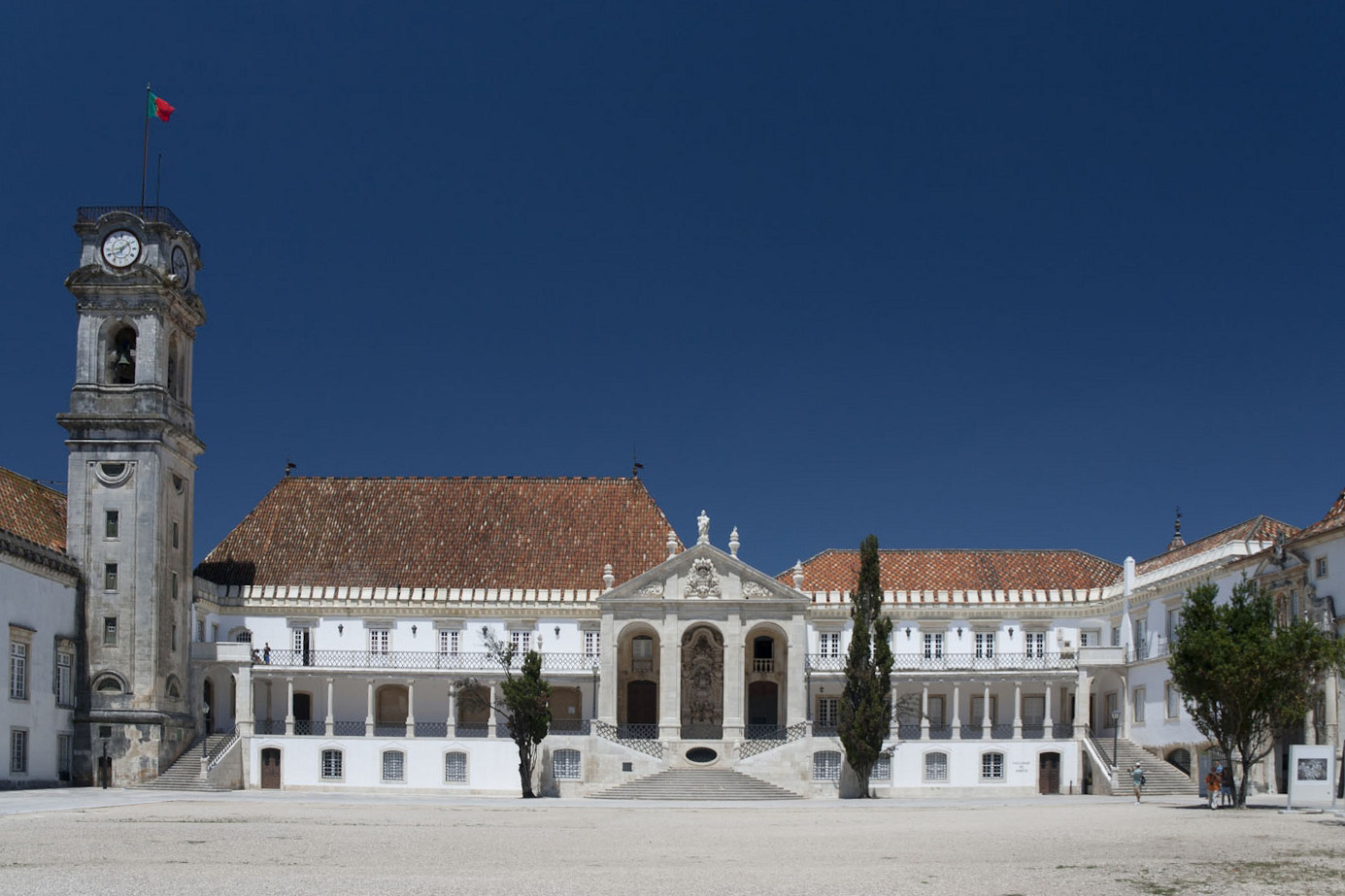
University of Coimbra, Portugal
photo: Digitalsignal

The University of Coimbra, established in 1290, is one of the oldest in Europe. In 1290 the University is founded in Lisbon by royal decree of King Dinis. Until the end of the 13th century it is part of a small group of 15 operating universities in Europe. After a period of alternation between the cities of Lisbon and Coimbra, the definite transference occurs in 1537, by order of King John III and with the strong influence of the Santa Cruz Monastery.


Today is UNESCO World Heritage. You could watch in the nomination video.


Within the framework of the European year for volunteering, special attention will be given to the European and national volunteering programme and to the role played by volunteers and volunteering in favor of the actions developed by CSOs to communicate and promote the European project and bridging the gap between citizens and the European institutions. 
Education:

Teachers must include into the school curriculum the Europe Day  and European Year of Volunteering to teach European citizenship. Portugal is an old member of the EU.

Curriculum : All curricula or cross-curricular.


Level : All levels. 

Let the students explore both themes and debate the meaning of solidarity between all the European countries!

"The European Union is at the service of its citizens. While keeping their own specific values, customs and language, European citizens should feel at ease in the "European home".

References for teachers:

9th of May 2011: Europe Day

Members States of the EU: Portugal

What is Europe Day


"The European Union is at the service of its citizens. While keeping their own specific values, customs and language, European citizens should feel at ease in the "European home".

G-Souto

09.05.2011
Copyright © 2011G-Souto'sBlog, gsouto-digitalteacher.blogspot.com®

Licença Creative Commons