Showing posts with label Easter season. Show all posts

Saturday, April 20, 2019

Schools : Earth Day 2019 & NASA #PictureEarth : Activities


Earth
credits: NASA


Earth Day is coming next 22 April. It's celebrated each year to remind each of us that the Earth and its ecosystems provide us with life and sustenance.
It began on April 22, 1970 – millions took to the streets to protest the negative effects of 150 years of industrialisation. In 2020 Earth Day will celebrate 50 years. Wow!

The Earth Day Network calls it "the anniversary of the birth of the modern environmental movement." True!


Protect our Species
credits: Jamie Bussey

Comedy Wildlife Photography Awards


Theme 2019: Protect our species!

"In Nature nothing exists alone."
Rachel Carson, 1962

Nature’s gifts to our planet are the millions of species that we know and love, and many more that remain to be discovered. Unfortunately, human beings have irrevocably upset the balance of nature and, as a result, the world is facing the greatest rate of extinction since we lost the dinosaurs more than 60 million years ago. But unlike the fate of the dinosaurs, the rapid extinction of species in our world today is the result of human activity.
All living things have an intrinsic value, and each plays a unique role in the complex web of life. 
We must work together to protect endangered and threatened species: bees, coral reefs, elephants, giraffes, insects, whales and more.


International Mother Earth Day
credits: WMO/Marlene Dapozzo Moali/ UN

Recognizing that Mother Earth is a common expression for the planet earth in a number of countries and regions, which reflects the interdependence that exists among human beings, other living species and the planet we all inhabit.

Noting that Earth Day is observed each year in many countries, the UN decide to designate 22 April as International Mother Earth Day.


#PictureEarth
credits: NASA

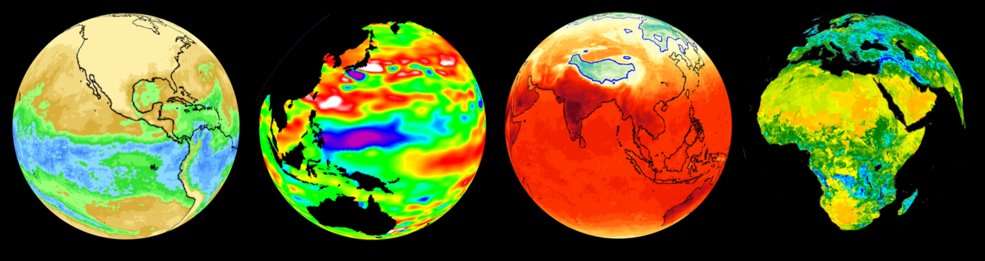
For Earth Day 2019, NASA invites students to celebrate the planet we call home with #PictureEarth social media event.
NASA studies Earth as a mission to let us know what’s happening to our home. Satellites and instruments #PictureEarth daily. 
Some take visible light photos, much like your camera. Others peer into the infrared, microwave and radio spectrums, which our human eyes can’t see. 
These images of Earth can be the width of an instrument’s path over the ground, a column of molecules in the air, the height of the ocean below, or even made up of signals emitted quietly from the surface.
Each satellite picture reveals a small detail of the land, water, atmosphere and life on Earth — a single brushstroke in the masterpiece that is our home planet.


credits: Adolie Day illustratrice
Education:
Unfortunately, European schools are closed for Easter Season. But teachers could contact their students using schools media accounts to invite them to participate on this activity.
They love media, Instagram, Twitter, Facebook. They will participate, I'm sure!

#PictureEarth
credits: NASA

How do you #PictureEarth?
Show NASA how you see our planet through photos posted on social media. Focus on the details around you with close-up images.

  • What makes your location on Earth special?
  • Where is the color of our living planet seen?

  • Is there a texture or pattern in your surroundings?

  • What makes Earth our home in the vast universe?

Look for Earth’s life, motion, and beauty: blooming flowers, ancient trees, colorful insects, furry and feathered animals, crashing waves, molten lava, puffy clouds, frozen ice and warm sunlight
Don't forget the 2019 theme for Earth Day. Protecting our species!


#PictureEarth
credits: NASA


Share your best Earth photo!
Share your best photo showing a detail of Earth on social media with hashtag #PictureEarth on Earth Day, Monday, April 22, 2019.


#PictureEarth
credits: NASA

Be sure to tell NASA where your photo was taken in the text of your social media post. NASA will be watching Instagram, Twitter, and its Facebook event page for your images and messages celebrating our planet’s special day. Earth Day!
NASA love to read posts from around the world because NASA Earth data is available to everyone – we’re all living on this planet together.
As with NASA previous Earth Day events, it will select some of the publicly-shared photos to showcase in videos and composite images featuring your beautiful imagery from around the world.


Global Strike for Future
credits: Elyx


Wow! Don't miss this opportunity! You are the climate generation, remember? You are streaking school on Friday to protest against climate change.
Climate change is one of the largest threats to sustainable development globally and is just one of many imbalances caused by the unsustainable actions of humankind, with direct implications for future generations.
“I don’t care if what I’m doing – what we’re doing – is hopeful. We need to do it anyway. Even if there’s no hope left and everything is hopeless, we must do what we can.”
Greta Thunberg


#PictureEarth
credits: NASA

Resources:
To see how NASA #PictureEarth from space, download the new NASA EARTH photo book featuring stunning satellite imagery.


On Earth day website:


  • Share photos, videos, and stories about what you, your students, and your schools are doing to Protect Our Speciesa all year round!

  • Tag your Facebook, Twitter, and Instagram posts with #EarthDay2019 #ProtectOurSpecies and tag @EarthDayNetwork


Earth Day Network is asking people to join Protect our Species campaign. The goals are to:
  • Educate and raise awareness about the accelerating rate of extinction of millions of species and the causes and consequences of this phenomenon.
  • Achieve major policy victories that protect broad groups of species as well as individual species and their habitats.
  • Build and activate a global movement that embraces nature and its values.
  • Encourage individual actions such as adopting plant based diet and stopping pesticide and herbicide use.


We'll see on Instagram, Twitter, or Facebook. You will be there ! So do I !


G-Souto

20.04.2019
Copyright © 2019G-Souto'sBlog, gsouto-digitalteacher.blogspot.com®

Creative Commons License
Schools : Earth Day 2019 & NASA #PiectureEarth ange : activities ! by G-Souto is licensed under a Creative Commons Attribution-NonCommercial-NoDerivatives 4.0 International License

Friday, April 14, 2017

Happy Easter : Reading children's books


Today, April 14 isGood Friday. Two days from EasterEaster is the most important Christian religious holiday and widely regarded as the second most popular holiday in general after Christmas.

Students and teachers got Easter school break in European countries and elsewhere.

Time is wonderful for those kids and families who will enjoy the traditional host of Easter egg hunts outdoor across the world next Sunday.

And why not to read some lovely children's books? Here some suggestions in three different languages:


Home For a Bunny/ Little Golden
Margaret Wise Brown
illustrations: Garth Williams

Generations of children have followed this furry, lovable bunny on his springtime journey to find a home. 

A family favorite since 1956, Margaret Wise Brown's simple yet playful tale is perfectly complemented by Garth Williams's exquisite artwork-and is now back in print as a Little Golden Book Classic.


Easter Blessings
 Bonnie Rickner Jensen
illustration: Donna Chapman

Flowers are blooming. Birds are chirping. And the Really Woolly characters are discovering God’s goodness all around them. Curl up with your little one, and join the fun while learning about the hope of Easter and springtime!

Adorable rhymes, sweet Bible verses, and prayer starters will make reading time a special moment for you and your child—to connect with each other and with God. 


Happy Easter Mouse
Laura Numetoff
illustrations: Felicia Bond


Join Mouse from If You Give a Mouse a Cookie as he goes on an Easter egg hunt! Who is hiding eggs in Mouse’s house? 
This adorable board book combines an engaging Easter theme with a story about colors!
This board book with sturdy pages is perfect for toddlers, who will enjoy the simple introduction to colors and counting. Each page has one or two sentences and points out a different color and number of eggs.
Starring the ever-popular Mouse, this is a colorful and fun addition to a little one's Easter basket.


The Easter Bunny That Overslept
Priscilla Friedrich

Having slept past Easter, the Easter bunny tries to distribute his eggs on Mother's Day, the Fourth of July, and Halloween, but no one is interested. At Christmas time it is Santa who gets him back on track.


Les Monsieur Madame Fêtent Pâques
Collectif

Heureux organise une grande chasse aux oeufs et confie à M. Incroyable le soin de les cacher dans des lieux... incroyables : les Monsieur Madame parviendront-ils à les retrouver ? 


Sami et Julie cherchent des oeufs
 Thérèse Bonté/  L. Lesbre

Sami et Julie sont chez leur mamie et aujourd'hui les cloches sont passées. Toute la famille cherche les oeufs en chocolat.

Une histoire à lire seul, encadré par ses parents/ enseignants. Avec des questions, en fin d'ouvrage, pour vérifier la compréhension et déclencher des réflexions et des échanges.


Joyeuses Pâques Fenouil
Brigitte Weninger
illustration: Ãˆve Tharlet

Le jour de Pâques, un lapin passe cacher des Oeufs pour tous les enfants. C'est tout au moins ce que Cerfeuil a entendu dire... Aussitôt, Fenouil part à sa recherche avec ses frères et soeurs : ils aimeraient bien avoir des oeufs, eux aussi ! Mais leur déception est grande: le lapin de Pâques est introuvable. Qu'à cela ne tienne, Fenouil a une idée ! Et le matin de Pâques, c'est finalement une double surprise qui attend ce petit lapin au grand coeur.


O Coelhinho que não era de Páscoa
Ruth Rocha
ilustrações: Elisabeth Teixeira

O que Vivinho vai ser quando crescer? Coelho de Páscoa, com certeza não, pois ele já tem sua vocação. Será que a família aceita outra profissão?


O Coelhinho Branco
António Torrado

Um coelhinho branco que é ajudado a voltar a casa por uma formiga...


Receitas para a Páscoa
Vários autores

Receitas deliciosas de Páscoa e muito apropriado para a época de Páscoa. A experimentar com as crianças na escola ou em família. 


Wishing you a Happy Easter! Blog resumes as normal next week.

G-Souto

14.04.2017
Copyright © 2017G-Souto'sBlog, gsouto-digitalteacher.blogspot.com®


Creative Commons License
Happy Easter : Reading children's books  bG-Souto is licensed under a Creative Commons Attribution-NonCommercial-NoDerivatives 4.0 International License.


Friday, March 25, 2016

Education : Talking about Daylight Saving Time


Portugal | Parque de Serralves | Porto
credits: Serralves

Spring is back! Last 20 March was the first day of Spring 2016. Also known as the vernal equinoxLast Sunday, the equinox marked the point in space and time when the sun moved across the celestial equator from south to north. 

Today March 25 is Good Friday. Two days from EasterEaster is the most important Christian religious holiday and widely regarded as the second most popular holiday in general after Christmas season.


Parque de Serralves, Easter activities
credits: Serralves

The students and teachers got Easter school break most countries in Europe and elsewhere.

Time is fresh no sunshine day. However kids and families will enjoy the traditional host of Easter egg hunts outdoor.

Oh! Yes, there is Daylight Saving Time (DST) next Sunday, Easter day! It gives families the opportunity to enjoy an extra hour outdoors on Easter day.


Next 27th March time changes in Europe clocks. The nights are becoming lighter, leading up to Easter Sunday - March 27th at 1am (GMT) to be precise, when the clocks spring forward again and we can look forward to the warmth of summer, (if we're lucky). 

Daylight saving time (DST) or summer time is the practice of advancing clocks during summer months by one hour so that in the evening daylight is experienced an hour longer, andnormal sunrise times are sacrificed.


Typically, regions with summer time adjust clocks forward one hour close to the start of Spring and adjust them backward in the Autumn to standard time.

Benjamin Franklin
credits: Joseph-Siffrein Duplessis,1785
The implementation of Daylight Saving Time has been fraught with controversy since Benjamin Franklin conceived of the idea. Even today, regions and countries routinely change their approaches to Daylight Saving Time.

Thus Daylight save first introduced in 1895 by George Vernon Hudson, a New Zealand entomologist (or insect expert). George Vernon Hudson, came up with the idea to the Wellington Philosophical Society outlining a daylight saving scheme which was trialled successfully in the country in 1927.
William Willett independently came up with the idea of DST in 1907. He waskeen to prevent people from wasting vital hours of light during summer mornings.


During 1916, Germany and its allies in World War 1 were the first countries to adopt daylight savings time to ensure consistent railroad times and limit coal usage.

Interestingly, not all countries will participate in the daylight savings 2016 time changes. EU countries which synchronise their DST include Portugal, UK, France, Germany, Spain, Italy and Bulgaria as well as most other European countries, including Norway and Switzerland.
A few European countries don't use DST at all: Russia, Iceland, Georgia, Armenia and Belarus.
In Europe, Summer time begins at 1:00 am. Universal Time (GMT). It begins the last Sunday in March.  
Most of the United States began Daylight Saving Time at 2am on March 13th, the second Sunday in March. See how different countries in the world.
Easter break
Education:

For the moment, schools are closed this year on Daylight Saving Time. So students will be used too when they return to school.

Teachers know that DST can be disruptive for some teenagers and school children everywhere. Students feel tired in the morning courses during the first week.

A discussion based on research shows that in the morning, young people need more time to sleep in for their health.

The rationale behind changing the times on the clock makes little (or more likely, no) sense to them. But let us explain the process using the video below:


Last year, I presented another video providing an animated explanation for moving our clocks forward and backward in the spring and fall.

Resources:
  • Videos
You can use the videos on my post to provide a good explanation of the rationale for Daylight Saving Time. Students will understand better the reasons of DST. And can discuss pros and cons.


Kids are always very curious about why 'things' happen! Here a good way to let them learn about Day Light Saving, Spring Equinox and some traditions of different civilizations.

Other Resources: 
  • Links:
Earth & Sky : Vernal Equinox 2016

Daylight Saving around the world 2016

Six Reasons Not to Like Daylight Savings Time

Twenty Clocks in Culture


Well, some people don't like daylight saving time. I do love Spring DST because I really hate Autumn DST. 

“General consensus is that really most of those things that were used as arguments for having daylight saving time in the past are really not applicable nowadays,” (...) "Every year, the question is: 'Why are we continuing with this, particularly when in some cases, it is more of a nuisance than benefit?' "
G-Souto

25.03.2016
Copyright © 2016G-Souto'sBlog, gsouto-digitalteacher.blogspot.com®

Creative Commons License
Education : Talking about Daylight Saving Time bG-Souto is licensed under a Creative Commons Attribution-NonCommercial-NoDerivatives 4.0 International License.