Showing posts with label guide. Show all posts

Tuesday, November 19, 2024

July in Review & Science : World AMR Awareness Week 2024


World AMR Awareness Week 2024

https://www.who.int/campaigns/


WAAW is celebrated from 18-24 November every year. Antimicrobial resistance (AMR) is an increasingly serious threat to global public health that requires action across all government sectors and society. It has significant impacts on human and animal health, food production and the environment.


credits: WHO


  • Antimicrobial resistance (AMR) occurs when bacteria, viruses, fungi and parasites change over time and no longer respond to medicines, making infections harder to treat and increasing the risk of disease spread, severe illness and death. 


  • As a result of drug resistance, antibiotics and other antimicrobial medicines become ineffective and infections become increasingly difficult or impossible to treat.


Drug-resistant-pathogens pose a threat to everyone, everywhere. Yet, much more can be done to raise public and stakeholder awareness.

Key objectives:


One of the key objectives of the plan is to improve awareness and understanding of AMR through effective communication, education and training.


  • Theme 2024: “Educate. Advocate. Act now.” 


The theme for the World AMR Awareness Week (WAAW) 2024 is “Educate. Advocate. Act now.” This theme was chosen based on feedback from an online survey among stakeholders from the human, animal, plant, and environmental health sectors, which collected nearly 200 responses. Globally much more can be done to raise public and stakeholder awareness.  


https://www.emro.who.int/


  • Education

Teachers can include into Science curriculum this campaign to students and motivate them to participate at the campaign following the guide to support WAAW 2024. 


This campaign guide offers key information and ideas on how you and your students can join and participate in the commemoration of WAAW. 


It serves as a resource inspiring and guiding you and your students developing activities that address the impact of AMR on our world. 


The guide includes the campaign theme, calls to action, how to participate, social media information and links to various campaign resources. 


WHO hopes it will inspire teachers and students in Science curricula to develop their own local activities. This support is crucial to the success of this campaign.


  • Activities: For young people and student groups

Reach out to policymakers with real-life AMR stories and bold statements on the need to preserve the effectiveness of antimicrobials for future generations. 


Lead awareness-raising activities: 


  • Organize educational events such as : walks, talks, competitions, workshops and seminars within your communities. 


  • Raise AMR awareness in other schools and show the linkages to water, sanitation and hygiene (WASH), vaccines, pollution, climate change, gender equality, among other important issues. 


  • Raise awareness through social media campaigns: Share examples of advocacy work and learnings to inspire other students and schools in your country or in coordination of European schools to become AMR champions.


  • Collaborate on research projects: Engage in or support research projects that focus on finding solutions to this pressing crisis. 


And now, time to share with you the rundown of the most read posts in July.


Here are the most popular posts of July 2024 :


Well, I will be back posting some ideas and educational resources very soon.

Hope you are doing well at your schools and doing interesting things with your students. Don't loose the power and hope to be a great teacher!


G-Souto 

18.11.2024
Copyright © 2024G-Souto'sBlog, gsouto-digitalteacher.blogspot.com®


July in Review & Science : World AMR Awareness Week 2024 by G-Souto is licensed under a Creative Commons Attribution-NonCommercial-NoDerivatives 4.0 International License.


sources : UN/ WHO/PAHO

Tuesday, September 29, 2015

Teachers ! Join the World's Largest Lesson


World Leaders have committed to 17 Global Goals to achieve 3 extraordinary things in the next 15 years: 
  • End extreme poverty. 
  • Fight inequality & injustice. 
  • Fix climate change. 
The 17 Global Goals

If every school in the world teaches children about these goals, educators will help them become the generation that will change the world.


Goal 4 : Education
Education:
The goal 4 is Education. Our most important goal as educators. 

This Goal aims to ensure that by 2030 all girls and boys around the world can complete free primary and secondary education. 

You could show in the classroom the film clip below from UNICEF to start off a lesson on the topic of 4th goal, education:


In the clip, children from all around the world tell us what education means to them - what does it mean to the children in your class?

It also includes targets supporting: the provision of pre-school education; equal access to tertiary and vocational education; enhanced vocational, technical, numeracy and literacy skills among young people and adults; reduced gender disparity in education provision; enhanced provision for vulnerable people and those with disabilities; and the recruitment of more teachers, especially in less developed.


Let's start our world's largest lesson ! Everything you need for your World's Largest Lesson is available at the website The World's Largest Lesson. 

Languages: The resources are available in 10 languages. No excuse ! You will find your language or the language you teach this school year.

The resources are introduced by children's heroes and are available in 10 languages, as i wrote above. They are straight forward and easy to use or develop.

With teachers and students helping we are going to have an amazing story to tell! 


http://naee.org.uk/

Digital Resources:

On the website The World's Largest Lesson you will find everything you need to teach a lesson. You can find:
  • Lesson plans created by teachers, 
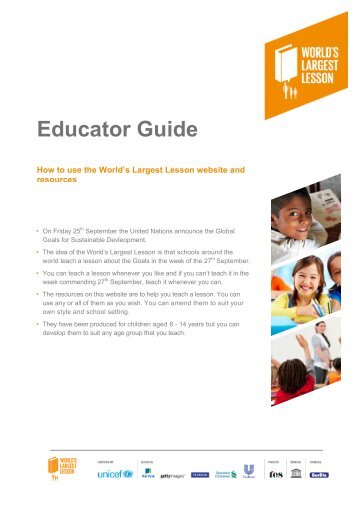
  • A techers' guide, 
  • A comic book ; a wonderful animation, 
  • a Global Goals guide for young people, and much more.
These pages provide information and resources to support teaching about the Global Goals for Sustainable Development.
On the website, you will find a wealth of background information on all of the Global Goals, together with teaching tips, classroom activity ideas and links to lesson plans, film clips and teaching packs.

  • Teachers guide: plans. Each plan have the time and age range;
  • The goals : a global goals animation video ; the global goals comic book ; the global goals guide written by and for children and young people across the world.
  • Global animation video:


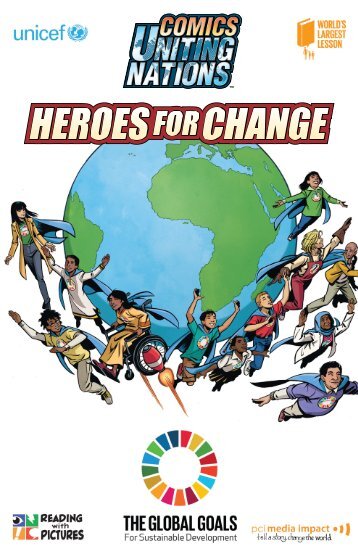
  • The global goals comic book:


The Global Goals comic book

Comics are effective teaching tools.  They require readers to not only passively receive information, but also interact with the text and images to construct meaning, and that is the key to the magic. Words and pictures work together!
Heroes for Change comic introduces the Global Goals and invites children to become superheroes themselves, by taking action to end poverty, inequality and climate change.


Students can read the comic book online ; download or print comic here.

Teachers can find more about using comics in the classroom here
  • The global goals comic book ; the global goals guide written by and for children and young people:


As educators, we have the power to inform and empower children and young people, so they are able to take action to help end poverty, reduce inequality and fight climate change.


  • Subjects & ideas:
Here are some teaching ideas for exploring the Goal 4 through different subjects:


English / Mother tongue (in 10 languages): Invite your students to write letters to friends in other countries (real or imaginary) describing school and school experiences.
Maths: Calculate percentages of boys/girls, primary/secondary etc pupils in education in different countries.
Geography: Use ShowWorld maps to help analyse education situations in different countries.
History: Focus on a historic education campaign (for example, education for girls, free education, universal primary education, other) and study the motivations, process and outcomes.

Civics : Students can imagine being the teacher for a day and write and perform role-plays of how they would run a class.
I do it sometimes, and students love playing the teacher. They prepare the lesson very well and they run a class with teacher tutoring and classmates cooperating.

Age range : from 4/5 to 15/16

Other resources: 


Toolkit:
You can download a toolkit for children and young people who want to make sure their voice is heard in a post-2015 world. 

The toolkit will help them develop the advocacy and campaign actions that they themselves want to take.


Some thoughts:


It’s one great big opportunity to foster global citizenship in your school, support students learning across a range of subject areas such as languages, science, geography, maths, citizenship and technology and develop big ideas including human rights, poverty, and environmental issues.

Students love to participate in great human causes. I remember the Earth Day first time they had the opportunity to join the Global Campaign for Education, Peace Day, We can end Poverty, Zero Discrimination.

Schools and teachers have a great role inspiring children and young adults know what they can do to get involved and become true global citizens!

The Global Goals and some of their themes can select and shape lessons that are relevant for the children that you teach.

Of course, you can share stories, photos and videos of your lessons directly The World Largest Lesson website or on twitter or facebook


G-Souto 

29.09.2015
Copyright © 2015G-Souto'sBlog, gsouto-digitalteacher.blogspot.com®

Creative Commons License

Teachers ! Join the World's Largest Lesson by GinaSouto is licensed under a Creative Commons Attribution-NonCommercial-NoDerivatives 4.0 International License.