The OECD’s Centre for Educational Research and Innovation (CERI) launched the New Millennium Learners (NML) project in 2007. It has the global aim of investigating the effects of digital technologies on school-age learners and providing recommendations on the most appropriate institutional and policy responses from the education sector.
NML
O conceito de New Millenium Learners sugere que a adopção das Tecnologias particularmente pelas novas gerações - os nativos digitais - tem uma presença forte na construção da sua identidade, no modo como comunicam socialmente em rede, e como administram a informação e o conhecimento.
The concept of New Millennium Learners suggests that technology uptake, particularly by younger generations, has an effect on the way people build their identities, communicate socially, and manage information and knowledge.
Durante três intensos dias de trabalho, investigadores de trinta países espalhados pelos vários continentes, apresentaram perspectivas desse impacto na Educação dos adolescentes Millenium.
No final de cada sessão foram apresentados vídeos com testemunhos de estudantes de uma escola secundária da Flandres, que demonstraram bem como o papel dos professores inovadores é importante no seu percurso escolar.
As chamadas competências do século XXI foram portanto o tema centralizador da Conferência. O consenso foi geral! A definição de aprendizagens e competências a serem exigidas aos jovens estudantes, de modo a tornarem-se futuros profissionais de qualidade e cidadãos responsáveis, é urgente.
These so-called 21st Century Competencies, which are the main topic of this conference, cover the range of skills and competencies that young people will be required to have in order to be effective workers and responsible citizens in the knowledge society of the 21st century.
Definiram-se várias estratégias, que passam pela transversalidade das Tecnologias e de temas de Cidadania em todos as áreas curriculares, pelo que áreas como Informática e Educação Cívica não terão mais razão de existir. Também são aconselháveis a modernização de alguns currículos escolares.
A responsabilização das escolas na formação dos seus professores, e consequente actualização dos mesmos, serão metas a atingir com carácter obrigatório.
No penúltimo dia foi oferecido aos conferencistas e participantes um jantar de confraternização no 30º andar de um edifício, com uma soberba panorâmica sobre uma grande área da cidade de Bruxela, num final de tade outonal de rara beleza. Um pôr-do-sol esplendoroso.
Saí mais enriquecida no final deste diálogo internacional! O projecto NML será um êxito se todos nos empenharmos nas novas tendências e objectivos da Educação, neste século XXI.
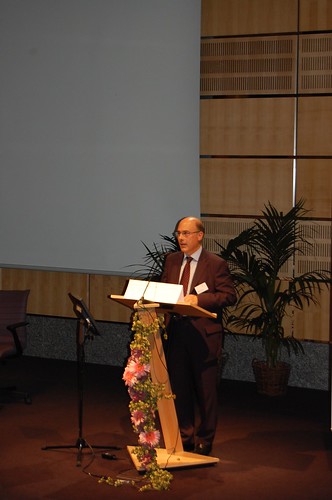
Dr Francesc Pedró OECD/CERI
100 researchers, teachers and organisations from 30 countries participated at the New Millenium Learners Conference that took place at the Flemish Ministry of Education, Brussels, Belgium, on 21-23 September 2009.
Micheline Scheys who manages the interface project between education and labour policy within the Flemish Ministry of Education and Training in Belgium has been an unique hostess of NML Conference.
All the sessions took place in the Auditorium of the Conscience Building. The first NML Conference aimed at showcasing the results of the first phase to link them to the next.
Many speakers presented their overview about changing policies and programs. This slide from Marc Durando of the European Schoolnet succinctly captures the inhibitors to implementing such policies and programs.
Marc Durando/ European Schoolnet (slide)
Finland is a nation that has been very successful in raising education performance. The “Road Ahead” provided by Oystein Johannessen could be useful. Mr Johannessen is the Deputy Director General from the Norwegian Ministry of Education and Research about to begin a secondment to the OECD’s Centre for
Educational Research and Innovation (CERI).
For three days, researchers presented their investigations and opened an interesting discussion with all participants, sharing ideas and experiences about "the range of skills and competencies that young students will be required to have in the knowledge society of the 21st Century".
Dirk Van Damme/Head of the CERI*
The last day, Anthony Mackay, conference rapporteur made the final report with some key-notes. Dirk Van Damme, head of CERI, presented general conclusions, mentioned the Global Financial Crisis.
This ongoing event highlights the need to prepare students for an unknown future where the only certainty is change and the most successful people will be able to analyze what’s happening and to make choices that support their own and their community’s welfare. This brings to clear focus the difference between ICT Literacy / “High Tech job prep” and 21st Century Skills.
Dirk Van Damme
Between all sessions, some videos with students' voices from the Provinciale Secundaire School Diepenbeek had been presented.
It's always very interesting to hear the voices of the students about their teachers, learning, e-skills, and Internet use, in school and out school, at home.
All the research outcomes or policy initiaves in the area can only be put in practice if teachers and students regard them as valuable and relevant to their teaching and learning experience.
NML country survey
My thougths:
I think, as an independent researcher on learning & ICT, and teacher/ e-facilitator that young people brought a fantastic new vision to Education, since the 'first digital generation', in the 90's with their visual spatial skills, non verbal intelligence, multi-tasking attitude, in the classroom. And of course, their first smartphones used in the classroom as an educative tool.
Schools must change. Completely! Curricula must be adapt to these 'new kids on the block'. Technology and digital devices will be incluse into school curriculum with books, pencils & other.
However there are some innovative teachers that are going digital and are more creative in their lessons.
As a "pioneer native" teacher and author, I create some educational digital resources in cross-curricular, increasing skills and competencies of my students, motivating them to go further "in order to be effective workers with the digital skills to have a decent job ans be responsible citizens in the knowledge society of the 21st century".
Wonderful and instructive conference!
G-Souto
01.10.2009
Copyright © 2009G-Souto'sBlog, gsouto-digitalteacher.blogspot.com®
References: Slides from Tom March's site.
Acknowledge:
Micheline Scheys
Flemish Ministry of Education
OECD/CERI
Sarina De Rijbel (Secretariat)