Showing posts with label graphic facilitation. Show all posts

Tuesday, July 26, 2011

PISA: Using graphic facilitation


Are students well prepared for future challenges? Can they analyse, reason and communicate effectively? Do they have the capacity to continue learning throughout life?

The OECD Programme for International Student Assessment (PISA) answers these questions and more, through its surveys of 15-year-old in the principal industrialised countries.

Every three years, it assesses how far students near the end of compulsory education have acquired some of the knowledge and skills essential for full participation in society.

But, what is PISA? If you're not quite sure what PISA is or does, and you've got about 12 minutes to spare, watch the video in graphics below:


It's a breathtaking concept. For the OECD, it's a very real way of finding out how well-prepared today's students are to participate in society.

Did this video helped you to understand why the OECD's number-crunchers trigger such intense debate about the state of education around the world every time they release the results of the latest PISA survey?

"The best teachers are often found in schools attended by advantage students who generally do well on their subjects anyway."

G-Souto

25.07.2011
Copyright © 2011G-Souto'sBlog, gsouto-digitalteacher.blogspot.com®

Credits video: EDUcontact

Licença Creative Commons
PISA: Using graphic facilitation bG-Souto is licensed under a Creative Commons Attribution-NonCommercial-ShareAlike 3.0 Unported License.

References: OECD
https://www.oecd.org/

Tuesday, May 24, 2011

Using VTS in Education


Dessin Gerard Mathieu


In our days, creativity and innovation are fundamental aims to captivate students in the classroom. Sometimes curricula are not very attractive! But educators can change it. 


Have you read Sunni Brown's "Game Storming Book"?  Watched her at the TED conference?

Thought doodling was a waste of time? It's not, for an example of useful doodling watch the video by Allison Crow below.


You have to admit! It's much more interesting than another yawner of a PowerPoint Presentation. 

Visual Thinking Strategies (VTS) is a research-based teaching method that improves critical thinking and language skills through discussions of visual images.


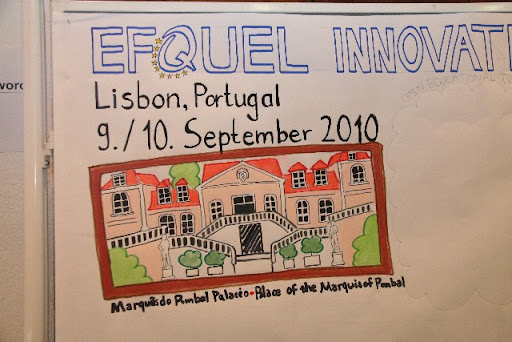
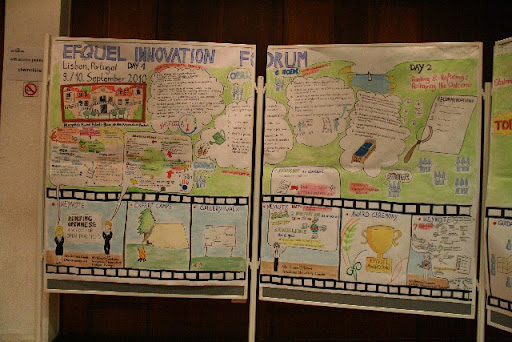
I can share with you the increadible work on visual thinking at Lisbon EFQUEL Innovation Forum, September 2010. It encouraged a lot the dialogue between all participants. And we could follow the disussions of all the workshops through the different graphic panels. 
The team of graphic facilitation students of the United Nations University, Vice-Rectorat in Europe (UNU-ViE) did an impressive and fantastic panel in visual thinking about all the sessions during three days and encourage a lot the discussion between all the participants.

EFQUEL Innovation Forum 2010
Part of final graphic panel 

VTS Facilitation in Education:

Visual Thinking Strategies uses art to foster students' capacities to observe, think, listen and communicate.

In VTS discussions teachers support student growth by facilitating discussions of carefully selected works of visual art. 

For example watch A VTS Discussion with Fourth Grade Students on the video below

A VTS Discussion with Fourth Grade Students from Visual Thinking Strategies on Vimeo.

VTS encourages participation, especially among students and educators. VTS is easy to learn and offers a proven strategy for educators to meet current learning objectives as you could watch on the video.

You can watch other videos with different grades here. And learn more about VTS here.

Educators an find some strategies and techniques here

"One of our most exciting partnerships is built around the Visual Thinking Strategies, an innovative arts based curriculum that offers great promise for education." (...)


G-Souto
24.05.2011

Copyright © 2011G-Souto'sBlog, gsouto-digitalteacher.blogspot.com®


Credits: Video Visual Thinking Allison Crow

Video VTS Discussion with Fourth Grade students


Licença Creative Commons