Thursday, December 18, 2014

Arts Education : Museums & Apps


Musée des Arts et Métiers, Paris (iPhone, tablet)
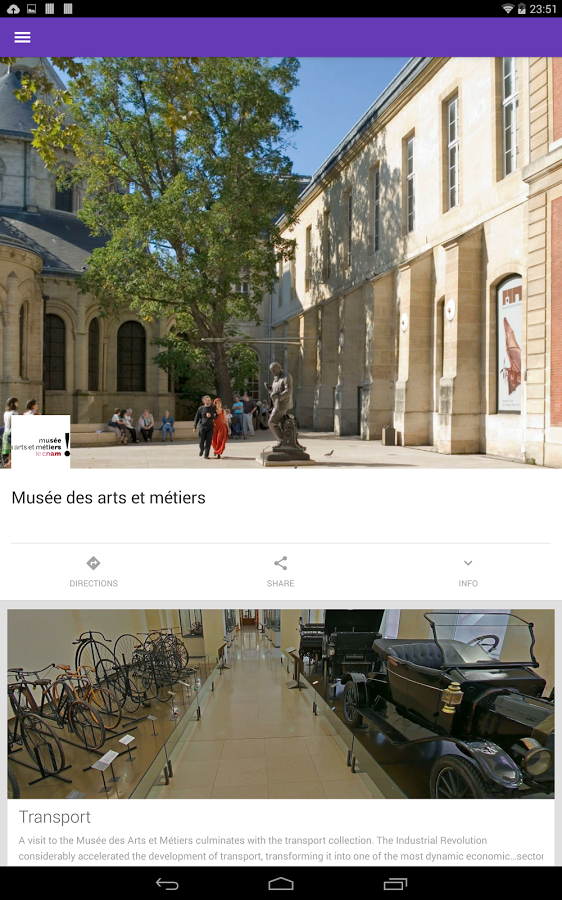


screenshot app Musée Arts et Métiers, Paris

Speaking on Arts in Education, here a new tool ! An app for students of Arts.

The Musée des Arts et Métiers has a new app for students of Arts. And for teachers of course.

We can enter at the Museum of Arts et Métiers, in Paris, and one of the first things on view is a strange looking plane perched over a historic staircase. Wonder what it is? Let's see !


Aeroplane 3
screenshot Musée des Arts et Métiers app

Since the 10th December, we can click on a mobile app based on Google Cultural Institute platform and learn about the French inventor and engineer Clement Adler’s 120-year old rival to the Wright Brothers.


Musée des Arts et Métiers, Paris (iPhone, tablet)

Some information:

L’application (appli) du Musée des arts et métiers disponible gratuitement sur la plateforme Google Play, permet de suivre en français et en anglais les 8 visites guidées thématiques suivantes :


• Collection Communication
• Collection Énergie
• Collection Instruments scientifiques
• Collection Transports
• Collection Construction
• Collection Matériaux
• Les objets phares

Plus de de 200 objets commentés accompagnés de photos en haute définition et une visite "Les objets phares" audioguidée pour découvrir les collections du musée en toute autonomie.


Education:

The Musée of Arts et Métiers is a new app for teachers and students of Arts. We can enjoy an artwork or love the story behind an object. 

Teachers and students can discover all the beautiful artworks at Musée des Arts et Métiers and  follow in "the footsteps of inventors and pioneers of progress and explore a one-of-a-kind repository of scientific and technical knowledge".


App:

More than 250 objects presented with 8 thematic tours : 

  • Highlights of the collection, 
  • Scientific instruments, 
  • Materials, 
  • Energy, 
  • Mechanics, 
  • Construction,
  • Communication and Transport.
Languages :
  • Français
  • English
Prize:

It's a Free app

Let's watch the video below:


credits video : Google Culture Institute

Other apps of Museums :

There are other interesting and motivating apps from different MuseumsEleven museums and cultural institutions in Italy, France, the Netherlands and Nigeria, have worked with Google engenineers on this pilot project. Their apps are available for free on thGoogle Play store.


Golden
screenshot Museo d'Arte Orientale MAO


Portrait of a Man
screenshot Fondazioni Torino Musei GAM
https://lh3.ggpht.com/

Palazzo Madama (iphone, iPad apps)


Palazzo Madama
screenshot Palazzo Madama


Museo MaGa
screenshot Museo Ma.Ga

In Turin, teachers and students can discover the riches of the near and far East at MAOwonder at the surprising artworks at GAM, and go from the Middle Ages to contemporary photography at Palazzo Madama

But they can discover as well the international street artworks and their authors,brought together by the Emergence Festival


Finally, strolling through MAGA to find out more about the Italian contemporary art scene.


Rijksmuseum Museum (iPhone, tablet apps)
In the Netherlands, learners and educators cavisit the Rijksmuseum van OudhedenIts app explores archaeological treasures from Egypt, Rome, and the Netherlands. 

And what about the history of Nigeria?  We can discover the story of the Amalgamation of the Southern and Northern Protectorate 100 years ago thanks to the Pan-Atlantic University app.


Digital Museum of Nigerian History

This is a chance to follow in the footsteps of artists, inventors and pioneers of art and progress and explore a one-of-a-kind repository of artistic, scientific and technical knowledge.

These mobile apps allow easy sharing with friends. Because Internet access can be a challenge when traveling abroad, we made sure these apps will work when you're offline.

The Internet no longer plays just a minor role in diffusing museum knowledge. It has become a major force, allowing museums to expand and strengthen their reach. 


Museums see digital media as core to their mission of education and inspiring people about art and culture.


screenshot app Musée Arts et Métiers, Paris

Some thoughts :

“Museums are an important means of cultural exchange, enrichment of cultures and development of mutual understanding, cooperation and peace among peoples”.

Unesco


In recent years  museums have begun to re-examine what education means for them and there has been a growing emphasis on the importance of all kinds of learning within museums

The world is changing faster than ever. New technology delivers new ideas, gigabytes of information, news of art and museums shared by social media. 

Increasing numbers of museums are experimenting with digital learning. This issue of Museum Practice looks at how museums are exploring the potential of digital technology to offers visitors personalised learning experiences with a focus on collaboration an participation

Modern museums must compete for an audible voice against the furious pace of this background.

Museums in a changing world is recognition that institutions are faced with interpreting, and existing in, a field that is becoming increasingly fluid. Each may face a unique set of goals, interests and audiences."

Museums  have an a attractive impact in the curriculum. Students love school visits to museums. Students can appreciate there is history all around them.

There is nothing to stop any school enjoying trips to educational historic sites if their pupils will benefit.

G-Souto

19.12.2014


Tuesday, December 16, 2014

Teaching Arts : How about Wassily Kandinsky & Abstract Art : Resources


Wassily Kandinsky

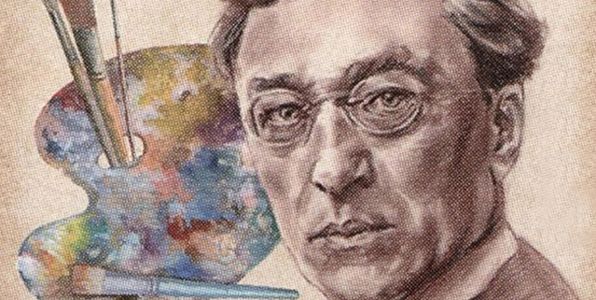
Detail of Serbian stamp commemorating 150 years 
since Wassily Kandinsky's birth
via the ArtStory


"Of all the arts, abstract painting is the most difficult. It demands that you know how to draw well, that you have a heightened sensitivity for composition and for colors, and that you be a true poet. This last is essential."

Wassily Kandinsky


One of the pioneers of abstract modern art, Wassily Kandinsky exploited the evocative interrelation between color and form to create an aesthetic experience that engaged the sight, sound, and emotions of the public. He believed that total abstraction offered the possibility for profound, transcendental expression and that copying from nature only interfered with this process.

Highly inspired to create art that communicated a universal sense of spirituality, he innovated a pictorial language that only loosely related to the outside world, but expressed volumes about the artist's inner experience. 


Google Doodle Wassily Kandinsky's 148th Birthday


Google Doodle:

December 16th, Google celebrates the 148th birthday of the Russian painter Wassily Kandinsky. The doodle reflects his own distinct abstract style.


There she is, you are saying ! Writing about Art and Doodles, again. I know, I know. Being from Humanities, I love all the expressions of Visual Arts, Music, Literature, Linguistics.


Google Doodle Wassily Kandinsky's 148th Birthday

Doodles! Well doodles are a awesome digital resource to introduce a new theme into curriculum and surprise the students as a motivation to awake their curiosity. Students love be surprised each lesson. Something rather new, unexpected is just the right tip.


Wassily Kandinsky (1866-1944)
The Granger Collection, New York


"To create a work of art is to create the world."

Wassily Kandinsky

Some information :

Born in Moscow in 1866, his career spanned five decades during which he was influenced by, among other artistic movements, Impressionism, Fauvism, Pointillism, Bauhaus architecture and Abstract expressionism.


Wassily Kandinsky, Nina Kandinsky, Georg Muche, Paul Klee, Walter Gropius, Dessau
Walter Obschonka, 1926


Kandinsky, who is credited with being the first painter to produce purely Abstract works, use colour as an expression of emotion, often likening the process of painting to composing music.


In Grey, 1919
Wassily Kandinsky
Paris, Musee National Art Moderne, Centre Georges Pompidou

Born on December, 16th, 1866 in Moscow, in a well-to-do family of a businessman in a good cultural environment. In 1871 the family moved to Odessa where his father ran his tea factory. There, alongside with attending a classical gymnasium (grammar school), the boy learned to play the piano and the cello and took to drawing with a coach. 

"I remember that drawing and a little bit later painting lifted me out of the reality", he wrote later. 

In Kandinsky's works of his childhood period we can find rather specific color combinations, which he explained by the fact that "each color lives by its mysterious life". 


Bustling Aquarelle, 1923
Wassily Kandinsky


Kandinsky only began his artistic career at the age of 30, having previously studied law and economics at university to satisfy his family’s wishes.

In 1896, he decided to give up a successful career (associate Professor at Law Faculty) to devote himself completely to painting. Later on Kandinsky recollected two events, which had affected this decision: his visiting an exhibition of the French impressionists in Moscow in 1895 and an emotional shock he experienced from K. Monet's, "Haystacks", and an impression of Richard Wagner's "Lohengrin" at the Bolshoi Theatre. 


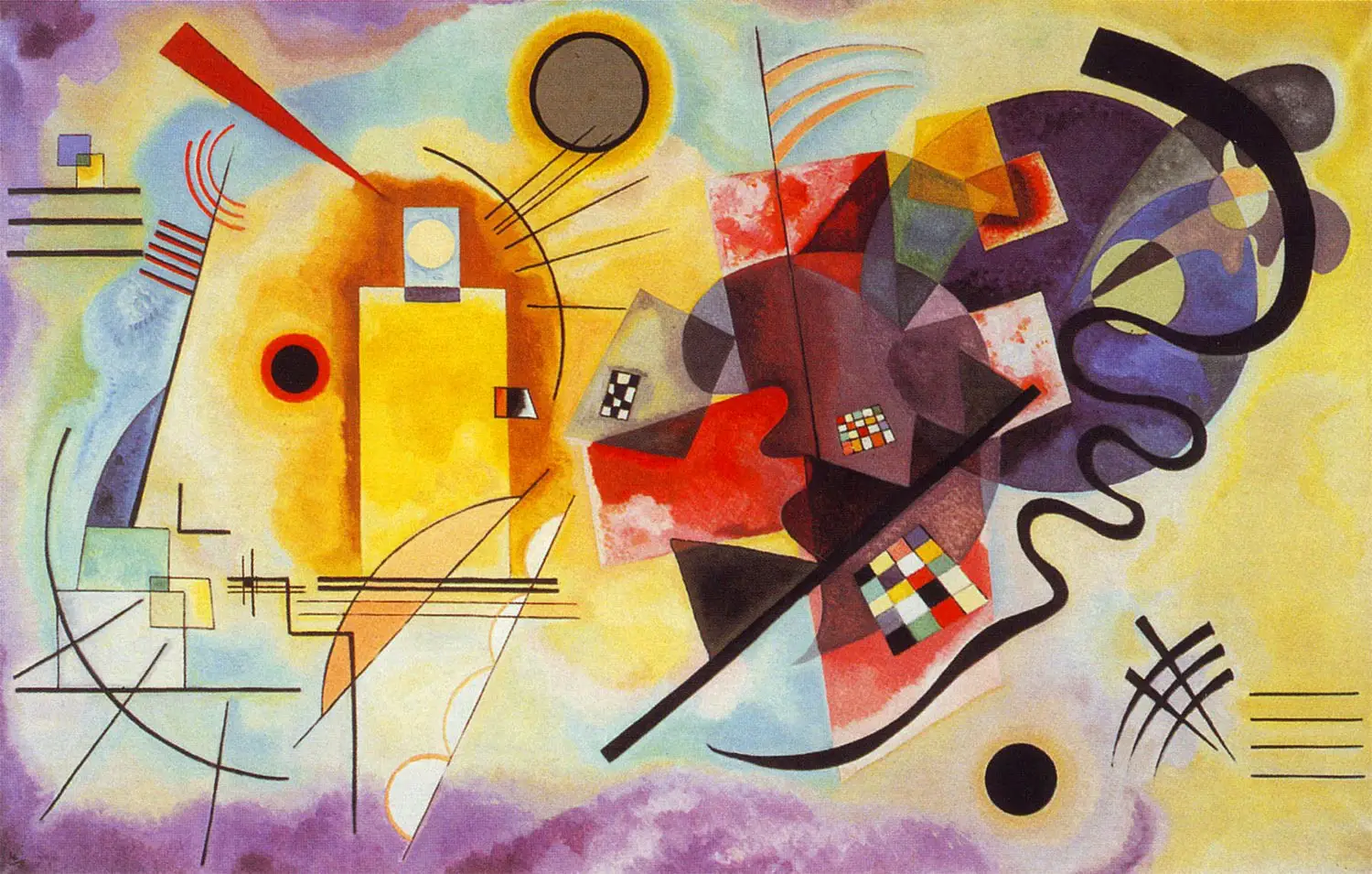
Yellow-Red-Blue, 1925
Wassily Kandinsky
Paris, Musee National Art Moderne, Centre Georges Pompidou
https://www.wassilykandinsky.net/


He left for Munich, at that time considered to be one of the centers of the European art, and entered Anton Azbe's (Yugoslavian artist) prestigious private painting school , where he received the first skills in image composition, in work with line and form. 

In 1900 after a failure of the previous year, Kandinsky entered the Munich Academy of Arts, and studied under Franz Stuck, "German graphic artist Number One". 


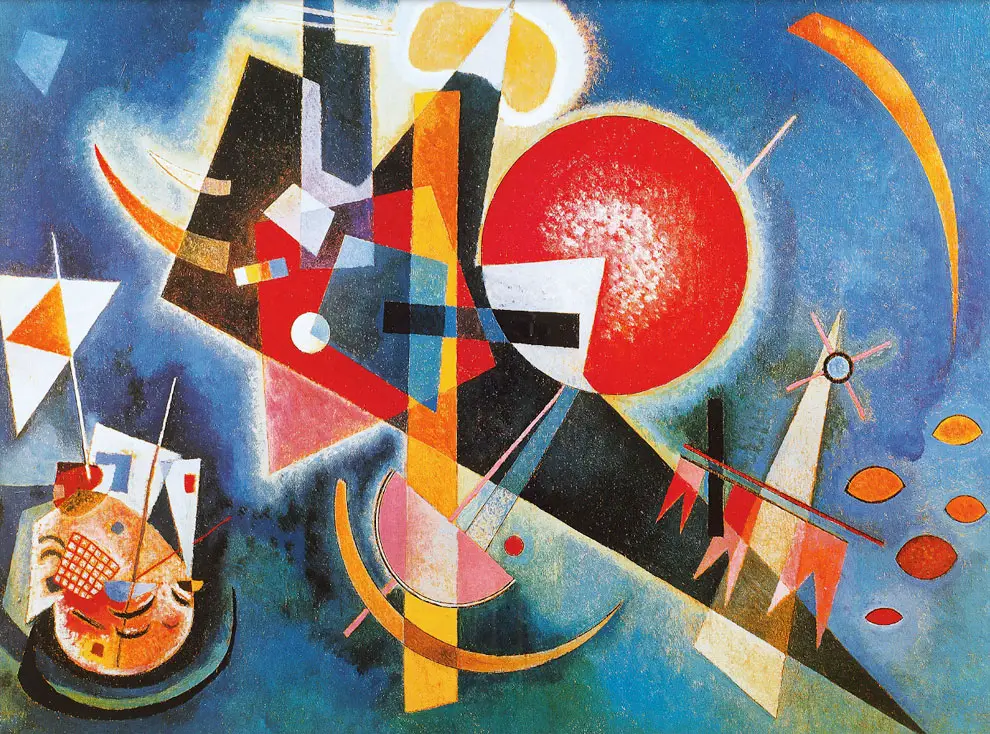
In Blue, 1925
Dusseldorf, Kunstsammlung Nordrhein-Westfalen, Germany
https://www.wassilykandinsky.net/

Kandinsky returned to Moscow after the outbreak of World War I, but was not sympathetic to the official theories on art in communist Russia and went back to Germany in 1921, where he taught at the Bauhaus school of art and architecture from 1922 until the Nazis closed it in 1933.

He then moved to France, where he lived for the rest of his life, becoming a French citizen in 1939 and producing some of his most prominent art. 

He died at Neuilly-sur-Seine (France) in 1944. His influence on 20th-century art, often filtered through the work of more accessible painters, was profound.


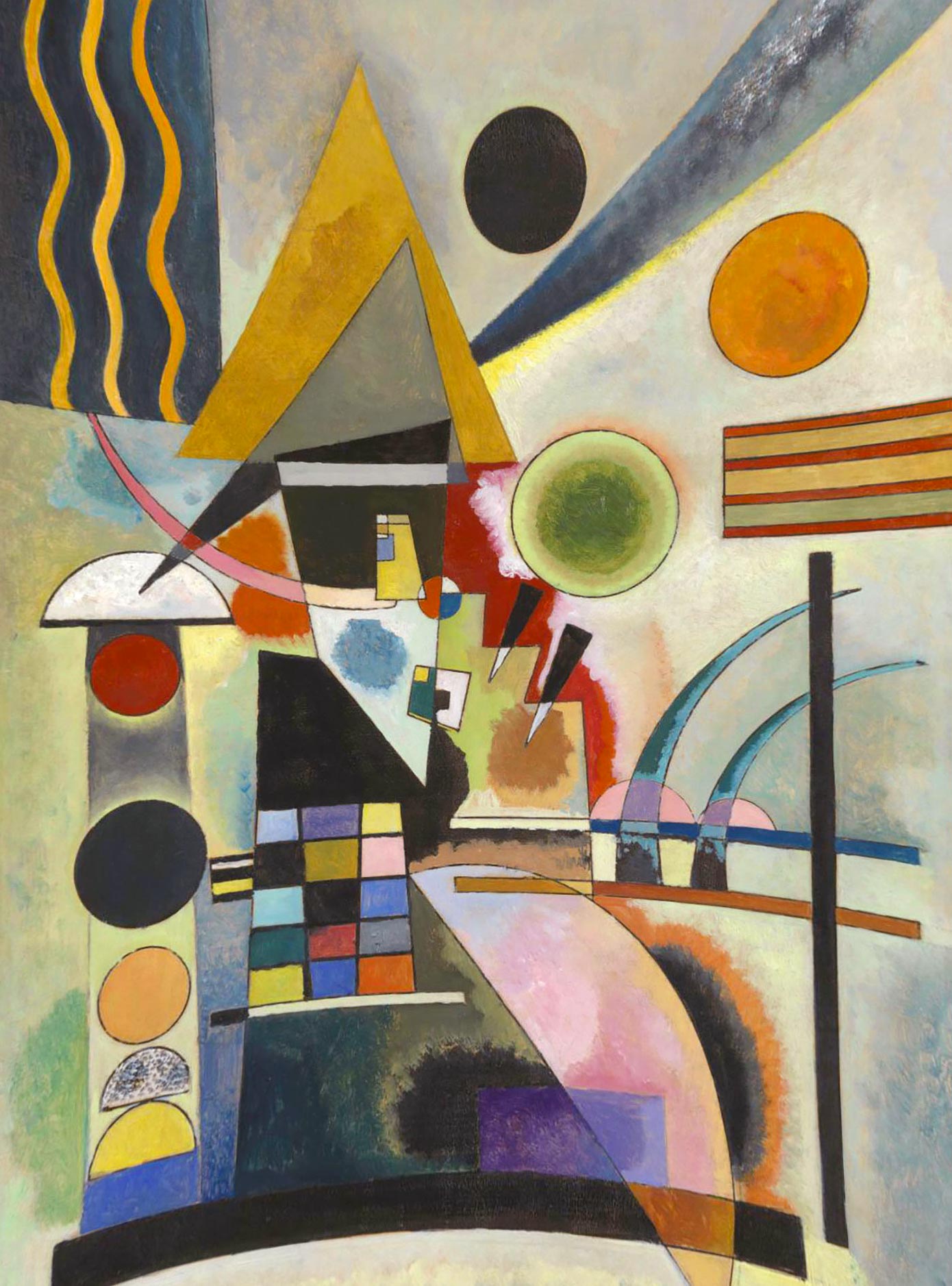
Swinging, 1925
Wassily Kandinsky

Education:

"Abstract art places a new world, which on the surface has nothing to do with "reality," next to the "real" world. Deeper down, it is subject to the common laws of the "cosmic world." And so a "new world of art" is juxtaposed to the "world of nature." This "world of art" is just as real, just as concrete. For this reason I prefer to call so-called "abstract art" "concrete art."

Kandinsky

All my usual readers know how I am a truly convinced defender of a complete education in school with Music and Art. STEM are crucial, Literature, Languages, Music and Arts are essential as well.

We can't develop our skills for life without a complete education. Art and Music are the first huge step towards a new future to gifted kids and all kinds students.

All over the years, you read my thoughts about the importance of Arts in School Education, no matter the art fields: MusicDance, Theatre LiteraturePainting, SculptureArchitecture.


"Everything starts from a dot."

Wassily Kandinsky

Arts are absolutely necessary to a complete and better education of children and young adolescents. Throught primary to se
condary education, some students discover their inner path on Arts and later they will choose Art colleges and Higher Schools of Arts to develop their aptitude by a real leaning.


DoodlesLove Google doodles! They can be include into any curriculum as I already wrote. Doodles combine creativity, curiosity, digital skills, culture and a motivation to a different start of an interesting lesson, You must think about it.


Teachers:

Here, a good digital resource to one or two lessons on Modernism. Of course each teacher must prepare and adapt the activities to the level they are teaching.

Ask your students to explore the websites Kandinsky and The Art Story/ Wassily Kandinsky 
to an interesting start on the subject.


IT and social media in the classroom are important tools to tackle the world's toughest problems creating bridges and establish a truly intercultural world, where diversity can be celebrated, a world where different cultures not only coexist but value each other for their contributions and potential.

Level: All levels including Vocational Education, Further Education.

Curricula: Arts; Cross-curricular (Literature, Arts, Music).


"Lend your ears to music, open your eyes to painting, and... stop thinking! Just ask yourself whether the work has enabled you to 'walk about' into a hitherto unknown world. If the answer is yes, what more do you want?"


Wassily Kandinsky


G-Souto
16.12.2014

update 21.12.2022
Copyright © 2014G-Souto'sBlog, gsouto-digitalteacher.blogspot.com®

Creative Commons License
Teaching Arts : How about Wassily Kandinsky & Abstract Art : Resources bG-Souto is licensed under a Creative Commons Attribution-NonCommercial-NoDerivatives 4.0 International License.