Showing posts with label smartphones in education. Show all posts

Friday, December 16, 2011

Schools & IT : Olive, a film about loneliness : some values


Olive 
 Patrick Gilles & Hooman Khali, 2011

Olive is the very first full length feature film shot 100% on a cellphone. The crew shot the film with a smartphone mounted to a modified 35-mm lens, to achieve a shallow depth of field. 

It’s crazy how far cellphone camera technology has advanced!
Olive follows the story of a little girl that transforms the lives of three people without speaking one word.
The film boasts the involvement of the two time Oscar Academy Award nominated 81 year old actress Gena Rowlands (The Notebook, A Woman Under the Influence, Gloria).


Olive
 Patrick Gilles & Hooman Khalili, 2011


  • Synopsis:

The film is about a little girl that goes into the lives of three people — an old lonely woman, a foreigner having a hard time acclimating in the United States, and an obese man — and transforms their lives without saying one word!

A mysterious child with magical powers and a great secret, invades the lives of three lonely people who learn to embrace life once again.


Olive
 Patrick Gilles & Hooman Khalili, 2011

Olive is the first full-length feature film shot entirely on a cell phone, a Nokia N8 smartphone. 

“Technology is moving so quickly and cellphones are really going to be the thing that does everything eventually,” director Hooman Khalili told AFP in an interview ahead of the US theater release of his movie on December 16, 2011.

Set for release in Los Angeles next week, the movie is eligible to be nominated for the Oscars in February.


“I thought, how great would it be to have a central character that doesn't speak but you understand everything she is trying to communicate,”

 Hooman Khalili (director)


Olive
 Patrick Gilles & Hooman Khalili, 2011

Education:

It's Christmas time! So many old people are alone on December and festive season.

Olive could be an interesting motivation to introduce the importance of values such as loneliness in old age, in school education. Here we can explore solidarity:

Values:
  • Sometimes, young people cross old people who have problems about loneliness. It's not so difficult to help old people with a word or a smile and give some 'sunshine' into their lives with a single gesture.
  • Every Christmas season, when December begins, my students and I had activities of solidarity included and developed in Languages curriculum.

I do remember, two years ago, I proposed different activities. I included some subjects into school curriculum. My students chose the activity. There were two or three, but the students chose to write Christmas cards and send them by mail to three elderly homes.

The old people in those elderly homes (women and men) were so touched that some of them answered to my students telling how lonely they were feeling and the joy of receiving a card from somebody for the first time in years.


So, after Christmas season, we decided to visit the elderly homes to meet those old people ! They were so touched and it was a good experience to students. They felt very happy about their activity.

“Every single one of us at one time of our lives is down in a ditch… The way you get out of that ditch is by having someone reach you with their hand and pull you out,” 

Hooman Khalili

G-Souto

16.12.2011
updated 03.09,2022
Copyright © 2011G-Souto'sBlog, gsouto-digitalteacher.blogspot.com®

Licença Creative Commons
Schools & IT : Olive, a film about loneliness : some values by GinaSouto is licensed under a Creative Commons Attribution-NonCommercial-NoDerivatives 4.0 International License.


Tuesday, February 8, 2011

Schools : Reading Jules Verne, the father of science-fiction : resources


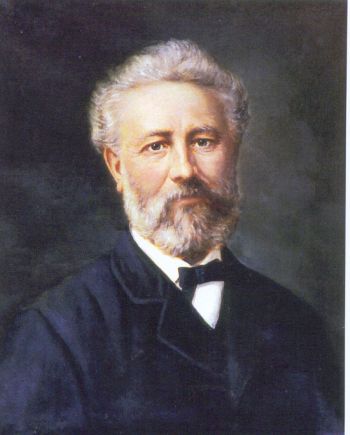
Jules Verne

“Anything one man can imagine, other men can make real.” 

Jules VerneAround the World in Eighty Days


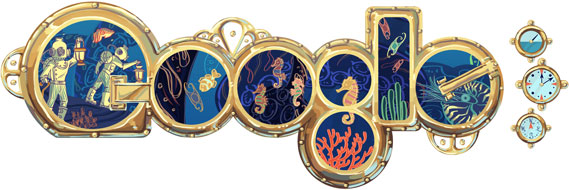
Google Doodle Jules Verne 183rd birthday

Today, 8 February, Google celebrates, with a interactive Doodle, the 183rd birthday of one of the most important science-fiction writer, Jules Verne, the French novelist, poet, and playwright best known for his adventure novels and his profound influence on the literary genre of science fiction. Verne was born on this day, 1828.

Jules Verne wrote fantastic novels as Twenty Thousand Leagues Under the Sea (1870) and Around the World in Eighty Days (1873), among many others. 

  • Google Doodle:

Google is celebrating the occasion with an interactive DoodleThe Doodle was inspired on the novel Twenty Thousand Leagues Under the Sea. 


It's beautifully designed and it also has a little secret! It lets your students 
navigate down 20,000 leagues under the sea. All they have to do is drag a lever with your mouse, tap your arrow keys, or - if they are viewing the Google page on an iPad, iPhone - tilt the screen.

They can explore the ocean from Jules Verne doodle in full view and HD.


Jules Verne
credits: Getty Images
https://www.gettyimages.com/

Some information:

Jules Gabriel Verne was born on February 8, 1828 in Nantes, in France. His novels (basically science-fiction) were all about his vision, as he wrote stories on space and underwater travel, even before spaceships and submarines existed. He is the pioneer of science-fiction genre. 


Jules Verne & science-fiction

Jules Verne is generally considered a major literary author in France and most of Europe, where he has had a wide influence on the literary avant-garde and on Surrealism. 

He has often been labeled a writer of genre science-fiction or children's books, largely because of the highly abridged and altered translations in which his novels are often reprinted.


  • Themes:

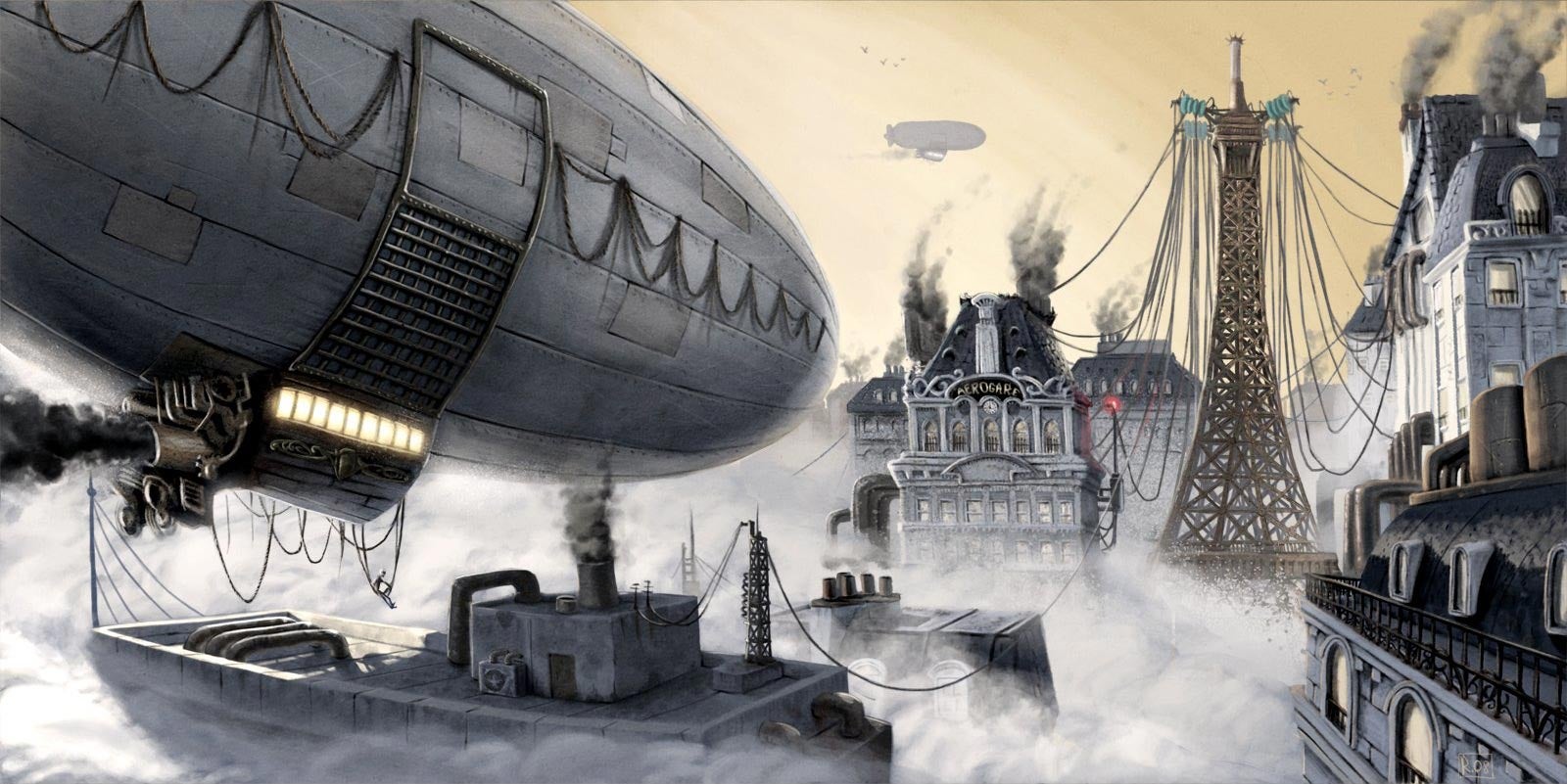
Verne wrote about: space, air, and underwater travel before air travel and practical submarines were invented, and before practical means of space travel had been devised. 


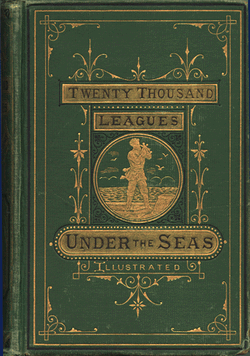
Twenty Thousand Leagues Under the Sea
Jules Verne, 1870

He is best known for novels such as Twenty Thousand Leagues Under the Sea (1870), A Journey to the Center of the Earth (1864), and Around the World in Eighty Days (1873).


Verne's stories, written for adolescents as well as adults, caught the enterprising spirit of the 19th century, its uncritical fascination about scientific progress and inventions. 

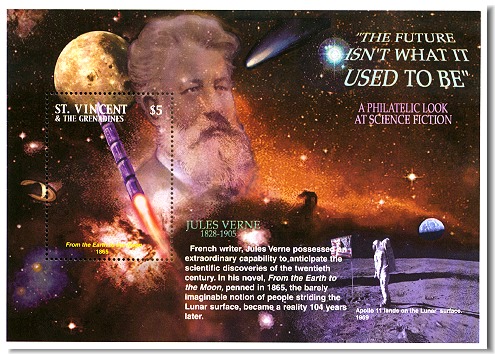
His works were often written in the form of a travel book, which took the readers on a voyage to the moon in From the Earth to the Moon (1865) or to another direction as in A Journey to the Center of the Earth (1874). 

Many of Verne's ideas have been hailed as prophetic. 


A Journey to the Center of the Earth
Jules Verne

  • Here & Now:

The pioneering ways of travel and exploration which he wrote so much about are now common-place for us, such as exploration of the moon, the north and south poles, and the use of hot air balloons for long-distance voyages.


Jules Verne illustration, surrounded by his inventions

  • Inventions & Characters:

In his time, Verne was a true inventor and visionary; the names of his inventions and characters such as Captain Nemo, Phileas Fogg, and the submarine Nautilus have entered, and remain, a part of our popular culture.


Journey to the Center of the Earth
Eric Brevic, 2008

Among his best-known books are Twenty Thousand Leagues Under the Sea (1870) and the classical adventure story Around the World in Eighty Days (1873).


Around the Wold in 80 Days
 Frank Coraci,2004

Other books:

He wrote numerous short stories, essays, plays, and poems, alongside 54 extremely popular novels that only show a glimpse of the extent of his imagination.

For over 40 years Verne published at least one book per year on a wide range subjects.  Verne's oeuvre include 65 novels, some twenty short stories and essays, thirty plays, some geographical works, and also opera librettos. 


Verne's works have inspired a number of film makers. Some of his books have been made into movies and now into games.

He remains the most translated novelist in the world, according to UNESCO statistics.

Verne is often hailed in level with Hugo Gernsback and H. G. Wells, as the "Father of Science Fiction."


Education :
  • Reading: Choose with your students a novel to read in the classroom;
  • Writing: Let your students explore Jules Verne's home website (English, French, Spanish, Italian) on their smartphones or iPads to prepare an  essay about the author;
  • Drawing: Students could create a comic strip from a novel they read or not. Let them be free to choose at the school library or at home which book;
  • Web: Explore the possibility of asking your students to build a web blog in an exchange project with a French school;
  • Web 2.0: Find school partners on Facebook Twitter or Instragram;
  • Multimedia:  There are some interesting tools as:

1) Cartonise Jules Verne - the biographical essay done by students, or the novel that  you read in the classroom, could be cartonised by an easy way to create cartonized versions of images and drawings (students and teacher)

2) Create a video with Animoto (students and educator)

And now, let your students watch the creative 3D video animation below, inspired on Jules Verne's work


"Science, my boy, is made up of mistakes, but they are mistakes which it is useful to make, because they lead little by little to the truth." 

Jules VerneJourney to the Center of the Earth

G-Souto

8.02.2011
update 08.02.2023

Copyright © 2011G-Souto'sBlog, gsouto-digitalteacher.blogspot.com®
Licença Creative Commons
Schools : Reading Jules Verne, the father of science-fiction : resources bG-Souto is licensed under a Creative Commons Attribution-NonCommercial-ShareAlike 3.0 Unported License.