Showing posts with label web 2.0 in education. Show all posts

Tuesday, October 21, 2014

Catching the Orionid Shower : Science curriculum


Orionid meteor streaks above Norway in 2013  
credits : Tommy Eliassen


Tonight (October 21-22, 2014), could we see meteors in the annual Orionid shower? 
Scientists say that we have a good chance, even though this morning before dawn might have presented the peak numbers. 
Perhaps "the year's best meteor showers occurs in October: the Orionids, which result when Earth plows through debris shed over the years by the famous Halley's Comet
This year, the Orionids peak overnight from Oct. 21-22. Stargazers under dark, clear skies can expect 20 or so meteors per hour after midnight, NASA officials said. 


Credits . Dr. Tony Philips/ Science@NASA


About the Meteor Shower:

The Orionids, which peak during mid-October each year, are considered to be one of the most beautiful showers of the year. 


If the meteors originate from Comet Halley, why are they called the Orionids? 

The answer is that meteors in annual showers are named for the point in our sky from which they appear to radiate. The radiant point for the Orionids is in the direction of the constellation Orion the Hunter. Hence the name Orionids.


Orionid meteors are known for their brightness and for their speed. These meteors are fast - they travel at about 148,000 mph (66 km/s) into the Earth's atmosphere. 


Fast meteors can leave glowing "trains" (incandescent bits of debris in the wake of the meteor) which last for several seconds to minutes. 

Fast meteors can also sometimes become fireballs: Look for prolonged explosions of light when viewing the Orionid meteor shower.


The Orionids are also framed by some of the brightest stars and planets in the night sky, which lend a spectacular backdrop for theses showy meteors.


Possible Orionid meteor moving by the Gemini stars Castor and Pollux
The constellation Orion the Hunter is found at the upper right and the star Sirius below Orion’s Belt
Image: via Mike Lewinski

Skywatchers :

Skywatchers could get good looks this month at several different planets. In early October, for example, Mars and Saturn were visible low in the southwestern sky in the evening. Jupiter, meanwhile, is king of the predawn hours throughout the month.

The shower may be active for several days before or after its broad maximum, which may last from the 20th through the 24th. 

Step outside before sunrise on any of these mornings and if you catch sight of a meteor, there’s about a 75 percent chance that it likely originated from the nucleus of Halley’s Comet. 

After peaking on the morning of Oct. 21, activity will begin to slow, dropping back to around five per hour around Oct. 26. 

Orionid shower tonight :

The best time for viewing for these fast-streaking Orionid meteors is between midnight and dawn. That time holds true no matter what time zone you’re in. 

In 2014, virtually no moonlight will interfere, as the slender lunar crescent wanes toward new moon.

How many meteors can we expect to see? 

The number of meteors we will see in any meteor shower always varies greatly depending on when and where we watch. Meteor showers are not entirely predictable. That’s the fun of them! 

At most – on a moon-free night – we might see about 25 meteors per hour, or one meteor every few minutes, during the Orionid peak. 

The dark skies make 2014 a favorable year for watching the Orionid meteors tonight.


Education:
Most of us are excited about Orionid shower. Science students too. Do you remember the Perseid meteor shower in August 2013? What a sky show full of stars. 

But this time, teachers and students are in school time. So, science curriculum will be enhanced with the help pf this incredible event.

Do you want a better science lesson ?

During skywatching, teachers, students can do some good shots, or videos with iphones, smartphones or tablets to discuss the theme tomorrow or next lesson. May be compare it with the Perseid meteor shower of last year?
Meteor showers aren’t just one-night events. In fact, they can last for several days nutil Friday.
Fortunately, in 2014, the slim waning crescent moon rising shortly before sunrise is not in the way and will only enhance your enjoyment of the meteor shower if you find yourself out before dawn. 
Resources :


NASA Science | News
Space.com | October Skywatching
Social media in education:
Earth Sky @earthskyscience
NASA @NASA
Hoping to be lucky! After two rainy weeks, since last Saturday, the weather is warm and shiny, and the night will be so bright.


G-Souto

21.10.2014
Copyright © 2014G-Souto'sBlog, gsouto-digitalteacher.blogspot.com®

Licença Creative Commons
Catching the Orionid Shower : Science curriclum bG-Souto is licensed under a Creative Commons Attribution-NonCommercial-NoDerivatives 4.0 International License.

sources :Space.com ; Earth Sky ; NASA

Saturday, August 10, 2013

Catching the Falling Stars : Science curriculum


Perseid 2012
David Harpe, Boulder USA

"We have found that one meteor shower produces more fireballs than any other," (...) "It's the Perseid meteor shower, which peaks on August 12th and 13th."

Bill Cooke, NASA's Meteoroid Environment Office 

According to NASA research, the upcoming Perseid meteor shower produces more fireballs — bright meteors that streak across the sky — than any other annual shower, earning it the title of "fireball".

What is the Perseid meteor shower?


The Perseid meteor shower is an annual event occurring every August. They are tiny particles of dust and debris from the tail of a comet (109P/Swift-Tuttle) which planet Earth encounters every year in its orbit around the Sun. When these particles collide with the Earth’s atmosphere, they burn up causing bright flashes and streaks in the night sky. These are known as shooting stars or meteors.


The Perseids produced 568 tracked fireballs while the Geminid meteor shower came in a close second, producing 426 from 2008 to 2013. 


The annual Perseid meteor shower will reach its peak early next Sunday and Monday, August 11 and 12 2013, all night, and skywatchers in the world are flocking to their nation's national parks, where pristine, dark skies are ideal for watching what is typically the most dazzling fireball display of the year.

Some night sky enthusiasts have already reported Perseid sightings, but the meteor shower is expected to peak overnight Monday, August 12, 2013. 


photo: Credit: Starry Night Software
"Comet Swift-Tuttle has a huge nucleus - about 26 kilometers [16 miles] in diameter," (...) "Most other comets are much smaller, with nuclei only a few kilometers across. As a result, Comet Swift-Tuttle produces a large number of meteoroids, many of which are large enough to produce fireballs."

Bill Coke | NASA

Every year, the Earth passes through a trail of dust left behind in the comet's wake. The dust burns up in Earth's atmosphere, creating the brilliant shower.


Education:

Most of us are on vacation. But students can watch this exciting event of the summer with family or in campus summer.

However, if you are a Sciences teacher you can do some amazing videos or photos to explain the Perseid show during a lesson after school summer holiday.

Resources:

There is an interesting guide written by Phil Plait (adaptation):
1) Find a place that's dark. The darker the spot you find away from house and city lights, the better.
2) Your best bet is to have as much sky visible as possible. The more heavenly real estate you can see, the better your chances of seeing more meteors.
3) Be outside after local midnight - literally, halfway between dusk and dawn. After midnight, you're on the part of the Earth facing into the direction of the Earth's travel around the Sun, so you'll see more meteors then.
4) Relax! Use a lounge chair or some other comfortable way to lie out. You'll see a meteors on average once a minute or three. So you need patience - which is rewarded when you see that bit of light zipping across the sky. 
5) Look up! You don't need a telescope or binoculars or other fancy equipment. Remember, the more sky you see the better.
6) Taking pictures of meteors is easy if you only have an inexpensive camera and a tripod. Set it up, point it anywhere you want - find a nice collection of bright stars if you prefer - and let it expose for a few minutes if you can. If you are lucky, you'll find a nice bright streak or two in some of the pictures. Meteors!
7) Got wireless? Then bring your mobile device outside with you and listen to the meteors, too! This is totally cool! son't miss it and 
Other Guides: 


Apps:

Meteor counter app for iPhone

Meteor counter app for Android

Social media:

Twitter: Join in with the worldwide #meteorwatch

Video: Tonight's Sky


Of course, you must keep the idea of the beauty and the pedagogical watching of this marvelous summer falling stars shower.

"The Perseids are the highlight of the astronomical calendar and a must see! They are ideal for those who want to see a meteor/ shooting star for the first time."

Hoping to be lucky! I am preparing my garden chair, a soft sweet-shirt, may be a blanket, a little Pink Floyd music, The great gig in the sky, my Android, and some green hot tea to watch the falling stars from my high balcony near country.


G-Souto

10.08.2013
Copyright © 2013G-Souto'sBlog, gsouto-digitalteacher.blogspot.com®

Licença Creative Commons
Catching the Falling Stars: Science curriclum bG-Souto is licensed under a Creative Commons Attribution-NonCommercial-ShareAlike 3.0 Unported License.


Tuesday, February 8, 2011

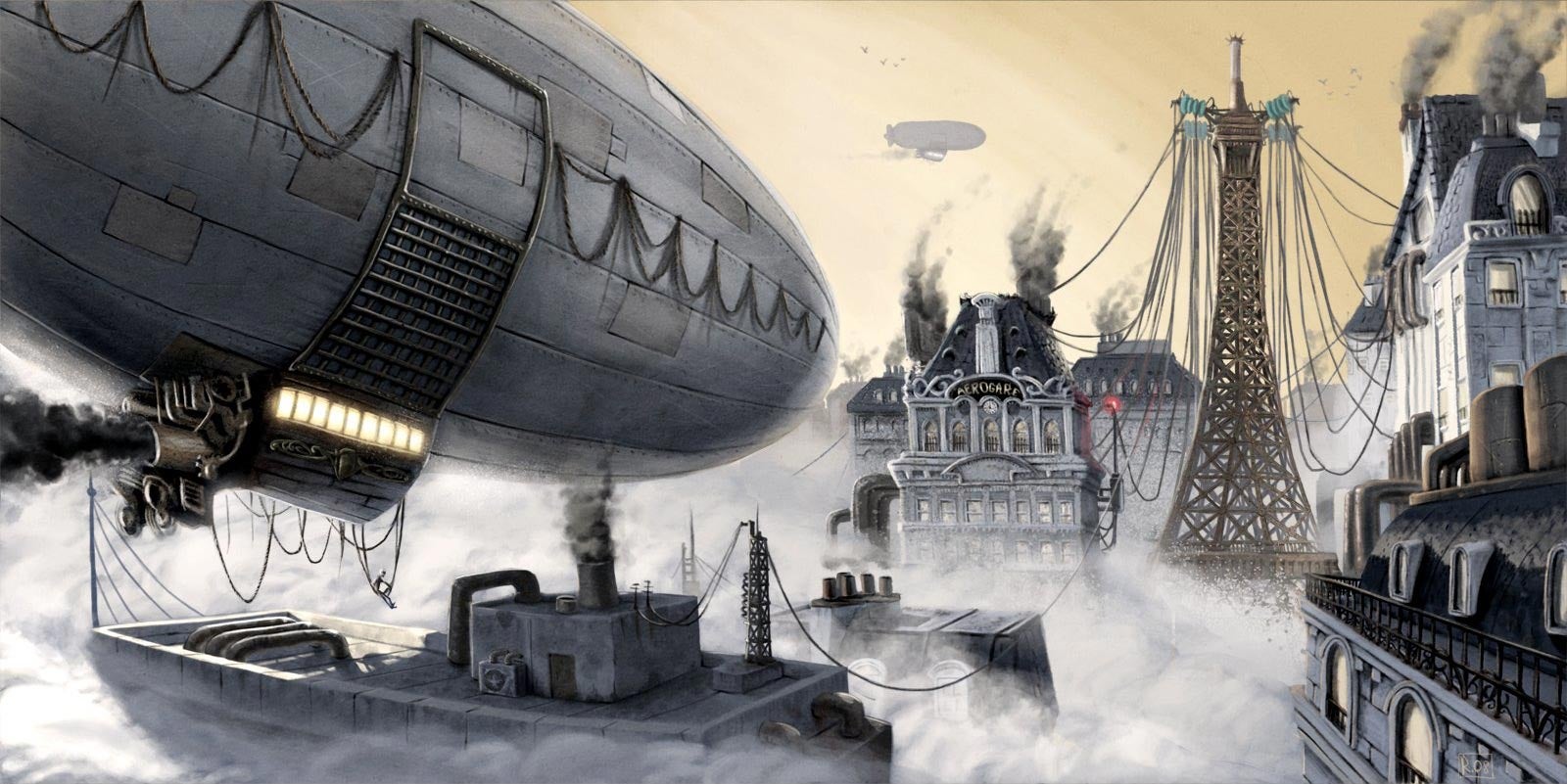
Schools : Reading Jules Verne, the father of science-fiction : resources


Jules Verne

“Anything one man can imagine, other men can make real.” 

Jules VerneAround the World in Eighty Days


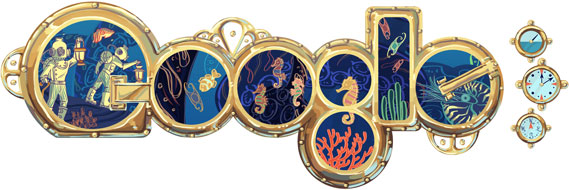
Google Doodle Jules Verne 183rd birthday

Today, 8 February, Google celebrates, with a interactive Doodle, the 183rd birthday of one of the most important science-fiction writer, Jules Verne, the French novelist, poet, and playwright best known for his adventure novels and his profound influence on the literary genre of science fiction. Verne was born on this day, 1828.

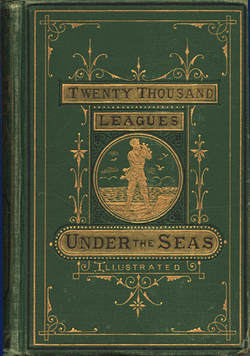
Jules Verne wrote fantastic novels as Twenty Thousand Leagues Under the Sea (1870) and Around the World in Eighty Days (1873), among many others. 

  • Google Doodle:

Google is celebrating the occasion with an interactive DoodleThe Doodle was inspired on the novel Twenty Thousand Leagues Under the Sea. 


It's beautifully designed and it also has a little secret! It lets your students 
navigate down 20,000 leagues under the sea. All they have to do is drag a lever with your mouse, tap your arrow keys, or - if they are viewing the Google page on an iPad, iPhone - tilt the screen.

They can explore the ocean from Jules Verne doodle in full view and HD.


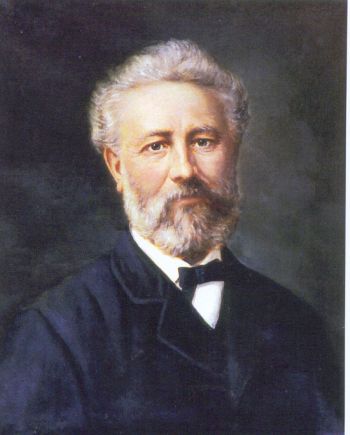
Jules Verne
credits: Getty Images
https://www.gettyimages.com/

Some information:

Jules Gabriel Verne was born on February 8, 1828 in Nantes, in France. His novels (basically science-fiction) were all about his vision, as he wrote stories on space and underwater travel, even before spaceships and submarines existed. He is the pioneer of science-fiction genre. 


Jules Verne & science-fiction

Jules Verne is generally considered a major literary author in France and most of Europe, where he has had a wide influence on the literary avant-garde and on Surrealism. 

He has often been labeled a writer of genre science-fiction or children's books, largely because of the highly abridged and altered translations in which his novels are often reprinted.


  • Themes:

Verne wrote about: space, air, and underwater travel before air travel and practical submarines were invented, and before practical means of space travel had been devised. 


Twenty Thousand Leagues Under the Sea
Jules Verne, 1870

He is best known for novels such as Twenty Thousand Leagues Under the Sea (1870), A Journey to the Center of the Earth (1864), and Around the World in Eighty Days (1873).


Verne's stories, written for adolescents as well as adults, caught the enterprising spirit of the 19th century, its uncritical fascination about scientific progress and inventions. 

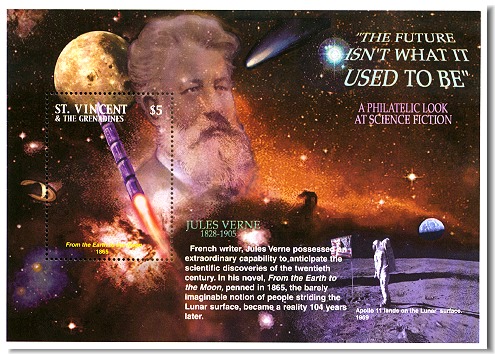
His works were often written in the form of a travel book, which took the readers on a voyage to the moon in From the Earth to the Moon (1865) or to another direction as in A Journey to the Center of the Earth (1874). 

Many of Verne's ideas have been hailed as prophetic. 


A Journey to the Center of the Earth
Jules Verne

  • Here & Now:

The pioneering ways of travel and exploration which he wrote so much about are now common-place for us, such as exploration of the moon, the north and south poles, and the use of hot air balloons for long-distance voyages.


Jules Verne illustration, surrounded by his inventions

  • Inventions & Characters:

In his time, Verne was a true inventor and visionary; the names of his inventions and characters such as Captain Nemo, Phileas Fogg, and the submarine Nautilus have entered, and remain, a part of our popular culture.


Journey to the Center of the Earth
Eric Brevic, 2008

Among his best-known books are Twenty Thousand Leagues Under the Sea (1870) and the classical adventure story Around the World in Eighty Days (1873).


Around the Wold in 80 Days
 Frank Coraci,2004

Other books:

He wrote numerous short stories, essays, plays, and poems, alongside 54 extremely popular novels that only show a glimpse of the extent of his imagination.

For over 40 years Verne published at least one book per year on a wide range subjects.  Verne's oeuvre include 65 novels, some twenty short stories and essays, thirty plays, some geographical works, and also opera librettos. 


Verne's works have inspired a number of film makers. Some of his books have been made into movies and now into games.

He remains the most translated novelist in the world, according to UNESCO statistics.

Verne is often hailed in level with Hugo Gernsback and H. G. Wells, as the "Father of Science Fiction."


Education :
  • Reading: Choose with your students a novel to read in the classroom;
  • Writing: Let your students explore Jules Verne's home website (English, French, Spanish, Italian) on their smartphones or iPads to prepare an  essay about the author;
  • Drawing: Students could create a comic strip from a novel they read or not. Let them be free to choose at the school library or at home which book;
  • Web: Explore the possibility of asking your students to build a web blog in an exchange project with a French school;
  • Web 2.0: Find school partners on Facebook Twitter or Instragram;
  • Multimedia:  There are some interesting tools as:

1) Cartonise Jules Verne - the biographical essay done by students, or the novel that  you read in the classroom, could be cartonised by an easy way to create cartonized versions of images and drawings (students and teacher)

2) Create a video with Animoto (students and educator)

And now, let your students watch the creative 3D video animation below, inspired on Jules Verne's work


"Science, my boy, is made up of mistakes, but they are mistakes which it is useful to make, because they lead little by little to the truth." 

Jules VerneJourney to the Center of the Earth

G-Souto

8.02.2011
update 08.02.2023

Copyright © 2011G-Souto'sBlog, gsouto-digitalteacher.blogspot.com®
Licença Creative Commons
Schools : Reading Jules Verne, the father of science-fiction : resources bG-Souto is licensed under a Creative Commons Attribution-NonCommercial-ShareAlike 3.0 Unported License.