My thoughts about Education Humanities, Technology and Digital Culture. Interested on social media tools in educational contexts and
gamification in education.
A Fox Tale is a short animated video made by 4 students, Thomas Bozovic, Alexandre Cazals, Julien Legay, Chao Ma at the French school Supinfocom Arles, in 2011. Please watch the guide on Vimeo.
Let's think how teachers can use in the classroom. But first here the short animated video:
I love animated movies ! They are so imaginative, poetic. The stories, the artistic design. I love to introduce animated movies into school curriculum. They are magic to children and young adolescents.
Teachers can explore the narrative and the difference between good and bad feelings:
bravery, love;
treason, hatred, perspicaciousness or ruse.
So often I share with my usual readers some ideas to explore the animated movies into the school curricula.
Here the most popular posts exploring animated movies and video games into school curricula.
Teachers will decide carefully wich animated video for wich students or level they are teaching.
Hoping you don't miss to introduce some of these animated videos in your lessons next school year, to explore the pedagogical richness of awesome digital resources.
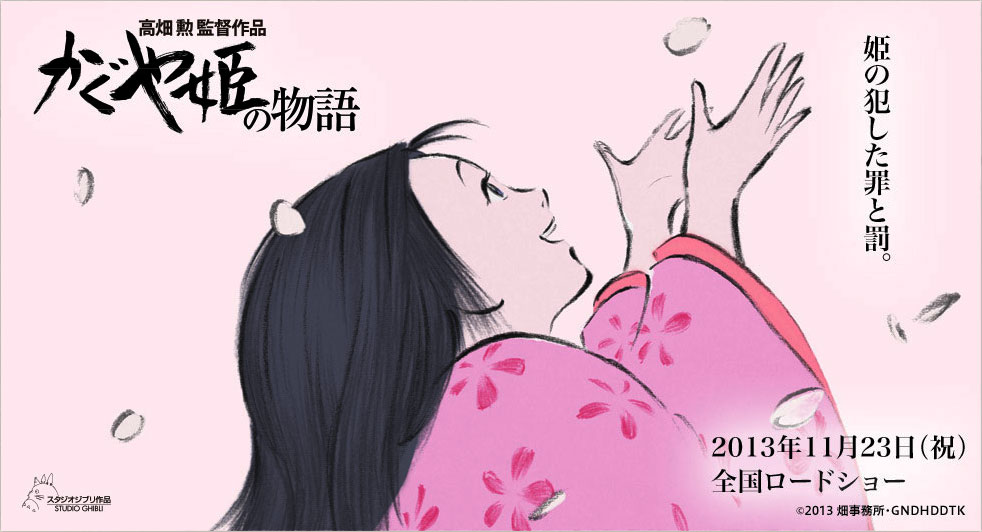
The Tale of Princess Kaguya, from Isao Takahata, Miyazaki’s fellow co-founder of beloved Japanese animation houseStudio Ghibli, is an eerie and plaintive folk tale, alive with sadness and drawn with an ecstatic freeness that recalls the animated adaptations of Raymond Briggs – The Snowman, Father Christmas, When the Wind Blows – far more than any other Ghibli film.
"There are no heroes or villains in the work of Studio Ghibli – just magic, everyday wonder, and love."
Robbie Collin, The Telegraph
Eight years in the making, the film is the untold story of The Princess Kaguya, the heroine of the ancient Japanese folktale, 'The Tale of the Bamboo Cutter'.
The Tale of Princess Kaguya was screened during the 2014 Directors' Fortnight at the Cannes International Film Festival. It is a visionary tour de force, morphing from a childlike gambol into a sophisticated allegory on the folly of materialism and the evanescence of beauty. The Tale of The Princess Kaguya isn't a short movie but it can be introduced in the curriculum using the same pedagocal strategies I proposed above. If you are a Japanese teacher, you can read the book in the classroom in Japanese, the mother language of your students. Otherwise, you can search for a translation. Make a research to find one. However, I can name two Resources : The Tale of Princess Kaguya - English version online Kids web Japan, Folk Legends, Kaguya Hime (English version, illustrations and text). The story is very specific to Japanese culture, with the consensus believing the film might not appeal as well overseas. But it will be in North America and perhaps in UK ?
An old man makes a living by selling bamboo. One day, he finds a princess in a bamboo. The princess is only the size of a finger. Her name is Kaguya. When Kaguya grows up, 5 men from prestigious families propose to her. Kaguya asks the men to find memorable marriage gifts for her, but the 5 men are unable to find what Kaguya wants. Then, the Emperor of Japan proposes to her.
The plot is based on a 10th-century Japanese legend about a poor woodcutter who finds, in the forest one morning, a tiny, doll-like girl sprouting from a bamboo shoot. He brings her home, clasped in his hands, and suddenly she puffs out and pinkens: then, with a satisfying pop, she transforms into a human baby.
The Tale of the Bamboo Cutter(竹取物語Taketori Monogatari?
The Tale of the Bamboo Cutter(竹取物語Taketori Monogatari?), also known as Princess Kaguya(かぐや姫Kaguya Hime?, 赫映姫 or 輝夜姫), is a 10th-century Japanese folktale. It is considered the oldest extant Japanese narrative and an early example of proto-science fiction.
Based on this famous Japanese folklore story, the film begins in the countryside at some time in the past, as a bamboo cutter discovers one magical glowing stalk, which splits open to reveal a tiny creature. He takes it home to his wife, at which point it turns into a human, or at least human-looking baby. Immediately nicknamed 'Princess' by the childless couple, and later officially christened Kaguya, which translates as 'Shining Light,' it begins growing at a remarkably fastrate, and soon grows into a beautiful young woman.
Visually a stunning film with a narrative that does not uses dialogue. A portrait of the problems of the modern world (and families) seen through the eyes of a child.
Suffering from the lack of the father, a boy leaves his village and discovers a fantastic world dominated by machines, animals and strange beings. An unsual animation with many artistic thecniques that portrait the issues of the modern world through the eyes of a child.
Described by Variety‘s Dennis Harvey as a “simple, universal parable played out in boldly imaginative design terms,”Abreu’s dialogue-free film follows the journey of a young boy who leaves his village to search for his father across a big city where he discovers a world dominated by animal-machines.
The Boy and the World/ O Menino e o Mundo is nominated Best Animated Film to the Oscars 2016 next February.
Visit the official Facebook O Menino e o Mundo or. You can invite your students to explore the film and follow the news on Facebook.
Almost Home | DreamWorks
20th Century Fox and DreamWorks Animation 3D animated feature film
When the galaxy's most annoyingly optimistic alien finds himself on the run from his own alien race, he's forced to team up with a fiercely stubborn teenage girl. Together they become the most unlikely fugitives ever to save the planet.
Synopsis:
It all starts with a school essay. When twelve-year-old Gratuity ("Tip") Tucci is assigned to write five pages on "The True Meaning of Smekday" for the National Time Capsule contest, she's not sure where to begin. When her mom started telling everyone about the messages aliens were sending through a mole on the back of her neck?
DreamWorks premiered online an exclusive new short Almost Home on Buzzfeed on March 10, 2014, to promote their next original feature, Home, which will debut on November 26, 2014 which features the voice of Steve Martin, who also stars in the full-length feature film, along with Rihanna, Parsons, and Jennifer Lopez. In Home, Steve Martin is the voice of Captain Smek, the pompous leader of the alien race known as the Boov, while Jim Parsons voices Oh, a Boov outcast who tries to help the teenage Tip (Rihanna) foil Smek’s plans for humanity. The short, which has also been playing in front of the theatrical release of Mr. Peabody & Sherman, is directed by Todd Wilderman.
An interesting proposition to your students, don't you think? A book and an animated video. You can begin by reading the book just before the animation releasing. Until there, introduce the trailer to your students as a motivation to the book reading.
The students watch the video and then respond with how they felt, what they liked about it, etc. Then several students share with the class. They will be excited to know that Rhiana (the youngest) Jennifer Lopez and Steve Martin, Coldplay (the oldest) feature in the movie.
Perhaps a good activity for the next school season in August or September (it will depend from the country).
My thoughts
Animated movies can be include into school curriculum to teach reading strategies for example. Animated movies are totally and completely amazing! What a great way to get (and keep) the attention of our students.
Animated videos, short or not, can offer teachers and students a nice motivating push to have a different lesson! These three animated (shorts) movies will be awesome educational digital resources:
to teach
literacy, grammar, morals, music, civics, sciences, drawing, other
to reinforce skills: reading, writing, drawing, composing, reinforcing or introducing the skill of inference.
Displaying movies in a face-to-face lesson is an important resource for teachers and students.
Students will create better storytelling, including good plots, characters and narrative points of view, the crucial elements of the Narrative text.
Narrative even without words lets us know something. It tells us what happened. It tells us a story.
Our students love to hear stories, watch, write, draw stories or narratives.
"Movies present language in a way that is often more natural than that found in course-books, the fantastic visual context aids understanding and boosts listening, and students just simply love them."
Steve Louw
Activities: Appliedto the level(s) you are teaching. You're the master in your class.