Showing posts with label literacy. Show all posts

Thursday, September 7, 2017

Schools : International Literacy Day in a Digital World


credits: UNESCO


Tomorrow, 8 September is the International Literacy Day. The International Literacy Day is celebrated annually on 8 September.


The theme of this year’s International Literacy Day on this 8 September:

 ‘Literacy in a Digital World’ 


credits: UNESCO


The day aims to highlight the kind of literacy skills people need to navigate this world and the literacy policies and programmes that can leverage the opportunities such a world provides.

Digital technologies, including the Internet, mobile phones, and all the other tools to manage information digitally, are fundamentally changing the way we live, learn and socialize. For many, digital technologies provide better access to information and knowledge, previously out of reach or costly, while facilitating the use of obtained information and knowledge.

“Digital technologies permeate all spheres of our lives, fundamentally shaping how we live, work, learn and socialize,” 

Irina Bokova, UNESCO Director-General, message 


credits: Unesco Photography contest 2017

Bokova emphasizes the importance of rethinking and improving skills required to take part in the digital world: 

“These new technologies are opening vast new opportunities to improve our lives and connect globally—but they can also marginalize those who lack the essential skills, like literacy, needed to navigate them.”


Gender disparities in literacy rates
credits: Unesco e-Atlas of Literacy

Literacy rates continue to rise from one generation to the next. Yet according to new data from the UNESCO Institute for Statistics, there are still 750 million illiterate adults, two-thirds of whom are women

These numbers are a stark reminder of the work ahead to meet Sustainable Development Goals (SDGs) 4 -Quality Educationand 5 - Gender Equality - the Education 2030 targets.


credits: UN


On 8 September, 2017 a global event will be organized at UNESCO’s Headquarters in Paris, with the overall aim "to look at what kind of literacy skills people need to navigate increasingly digitally-mediated societies, and to explore effective literacy policies and programmes that can leverage the opportunities that the digital world provides."


credits: © UNESCO/Taweepon Kingkaew


The 2017 UNESCO International Literacy Prizes awards ceremony will also take place to recognize and reward excellent literacy practices from around the world in connection with this year’s theme.

In addition to greater data on basic literacy and numeracy, we also need data on digital literacy, including data on the digital divide, with some people having less access than others to ICTs, less opportunity to use ICTs and lacking the empowerment to incorporate ICTs in their work and everyday life.


  • Education: 

Literacy is a human right, a tool of personal empowerment and a means for social and human development. Educational opportunities depend on literacy.

With the evolution of knowledge and skills in the digital world, the meaning of literate also changes. In an effort to close the gap in literacy skills and decrease the inequalities, the 2017 International Literacy Day will focus on the challenges and prospects in endorsing literacy in the digital world


Literacy among Youth
credits: Unesco e-Atlas of Literacy

How possible is that if there are roughly 750 million adults and 264 million school-aged children (not in school) that do not have the basic literacy skills.

In addition we need data on digital literacy, including data on the digital divide, with some people having less access than others to ICTs, less opportunity to use ICTs and lacking the empowerment to incorporate ICTs in their work and everyday life.


A good quality basic education equips pupils with literacy skills for life and further learning; literate parents are more likely to send their children to school; literate people are better able to access continuing educational opportunities; and literate societies are better geared to meet pressing development.


"Information and communication technology (ICT) is fundamentally changing the way people live and work, learn and socialise." But 758 million adults in the world, including 115 million youth, still lack the basic literacy skills needed to enjoy the benefits of increasingly digitised economies and to participate fully in modern society.


credits: Elyx Yak, virtual Ambassador

A joint project by UNESCO and Pearson, an international education company, will explore new ways to enable low-skilled and low-literate youth and adults to profit from inclusive digital technologies, which in turn will strengthen their literacy and basic skills.

However, we live in digital world so the focus on IT in the SDGs reflects the importance of such skills for workforce development. Their measurement, however, is a complex task for three reasons. 


Some ideas:

  • Use any increased flexibility offered in the curriculum to respond to issues as they arise including IT skills;
  • Provide space for teachers and students to discuss and reflect on these issues;
  • Pupils get a lot of their information about global issues from the media so help them to interrogate this information critically and consider a range of perspectives;
  • Help your students by engaging them in an extra ICT literacy skills in the classroom and on the Internet. Explore digital resources;
  • Inspire students to build an out-of-this-world literacy habits.


  • Display the video above and discuss with your students the importance of Digital Literacy;
  • Join the global celebration, and be sure to let the International Day of Literacy know how your students are celebrating Literacy Day in Digital World;
  • Share pictures and videos on FacebookTwitter, and Instagram using the official hashtag #ILD17

G-Souto

07.09.2017 

update 08.09.2024

Copyright © 2017G-Souto'sBlog, gsouto-digitalteacher.blogspot.com®

Creative Commons License
Schools : International Literacy Day in a Digital World bG-Souto is licensed under a Creative Commons Attribution-NonCommercial-NoDerivatives 4.0 International License.


Thursday, September 8, 2016

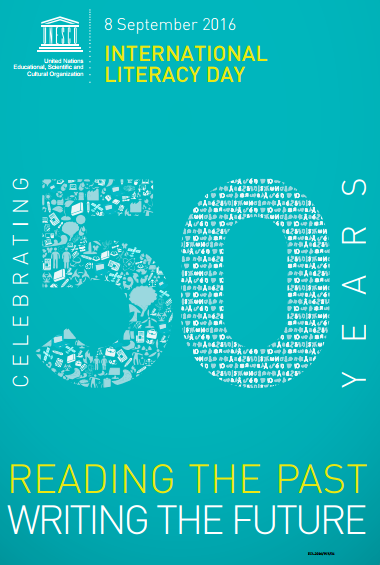
Schools : International Literacy Day : 50th Anniversary


Reading the Past, Writing the Future


"The world has changed since 1966 – but our determination to provide every woman and man with the skills, capacities and opportunities to become everything they wish, in dignity and respect, remains as firm as ever. Literacy is a foundation to build a more sustainable future for all."

Irina Bokova, UNESCO Director-General  

Fifty years ago, UNESCO officially proclaimed 8 September International Literacy Day to actively mobilize the international community and to promote literacy as an instrument to empower individuals, communities and societies.

This year marks the 50th anniversary of International Literacy Day and UNESCO is celebrating it under the theme:

“Reading the Past, Writing the Future”. 

"International Literacy Day 2016 celebrates and honours the past five decades of national and international engagement, efforts and progress made to increase literacy rates around the world. It also addresses current challenges and looks to innovative solutions to further boost literacy in the future."

Unesco


ILD 2016 infographic
credits: UNESCO

For 50 years, UNESCO has been celebrating International Literacy Day by reminding the international community that literacy is a human right and the foundation of all learning. 

Now International Literacy Day is celebrated worldwide, bringing together governments, multi-and bilateral organizations, NGOs, private sectors, communities, teachers, learners and experts in the field. 


"Illiteracy remains synonymous with exclusion and poverty -- we must turn this around."
Irina Bokova, message 2016
On this day also International Literacy Prizes are awarded to people with outstanding solutions that can drive literacy towards achieving the 2030 Education Agenda. This year the focus is on innovation.

This is the first year of implementation of the 2030 Agenda for Sustainable Development. In this context the vision of literacy is aligned with lifelong learning opportunities with special focus on youth and adults


Goal 4
credits: Elyx Yak

Literacy is a part of Sustainable Development Goal 4, which aims to “ensure inclusive and equitable quality education and promote lifelong learning opportunities for all”. The target is that by 2030 all youth and a substantial proportion of adults, both men and women, achieve literacy and numeracy (SDG Target 4.6).


 Education:

Literacy is a fundamental human right and the foundation for lifelong learning. It is fully essential to social and human development in its ability to transform lives. For individuals, families, and societies alike, it is an instrument of empowerment to improve one’s health, one’s income, and one’s relationship with the world. 


Activities: some ideas

  • Use any increased flexibility offered in the curriculum to respond to issues as they arise.
  • Provide space for teachers and students to discuss and reflect on these issues.
  • Pupils get a lot of their information about global issues from the media so help them to interrogate this information critically and consider a range of perspectives.
A good quality basic education equips pupils with literacy skills for life and further learning; literate parents are more likely to send their children to school; literate people are better able to access continuing educational opportunities; and literate societies are better geared to meet pressing development.
Ideas + :

Whether it’s reading or writing, literacy is an outlet to an untouchable world – our imagination. 


Readathon:
  • Host a friendly reading challenge to spark students’ interest. Encourage children to read as many books as possible during this month and have them track their progress. Their efforts can be sponsored by teachers, family and friends or by incentives created through school library, local libraries or bookshops.

Host a speaker or display a video:

  • Invite a local role model or author to discuss the impact literacy has had on their lives. 
  • Discuss with the students the impact of literacy in role model, actor/actress, writer success?

Of course a writer is always curious to know the books read by the students and their favorite authors. This is another idea. I practiced along the years teaching face-to-face.  


@UNESCO


Resources 4Teachers: 


Download ILD 2016 infographic

New publications on Literacy

Promoting Literacy over Five Decades. A Concise Review


Find further ideas and activities for different levels or curricula on Unesco website Education/ Literacy; my posts International Literacy 2015International Literacy Day 2014 and other posts on education and reading.

"Literacy is vital for poverty eradication, for gender equality, for more inclusive and sustainable societies."

Irina Bokova, message 2016


G-Souto

08.09.2016
Copyright © 2016G-Souto'sBlog, gsouto-digitalteacher.blogspot.com®

Creative Commons License
Schools : International Literacy Day : 50th Anniversary bG-Souto is licensed under a Creative Commons Attribution-NonCommercial-NoDerivatives 4.0 International License.
Tuesday, December 30, 2014

2014 rundown of the best posts #2


Looking back at 2014 I've come up with a my roundup of what's been most-read on the G-Souto's Blog.

Below you’ll see the top posts along the second semester 2014 containing edtech,historical, linguistic, scientific, artistic, and social themes or resources I have relied for teaching and learning.

The selection is based on page views but also based on pedagogical relevance of the most read posts.

I kept the order of the most viewed, but eliminated the posts that seemed less relevant. The main reason is that sometimes certain posts acquire too much visibility, not for their value but for the keywords that the search engines "like" indexing.


Je suis ravie de partager avec vous le Top des posts les plus lus du 2eme semestre 2014. Vous êtes de plus en plus nombreux à me suivre au quotidien.

Je vous remercie, chers enseignants, chers lecteurs, de votre intérêt et m’efforce d’être toujours au plus proche des événements concernant des idées pédagogiques pour vous offrir les dernières actualités en éducation et numérique. Bien sûr le numérique est essentiel.  Les technologies donnent aux jeunes des possibilités que les générations précédentes ne pouvaient pas avoir au même âge." 

Mais aussi aux grandes thématiques historiques, linguistiques, culturelles et sociales, des ressources en ligne, et de nombreuses observations personnelles sur la pédagogie de façon à faciliter Ã  tous les élèves des chances égales de réussite.

Here are the 2nd semester's most popular posts of 2014 :

Le Top des posts du 2e semestre 2014 :


My crush of the #2nd semester? Monsieur LazharAbsolutely! Avec une belle légéreté, Monsieur Lazhar dépeint un tableau très actuel et réaliste de ce qu’est l’école de maintenant. 

A powerful and delicate human portrait of a techer and his students. A movie by Philippe Falardeau based on the play Bashir Lazhar by Evelyne De la Chenelière

I hope there's something that looks of interest to you.  If it does, check it out. If you’re inspired use one of the icons to share it with others. And why noit to leave a comment?

May the coming year be a successful one for all those educators who love teach and see children as creative individuals. Preparing learners for the future should therefore be a prime function of all schools.

G-Souto

30.12.2014
Copyright © 2014G-Souto'sBlog, gsouto-digitalteacher.blogspot.com®

Creative Commons License

2014 rundown of the best posts #2 bG-Souto is licensed under a Creative Commons Attribution-NonCommercial-NoDerivatives 4.0 International License.