Showing posts with label Eta Aquarid meteor shower. Show all posts

Monday, June 6, 2016

May rundown of the most read posts


Put Your Head into Gallery | Gagosian Gallery


Are you mad about Art ? I am! I write often about Art, as you know if you are a regular reader. Of course you are. My last post was about the artist Lotte Reiniger.
You have a dream of one day seeing a piece of your own displayed and admired in a famous art gallery? Well, I'm not enough mad about it. Ok! But your students will love! Remember my post Schools: Take a Selfie with a Painting.(2014). A huge success among students.
Now a new project Tezi Gabunia, interactive installation allows you/ them to experiment this thrill. 


Put Your Head into Gallery | Tate Modern
Through four different models of world famous galleries, his installation Put Your Head into Gallery, literally allows one to become a feature of the exhibit.
The project includes four miniature recreations of Saatchi Gallery (Tezi Gabunia), The Louvre (Rubens), Tate Modern (Hirst), and Gagosian Gallery (Liechtenstein).

Transportable feature of the models makes these galleries accessible for everyone. Moreover, anyone can look into gallery, take a photo and become an exhibition.
"The installation aims make the art scene accessible to everyone by bringing the prominent buildings to the audiences, as opposed to the other way around.
Nothing better that let your students discover the wonders of new technology by sharing this project.

Oh! By the way tomorrow we will celebrate the 2016 edition of the United Nations World Oceans Day, held each year on 8 June. People all over the globe are celebrating in multiple events to mobilize society and protect the ocean, its biodiversity and its resources. Ask your students to join this event.


Education:
If you are lucky and you're teaching near this gallery, don't loose the opportunity to let your students enjoying this awesome experience.
Include the events into your curriculum at school and let your students participate with some nice activities.
I couldn't miss to share with teachers  two importantant events as introduction of the rundown of the most read posts in May.

Here are the most popular posts of the last month:


Hope you enjoyed the different themes and resources published on May on my blog It was a fantastic month full of good pedagogical themes - museums, ICT, arts, environment, science, exhibitions, citizenship - different pedagogical resources to motivate some of your lessons.

I'm back to posting the normal roundup every week. 


G-Souto 


07.05.2016
Copyright © 2016G-Souto'sBlog, gsouto-digitalteacher.blogspot.com®

Creative Commons License
May rundown of the most read posts by G-Souto is licensed under a Creative Commons Attribution-NonCommercial-NoDerivatives 4.0 International License.

Friday, May 6, 2016

Science education : Don't miss Eta Aquarid meteor shower


credits: David Kingham / Flickr
Tonight greatest number of Eta Aquarid meteors will light up the predawn darkness on May 6, 2016. 

In a dark sky, especially at latitudes in the Southern Hemisphere, the Eta Aquarids can produce up to 20 to 40 meteors per hour – or more.
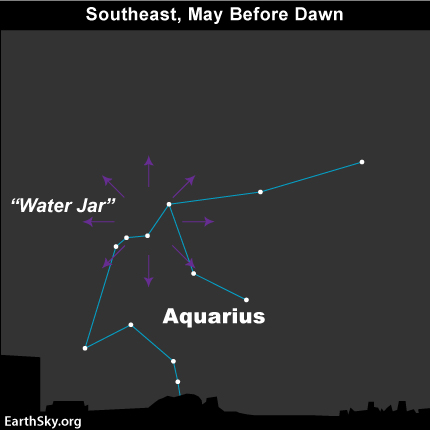
These meteors are named "Eta Aquarid" because they appear to emanate out of the constellation Aquarius, which takes the shape of a dude pouring out a jug of water for eternity. 
The meteors fly out from a star near the top of the constellation named Eta Aquarii. 
We come across this patch of debris again in October, when the skies light up with the Orionid meteor shower


credits: EarthSky
The Eta Aquarid meteor shower is usually active between April 19 and May 28 every year. Twice every year Earth collides with a ring of debris left behind by Halley’s comet, creating a pair of sibling meteor showers that can dazzle in the night sky.

2016 should be a good year for this shower, with the May 6 new moon guaranteeing deliciously dark skies for the 2016 Eta Aquarids. 

The Eta Aquarids is one of the fastest meteor showers. Its specks pierce the sky at about 148,000 miles per hour.


The Eta Aquarids is one of two meteor showers created by debris from Comet Halley. 
Halley's comet won't return to the skies until the 2060s. But tonight, you can catch a glimpse of it in the Eta Aquarid meteor shower.
The Earth passes through Halley's path around the Sun a second time in October. This creates the Orionid meteor shower, which peaks around October 20.


Comet Halley. Credit: ESA/Max-Planck-Institute

Comet Halley takes around 76 years to make a complete revolution around the Sun. 

This shower favors the Southern Hemisphere, ranking as one of the finest showers of the year. At mid-northern latitudes, these meteors don’t fall so abundantly, though mid-northern meteor watchers will catch some, too, and might be lucky enough to catch an earthgrazer – a bright, long-lasting meteor that travels horizontally across the sky – before dawn. The Eta Aquarids are mainly a predawn shower. 

Earth is currently passing through a patch of debris created in the wake of the comet's tail. When that debris hits our atmosphere, it will burn up and scar the night sky as meteors in the predawn hours between May 5 and 6 (though you may be able to see a few meteors a night until May 28) .


credits: EarthSky
When and how should I watch the Eta Aquarids? 
The 2016 Eta Aquarid meteor shower is expected to produce the greatest number of meteors in the wee hours before dawn on May 5 and 6. However, the broad peak of the Eta Aquarid shower may present a decent showing of meteors during the predawn hours on May 4 and May 7, too.
We don’t have to locate the Water Jar, or the radiant of the shower, to enjoy the Eta Aquarids. These meteors fly every which way across the sky, in front of numerous constellations. We can find a dark, open sky away from artificial lights, and sprawl out on a reclining lawn chair to comfortably watch the wondrous nighttime attraction.
The Eta Aquarids are viewable in both the Northern and Southern hemispheres during the pre-dawn hours. 
The best time to watch these fast and often bright meteors is in the early morning hours, before the onset of morning twilight. 
We must give at least an hour of viewing time for watching any meteor shower. Meteors tend to come in spurts that are interspersed by lulls. Also, it can take as long as 20 minutes for your eyes to adapt to the dark.
We don't need no special equipment to watch a meteor shower, but a little luck always helps. Meteor watching is a lot like fishing. Sometimes you catch a good number of them and sometimes you don’t.


credits : REUTERS/ Ognen Teofilovski)
Education:
Today, 06 May, the awesome Eta Aquarid meter shower will be a spectacular show. 

Most of us are excited about the Eta Aquarid meteor shower. Science teachers and students. Skywatchers as well. 

I'm not a science pedagogue, but I love science and all the high technology near science.

Do you remember Science education : Ready to watch the Geminids shower last December 2015? Or Catching the Falling Stars, the Perseids last August 2015? Just awesome! A sky full of stars. 

Teachers invite your students to be ready as skywatchers. Sciences curriculum will be enhanced with the help of another awesome event in the sky. The Eta Aquari meteor shower.

Do you want a better science lesson ? Two nights on live science. Wow! No special equipment. 

Activities: 

During Eta Aquarid meteor shower skywatching, teachers, students can be skywatchers, and at the same time do some good shots, or videos with iphones, smartphones or tablets. 

The event will be discussed next week in the classroom. 

Resources: 


Teachers be prepared for the next great event! May 9 Mercury will cross the Sun!

G-Souto

06.05.2016
Copyright © 2016G-Souto'sBlog, gsouto-digitalteacher.blogspot.com®

Creative Commons License
Science education : Ready to watch the Geminids shower ? by G-Souto is licensed under a Creative Commons Attribution-NonCommercial-NoDerivatives 4.0 International License.

References:

NASA | Earth Sky