
Apollo 11
credits: NASA
“I think we’re going to the Moon because it’s in the nature of the human being to face challenges. It’s by the nature of his deep inner soul. We’re required to do these things just as salmon swim upstream.”
Neil Armstrong
It's been exactly 50 years since Apollo 11 was launched. The first mission to land men on the moon. On July 16, 1969, Apollo 11 was launched into space and on July 20, it landed the first two humans on the Moon - Commander Neil Armstrong and lunar module Eagle's pilot Buzz Aldrin. Their lunar module Eagle landed on July 20, 1969 on the moon’s Sea of Tranquility.
Some information:
This week in 1969, Apollo 11 launched from NASA’s Kennedy Space Center carrying astronauts Neil Armstrong, Edwin "Buzz" Aldrin and Michael Collins.
The primary mission objective was to fulfill a national goal set by President John F. Kennedy on May 25, 1961, to perform a crewed lunar landing and return safely to Earth before the decade was out.

John Fitzgerald Kennedy
50 years ago today, on September 12, 1962, President John F. Kennedy delivered one of his best and most inspiring speeches. Arguably, one of the best in the history of the United States, historians say.
The speech resonated widely and is still remembered, although at the time there was disquiet about the cost and value of the Moon-landing effort. Kennedy's goal was realized in July 1969, with the successful Apollo 11 mission.

On July 20 1969, Armstrong and Aldrin became the first men to walk on the Moon. The two astronauts spent more than 21 hours on the lunar surface deploying scientific experiments and gathering samples before returning to the orbiting command module, piloted by Collins.
Some information:
This week in 1969, Apollo 11 launched from NASA’s Kennedy Space Center carrying astronauts Neil Armstrong, Edwin "Buzz" Aldrin and Michael Collins.
The primary mission objective was to fulfill a national goal set by President John F. Kennedy on May 25, 1961, to perform a crewed lunar landing and return safely to Earth before the decade was out.

John Fitzgerald Kennedy
Rice University, Houston
credits: White House/Robert Knudsen courtesy of the JFK Library
"We choose to go to the Moon"John Fitzgerald Kennedy
50 years ago today, on September 12, 1962, President John F. Kennedy delivered one of his best and most inspiring speeches. Arguably, one of the best in the history of the United States, historians say.
The speech resonated widely and is still remembered, although at the time there was disquiet about the cost and value of the Moon-landing effort. Kennedy's goal was realized in July 1969, with the successful Apollo 11 mission.

Apollo 11 astronauts Neil Armstrong & Edwin E. "Buzz" Aldrin
credits: Science & Society Picture Library
via BBC
Google Doodle:
The Moon landings inspired a generation of scientists and engineers and a cultural outpouring - from songs like Space Oddity and Rocket Man to an episode of cult TV series The Simpsons.
The Moon landings inspired a generation of scientists and engineers and a cultural outpouring - from songs like Space Oddity and Rocket Man to an episode of cult TV series The Simpsons.

A team of some 400,000 people from around the world worked on Project Apollo, mostly factory workers, scientists, and engineers who never left the ground. Within those 400,000 were the mission’s astronauts Neil Armstrong, Edwin “Buzz” Aldrin, and Michael Collins.
Their historic journey began when a Saturn V rocket blasted off from Florida’s Kennedy Space Center on July 16, 1969. After achieving orbit around the moon, the lunar module, known as “the Eagle,” separated for a 13-minute journey to the surface. Meanwhile, astronaut Michael Collins stayed behind in the command module, which would eventually bring all three astronauts back home to Earth.
Their historic journey began when a Saturn V rocket blasted off from Florida’s Kennedy Space Center on July 16, 1969. After achieving orbit around the moon, the lunar module, known as “the Eagle,” separated for a 13-minute journey to the surface. Meanwhile, astronaut Michael Collins stayed behind in the command module, which would eventually bring all three astronauts back home to Earth.
Google Doodle: 50th Anniversary of the Moon landing
Fifty years ago, NASA’s Apollo 11 mission changed our world and ideas of what is possible by successfully landing humans on the surface of the Moon - and bringing them home safely for the first time in history.
The video Doodle celebrates this moment of human achievement by taking us through the journey to the moon and back, narrated by someone with firsthand knowledge of the epic event: former astronaut and Apollo 11 command module pilot Michael Collins.
NASA unveiled an official logo for use in observing these milestone anniversaries Friday at the Kennedy Center for the Performing Arts in Washington.
This July, in a series of special events, NASA is marking the 50th anniversary of the Apollo Program - the historic effort that sent the first U.S. astronauts into orbit around the Moon in 1968, and landed a dozen astronauts on the lunar surface between 1969 and 1972.

The Moon 2024 Education Guide is published by NASA’s Office of STEM Engagement to accompany the STEM Education segment of the Apollo Anniversary broadcast aired on NASA TV July 19, 2019.
May be used into different curricula, in-person lessons or distance learning (hybrid education).
Target audience : the chosen activities students all levels, all ages: Teachers will adapt to the level or age they are teaching in-person lessons or distance learning. Parents in homeschooling.

On July 18, museums nationwide were teaming up on a virtual NASA mission as they building lunar spacecraft out of materials chosen by their social media followers then launch them on a #VirtualMoonshot.
If you couldn't follow the fun live on the 18th, you can build your own straw rocket, lander or rover anytime!
For more material, pictures, or connect to NASA’s remarkable history, visit the Marshall History Program’s webpage. (NASA)
The video Doodle celebrates this moment of human achievement by taking us through the journey to the moon and back, narrated by someone with firsthand knowledge of the epic event: former astronaut and Apollo 11 command module pilot Michael Collins.
From October 2018 through December 2022, NASA will mark the 50th anniversary of the Apollo Program that landed a dozen Americans on the moon between July 1969 and December 1972.

NASA unveiled an official logo for use in observing these milestone anniversaries Friday at the Kennedy Center for the Performing Arts in Washington.
The unveiling was part of “NSO Pops: Space, the Next Frontier,” a National Symphony Orchestra celebration of NASA’s 60 years of accomplishment.
Education:

The Moon 2024 Education Guide is published by NASA’s Office of STEM Engagement to accompany the STEM Education segment of the Apollo Anniversary broadcast aired on NASA TV July 19, 2019.
May be used into different curricula, in-person lessons or distance learning (hybrid education).
Target audience : the chosen activities students all levels, all ages: Teachers will adapt to the level or age they are teaching in-person lessons or distance learning. Parents in homeschooling.
VirtualMoonshot
If you couldn't follow the fun live on the 18th, you can build your own straw rocket, lander or rover anytime!
For more material, pictures, or connect to NASA’s remarkable history, visit the Marshall History Program’s webpage. (NASA)

Resources:
- Logo:
The Apollo 50th anniversary logo is available for download from the NASA Images and Video Library.
Virtual resources:

A real-time journey through the first landing on the Moon. The website consists entirely of original historical mission material.

Some events in history stand above all the rest. Mankind's first venture off this planet is still the pinnacle of human achievement.
You can experience the historic events of 1969 through the eyes of Neil, Buzz and Michael as they embark on history's greatest journey.

Play word and number puzzles while you learn about the Apollo mission that first put people on the Moon. Find out about the Artemis mission that will land the first American woman and the next American man on the Moon.
The free, printable booklet has mazes, word searches, sudoku puzzles with pictures and other types of puzzles. You can learn about NASA's new Space Launch System rocket and Orion spacecraft. These space vehicles will take humans to the Moon and to Mars.
Audience: Students different levels and age.
K-4 ; 5-8

screenshot Apollo 11 in real time
credits: NASA
- Apollo 11 in real time:
A real-time journey through the first landing on the Moon. The website consists entirely of original historical mission material.

Apollo 11 3D
screenshot Apollo 11 360º VR
- Apollo 11 360º VR
Some events in history stand above all the rest. Mankind's first venture off this planet is still the pinnacle of human achievement.
You can experience the historic events of 1969 through the eyes of Neil, Buzz and Michael as they embark on history's greatest journey.
Invite your students or children to dare entering in the lunar module Apollo 11. It's free! You will love the journey! Believe me!
- Puzzles:

Forward to the Moon with Artemis
NASA, 2019
The free, printable booklet has mazes, word searches, sudoku puzzles with pictures and other types of puzzles. You can learn about NASA's new Space Launch System rocket and Orion spacecraft. These space vehicles will take humans to the Moon and to Mars.
Audience: Students different levels and age.
Grade Levels:
K-4 ; 5-8

The Eagle has landed: Apollo 11 Crossword Puzzle
Visit the mission overview website below to learn more about the historic mission and find clues to solve this crossword puzzle!
Audience: Educators; Students
Grade Levels:
5-8 ; 9-12
- Videos:
- Comics: Tintin on the Moon? Hergé

Tintin et la Lune
50e anniversaire des premiers pas sur la Lune
16 après Tintin
To celebrate the triple anniversary of the 90th anniversary of Tintin’s debut, 50 years since the first Moon landing, and the 10th anniversary of the opening of the Hergé Museum, SwissApollo and Titan Films have joined forces to create a digital series with a lunar theme.
On this occasion, the Hergé Museum is organizing its own screening of this series of short documentaries, on July 21 at 3 p.m. and at the Institut Français in Tel-Aviv on July 22.

Objectif Lune (1952) & On a marché sur la Lune (1954)
albums Tintin
Hergé
éditions Casterman
sur Amazone.fr
Six thrilling episodes in the company of Tintin and Snowy. The conquest of space which included walking on the Moon and other prestigious events illustrates how much of a visionary Hergé was.

- Children's book:

Moonshot : The Flight of Apollo II
Brian Floca (text & illustration)
Richard Jackson/Atheneum, 2019

Moonshot : The Flight of Apollo II
Brian Floca (text & illustration)
Richard Jackson/Atheneum, 2019
https://www.amazon.com/
Brian Floca (text & illustration)
Richard Jackson/Atheneum, 2019
https://www.amazon.com/
"In watercolors, ink and acrylics, the story of how the Apollo 11 mission unfolded."
Brian Floca explores Apollo 11’s famed moon landing with this beautifully illustrated picture book!

Simply told, grandly shown, here is the flight of Apollo 11. Here for a new generation of readers and explorers are the steady astronauts, clicking themselves into gloves and helmets, strapping themselves into sideways seats.
Here are their great machines in all their detail and monumentality, the ROAR of rockets, and the silence of the Moon.

Here is a story of adventure and discovery, a story of leaving and returning during the summer of 1969, and a story of home, seen whole, from far away.
Moonshot : The Flight of Apollo II
Brian Floca (text & illustration)
Richard Jackson/Atheneum, 2019
Simply told, grandly shown, here is the flight of Apollo 11. Here for a new generation of readers and explorers are the steady astronauts, clicking themselves into gloves and helmets, strapping themselves into sideways seats.
Here are their great machines in all their detail and monumentality, the ROAR of rockets, and the silence of the Moon.
Moonshot : The Flight of Apollo II
Here is a story of adventure and discovery, a story of leaving and returning during the summer of 1969, and a story of home, seen whole, from far away.
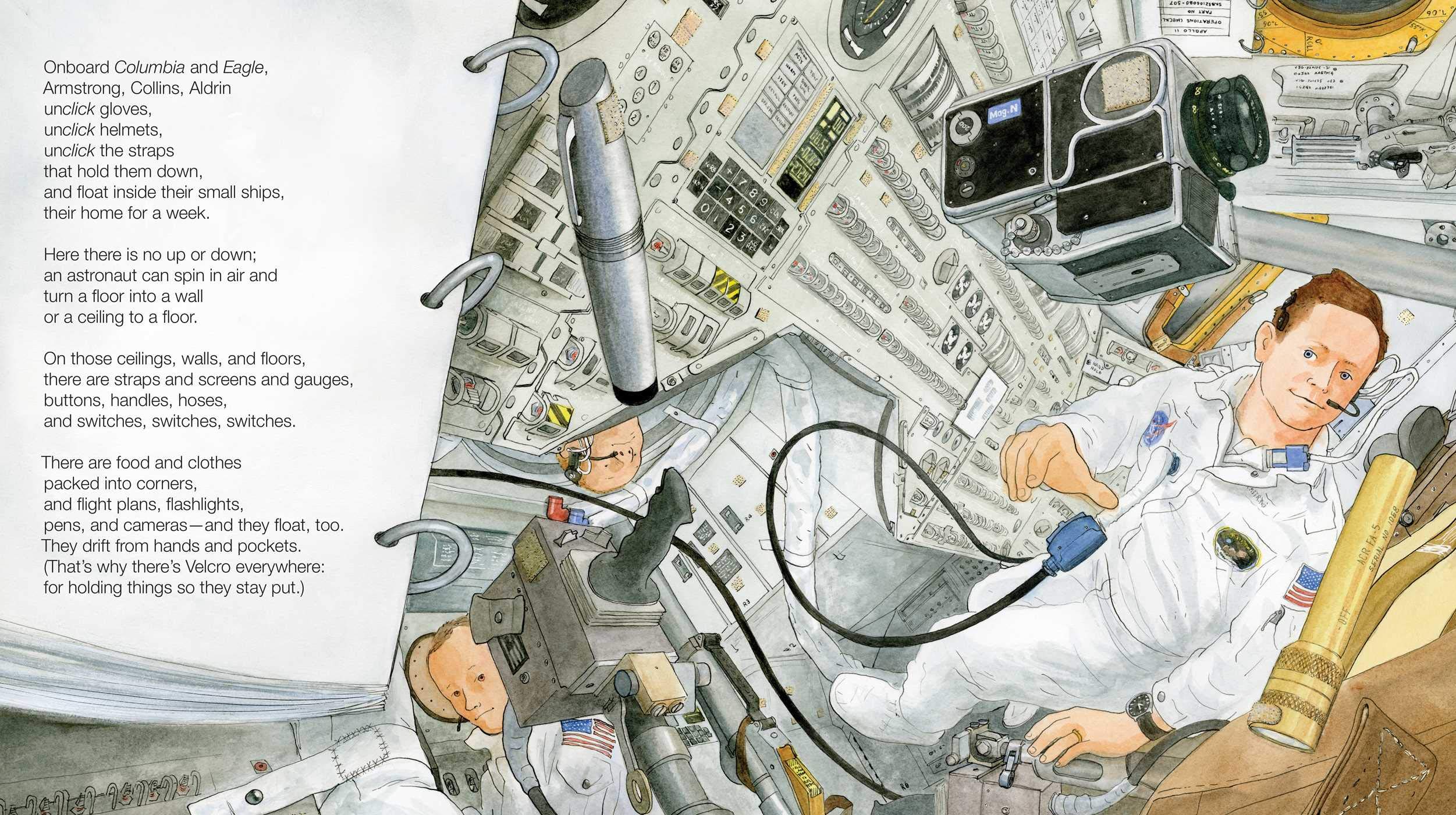
Moonshot : The Flight of Apollo II
On the website, you can explore each illustration in detail by clicking on the image.
“What I want to remember most is the glance between Neil and myself, with the engine shutoff, just that second after we touched down, because we had just completed the most critical door opening for space exploration in all of humanity.”
Buzz Aldrin
G-Souto
21.0.2019
updated 20.07.2021
 Schools : 50th Anniversary Apollo 11 ! Man on the Moon : resources for teachers & students by G-Souto is licensed under a Creative Commons Attribution-NonCommercial-NoDerivatives 4.0 International License
Copyright © 2021G-Souto'sBlog, gsouto-digitalteacher.blogspot.com®


