
The bell of the school year is ringing again. The first days or first week were a bit difficult. For both sides. Educators, whether it's first year at school or not, starting school back up can get a little nerve racking.
Students had to adapt to different learning rhythms. A new school year! A new grade for the most part of them. So, new teachers, new students, new curriculum.
After a long and leisurely summer, some students need extra boost or motivation toget amped about school.
I'm guessing some students "were dragging their feet to hop back on the learning wagon." But nothing that a motivated teacher could not, isn't that so?
We know how to put students again on learning. In a creative environment - yes the school is not confined to some walls - we empower students to learn independently in areas of interests and talents on formal and informal learning.

" Your teacher can open the door, but you must enter by yourself"
Chinese proverb
Chinese proverb
The quote identifies the way I always teach and the values of my pedagogical proposals introduced to my students in school curricula and shared with you throughout the years on this blog.
The classroom is an open window to the world. Students must feel free to talk and share ideas about all the subjects they care about, in and around every curriculum.
September rundown shows the diversity of subjects and some of my values in teaching, and summarize the most-read topics, this time, in a collection of five posts and not six, not to be too long.
As you already know I write in English, French, and Portuguese, on my blog:

Oh! La rentrée! Oui, je le sais bien! Pour les enfants et ados en France, la rentrée, c'est mardi, le 4 septembre. Mais les enseignants français font leur rentrée ce lundi, soit 24 heures avant les élèves.
Bien sûr on n'a pas eu deux mois de vacances. On travaille, même en vacances, en préparant les cours pour la rentrée.
Bien sûr on n'a pas eu deux mois de vacances. On travaille, même en vacances, en préparant les cours pour la rentrée.
Mais la rentrée scolaire 2012 s'annonce pleine de changements. Réforme des rythmes scolaires, scolarisation des enfants de moins de 3 ans encouragée, allocation de rentrée revalorisée.

.jpg)

In 1987, Grupo Lobo created the Iberian Wolf Recovery Center (IWRC), aiming to provide a suitable environment for wolves that cannot live in the wild – giving wolves that have been rescued from inappropriate captivity, or are injured or disabled, a safe and secure sanctuary.
Teaching our students about the world around them, giving them an appreciation for Nature and wild animals in environmental centers that are protecting endangered species.

Snežana Samardžić-Marković
Director General of Democracy of the Council of Europe
Let's Celebrate the European Day of Languages. Yes! Students like to communicate and interact with other students from European schools and countries, So, they can get a taste of the various languages of Europe.


In 2005, a group of students aged 10-13 started a blog as an acitvity of European Day of Languages.
Dia Europeu das Línguas 2005 was the first project ICT & Languages in secondary education.
By groups, they chose a country and elaborated a post where it should appear the word "Hello" (translated), the flag and a tradition. You can watch here (France) for example, but feel free to watch other ten countries in different posts.
Among the students, there was some students with special needs, and they really were well integrated in the activities.
In 2005, another group of students, aged 10-13 too, started a blog in French / Portuguese with a French school as an European project for Languages.

Families and schools can use the most recent technologies and instruments with the guidance of scientists, participate in experiments, competitions and quizzes, watch demonstrations and simulations, exchange ideas and party with the researchers.


Les cartables des écoliers ne sont plus ce qu’ils étaient. La tablette remplace souvent (oh! les chanceux!) les livres, les cahiers, les manuels, le journal de classe et les classeurs. Les enseignants ont évolué! Ils ont bien compris que les enfants, et les adolescents dominent les technologies dans leur vie hors école (ipads, portables, smartphones). Alors, à vous de faire avancer le numérique éducatif.
Montrer que tous ces outils sont bienvenus à l'école, collège ou lycée, et qu'on peut apprendre enormément à l'aide de toute cette parafralie techonologique est le rôle de l'enseignant du 21ème siècle.
Montrer que tous ces outils sont bienvenus à l'école, collège ou lycée, et qu'on peut apprendre enormément à l'aide de toute cette parafralie techonologique est le rôle de l'enseignant du 21ème siècle.
Vous vous rendez compte? On a la chance, nous, avec toute la nouvelle technologie, et les apps pédagogiques, les jeux pour apprendre à lire, à compter.

Foram muitas as gerações que leram comigo Saramago! Do ensino médio ao secundário, passando pelo ensino vocacional. Lemos por missão, lemos por prazer. A isso juntámos a admiração, mais tarde, quando foi laureado com o Prémio Nobel da Literatura em 1998.
"Começar a ler foi para mim como entrar num bosque pela primeira vez e encontrar-me, de repente, com todas as árvores, todas as flores, todos os pássaros. Quando fazes isso, o que te deslumbra é o conjunto. Não dizes: gosto desta árvore mais que das outras. Não, cada livro em que entrava, tomava-o como algo único."
José Saramago
"Contributo maior para o conhecimento do Oriente escrito por uma das personalidades de aventureiro mais interessantes do século XVI, a Peregrinação é seguramente a mais conhecida e estimada obra portuguesa de literatura de viagens de todos os tempos e o primeiro testemunho directo de um europeu sobre o Japão."
Este documentário realizado em 2007 para a inauguração do Museu do Oriente pode valorizar imenso a leitura de uma obra que não é muito acessível às novas gerações.
Concordo em tudo com as palavras de Vasco Graça Moura quando afirma que os jovens demonstram um crescente desinteresse pelos clássicos da literatura portuguesa.
É certo que uma geração nascida na era digital, tudo o que se associe mais rapidamente aos 'sreen-touch' é bem apetecível. Mas os ensinamentos que advêm destas obras são importantes para transmitir aos estudantes a verdadeira dimensão da história e da cultura e podem ser leccionados via digital
.jpg)
Os Lusíadas para gente nova
Vasco Graça Moura | Gradiva
"Para o fazer, Camões usou a oitava / Que é feita de oito versos a rimar. / Até ao sexto as rimas alternava, / Nos dois finais a rima vai a par. / Com oitavas assim, organizava / Essa história que tinha de contar / Em cantos que são dez e a nós, ao lê-los, / Espanta como pôde ele escrevê-los."
Vasco Graça Moura, Os Lusíada para gente nova, Introdução
"Os Lusíadas para gente nova" da autoria de Vasco Graça Moura, 440 anos depois da primeira publicação de "Os Lusíadas", é a simplificação poética desta enorme obra da literatura portuguesa para as gerações mais jovens.
"Lusíadas para gente nova" é uma adaptação inovadora da epopeia camoniana, que tenta tornar mais simples a leitura da obra por parte dos mais novos e que tem o apoio do Plano Nacional de Leitura.

Grupo Lobo
If you a are a good reader of my blog, you already know that I am a huge fan of Environmental Education in school curriuculum. Not as a specific curriculum, but as a cross-curricula. I share the same ideal about IT.
Environmental education must start in early years in school. Environmental education is not only talking and learning about climate changes.
Environmental education is about help endangered species, teaching solidarity with animals, learning to protect animals and helping injured or disabled animals.
Environmental education must start in early years in school. Environmental education is not only talking and learning about climate changes.
Environmental education is about help endangered species, teaching solidarity with animals, learning to protect animals and helping injured or disabled animals.
Grupo Lobo, the responsible for the IWRC, is an independent non-profit NGO founded in 1985. Grupo Lobo works to conserve the Iberian wolf (Canis lupus signatus) and its habitat in Portugal, where the wolf population has been declining for many decades.
In 1987, Grupo Lobo created the Iberian Wolf Recovery Center (IWRC), aiming to provide a suitable environment for wolves that cannot live in the wild – giving wolves that have been rescued from inappropriate captivity, or are injured or disabled, a safe and secure sanctuary.
In 2007, in Languages curriculum, my students were involved in a competition (essay and design) opened to schols by Grupo Lobo that had the aim of demystifying the wrong ideas about wolves.
Grupo Lobo | Environmental education
Schools
In 2007, in Languages curriculum, my students were involved in a competition (essay and design) opened to schols by Grupo Lobo that had the aim of demystifying the wrong ideas about wolves.

Grupo Lobo | Environmental education
Schools
Visiting natural centers is the best way to have a practical lesson about Environment and Endangered Species.
We had some good experiences in school. Of course this is something we must prepare carefully. But the final result is awesome.
Watch this video (student work from Arts Education) in Portuguese language.
Teaching our students about the world around them, giving them an appreciation for Nature and wild animals in environmental centers that are protecting endangered species.

"Europe is rich in languages – there are over 200 European languages in daily use and many other languages are spoken by citizens whose family origins are in other continents.
Respect for cultural and linguistic diversity and support for language learning are at the core of the work of the Council of Europe."
Director General of Democracy of the Council of Europe
Let's Celebrate the European Day of Languages. Yes! Students like to communicate and interact with other students from European schools and countries, So, they can get a taste of the various languages of Europe.

In French and Portuguese curriculum, my students had wonderful exchanges with students from several European schools from Austria, Romania, Spain, Italy, Switzerland, France - by email or/and by letters - and a Comenius school exchange project with Holland. Read some impressions about this last one.
Blogs are an interesting activity to introduce ICT in Languages curriculum (mother language or/and foreign languages)
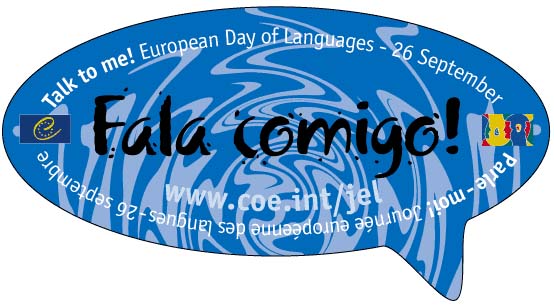
In 2005, a group of students aged 10-13 started a blog as an acitvity of European Day of Languages.
Dia Europeu das Línguas 2005 was the first project ICT & Languages in secondary education.
By groups, they chose a country and elaborated a post where it should appear the word "Hello" (translated), the flag and a tradition. You can watch here (France) for example, but feel free to watch other ten countries in different posts.
Among the students, there was some students with special needs, and they really were well integrated in the activities.
In 2005, another group of students, aged 10-13 too, started a blog in French / Portuguese with a French school as an European project for Languages.
E eis-nos de novo a festejar A Noite Europeia dos Investigadores. A NEI é um evento europeu que permite a cientistas e público em geral conviverem num ambiente descontraído.
A troca de ideias e experiências que a NEI proporciona pretende contribuir para a construção de uma imagem saudável dos investigadores junto do público e demonstrar que, afinal, a ciência não é tão complicada nem tão distante quanto se julga.
A extensa programação nacional tem como objectivo mostrar ao público que os cientistas são pessoas comuns mas com trabalhos extraordinários.
A NEI 2012 celebra o 100º aniversário da participação portuguesa no Jogos Olímpicos, as várias competições desportivas internacionais onde o país participa e a importância do desporto para a qualidade de vida.
Assim, a NEI dedica a edição 2012 à relação entre Desporto e Ciência: "Exploring science through fun learning"
And today we are celebrating a special night! Yes, the Researchers' Night 2012.
The Researchers' Night is an event bringing together the public at large and researchers. It occurs annually on the fourth Friday of September, the 28th, all over Europe.
Its main objective is to reveal scientists and science in a relaxed and friendly atmosphere.
The Researchers' Night offers the opportunity to discover research facilities that are usually not open to public such as:
- laboratories;
- research centres;
- museum collections;
Families and schools can use the most recent technologies and instruments with the guidance of scientists, participate in experiments, competitions and quizzes, watch demonstrations and simulations, exchange ideas and party with the researchers.
Exciting, isn't it? More exciting if your students can use:
Mobile devices & social media:
Of course tablets and smartphones are allowed and are great tools (no more paper notebooks) to capture the most important moments of the night and to discuss next week in the classroom.
Social networks as Facebook profiles from a lot of European schools or Twitter profiles linked to Researchers' Night 2012 will be a good resource to contact other schools and share experiences.
I really hope that you will enjoy every pedagogical proposal written in September or will discover some new pedagogical ideas to introduce in your lessons.
I thank you very much to all the colleagues from around the world that kindly read my blog.
"Education is the proper way to promote compassion and tolerance in society.(...) Education, however, is the instrument that increases our ability to employ our own intelligence."
Dalai Lama
Dalai Lama
G-Souto
08.10.2012
copyright © 2012G-Souto'sBlog, gsouto-digitalteacher.blogspot.com


