Showing posts with label reading at school. Show all posts

Friday, April 22, 2016

Schools : World Book Day and Copyright ! Resources


World Book and Copyright Day 2016
credits: UNESCO


"A book is a link between the past and the future. It is a bridge between generations and across cultures. It is a force for creating and sharing wisdom and knowledge.
Frank Kafka once said, “a book must be an ice-axe to break the seas frozen inside our soul.”
A window onto our inner lives, books are also the doorway to mutual respect and understanding between people, across all boundaries and differences."

Irina Bokova, Former Director-Generale UNESCO


UNESCO is celebrating World Book and Copyright Day on 23 April for 19 years now. 


World Book Day and Copyright takes place today, with festivities such as the Catalan Sant Jordi – to mark Saint George's day, in honour of Catalonia's patron saint.
 

This "day of the book and the rose" is a Valentine's day of sorts in which streets are packed with stalls, and couples demonstrate their love by exchanging roses and books – giving publishers a massive boost along the way.


"In turbulent times, books embody the human capacity to conjure up worlds of reality and imagination and express them in voices of understanding, dialogue and tolerance. They are symbols of hope and dialogue that we must cherish and defend."(...)

Irina Bokova, message

Literacy is the door to knowledge, essential to individual self-esteem and empowerment. Books, in all forms, play an essential role here. 

With 175 million adolescents in the world - mostly girls and young women - unable to read a single sentence, UNESCO is committed to harnessing information and communication technologies, especially mobile technology, to support literacy and to reach the unreached with quality learning.


Wroclaw, Poland, is the 2016 World Book Capital, for its commitment to spreading this message across the globe. 

This has never been so important at a time when culture is under attack, when freedom of expression is threatened, when diversity is challenged by rising intolerance.

April is a month full of good things to celebrate about books and literature. April 23 is a day when books are the centre of activities in schools and events all around the world. 


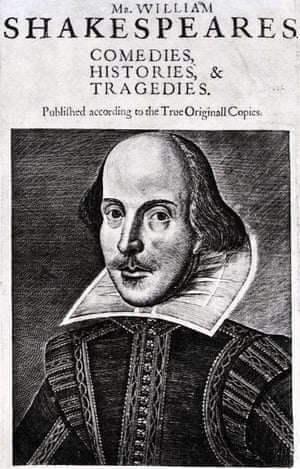
Seven years after his death … the First Folio
Photograph: Bettmann/Corbis


Miguel de Cervantes Saavedra commonly said to be that which, according to the prologue to Cervantes' 
"Exemplary Novels", 
painted by Juan de Jáuregui 


William Shakespeare died on 23 April, 1616, preceded by only one day by Cervantes. On this day, I call upon all of UNESCO’s partners to share the message that books are a force to counter, what Shakespeare called, “the common curse of mankind - folly and ignorance.”

Irina Bokova, message 2016


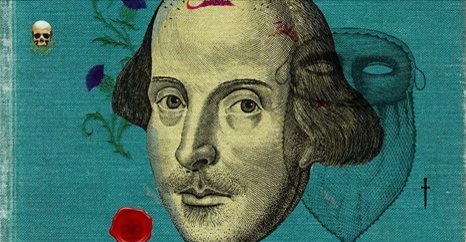
400th anniversary of Shakespeare death

This year we are celebrating the 400th anniversary of Shakespeare’s death in 2016.


The world is going barmy for The Bard this weekend, and more with celebrations to mark the 400th anniversary of William Shakespeare's death.

Google has decided to pay its own tribute to Britain's favorite playwright with a Google Doodle that celebrates William Shakespeare and St. George's Day.


Google Doodle William Shakespeare and St. George's Day

Education:

“Fairy tales are more than true: not because they tell us that dragons exist, but because they tell us that dragons can be beaten.” 

 Neil GaimanCoraline

April is a month full of good things celebrating books & writers. First, April 2nd Christian Andersen's birthday and International Children's Book Day


April 23 Shakespeare's death and April 22 Cervantes' death. It's the day when books are the centre of activities in schools and events all around the world. 


Reading a book is in our days a large concept. All formats are available for those who love to read. Many of these emphasize international cooperation or friendships between schools.


“Too much sanity may be madness and the maddest of all, to see life as it is and not as it should be.”
Miguel de Cervantes, b. 29 September 1547


Let's celebrate World Book and Copyright Day 2016 Worldwide. Register your celebration for World Book and Copyright Day 2016 and share your plans with other school that might be interested in participating or promoting this important day on the world map (UNESCO website linked above)


  • Resources:


Shakespeare Lives is an unprecedented global programme of events and activities celebrating William Shakespeare’s work on the occasion of the 400th anniversary of his death in 2016.

"It is an invitation to the world to join in the festivities by participating in a unique online collaboration and experiencing the work of Shakespeare directly on stage, through film, exhibitions and in schools."
Britsh Council

It will run throughout 2016, exploring Shakespeare as a living writer who still speaks for all people and nations.


Spain is celebrating the 4th Centenary of the death of its bard, Miguel de Cervantes:


Discover the official Programme to mark the 4th Centenary of the death of Miguel de Cervantes here

  • Activities:

You will find different ideas and some funny activities on this blog to motivate your students to read and to love books.

You can also organize different events at your school: relay readings of books and plays; the distribution of bookmarks; the announcement of the winners of school literary competitions.


Primary School in UK
via BBC


Children should be introduced to Shakespeare for no other point than to explore the acting of it. Students love perform plays.

”The Shakespeare canon consists of manuals on how to perform his plays; they are not books to be read.”

Teachers with their students can unlock Shakespeare’s themes, characters and stories. Shakespeare’s life and works come alive for learners of all ages. 

Exploring Shakespeare is one challenge that a primary school has taken seriously in 2014, when a class of 30 pupils, aged between nine and ten took to the state to perform a 30 minute adaptation of Julius Caesar, under the watchful eye of teacher Ruth Brock.

"It's heart surgery, acting Shakespeare. Students dissect the hearts of characters, they learn how to manipulate their own body, voice, and emotions, and to a certain extent their mind, to mirror the humanity of a fictional life."

Ben Crystal (adaption)

Some schools simply can’t afford drama departments or visiting specialists, but perhaps one day the education system will change, and actors come into schools across the world free of charge. It would wonderful. Students like to talk with writers, actorsm illustrators, musicians.


400 Años sin Cervantes

But this year we are celebrating the 400th anniversary Cervantes' death as well. And I can say to you they love Miguel de Cervantes and his book Don Quijote.


  • Copyright:

If your students are kids, don't forget some 
actions to promote the understanding of laws on copyright and the protection of authors' intellectual property.


Hamlet
credits: Fundação Calouste Gulbenkian


  • Resources +


On World Book and Copyright Day (2014), Calouste Gulbenkian Museum joined the commemorations for the 450th anniversary of the birth of William Shakespeare (Stratford-upon-Avon, 23 April 1564 - 23 April 1616) by displaying a copy of the tragedy Hamlet in the permanent exhibition space. 


The copy in question is a translation into French by André Gide, who also wrote the introduction, and is illustrated with burin engravings by Albert Decaris. This work was acquired by Calouste Gulbenkian in 1947 in his capacity as a member of the Société des Bibliophiles Franco-Suisses, which joined in 1932.´


Some thoughts:

My usual readers knows I write so often on G-Souto's Blog about the importance of reading in school! I have a Master in Literature and Linguistics. So, humanities are my priority and I am a huge fan of books. No matter the format. However I prefer printed books. What can I say?


You will find so many posts about books, reading, literature in my blog! If you search you will find a great number of authors and books in different languages and to different levels of education.

From Harry Potter to classical authors Leo Tolstoi, Lewis Carroll, Rimbaud, from science-fiction to comics, educators will find interesting resources.


And some good appsanimated films and games that involve students to learn the way they like. Using the new educational digital resources.


G-Souto


22.04.2016

update 26.04,2925
Copyright © 2016G-Souto'sBlog, gsouto-digitalteacher.blogspot.com®

Creative Commons License
Schools : World Book Day and Copyright ! Resources bG-Souto is licensed under a Creative Commons Attribution-NonCommercial-NoDerivatives 4.0 International License


Tuesday, January 12, 2016

Schools : Reading Charles Perrault, the inventor of fairy tales ! Resources


Charles Perrault
The Complete Fairy Tales 
Oxford World's Classics

Most children in the world are familiar with the tale of Puss in Boots or The Sleeping Beauty .

But did they know these famous stories were actually the work of a Frenchman called Charles Perrault?

Charles Perrault was a French writer who lived in the second half of XVII century. He was one of the first writers in European literature who turned his eyes to folklore.

Doodle:


Charles Perrault's 388th birthday
La Belle au Bois Dormant/Sleeping Beauty
Doodler:  Sophie Diao

Google has decided to celebrate this legendary writer on his 388th birthday today, 12 January, by giving him his very own Doodle.

"What's that story, with the glass slipper and the pumpkin that turns into a carriage? How about the one where a princess falls into a deep sleep when she pricks her hand on a spindleWe owe the Cinderella and Sleeping Beauty narratives we've known since childhood to Charles Perrault."


Le Chat Botté/Puss in Boots
Charles Perrault's 388th anniversary
Doodler:  Sophie Diao

There are three versions of the Doodle, which honors Charles Perrault, the French author born on this day in 1628. 

He’s widely considered to be the inventor of the fairy tale, writing down both original stories and altered versions of older, orally transmitted stories. No, not Grimm Brothers or Hans Christian Andersen. They came later.

Perrault's stories set the standard for the modern fairy tale. Perrault borrowed basic plots and the familiar opening "Once upon a time" or in his own language and writing "Il était une fois" from traditional stories told aloud, while modernizing them with both fashionable embellishments and the very act of putting them into writing. 


Jacques Perrault
Philippe Lallemand, 1672


Some facts - biography:

French poet and writer Charles Perrault was born on January 12, 1628, in Paris, France. Perrault was born into a wealthy family, studied law and enjoyed a successful career as a civil servant.

In Folk Art Perrault found rich stories and images to create new artistic works. He turned to folklore by collecting a number of stories and published them in 1697 under the title "Tales of mother Goose". This collection included eight fairy tales, including "Little Red Riding Hood", "Puss in Boots", "Little Thumb" and "Cinderella." In subsequent editions Perrault added two more stories and a novelette.

But after losing his job aged 67, he decided to dedicate time to his children and penned a book called Histoires ou Contes du Temps passé (Tales and Stories of the Past With Morals), with the famous subtitle "Tales of Mother Goose".
In 1671, he worked in the Académie Française, and played a prominent role in a literary controversy known as the dispute between the Ancients and Moderns. 


Charles Perrault
Red Riding Hood by Jessie Willcox Smith, 1911
Le Petit Chaperon rouge par Jessie Willcox Smith, 1911

Perrault is perhaps best known for his Mother Goose fairy stories, including Little Red Riding Hood and Puss in Boots, which he wrote for his children. Perrault died on May 16, 1703, in Paris, France.


Little Red Riding Hood
London, 1810
British Library

Little Red Riding Hood is perhaps one of the best known fairy tales. Like most European fairy tales, its origins lie within a sprawling folk tradition of oral storytelling. 

It was first published in the late 17th century by Charles Perrault the French author who is considered to be the father of the fairy tale genre due to his work collecting these tales together for the first time in print. 

"This later version, contained within a small, hand-coloured chapbook, dates from 1810 and was published in Moorfields, London. It is told in the form of a verse poem with alternating unrhymed and rhymed couplets. The clear text and simple language, coupled with the large colourful illustrations, suggests that this chapbook was aimed at young readers."

The British Library

One of the first and perhaps most beloved classics of children's literature was the French poet and author Charles Perrault's collection Contes de ma mère l'oye (1697; Tales of Mother Goose). 


Charles Perrault's 388th anniversary
Cendrillon/Cinderella
Doodler:  Sophie Diao

Its classic fairy tales include Cinderella, (written 200 years before the Brothers Grimm wrote theirs!), Little Red Riding Hood, The Sleeping Beauty, Puss in Boots, Blue Beard, Little Thumb, other.


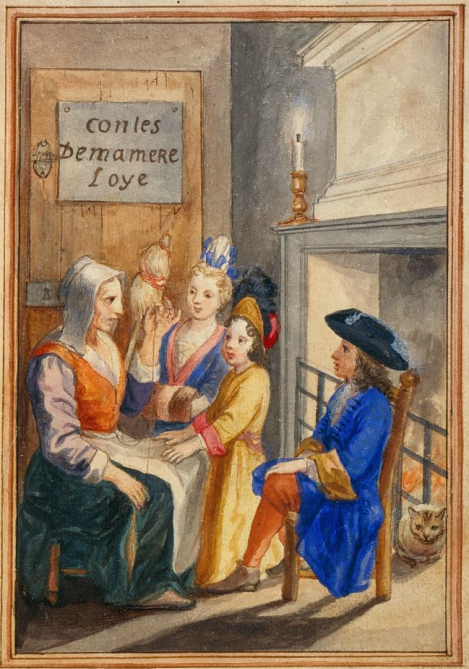
Les contes de la Mère L'Oye, 1697

In 1697, Perrault published Tales and Stories of the Past with Morals (Histoires ou Contes du Temps passé), subtitled Tales of Mother Goose (Les Contes de ma Mère l’Oye). 

This “Mother Goose” has never been identified as a person, but used to refer to popular and rural telltales traditions in proverbial phrases of the time.*  

These tales, based on French popular tradition, were very popular in sophisticated court circles. Its publication made him suddenly very widely known and he is often credited as the founder of the modern fairy tale genre. Yet his work reflects awareness of earlier fairy tales written in the salons, most notably by Marie-Catherine Le Jumel de Barneville, Baroness d’Aulnoy, who coined the phrase “fairy tale” and wrote tales as early as 1690. 

Even so, many of the most well-known tales that we hear today, such as Cinderella and Little Red Riding Hood, are told as he wrote them.


Charles Perrault 
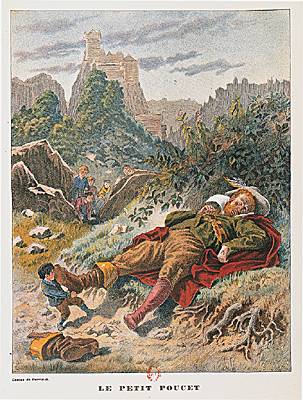
Le Petit Pousset/Little Thumb

Education:

What's that story, with the glass slipper and the pumpkin that turns into a carriage? How about the one where a princess falls into a deep sleep when she pricks her hand on as pindle? We owe the Cinderella and Sleeping Beauty narratives we've known since childhood to Charles Perrault, the 17th-century French author and academician. Perrault was born in Paris 388 years ago today

You know me!  I am a huge fan of reading at school. And I don't miss a good resource to introduce in every day lesson!


Google Doodlers & Sophie Diao

Today, we are very lucky! We have these lovely three doodles to motivate the students to read, created by someone who have wonderful memories of her childhood fairy tales to motivate the students to read.

Reading! As educators, we have an ubiquitous responsibility of encourage the love of reading in our students by exploring this wonderful and magical resource in our lessons, in formal and informal learning.

Of course, today is the fay of reading by pleasure! Let your students read the fairy tales they like the most. There are two reasons for this:

  • One is benefiting those readers in your classroom that wish to read from you and need to let them be free. 
  • Secondly, it is so you can reap the exponential rewards their choices offers. 
By inviting your students to bring a book or e-book from home or go at the school library to choose a book/e-book to read aloud in the classroom will let them completely free and happy! Students like to be active in the classroom. You know that.

The love of books and reading are awesome moments in Languages curriculum face-to-face or oline.

Students become better readers when their teachers love books and love to read. Believe me. They feel if the teacher loves to read. 

It's a divisible love! Even for those students that at the beginning are poor readers. 

Reading has a curative power. And helps to spot 'problem behaviour' and attention deficit hyperactivity disorder (ADHD)


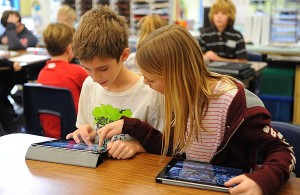
students using tablets in the classroom

So, first, ask your students to use their tablets or smartphones, and invite them to discover the Charles Perrault's Doodle.

  • Let them find the stories in every Doodle;
  • They can read about Perrault's life and work, or explore highlights of his biography;
  • Of course ,they will be curious to find different fairy tales to read online.

Curricula: Languages; Arts.

Level: Primary education.

Educators will adapte some activities to the grade they teach.


Some Resources for teachers:

Charles Perrault's Biography: 

Larousse enclypodie

Les Immortels: Charles Perrault


Languages:

If you teach French, your students can read online:

  • Perrault' s fairy tales in French here
  • Charles Perrault's fairy tales on Pinterest 


Charles Perrault/ Fairy Tales, iBook

Apps & iBooks:

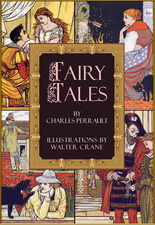
  • Tales of Charles Perrault illustrated by Walter Crane: Puss in Boots, Blue Beard, Sleeping Beauty, Cinderella) on iTunes (classical version), iBook;
  • Pussy in Boots, interactive storybook on iTunes;
  • Cinderella 3D Pop-up Fairy tale Lite, app, iTunes.

Arts: 

Your students could read the article where the doodler Sophie Diao explains her imagining of scenes from three of the stories Perrault, and the different phases before to finish the act of creation.


Finally, just to finish with a modern "fairy" tale that could motivate even more your little students, here the trailer of the beloved classic The BFG to life, directed by Spielberg, Disney’s.


Sophie, a precocious 10-year-old girl from London, is initially frightened of the mysterious giant who has brought her to his cave, but soon comes to realize that the BFG is actually quite gentle and charming, and, having never met a giant before, has many questions. The BFG brings Sophie to Dream Country where he collects dreams and sends them to children, teaching her all about the magic and mystery of dreams.


Some thoughts:

Charles Perrault's Fairy Tales have a universal value and are part of the world literary heritage.“Perrault’s stories set the standard for the modern fairytale,” said Google.

"And that is where the story begins..." is the modern "Once upon a time..." don't you agree?

You can start from Perrault's fairy tales to The BFG ( a modern tale of a giant who captured dreams and kept them in bottles for children to enjoy while they were asleep). Or on the contrary start from The BFG to Perrault's fairy tales. Your choice.

It occurred to me that there is a simple pedagogical principle that explains the appeal of very early learning, homeschooling, and reading began at home, with parents since childhood. But sometimes this is not possible. There are some poor readers among parents.

So educators are an important reference to students. We must valorize books and read a lot in the classroom. We can do a better job if we are rich readers.

Reading is a pleasant act that must start in kindergarten and must be continued along all school degrees. Even in Higher Education.

Reading out loud is a pleasant way that students love the most. One important point: schools need more time for reading aloud, choosing new books, and sharing the pleasure of reading full books and not just excerpts. Teachers can make reading exciting all through the school levels.

“If you want your children to be intelligent, read them fairy tales. If you want them to be more intelligent, read them more fairy tales.


Albert Einstein 

G-Souto

12.01.2016
Copyright © 2016G-Souto'sBlog, gsouto-digitalteacher.blogspot.com®

Creative Commons License
Schools : Reading Charles Perrault, the inventor of fairy tales ! Resources bG-Souto is licensed under a Creative Commons Attribution-NonCommercial-NoDerivatives 4.0 International License.

*Source : Dictionnaire de l’Académie, 1694, quoted by Nathalie Froloff in her edition of the ‘’Tales’’ (Gallimard, Folio, Paris, 1999.- p.10)