"Teachers are a critical foundation of every society’s long-term strength - providing
children, young people and adults with the knowledge and skills they need to fulfill
their potential."
UNESCO, ILO, UNICEF, message 2017
UNESCO, ILO, UNICEF, message 2017
Today is annual World Teachers’ Day, a UNESCO initiative devoted to appreciating, assessing and improving the educators of the world.
Held annually on 5 October since 1994, World Teachers’ Day commemorates the anniversary of the signing of the 1966 UNESCO/ILO Recommendation concerning the Status of Teachers, which celebrated its 50th anniversary during last year’s edition.
However, local events may be on some other date close to October 5, so that they do not fall during fall (northern hemisphere) or spring (southern hemisphere) school vacations.

World Teachers’ Day 2017 will be celebrated under the theme:
“Teaching in Freedom, Empowering Teachers”
It echoes the 2015 theme that followed the adoption of the new Sustainable Development Goals (SGDs) in September 2015, when teacher empowerment was reaffirmed as a top priority in all education and development strategies.
"Being an empowered teacher means having access to high-quality training, fair wages, and continuous opportunities for professional development. It also means having the freedom to support the development of national curricula - and the professional autonomy to choose the most appropriate methods and approaches that enable more effective, inclusive and equitable education. Furthermore, it means being able to teach in safety and security during times of political change, instability, and conflict."

It has become the occasion to mark achievements and reflect on ways to counter the remaining challenges for the promotion of the teaching profession, like the acute shortage of teachers. Indeed, according to the UNESCO Institute of Statistics, the world needs 69 Million teachers if we are to achieve universal primary and secondary education by 2030.
Education is the 4th goal after growth and employment, sustainable consumption and production, and climate change.
Sustainable Development Goal 4 has 10 targets encompassing many different aspects of education. There are seven targets which are expected outcomes and three targets which are means of achieving these targets.

This year, World Teachers’ Day commemorates the 20th anniversary of the 1997 UNESCO Recommendation concerning the Status of Higher-Education Teaching Personnel. Teaching personnel at institutions of higher education are often overlooked in discussions concerning the status of teachers.
Like teachers at pre-primary, primary, and secondary levels, teaching in higher education is a profession requiring expert knowledge, specialized skills, and pedagogical competence.

"Being an empowered teacher means having access to high-quality training, fair wages, and continuous opportunities for professional development. It also means having the freedom to support the development of national curricula - and the professional autonomy to choose the most appropriate methods and approaches that enable more effective, inclusive and equitable education. Furthermore, it means being able to teach in safety and security during times of political change, instability, and conflict."
It has become the occasion to mark achievements and reflect on ways to counter the remaining challenges for the promotion of the teaching profession, like the acute shortage of teachers. Indeed, according to the UNESCO Institute of Statistics, the world needs 69 Million teachers if we are to achieve universal primary and secondary education by 2030.
Education is the 4th goal after growth and employment, sustainable consumption and production, and climate change.
Sustainable Development Goal 4 has 10 targets encompassing many different aspects of education. There are seven targets which are expected outcomes and three targets which are means of achieving these targets.
This year, World Teachers’ Day commemorates the 20th anniversary of the 1997 UNESCO Recommendation concerning the Status of Higher-Education Teaching Personnel. Teaching personnel at institutions of higher education are often overlooked in discussions concerning the status of teachers.
Like teachers at pre-primary, primary, and secondary levels, teaching in higher education is a profession requiring expert knowledge, specialized skills, and pedagogical competence.
Despite global recognition of the importance of teachers in changing children’s lives and building sustainable and prosperous societies, teachers are all too often undervalued and under-empowered.
Worldwide there is a growing shortage of quality teachers and inadequate professional training. The UNESCO Institute for Statistics estimates that to achieve universal primary education by 2030 the world needs 69 Million teachers if we are to achieve universal primary and secondary education by 2030.
All these factors result in equity gaps in access and learning which mostly affect the poorest regions and schools and the earliest grades. This is particularly damaging, as there is clear evidence that the earliest years of a child’s development are the most critical.
UNESCO Institute for Statistics
Some Data:
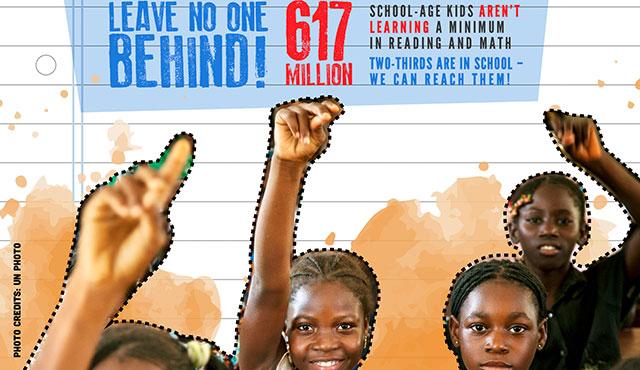
New data from the UNESCO Institute for Statistics show that 617 million children and adolescents worldwide are not achieving minimum proficiency levels in reading and mathematics. The figure signals “a learning crisis” according to the UIS, which could threaten progress towards the Sustainable Development Goals (SDGs).
Two-thirds of the children who are not learning are in school. Of the 387 million primary school-age children unable to read proficiently, 262 million are in school. There are also about 137 million adolescents of lower secondary school age who are in classrooms but unable to meet minimum proficiency levels in reading.
“The figures are staggering but they show the way forward,” says Ms Montoya. “We know where these children live and go to school. They are not hidden or isolated from their governments and communities – they are sitting in classrooms with their own aspirations and potential. We can reach these kids but not by simply hoping that they stay in school and grasp the basics.”

My thoughts:
Teachers are too often undervalued and under-empowered. Often they don't have access to high-quality training and continuous opportunities for professional development.
When they want to have the autonomy to choose the most appropriate methods and approaches that enable more effective the learning of their students, and practice inclusive and equitable education, they are not empowered by the school director, other colleagues, and sometimes by parents who don't understand the visin of a different pedagogue who knows well the capacities of their students. A class has different students and some of them learn in different levels.
Sometimes, they don't have the freedom to support the development of national curricula and the professional autonomy to choose the most appropriate methods and approaches that enable more effective, inclusive and equitable education.
To engage their students, teachers create, collaborate, communicate and think critically. Teachers who love to teach they know which are the best methods and approaches that enable every student in a class.
If we love to be a teacher, the most important are our students. And every student must be empower to learn and be a better learner even on a different rythm to enable each one with its own aspirations and potential.
"Good teachers know how to bring out the best in students."
Charles Kuralt
G-Souto
05.10.2017
Copyright © 2017G-Souto'sBlog, gsouto-digitalteacher.blogspot.com®

World Teachers' Day : Teaching in Freedom, Empowering Teachers by G-Souto is licensed under a Creative Commons Attribution-NonCommercial-NoDerivatives 4.0 International License.
05.10.2017
Copyright © 2017G-Souto'sBlog, gsouto-digitalteacher.blogspot.com®
World Teachers' Day : Teaching in Freedom, Empowering Teachers by G-Souto is licensed under a Creative Commons Attribution-NonCommercial-NoDerivatives 4.0 International License.