Showing posts with label e-books. Show all posts

Wednesday, January 8, 2014

Reading Stephen Hawking at school : resources for teachers


Riddles Of Time & Space
Stephen Hawking
illustrator: Michael Lent Brian McCarthy


Riddles Of Time & Space
Stephen Hawking
illustrator: Michael Lent Brian McCarthy

So, Happy Birthday Stephen Hawking ! Yes, today January 8th, we celebrate the birthday of the inspirational scientist.

No! This post is not only about Visual learning & Stephen Hawking. It´s about reading in school.


Riddles Of Time & Space
Stephen Hawking
illustrator: Michael Lent Brian McCarthy

Education:

Celebrate the birthday of Stephen Hawking reading fantastic books and e-books in the classroom will be a lovely idea.


Here some irrefutable reading proposals for different targets. I hope so!

Of course you will explore with your students, as you wish. You are the teacher. You know your students. And the skills you want to develop.

Target: Secondary Education


Curricula: Cross-curricular: Languages, Sciences, Arts.


There a possibility of making download from iTunes but it's not free. Available on iPhone, iPad, iPod touch, and Mac. Please read here
  • The second one, the children's book by Stephen Hawking George's Secret Key to the Universe written in 2007 with his daughter Lucy. And that makes the book especially endearing. Hawking co-wrote it with his daughter Lucy.
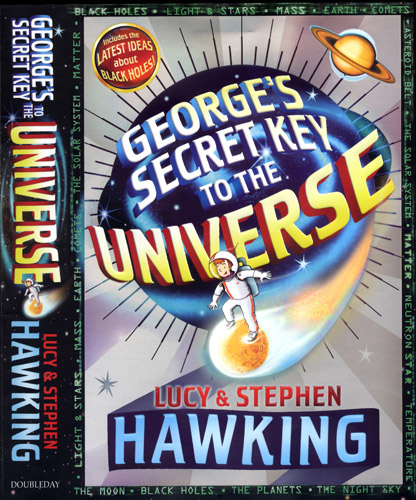


George's Secret Key to the Universe
Lucy & Stephen Hawking
illustrator: Garry Parsons

Synopsis:

George's best friend Annie needs help. Her scientist father, Eric, is working on a space project - and it's all going wrong. A robot has landed on Mars, but is behaving very oddly. And now Annie has discovered something weird on her dad's super-computer..

In their bestselling book for young readers, noted physicist Stephen Hawking and his daughter, Lucy, provide a grand and funny adventure that explains fascinating information about our universe, including Dr. Hawking's latest ideas about black holes. 


George's Secret Key to the Universe
Lucy & Stephen Hawking
illustrator: Garry Parsons


It's the story of George, who's taken through the vastness of space by a scientist, his daughter, and their super-computer named Cosmos. George's Secret Key to the Universe was a New York Times bestseller and a selection of Al's Book Club on the Today show.

In 2007, Hawking wrote George’s Secret Key to the Universe, a charming, imaginative story about the mesmerism of space and the allure of time-travel, featuring lovely semi-Sendakian crosshatch illustrations by Garry Parsons


George’s Secret Key to the Universe
Lucy & Stephen Hawking
illustrator: Garry Parsons

Once upon a time...

When George's pet pig breaks through the fence into the yard next door, George meets his neighbors - Annie and her scientist father, Eric - and dicover a secret key that opens up a whole new way of looking at the world. From outer the space. "(...)

Target: Primary Education; K-12.

Curricula: Cross-curricular : Languages, Sciences, Arts.
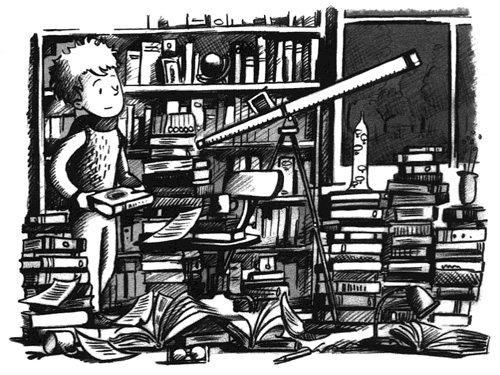


George’s Secret Key to the Universe
Lucy & Stephen Hawking
illustrator: Garry Parsons


George's Secret Key to the Universe was written to interest children in Physics and the universe and is an entertaining blend of a fictional story based on Science fact, with factual text boxes explaining the Science throughout. 

On publication in September 2007 contained brand new information about black holes. The book is a global bestseller, with rights sold in over 30 languages. 


George’s Secret Key to the Universe
Lucy & Stephen Hawking
illustrator: Garry Parsons


  • Resources : Books online

Students can read a little of George's Secret Key to the Universe online here. Kindle edition here


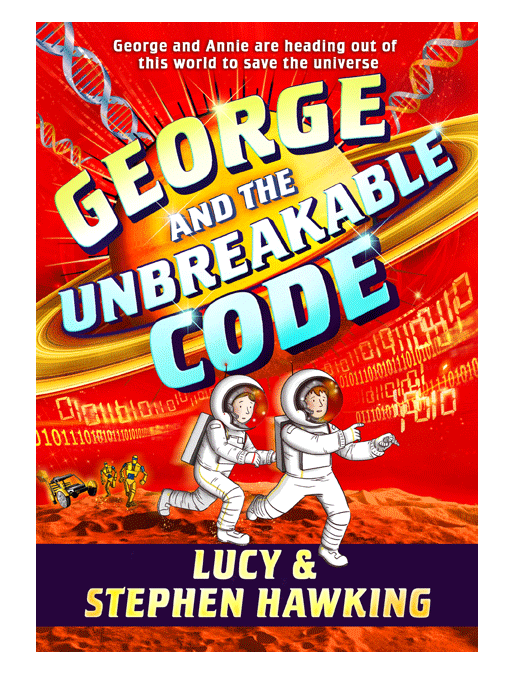
George and the Unbreakable Code
Lucy & Stephen Hawking
illustrator: Garry Parsons

There are two other books that complete the scientific saga. As you will hear from Stephen Hawking on the video below. George's Cosmic Treasure Hunt (2008) and third book of the series George and the Big Bang (2009). And the four George and the Unbreakable Code


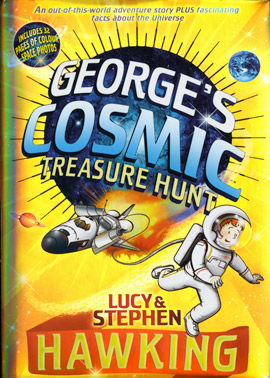
George's Cosmic Treasure Hunt
Lucy & Stephen Hawking
illustrator: Garry Parsons

The second book about George has him going on a treasure hunt in space. The second in the series of children's books written by Stephen and Lucy Hawking. George and Annie, the middle-school cosmologists, return in this sequel to the 2007 story, George's Secret Key to the Universe.
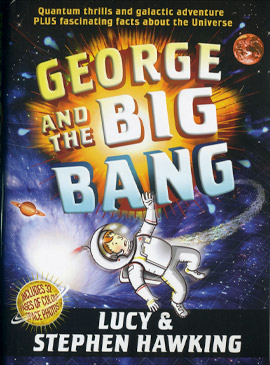


George and the Big Bang
Lucy & Stephen Hawking
illustrator: Garry Parsons

George and the Big Bangthe final volume of the trilogy, brings George’s adventures in the universe to a fitting close. It includes essays by some of world’s most important cosmologists, brilliant illustrations by Garry Parsons, a thrilling plot line and a series of easy to read scientific inserts. 

With a full colour set of photographs, illustrating the wonder of the cosmos, George and the Big Bang, the final volume of the trilogy.

  • Other Resources: videos

You can complete the Stephen Hawking's presentation in your lesson, displaying for discussion with your students, the videos below:


Hope Stephen Hawking have a long life ! Stephen Hawking is regarded as one of the most brilliant theoretical physicists since Einstein.

Happy Birthday Stephen Hawking !

G-Souto

08.01.2014
update: 14.03.2018
Copyright © 2014G-Souto'sBlog, gsouto-digitalteacher.blogspot.com®

Licença Creative Commons
Reading Stephen Hawking at school : resources for teachers by G-Souto is licensed under a Creative Commons Attribution-NonCommercial-NoDerivatives 4.0 International License.

Tuesday, April 23, 2013

World Book & Copyright Day at school


Livraria Ler Devagar | Lisboa (Portugal)

23 April is a symbolic date for world literature for on this date in 1616, Cervantes, Shakespeare and Inca Garcilaso de la Vega all died. It is also the date of birth or death of other prominent authors such as Maurice Druon, Haldor K.Laxness, Vladimir Nabokov, Josep Pla and Manuel Mejía Vallejo.
UN
For this reason, UNESCO's General Conference (1995) chose this date to pay tribute to books, the authors who wrote them, and the copyright laws that protect them.

UNESCO is celebrating World Book and Copyright Day on 23 April for 17 years now. UNESCO Member States around the world celebrate the power of books to bring us together and transmit the culture of peoples and their dreams of a better future.


This day provides an opportunity to reflect together on ways to better disseminate the culture of the written word and to allow all individuals, men, women and children to access it, through literacy programmes and support for careers in publishing, book shops, libraries and schools. Books are our allies in spreading education, science, culture and information worldwide.


Dan Atkin Alarmy

This day also calls us to reflect on the changes in books over the long term and the intangible values that should guide us. 


Digital books offer new opportunities for access to knowledge, at reduced costs and over wide geographical areas. Traditional books are still powerful technology: failsafe, portable and standing the test of time. 


Image: UNESCO

Education:
I write so many times on my blog about the importance of reading at school! If you are a regular reader, you know that!

The last time it was 2013 International Children's Books Day. But there is a special one (between others) The Love for Books.


As the idea for the celebration of "Book Day" is originated in Catalonia (Spain) where on 23 April, Saint George's Day, a rose is traditionally given as a gift for each book sold.

Activities:
  • Make a similar activity at the school library. Give a little flower to every student who enter at the school library to get a book or e-book to read!


  • Download Free UNESCO e-books published over 100 years ago on Kindle here;
  • Ask students to share their passion for an author by offering his book to the school library or to a friend who can not buy a book;
  • Take this opportunity to let your students discover something new from what they're used to read. Surprise them! ;
  • Ask your students to leave a book on a park bench or a metro  or bus seat with a note saying “Happy Book and Copyright Day!”;
  • Find out how to send students old books to schools and libraries in countries facing a post-disaster situation. They love this activity;
  • Educate students on books pirating: respect for copyright encourages the dissemination of knowledge and rewards their creators and publishers;
  • Educate them never throw away their books, getting them or the school involved in local community or online book swapping and donation campaigns and initiatives.
  • Plan local reading events in schools and libraries and encourage famous guest read. Authors are welcome at school, always;

I do love to read! My students love to read! But, most of all, I really believe that reading at school is a value to students' life and studies.


And finally, the city of Bangkok has been designated World Book Capital 2013 in recognition of its programme to promote reading among young people and underprivileged sections of the population.

The theme selected for the Bangkok World Book Capital City 2013 is "Bangkok, Read for Life".

"All forms of books make a valuable contribution to education and the dissemination of culture and information. The diversity of books and editorial content is a source of enrichment that we must support through appropriate public policies and protect from uniformity. "
Irina Bokova, UNESCO Director-General


G-Souto

23.04.2013
Copyright © 2013G-Souto'sBlog, gsouto-digitalteacher.blogspot.com®

Licença Creative Commons
World Book & Copyright Day at school by G-Souto is licensed under a Creative Commons Attribution-NonCommercial-ShareAlike 3.0 Unported License.


Friday, July 1, 2011

e-Books and School Library


Last post, I wrote about the importance of JK Rowling books to captivate a new public of readers at school.

"All educators of Languages curriculum can assure that the "Harry Potter 'folie' brought enormous number of new readers in the Languages courses in the school, since we as educators understood the importance of reading the Harry Potter books in the curriculum of Languages and Literature."


As I read five books Harry Potter in the Literature | Language classroom with my students, I can say having a Master degree in Literature and Linguistics that the story world of Harry Potter is vastly detailed and believable enough for a young-adults fiction.
  
Almost every character had flaws to overcome which made them fascinating to read. The mysteries were masterfully produced by Rowling and cleverly explained.  All of these things drove the story forward.  They were all great elements to help create the whole.

And JK Rowling wrote for the present. As her audience grew up so did the story.

Education:


Diversity in children and adolescents' books had long been a complex issue. Despite good  efforts and some big strides forward in the last years, children's books remained disappointingly short of enough culturally diverse stories.

So, in the 90's, Eragon and Harry Potter were the first books that contained a suitable number of pages and a good story to captivate youngs really absorved into a book.

I can't be so helpful about books which challenge gender stereotypes. Whenever one is published there is a media storm of protest. But this is another point not included here.
Though there are not enough, there are some and they are excellent.

The idea of JK Rowling transforming her books in e-books on Pottermore.com bring to my thoughts another important matter: Best practices in school library.


Interactive children’s books for the iPad are becoming more engaging and, in some cases, are visually stunning. Remember Alice in Wonderland for iPad or iPad features & Education?

The Kindles, Nooks and iPads, Oh My! Implementing eReaders into the school libraries program is about more than just jumping on the latest technological bandwagon or attempting to reinvent the library in order to stay relevant. It’s about good practice in school library, an impressive support to students.

So. let's follow Buffy J. Hamilton, an teacher librarian, and her ideas to understand how eReaders have helped them provide students with: 

a) access to the most up to date titles, 

b) the unique ability to efficiently link works of fiction with non-fiction resources and, 

c) the opportunity to interact with texts in ways that are simply not possible with traditional, library owned, books – all in an environment that both appeals to and enhances their skills as 21st century learners.

Now! My question is: Are school libraries prepared to introduce innovative devices? Sometimes, teachers librarians are conservative. And directors are not so open to new ideas.

And there is another point! A very important one! The chidren's preparation for e-Readers, especially children and adolescents students from disadvantaged social backgrounds

So, perhaps the Jennifer LaGarde slideshare below might help...

Conclusion:


The critical thing that is happening is students are living and breathing, within a much larger sphere of information and knowledge. That critical openness to knowledge, that is something we had better address, or we are ill-serving our students. Seeing students utilize the information literacy skills we have previously taught them in a new context and independently without it being a mandate is probably one of the most joyful experiences as an educator.  

We pay attention! Always!

G-Souto

01.07.2011
Copyright © 2011G-Souto'sBlog, gsouto-digitalteacher.blogspot.com®

Credits: video Jennifer LaGarde

Licença Creative Commons
e-Books and School Library by G-Souto is licensed under a Creative Commons Attribution-NonCommercial-ShareAlike 3.0 Unported License.