Showing posts with label architecture. Show all posts

Thursday, May 14, 2020

Culture & éducation : On va connaître Paris ? Livre numértique gratuit, De Lutèce au Grand Palais !


De Lutèce au Grand Paris
Christine Dodos-Ungerer
illustrations: Juanma Gomez
Pavillon de l'Arsenal

Le confinement coronavirus dure. Une chose est sûre, les étudiants ne manquent pas de temps libre ! Résultat, ils ont l’impression d’avoir fait le tour de toutes les activités possibles et imaginables pour apprendre et se divertir?

"Dans le nord de la Gaule celtique, à la croisée des voies qui relient la Belgique, la Normandie et la Loire, s'écoule lentement un fleuve sinueux : la Seine. C'est là que tout a commencé".

C'est ainsi que débute ce livre jeux. La première partie du récit raconte les origines de la cité puis plonge les lecteurs/ joueurs au beau milieu de la Renaissance et des tourments de la révolution française.

"C'est une révolte ?, demande Louis XVI. – Non, sire, c'est une révolution », répond La Rochefoucauld (15 juillet 1789)."


De Lutèce au Grand Palais 1/2
Christine Dodos-Ungerer
illustrations: Juanma Gomez
Pavillon de l'Arsenal

Si l’histoire et l’évolution de Paris vous fascine vous voilà! Le Pavillon de l’Arsenal met à votre disposition une version numérique et complètement gratuite du livre jeux : De Lutèce au Grand Paris.

Parcourez en famille, à la maison, en cours sur le net ou réseaux sociaux avec vos professeurs, les grands moments de l’évolution de Paris, ses architectures et la vie de ses habitants avec cette version numérique et gratuite du livre jeux De Lutèce au Grand Paris pour apprendre en s’amusant à la maison !


De Lutèce au Grand Palais
Christine Dodos-Ungerer
illustrations: Juanma Gomez
Pavillon de l'Arsenal, 2013

De Lutèce au Grand Paris : Pour comprendre l'évolution de la ville / Albums 1  & 2.

Christine Dodos-Ungerer, conceptrice, et Juanma Gomez, illustrateur, proposent 23 séquences chronologiques, 200 illustrations couleurs et de nombreux jeux et cartographies vous plongeant davantage dans le Paris d'avant.

Saurez-vous différencier les devantures du palais du Luxembourg, des chapelles de la Sorbonne et du Val-de-Grâce ?

Premier livre sur l’histoire et l’actualité du Grand Paris destiné aux juniors, "De Lutèce au Grand Paris" raconte de façon pédagogique et ludique les grands moments de l’évolution de Paris et la métropole, ses architectures et la vie de ses habitants.


De Lutèce au Grand Palais
Christine Dodos-Ungerer
illustrations: Juanma Gomez
Pavillon de l'Arsenal


23 séquences chronologiques, 200 illustrations couleurs et de nombreux jeux guident les enfants dans les his- toires, petites et grandes, passées et actuelles de la capi- tale. Seul, accompagné ou en famille, ce voyage dans le temps permet ainsi à tous de découvrir ou redécouvrir que la tour Eiffel devait être détruite après l’exposition universelle de 1889, que le tout premier gratte-ciel pari- sien a été construit dans le 13e arrondissement, qu’il y avait déjà des embouteillages du temps de Louis XIV, que des gens habitaient dans des maisons sur les ponts au Moyen Âge, qu’il y avait un mur autour de Paris jusqu’au début du XXe siècle, que la gare des halles est la plus fréquentée d’Europe,.

Et voilà, ça vient de sortir en version numérique à télécharger gratuitement, pour apprendre à la maison.

À travers un parcours initiatique, le jeu est découpé en deux parties possédant chacune trois périodes historiques


De Lutèce au Grand Palais
Christine Dodos-Ungerer
illustrations: Juanma Gomez
Pavillon de l'Arsenal

La première partie de ce récit pédagogique découpé en trois périodes retrace la fabrication de Paris, depuis les origines de la cité jusqu'au Paris révolutionnaire puis impérial. Rythmé par des textes courts et de nombreux jeux, ce voyage, conçu par Christine Dodos-Ungerer et illustré par Juanma Gomez, offre une lecture unique de l’histoire urbaine de la capitale et des anecdotes qui jalonnent son évolution : savez-vous qu’il y avait déjà des embouteillages du temps de Louis XIV, que des gens habitaient dans des maisons sur les ponts au Moyen Âge, qu’il y avait déjà un million d’habitants à Paris au milieu du XIXe siècle?


De Lutèce au Grand Palais 2/2
Christine Dodos-Ungerer
illustrations: Juanma Gomez
Pavillon de l'Arsenal

La seconde partie découpée en trois périodes, retrace la transformation de la ville par le baron Haussmann jusqu'à la création de la métropole. Rythmé par des textes courts et de nombreux jeux, ce parcours, conçu par Christine Dodos-Ungerer et illustré par Juanma Gomez, offre une lecture unique de l’histoire urbaine de la capitale et des anecdotes qui jalonnent son évolution.

Christine Dodos-Ungerer raconte, dans la deuxième partie, la modernisation de la ville par le baron Haussmann. La rétrospective continue, les villes doivent se reconstruire après les deux guerres mondiales. D'immenses chantiers sont instaurés à la fin des années 1980 sous la présidence de François Mitterrand qui cherche à agrandir la métropole.

Aujourd'hui, les enjeux pour la capitale mondiale sont davantage environnementaux. Un livre jeux rempli d'anecdotes qui risque bien d'occuper tout votre après-midi.


De Lutèce au Grand Palais 2/2
Christine Dodos-Ungerer
illustrations: Juanma Gomez
Pavillon de l'Arsenal

Avis aux amoureux de Paris, petits ou grands, Parisiens ou non ! En un clic, le Pavillon de l'Arsenal vous propose d'accéder, depuis chez vous, à toute l'histoire de la capitale française. À travers un parcours initiatique, le jeu est découpé en deux parties possédant chacune trois périodes historiques. Vous pourrez traverser tous les temps forts de la Ville Lumière.
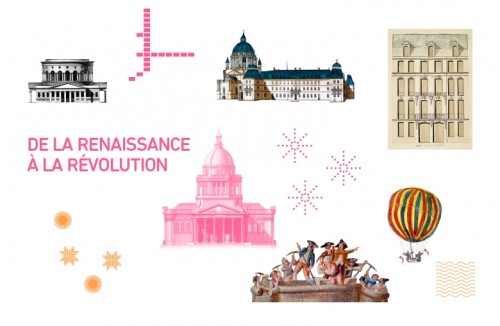
Christine Dodos-Ungerer, conceptrice, et Juanma Gomez, illustrateur, proposent quelques 23 séquences chronologiques, 200 illustrations couleurs et de nombreux jeux et cartographies vous plongeant davantage dans le Paris d'avant. Saurez-vous différencier les devantures du palais du Luxembourg, des chapelles de la Sorbonne et du Val-de-Grâce ?

Télécharger gratuitement:

En un clic, téléchargez gratuitement chaque chapitre dans un format optimisé pour dessiner ou obtenir l’intégralité du livre-jeux et partez à la découverte de l’incroyable histoire de la fabrication de Paris et de sa métropole !


De Lutèce au Grand Palais 2/2
Christine Dodos-Ungerer
illustrations: Juanma Gomez
Pavillon de l'Arsenal


 Éducation:

Livre sur l’histoire et l’actualité du Grand Paris destiné aux juniors, De Lutèce au Grand Paris raconte de façon pédagogique et ludique les grands moments de l’évolution de Paris et la métropole, ses architectures et la vie de ses habitants.

Conçu par Christine Dodos-Ungerer et illustré par Juanma Gomez ce livre jeux au visuel très agréable donne aux étudiants et enseignants ou famille. accès à une multitude de notions liées à l’architecture, à la vie des habitants ainsi qu’à toutes les anecdotes qui ont participé à la construction de l’histoire de Paris.

C’est au rythme de petits textes explicatifs, d’illustrations et de nombreux jeux que les étudiants et les enseignants, les enfants et leurs parents, baigneront au cœur de l’histoire de la capitale.

Divers petits jeux permettant de tester la compréhension de vos étudiants et de vos enfants tout en mettant en œuvre leurs connaissances.


Apprenez chez-vous... en vous amusant !

G-Souto
14.05.2020
Copyright © 2020G-Souto'sBlog, gsouto-digitalteacher.blogspot.com®

Creative Commons License

Culture & éducation : On va connaître Paris ? Livre numérique gratuit De Lutèce au Grand Palais bG-Souto is licensed under a Creative Commons Attribution-NonCommercial-NoDerivatives 4.0 International License.

Tuesday, May 31, 2016

Higher Education : Intl Contest DPic : Architecture, Art & Image – Utopia500


Drawing and Photography Intl Contest DPic
credits: Ana Aragão

DPic: Architecture, Art and Image – Utopia500 is an international Drawing and Photography contest based on the concept of “Utopia” and is aimed at undergraduate students and young researchers enrolled at  any institution of higher education or research in the world.
Organised by UTOPIA500, in partnership with scopio Editions, Project AAI and the research group CCRE (FAUP), the contest is promoted by CETAPS and the Cultural Association Cityscopio. Institutional support is provided by the University of Porto’s School of Arts and Humanities and School of Architecture, as well as by the Art School of Porto (Escola Superior Artística do Porto) and the UNESCO Literary Town of Óbidos.


Drawing and Photography Intl Contest DPic
credits: Claudio Reis
Aims:
  • To help raise awareness within younger generations of the potential for transformation that the idea of utopia represents, while also applying this concept to arts-based fields of study.

  • To make young students and researchers of Architecture, Fine Arts and Image aware of the potential impact that their work can have on the peaceful transformation of society.

  • To sensitise citizens in general to the need of considering alternative building spaces.

  • To promote an understanding of image and its use as a means of representation that allows the development of new ways of understanding and interacting with a wide range of public spaces in the fields of Architecture, City and Territory.

  • To prove the advantages of exploring image as a means capable of crossing the boundaries between different problem areas and disciplines within Architecture and Art.

Participants will be able to compete as individuals although we encourage the formation of multidisciplinary teams, composed of members with wide-ranging academic profiles. 

Target: 
It is, however, mandatory for one participant to be a student of Architecture, the Fine Arts or Image.
Level: 
Students enrolled either in higher education or a research centre
Age:
No member should be older than 35 years of age.


Prizes:
The designers of the 20 selected entries will be invited to send their original copies to be exhibited during the 2016 Folio Literary Festival in Óbidos and then later in an itinerant exhibition the Organising Committee intends to set up.

The 20 entries will be included in the catalogue to be published by scopio Editions. The designers of the selected entries will each receive a certificate.

Voting:

The voting process will determine the winner and eventually one or two Honourable Mentions, who will all be awarded a document certifying the judges’ selection. 

These designs will then feature on the website for both scopio and CETAPS, in addition to being promoted worldwide via the Utopia500 Facebook page

The contest winner will receive three copies of the scopio catalogue and the Honourable Mentions shall each be given two.

The contest’s Organising Committee is actively seeking suitable prizes for the winning entry and Hon- ourable Mentions.


DPic Drawing and Photography Intl Contest

Submissions:
The contest involves submitting two A3-size designs, the first showing a part of the city as it is now, and the second a utopian vision of how this same area could be in the future. 
Although these must be submitted in design or photograph format, there is no limitation on the blending of the two or on the use of photo manipulation and montage.
Note:
Entries should be submitted by email to dpic.utopia@ gmail.com with the application form attached, along with the two separate design sheets as laid out in Chapter II of these Regulations. 
These two files should each be in JPEG or TIFF format, a maximum of 2MB, and be saved as the abbreviated name of the project followed by numbers 1 and 2, respectively. Neither image should contain any form of signature or watermark.
Deadline:
Deadline for submissions 31.07.2016
G-Souto

31.05.2016
Copyright © 2016G-Souto'sBlog, gsouto-digitalteacher.blogspot.com®
Creative Commons License
Higher Education Arts : Intl Contest DPic Architecture Art & Image - Utopia500bG-Souto is licensed under a Creative Commons Attribution-NonCommercial-NoDerivatives 4.0 International License.

Tuesday, June 25, 2013

Schools : Antoni Gaudi : Arts Education... again!


Antoni Placid Gaudí i Cornet
 15 de March 1878, Barcelona, Espña,
credits:  Pau Audouard/ Wikipedia

Today the world of arts celebrates the 161st birthday of Catalan architect Antoni GaudiGaudi was born on June 25, 1852, in Reus, a small town south of Barcelona, and he died in a street accident in 1926.

Google Doodle:


Google Doodle Antoni Gaudi's 161st Birthday

Today Google celebrates the 161st birthday of Catalan architect Antoni Gaudi with a colorful, stylized Doodle, snippets of six of Gaudi’s iconic modernist buildings or mosaics spell out.

  • Some notes about Gaudi:

Under the influence of neo-Gothic art and Oriental techniques, Gaudí became part of the Modernista movement which was reaching its peak in the late 19th and early 20th centuries.

The intellectual context towards the end of the 19th century in Catalonia was marked by Modernism, a movement that extended from around 1880 to the First World War, parallel to currents such as Naturalism, Arts and Crafts, and Art Nouveau. It was motivated by return to traditions as an expression of national identity, as well as by the introduction of modern techniques and materials. 

Modernism differed from the other movements by becoming important for popular cultural identity. You do remember The Rite of Spring by Igor Stravinsky, another modern artist, a great composer, pianist and conductor.


Antoni Gaudi

"Those who look for the laws of Nature as a support for their new works collaborate with the creator."

Antoni Gaudi

Gaudí's work was influenced by his passions in life: architecture, nature, and religion. 
Known as "God's architect", Gaudí's work represents the genius of the architect, expressing particular spatial qualities and plasticity in the undulating lines and harmonies of colours and materials in architectural surfaces and sculpted features.


Casa Batlló
Antoni Gaudi
httpS://www.theartstory.org/

This is the reason of seven of his designs, in and around Barcelona, have been designated UNESCO World Heritage Sites. Those works build in or near Barcelona testify to Gaudí’s exceptional creative contribution to the development of architecture and building technology in the late 19th and early 20th centuries. 


"These monuments represent an eclectic, as well as a very personal, style which was given free reign in the design of gardens, sculpture and all decorative arts, as well as architecture."


The seven buildings are: Parque Güell; Palacio Güell; Casa Mila; Casa Vicens; Gaudí’s work on the Nativity facade and Crypt of La Sagrada Familia; Casa Batlló; Crypt on Colonia Güell.


La Sagrada Familia
Antoni Gaudi

Gaudi never managed to finish his masterpiece, the Sagrada Familia church, as he was struck and killed by a tram in Barcelona in 1926. The church is one of the largest in the world, and remains one of the most visited sights in Barcelona to this day.


Education:


All my readers know how I'm a defender of Arts Education in school curricula. You know my thoughts about the importance of Arts in School Education, no matter the art fields: Music, Dance, Literature, Painting, Architecture, other. All Arts are essential to a complete and better education of young people.

And I love Google doodles! They can be included in every school curriculum as I already wrote. I write a lot about Google doodles, my usual readers know it. Doodles combine creativity, digital culture and motivation to include into school lessons. You must think about it.

Asymmetrical layouts, visionary facades, curved lines, pristine forms and colorful ceramic tiles on top, with this dream the sixteen year-old Antoni Gaudí left his hometown Reus in 1868. Once he got there the Catalan port city never let him go. From study to death – his entire life and work took place in Barcelona. 


Antoni Gaudi
The complete work of Antoni Gaudi


Here, a good motivation to one or two lessons about Arts, Modernism, and Architecture. 

Level: All levels including Vocational Education.

Curricula: Arts; cross-curricula (Literature, Arts, Music).

Of course each teacher must prepare and adapt the activities to the level they are teaching.


  • Resources for teachers & students of Arts:


Exhibition Gaudí, an architecture of anticipation

If you are lucky and you are teaching in Brussels or near Brussels, don't loose the possibility to prepare a school visit with your students next September at the exhibition about Gaudí's innovative art held in Brussels. 

The exhibition Gaudí, an architecture of anticipation is open to the public in the Catalunya Europa space in the offices of the Catalan Government Delegation in Brussels and will be on show until the end of this year. 

The exhibition presents the art and the creative genius of the Catalan architect and has a space reserved for the Sagrada Família, with a model and an information panel with pictures and texts. 


Antonio Gaudi
 Hiroshi Teshigahara, 1984

There is an interesting digital resource that you can include into your lessons. A documentary Antonio Gaudi by Hiroshi Teshigahara. His camera takes us over, under, around, and into buildings and a park designed by Antoni Gaudí.


  • Some thoughts:

Of course, new technologies, videos, films and social media in the classroom are important tools to tackle the world's toughest problems creating bridges and establish a truly intercultural world, where diversity can be celebrated, a world where different cultures not only coexist but value each other for their contributions and potential. Your students will be prepared to be entire citizens.

“Art is not what you see, but what you make others see.”

Edgar Degas

G-Souto

25.06.2013
Copyright © 2013G-Souto'sBlog, gsouto-digitalteacher.blogspot.com®

Licença Creative Commons
Schools : Antoni Gaudi : Arts Education... again ! bG-Souto is licensed under a Creative Commons Attribution-NonCommercial-NoDerivatives 4.0 International License.