My thoughts about Education Humanities, Technology and Digital Culture. Interested on social media tools in educational contexts and
gamification in education.
How a hundred years after his birth, Claude Shannon’s fingerprints are on every electronic device we own. Shannon was a Member in the School of Mathematics from 1940–41?
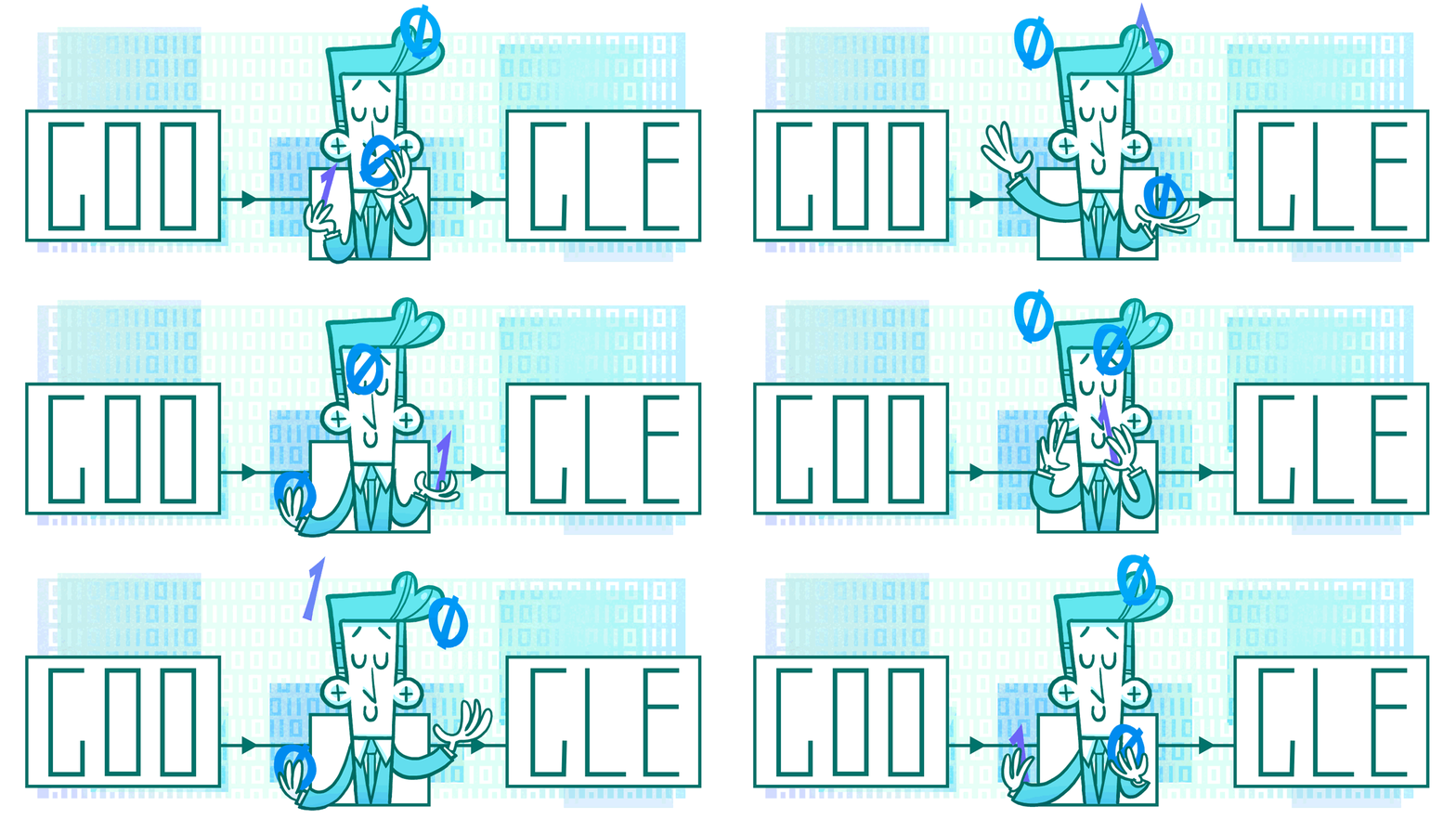
Last Saturday, 30 April, Google celebrated the 100th Anniversary of Claude Shannon with an interactive Doodle. The creative Doodle by Nate Swinehart celebrated the brilliance and lightheartedness of the father of modern digital communication.
Now it is the turn of Claude Shannon, who worked with Turing on Allied code breaking during the Second World War - not at Bletchley Park, but in Washington, where Turing had been seconded in 1943 to bring the US up to speed with British crypt analytic developments.
Claude Elwood Shannon is often described as the father of the information age who created the term "bit", short for binary digits.
It's impossible to overstate the legacy of Claude Shannon. The paper he wrote for his master’s thesis is the foundation of electronic digital computing.
Claude Shannon
Alfred Eisenstaedt / The Life Picture Collection / Getty
His most famous work is A Mathematical Theory of Communication (1949) in which Shannon introduced information theory, the branch of mathematics focused on transmitting digital data.
It was in this masterpiece that he coined the term "bit", the fundamental unit of information which relates to digital certainty: true or false, on or off, yes or no.
Education:
Include this Doodle into your sciences and math curriculum at school and let your students discover the incredible sicentific work of Claude Elwood Shannon's research work as possible.
Discuss with your students the importance of this mathematician to modern digital communication.
I couldn't miss this Doodle (my usual readers know I am a fan of Doodles, a awesome resource to introduce any theme in the classroom) as the introduction of the rundown of the most read posts in April.
Here are the most popular posts of the last month:
Hope you enjoyed the different themes and resources published on April on my blog It was a fantastic month full of good themes - books, ICT, arts, environment, animated movies - different pedagogical resources to motivate some of your lessons.
I'm back to posting the normal roundup every week.
On October 28th 2014, Googlecelebrated with a Doodle the 100th birthday of the American scientist behind the first effective polio vaccine: Dr. Jonas Salk. Jonas Edward Salk was born on this day a century ago in New York.
“Thank You, Dr. Salk!” we can read on the homepage animation, which depicts joyful, fully mobile children dancing and running around with dogs and balloons. We know how polio largely impacted children.
This is a beautiful tribute.As so many tens of thousands of children suffered from polio into midcentury, his vaccine began as the stuff of dreams; by the mid-’50s, it was the substance of a profoundly life-altering reality.
Born in New York City on October 28, 1914, Jonas Salk was one of the leading scientists of the twentieth century and the creator of the first polio vaccine. He grew up poor in New York City, where his father worked in the garment district. Education was very important to his parents, and they encouraged him to apply himself to his studies.
Dr. Salk got his medical degree in 1939, at the New York University School of Medicine, and was working at the city’s Mount Sinai Hospital before a research fellowship at the University of Michigan - with his mentor - beckoned.
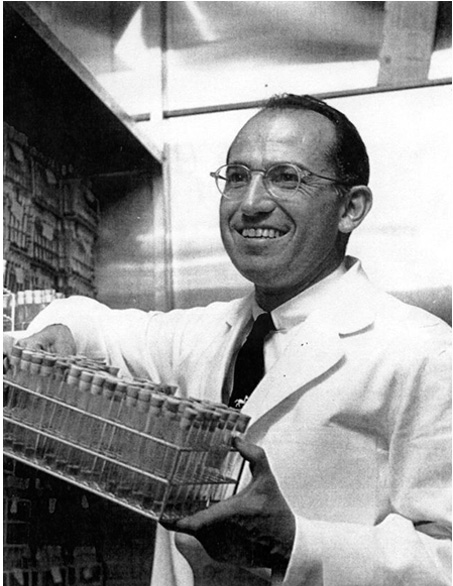
Dr Jonas Salk at his lab
credits : Mandeville Special Collections Library, UCSD
In 1947, he moved to head up the University of Pittsburgh School of Medicine’s Virus Research Laboratory, where he did the real groundbreaking work in his march toward a vaccine for paralytic poliomyelitis, or polio.
For one, the team of Harvard scientist John Enders solved how to grow the pure polio virus in the test tube - a crucial step that enabled Salk’s effective experimentation with a “killed virus.”
Then there were the needed funds - Salk got backing from the National Foundation for Infantile Paralysis (the March of Dimes Birth Defects Foundation).
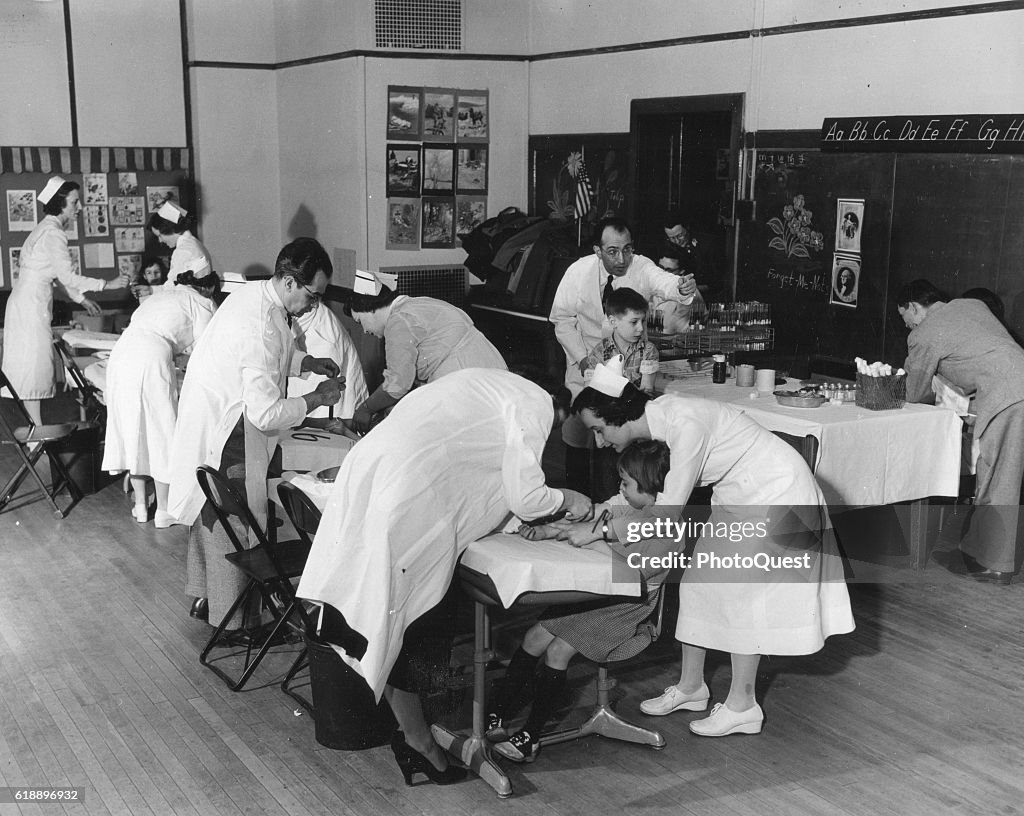
In 1954, at least 1-million children - the Polio Pioneers - were tested across the nation (this followed testing that ranged from monkeys to Salk’s own family).
The vaccine was announced as safe and largely effective on April 12, 1955. Dr. Jonas Salk himself was a humble man and never patented the vaccine, forgoing an immeasurable fortune.
On the day his vaccine was announced as safe, Salk told the legendary newsman Edward R. Murrow: “There is no patent. Could you patent the sun?”
In the ’60s, Salk built his La Jolla biological studies center — his “dream” institute - where he helped lead research on cancer immunology, multiple sclerosis and autoimmune diseases, as well as on development of an AIDS vaccine.
In addition to his research, Salk also wrote several books on philosophical topics. His works include Man Unfolding (1972) and The Survival of the Wisest (1973), which he co-wrote with son Jonathan.
"Salk is known best as the developer of the first successful vaccine against poliomyelitis, but he also made many other contributions in the fields of medicine and biology, philosophy, architecture and the history of medicine."
Dr Jonas Salk
photo: James A. Cox, courtesy of the Salk Institute for Biological Studies
Jonas Salk died of heart failure on June 23, 1995, at his home in La Jolla, California. He was 80.
With his groundbreaking vaccine, Salk had earned his place in medical history. He will always be remembered as the man who stopped polio.
There in La Jolla, near where nimble-limbed hang-gliders launch against the backdrop of the institute’s sun-bleached concrete, resides a memorial to Salk, the pioneer, the hero, the icon. It reads:
“Hope lies in dreams, in imagination and in the courage of those who dare to make dreams into reality.”
" I feel that the greatest reward for doing is the opportunity to do more." Jonas Salk
My usual readers know I often include Google doodles of the day into curricula. It's a wonderful motivation and it can surprise your students and want to know more. This one is very important to start a conversation about Polio virus in Sciences lesson
Doodles are the funny, surprising, serious and sometimes spontaneous changes that we can include into our lessons to teach about famous writers, poets, pioneers, and scientists.
Everyday we must introduce something captivating in our lessons, even we are teaching important skills in serious curriculum.
Passion is what will make our students enter in the classroom waiting for something special in the middle of a lesson everyday.
Schools are very important environments of teaching and learning. They have an important role aiming to renew and reinvigorate global knowledge as they have the mission toeducatechildren and adolescents as future citizens. These little digital resources can be educational challenges to promote some good values in the new generations that will be vigilant and helping to find path towards precious solutions to society and planet. Humanities and Sciences are the basic curricula.
I think some of the activities below could inspire your students but you are free to propose your own ideas:
Organize an open day (today or/and nex week) in your school with the help of your students to highlight the importance ofsciencefor world development;
Open discussions in the classroom to discuss the fundamental importance of polio vaccine in the life of so many children and adolescents and to eradicate polio.
Emphasize the different ways science & technologies touch our daily lives;
Contact a scientist to a conversation in the school library with students, teachers, parents to highlight the importance of celebrating the centenary anniversary of Dr Jonas Salk;
Ask the students to write articles, biographical essay of true stories of children (after a good research on the school library and on the internet), scientific comics (cross-curricula Languages, Sciences, Arts) to highlight the importance of science for sustainable societies;
Include the work in the school newspaper;
Build classroom-to-classroom connections between schools via the Internet: schools websites, schools accounts on Facebook or Twitter, to share science projects that will interest students;
Arrange a Science Museum visit. Museums are awesome practical lessons.
Levels: All levels (different activities for different grades).
So as you see, can we say that formal learning is a non captivating method? Of course, not! It must be creative! And teachers are so creative!
Well, there are a lot of funny and engaging activities about Sciences and Humanities that we can create and share with our students, on informal learning (online learning) and formal learning (face-to-face teaching).
Social networks, devices as tablets and smartphones became fundamental in the classroom.
Believe me! You will have a motivated class that will learn science or humanities.
To us, as educators, "the attitude" of changing methods, and our creative mind to facilitate different learning activities at our young students is happening and used every day at school
"Be less curious about people and more curious about ideas."