Showing posts with label skywarchers. Show all posts

Friday, November 17, 2023

Science : Wow ! The magic Leonids meteor shower ! Let's prepare for a fall meteor shower !


Dozens of meteors streak across the sky in this composite image, 

captured in the Heilongjiang province of China

credit: Jeff Dai/Stocktrek Images


Are you ready for a fall meteor shower? On November 18th, join us as we witness the magic of the Leonid Meteor Shower at its peak. See a breathtaking display of shooting stars lighting up the night sky. You might also try watching on the morning of November 17. These ultrafast meteors are due to reach their peak on Saturday morning, November 18. 


In the modern age, Leo is the home in the sky of a wealth of objects of great scientific interest meaning skywatchers and astronomers today are as fascinated with the lion as were antiquity's astrologers and myth-weavers. 


The Leonids, which peak during mid-November each year, are considered to be a major shower though meteor rates are often as low as about 15 meteors per hour. The Leonids are bright meteors and can also be colorful. They are also fast: Leonids travel at speeds of 44 miles (71 kilometers) per second, and they are considered to be some of the fastest meteors.
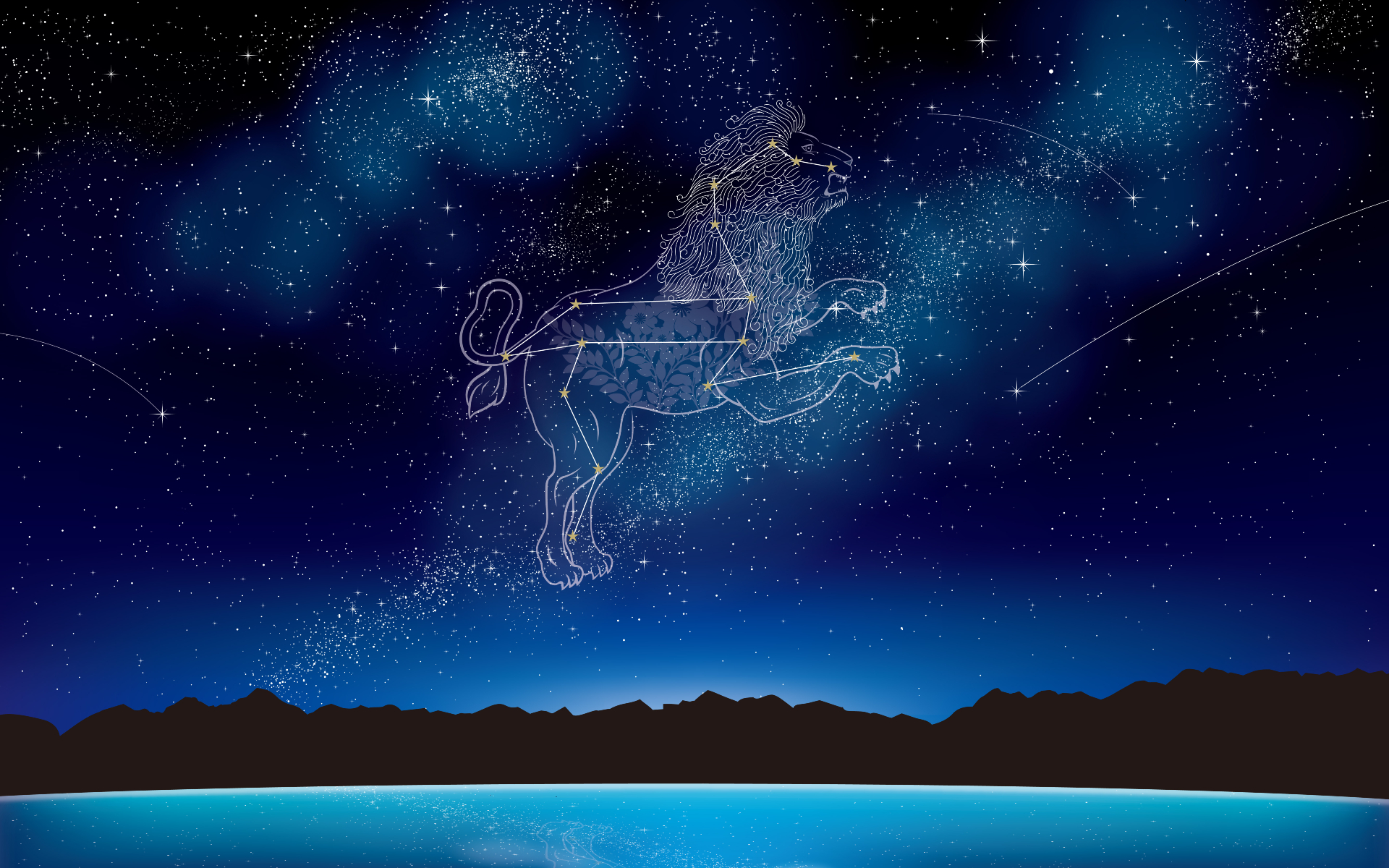


Leo is one of the most prominent constellations in the night sky. 
credit: manpuku7 via Getty Images


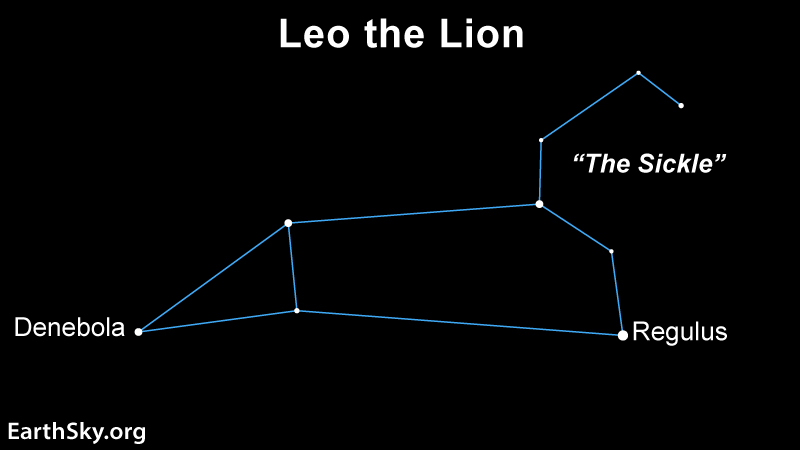
The Leonids are named after the area of sky from which they seem to originate - the sickle-shaped constellation of Leo (the Lion). 


The constellation of Leo is one of the easiest to spot over Earth inspiring both mythology and cutting-edge astronomy.


Leo is part of the twelve constellations that comprise the zodiac with the others being AriesTaurus, Gemini, Cancer, Virgo, LibraScorpius, Sagittarius, Capricornus, Aquarius, and Pisces. It follows the naming convention of these groupings taking its name from an animal. 


Every year the Earth passes through these debris trails, which allows the bits to collide with our atmosphere where they disintegrate to create fiery and colorful streaks in the sky. 


A meteor storm versus a shower is defined as having at least 1,000 meteors per hour. Viewers in 1966 experienced a spectacular Leonid storm: thousands of meteors per minute fell through Earth's atmosphere during a 15-minute period. 


There were so many meteors seen that they appeared to fall like rain. The last Leonid meteor storm took place in 2002.


Illustration courtesy of Sky & Telescope


The Leonids are renowned for producing bright fireballs, which outshine every star and planet. Their long trails are often tinged with blue and green, while their vapour trains may linger in the sky for five minutes or more. 


Although the incoming particles are small, ranging from specks of dust to the size of small pebbles, the Leonids glow brightly because they are the fastest of all the meteors. 


A typical Leonid meteor, arriving at a speed of 71 km s-1, will start to glow at an altitude of about 155 km and leave a long trail before it is extinguished.


Education:


Learn the fascinating science behind this phenomenon, as these meteoroids originate from Comet Tempel Tuttle, a celestial traveler on a 33-year orbit around the Sun.


Expect 10-15 meteors per hour at peak during this year’s shower. Grab your telescope, find a spot away from city lights, and immerse yourself in the wonders of the cosmos


  • When to watch: Watch late on the night of November 17 until dawn on November 18. The morning of November 17 might be worthwhile, too.
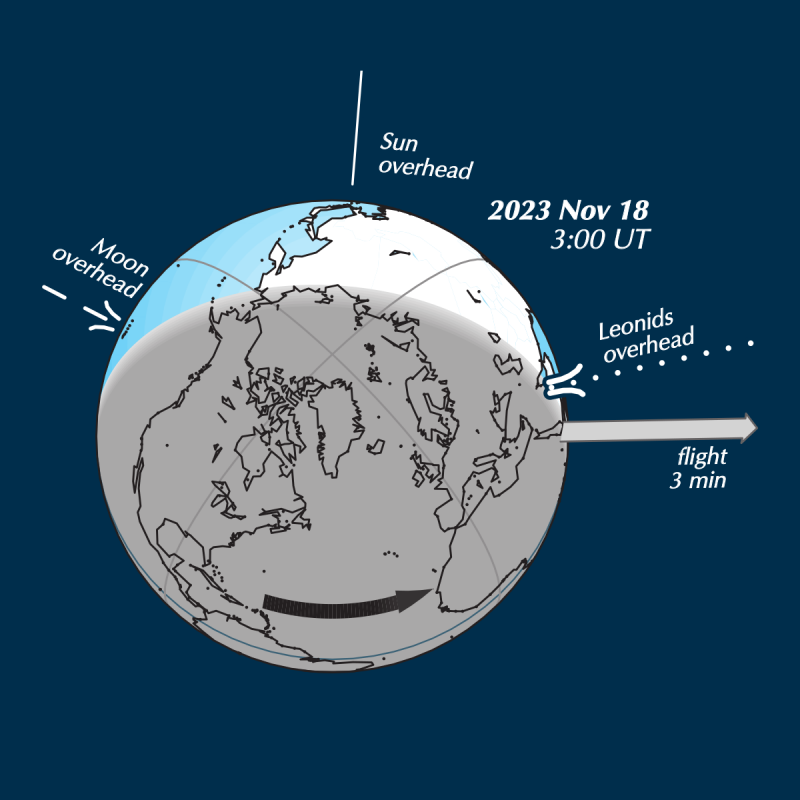


 credit: Image via Guy Ottewell. Used with permission.

via EarthSky


In 2023, first quarter moon falls on November 20. So there will very little interference from moonlight in 2023.


The Leonids are best viewed starting at about midnight local time. Find an area well away from the city or street lights. 


Come prepared for winter temperatures with a sleeping bag, blanket, or lawn chair. Orient yourself with your feet toward the east, lie flat on your back, and look up, taking in as much of the sky as possible. In less than 30 minutes in the dark, your eyes will adapt and you will begin to see meteors. 


Be patient – the show will last until dawn, so you have plenty of time to catch a glimpse.


Gina Souto

17.11.2023

Copyright © 2023G-Souto'sBlog, gsouto-digitalteacher.blogspot.com®


Science : Wow ! The magic Leonids meteor shower ! Let's prepare for a fall meteor  shower ! bG-Souto is licensed under a Creative Commons Attribution-NonCommercial-NoDerivatives 4.0 International License.

references: The Museum of Science/ ESA/ EarthSky


Monday, August 21, 2017

Schools : Wow ! Stay up & watch the Total Eclipse !


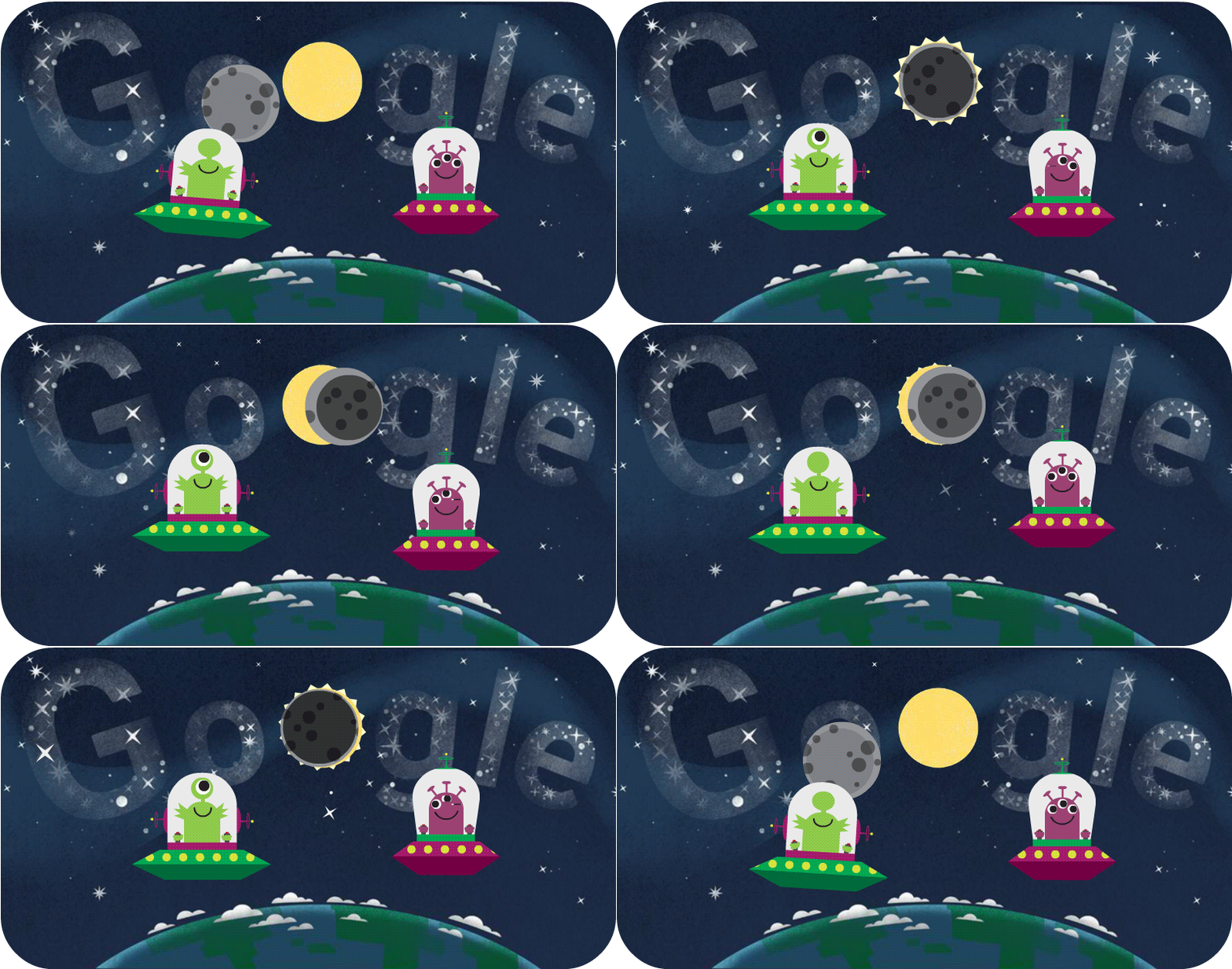
Google Doodle Great American Eclipse 2017

Today is the big day to America. First total solar eclipse visible from the contiguous U.S. since 1979!

It’s been 99 years since an total eclipse crossed the width the United States. 

On Monday, August 21, 2017, all of North America will be treated to an eclipse of the sun. Anyone within the path of totality can see one of nature’s most awe inspiring sights - a total solar eclipse. 

While eclipses aren’t rare, a total eclipse, when viewers from Earth are at the very center of the moon’s shadow, only happens once every 18 months. 

To see one requires you to be in just the right place on earth, and a total eclipse in the same location only happens every 375 years on average.

"This year, the 65-mile wide path of totality with sweep, sash-like, across the country—entering the map at Oregon and exiting at South Carolina."


credits: NASA


The once-in-a-lifetime spectacle will attract an estimated 7.4 million people to areas in the path of totality, including so-called eclipse-chasers, who plan for years in advance and travel from far and wide to get a glimpse of the stellar phenomenon.


This video, narrated by actor George Takei, provides a few viewing tips for the public.

"During the August 21, 2017 total solar eclipse, scientists will use the Earth Polychromatic Imaging Camera (EPIC) on the Deep Space Climate Observatory satellite (DSCOVR), along with measurements taken from within the moon's shadow on the ground, to test a new model of Earth's energy budget."

Skywatchers on the American continent today are in for a special astronomical treat: front row seats to a total solar eclipse

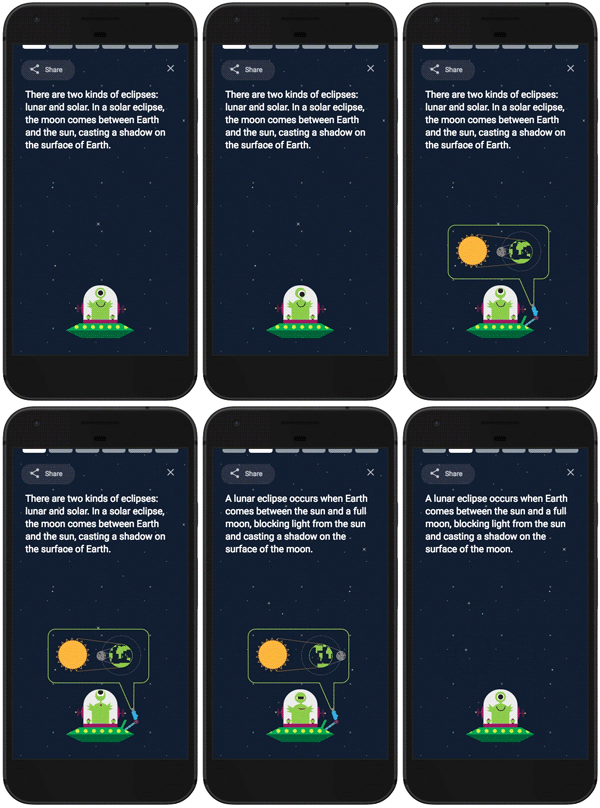
An eclipse occurs when the moon passes between the sun and the earth, blocking the light of the sun from reaching us. 


No matter where you are in the country, if you plan to look at or even toward the sun, be sure to protect your eyes

According to experts, only those in the path of totality are safe to look at the eclipse without protection, and only during totality.

The only safe way to look directly at the uneclipsed or partially eclipsed sun is through special-purpose solar filters, such as eclipse glasses (example shown at left) or hand-held solar viewers. 


Google Doodle 

Who can watch the Total Eclipse:


Resources 4 All:

To learn all about the 2017 Total Eclipse visit the website NASA Total Eclipse August 21, 2017 and follow NASA’s live, streaming video of the event. 

Education:
On Monday 21 August only some countries North America, Australia, began school time. Not European countries. Not France or French Antilles.

Even so, teachers had prepared students to understand this incredible moment and will join astronomers on NASA streamingskywatchers, or national observatories of Astronomy.


Safety measures:

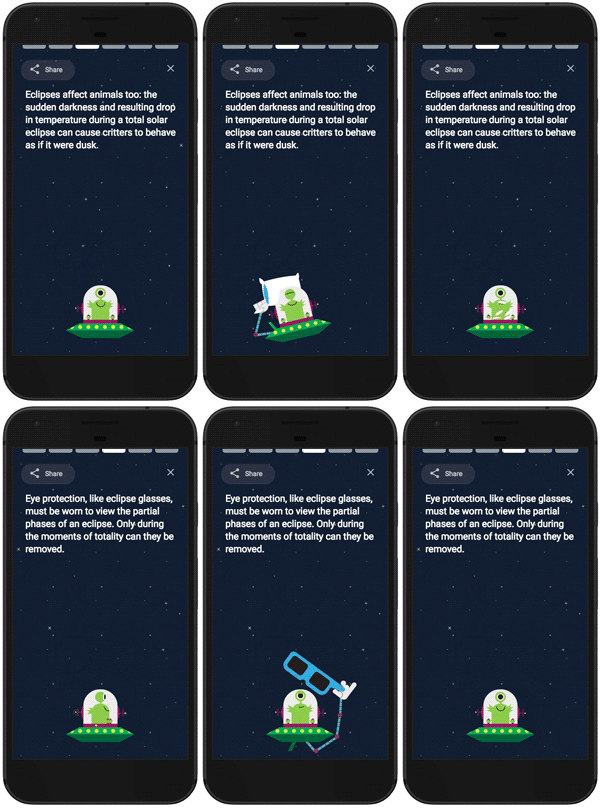
Remember your students ! DO NOT look directly at the Sun without appropriate protection, such as special eclipse glasses. 

Special glasses that ensure sun spotters do not damage their eyes. Good solar eclipse glasses filter out all of the harmful ultraviolet and infrared light and almost all of the intense visible light to allow you to view the eclipse safely.

But thousands of people across the world are in the precess of building their own viewers. Children should get an adult to help build and use this projector. Take extra care when using sharp tools like craft knifes and scissors.

The safest way to view a solar eclipse is to project it onto a piece of paper. Using a cardboard box, you can make a pinhole projector.

Curricula: Cross-curricular: Sciences; Languages; Geography; other.

Level : All levels.


Google Doodle 

Teachers must consider the activities to every level or curriculum they are teaching.

Invite your students to share their experiences on Twitter, Facebook, Instagram  (school or class account) during the event.


After summer holidays, European achools will discuss their experiences and knowledge if they could watch the partial eclipse. Not so lucky as North American schools.


Resources for students:

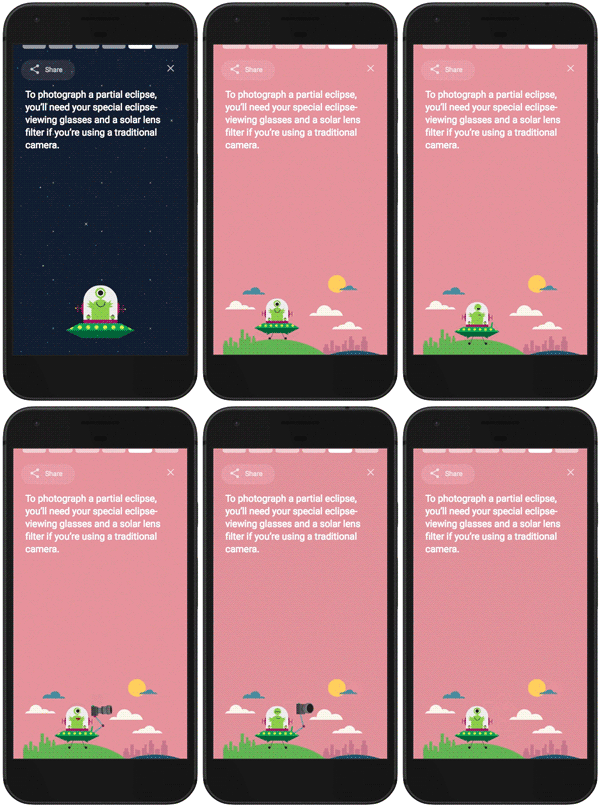
To learn more about solar eclipse science, you can click beyond the Doodle to Google Search and get some fun facts courtesy of our friendly space aliens. 

They can learn about a crowd-sourced photo project to capture images of the eclipse as it traverses North America.


The MegaMovie Project

The Megamovie Project:

"The Eclipse Megamovie Project is gathering images of the 2017 total solar eclipse from over 1,000 volunteer photographers and amateur astronomers, as well as many more members of the general public. We’ll then stitch these photos together to create an expanded and continuous view of the total eclipse as it crosses the United States. The resulting dataset will be open to the scientific community and general public for future research."


The MegaMovie Project

If students and teachers were under the path of totality for the August 21, 2017 total solar eclipse, they can participate in the project. Wow! It will be excinting! 

If you haven't already, go to your profile to update your eclipse viewing location, your camera setup and your photos!


Google Doodle

Apps: Apple; Google Play

iTunes:

The Eclipse Megamovie Mobile app from the Space Sciences Laboratory at UC Berkeley and Ideum is specifically designed to help you students, teachers, skywatchers view and photograph this incredible event and link them to a nation wide citizen-science project studying the sun.

The app also helps you plan ahead with information about the best route from your location to the eclipse’s path and a countdown clock ticking down to the big event. And if you use a DSLR to capture the eclipse, your images may become part of a stunning crowd-sourced movie created by Google


Google Play:

Led by Google, the Eclipse Megamovie Project will add a new dimension to our studies of the sun’s faint outer atmosphere – the corona. Corona is Latin for, “crown,” but in astronomy, it is an aura of plasma that explodes and arches out the Sun. The plasma corona extends millions of kilometers into space from the Sun and is easiest to see during a total solar eclipse or with a coronagraph.

NASA apps: 

You can even download the official NASA apps for iPhone and Android

Social media:

NASA will stream the event live on a number of platforms: 

NASA official Facebook ; Periscope ; Twitch & UStream pages, as well as on NASA TV and the official NASA YouTube channel. 

Well! You have all you need to enjoy and learning about Total Eclipse. It will be a great science lesson, for sure!

G-Souto

21.08.2017
Copyright © 2017G-Souto'sBlog, gsouto-digitalteacher.blogspot.com®

Creative Commons License
Schools : Wow ! Stay up & watch the Total Eclipse 2017 by GinaSouto is licensed under a Creative Commons Attribution-NonCommercial-NoDerivatives 4.0 International License.

Sunday, November 13, 2016

Sciences education : here comes the 2nd Supermoon, the Mega Beaver moon


Super Moon of 2013
rising above the church Nossa Senhora do Castelo
Sesimbra, Portugal
credits: Miguel Claro

The moon is a familiar sight in our sky, brightening dark nights and reminding us of space exploration, past and present says NASA. And it's so true. We love bright nights. But the upcoming super moon will be special!
Tomorrow, Monday, November 14 will be especially “super happy" because it’s the closest full moon to Earth since 1948. We won’t see another supermoon like this until 2034. This full moon will be not only the closest and brightest supermoon of 2016 but also the largest since 1948.
October 16, November 14 and December 14 are the dates to see the moon at perigee, its closest point to Earth.  The 'supermoon' can be up to 14% larger and 30% brighter than an apogee moon, when it's the furthest from Earth. 


This is actually the second of three supermoons in a row, so if the clouds don’t cooperate for you this weekend, you will have another chance next month to see the last supermoon of 2016 on Dec. 14.


"This [supermoon] is more a technicality than an intense scientific interest,” MIT planetary scientist Richard Binzel said. “But anything that gets people interested to look up and notice the night sky and ponder the universe is a good thing.”
Super moon?
The term 'supermoon' as entered popular consciousness in recent years, says NASA. 
Originally a term from modern astrology for a new or full moon that occurs when the moon is within 90% of its closest approach to Earth in a given orbit, supermoon now refers more broadly to a full moon that is closer to Earth than average. But why is the moon closer to Earth at some times but not others?


Apogee and perigee describe the two points in the Moon’s orbit
credits: Anthony Ayiomamitis
The moon’s orbit around Earth is slightly elliptical so sometimes it is closer and sometimes it’s farther away. When the moon is full as it makes its closest pass to Earth it is known as a supermoon. 
At perigree - the point at which the moon is closest to Earth - the moon can be as much as 14 percent closer to Earth than at apogee, when the moon is farthest from our planet. The full moon appears that much larger in diameter and because it is larger shines 30 percent more moonlight onto the Earth.


A supermoon is seen during a lunar eclipse behind pods of the London Eye heel London, September 28, 2015
credits: REUTERS/ Toby Melville
http://www.telegraph.co.uk/

The biggest and brightest moon for observers in the world will be on Monday. The supermoon should be visible from anywhere in almost every country, cloud permitting.
NASA says this month’s super moon will appear 30 percent brighter and 14 percent larger than a typical full moon.


Three supermoons in a row 2016

Education:

Three supermoon? Here comes the second! Wow!

The last time a supermoon made headlines on my blog in October 2016, when it appeared to be 14 per cent bigger and 30 per cent brighter. However, you can read my post Science education: here comes the first supermoon (2015) or Supermoon in Science education (2013).

Teachers are prepared to tomorrow lessons. Sciences or Languages, why not? There's a huge of literature texts about moon. Not only the juvenile saga Twilight, of course.

Teachers will be face-to-face their students in the classroom or via Facebook live, Twitter, Google + hangouts to share experiences on sky watching.

I think they will invite their students to join some sky watchers at national observatories of Astronomy, or to go out with family observing the supermoon of tonight or tomorrow. It will depend of the continent where you are living.

“The difference in distance from one night to the next will be very subtle, so if it’s cloudy on Sunday, go out on Monday. Any time after sunset should be fine."

Since the moon is full, it’ll rise at nearly the same time as sunset, so Noah Petro, deputy project scientist for NASA’s Lunar Reconnaissance Orbiter (LRO) mission suggests that you head outside after sunset, or once it’s dark and the moon is a bit higher in the sky. "You don’t have to stay up all night to see it, unless you really want to!”

Ask students to take some photos or produce some videos with their smartphones, tablets to be exposed and explored in Sciences curriculum along the week.

Teachers and students will exchange their incredible experiences, exploring the resources and debating the awesome Mega Beaver Moon.


The closest supermoon will fall next December 14. Or like this one only in 2034! Wow! 


Mega Beaver Moon
credits: Slooh Space for everyone
Why November's full moon is also called a Beaver Moon?

November’s full Moon was called the Beaver Moon by both the colonists and the Algonquin tribes because this was the time to set beaver traps before the swamps froze, to ensure a supply of warm winter furs. It was also called the Full Frost Moon by Native Americans. It is also sometimes called a Frost Moon.

Resources:
What's more, the full moon won't come this close to Earth again until Nov. 25, 2034, according to a statement from NASA. 
The Slooh Community Observatory will offer a live broadcast for November's full moon on Nov. 13 at 8 p.m. EST (0100 GMT on Nov. 14).

NASA's LRO mission website

What is a 'supermoon' and when can I see the largest moon in 70 years?

Tips for photographing the Supermoon

Let's have fun!

The mainstream media is going to have a field day with the Super Moon. So, why shouldn’t we? 


"Let’s spread the word that astronomy’s not all about math, light-years, and dark energy. It can be fun, too."


G-Souto

13.11.2016
Copyright © 2016G-Souto'sBlog, gsouto-digitalteacher.blogspot.com®

Creative Commons License
Science education : here comes the 2nd supermoon the Mega Beaver moon bG-Souto is licensed under a Creative Commons Attribution-NonCommercial-NoDerivatives 4.0 International License.