Showing posts with label DNA structures. Show all posts

Saturday, July 25, 2020

Science : Rosalind Franklin Centenary : Image Competition & Essay Competition


Rosalind Franklin [1920-2020]

This year, to mark 100 years since the birth of Rosalind Franklin The Rosalind Franklin Institute is looking back and celebrating on the life and work of this amazing scientist. The Rosalind Franklin Institute will be highlighting how many current discoveries and inventions would not have been possible without Rosalind Franklin’s work

Mys usual readers know that I published an article about Rosalind Franklin on her 93rd birthday the 25th July 2013.


The Franklin Family
via BBC
Scientist Rosalind Franklin would have been "totally amazed" that 100 years after her birth she is being commemorated, according to her sister.
She is best known for her pioneering work which guided James Crick and Francis Watson to unlock DNA's secrets.
But far more of her short career was spent unravelling the molecular structures of coal and viruses. 
Jenifer Glynn, 90, her sister, said she would have been pleased if her career "encourages girls into science".

"I think she would be totally amazed at the fact that 100 years after her birth there's such commemorations," 
Jenifer Glynn
Mrs Glynn said before her "sadly early death" aged 37 in 1958, she worked across biology, chemistry and physics, with a "focus on research that mattered to society."


Rosalind Franklin Papers 1951-1954

"She would have also been amazed at the idea she has become a feminist icon - it was not in her mind at all.
"She was aware that it was harder for women, but wasn't trying to blaze a trail, although nothing would have pleased her more than the fact that perhaps it encourages girls into science."
Mrs Glynn said before her "sadly early death" aged 37 in 1958, she worked across biology, chemistry and physics, with a "focus on research that mattered to society".
Newnham College and the Churchill Archives Centre in Cambridge, which holds her scientific papers, are marking the Centenary of her birth this 25 July 2020.


Rosalind Franklin 100 Image Competition


  • Rosalind Franklin 100 Image & Essay Competitions:


This year marks the Centenary of Rosalind Franklin’s birth. It's an exciting time for the institute named in her honour
As the institute prepares to open the new building, a four storey on the Harwell Campus which will house a world-unique technologies.
The Rosalind Franklin Institute was looking for images from member institutions to celebrate both its namesake and the interdisciplinary work she has inspired
  • Images in three categoriesfactexperience, and experiment
The Rosalind Franklin Centenary Image Competition was open on 14th April and will close on 25th July, with the winner being announced in September 2020.


Rosalind Franklin 100 Essay Competition


At the same time an essay competition for undergraduate scientists at member institutions was running as well for passionate about exploring the intersection between physical and life sciences. 
  • The Rosalind Franklin Centenary Essay Competition was open on 14th April and will close on 25th July, with the winner being announced in September 2020.


Rosalind Frank
Visionary scientist
Illustration by Jody Hewgill for TIME
Time Magazine, 1953
In 1953, Time published an article about Rosalind Franklin on the cover included in the well known project 100 Women of the Year.

 In 1953, Watson, who had been investigating the structure of DNA as well, was shown the image and immediately knew its significance. 

"The instant I saw the picture my mouth fell open and my pulse began to race,” he wrote in his 1968 book, The Double Helix. “The black cross of reflections which dominated the picture could only arise from a helical structure.”

As we know, at age 37, Franklin died of cancer (1958). Only now is she being appreciated. 

"In my cancer advocacy work, I’ve met female scientists who are welcomed and respected by their male colleagues. I’m sorry Rosalind Franklin wasn’t. But from now on, whenever you hear the names of the two men who discovered DNA, make it a troika: Franklin, Watson and Crick - in that order."

Katie Couric, Time, 1953
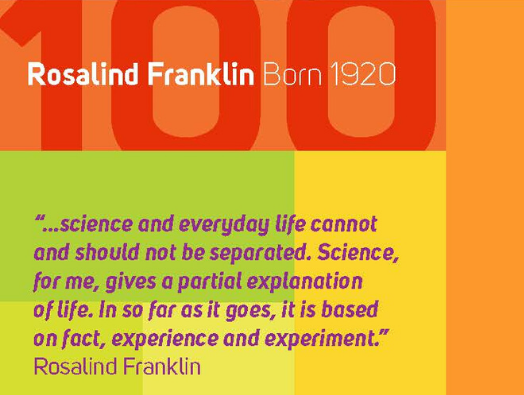


Rosalind Franklin Centenary 

Well, we will be back in September with the names of the winners of the two competitions: Rosalind Franklin image competition and Rosalind Franklin essay competition.

"I think she would be totally amazed at the fact that 100 years after her birth there's such commemorations," 
Jenifer Glynn

Note: Jenifer Glynn is the sister of Rosalind Franklin

G-Souto 

23.07.2020
Copyright © 2020G-Souto'sBlog, gsouto-digitalteacher.blogspot.com® 

Licença Creative Commons
Schools : Women in Science : Rosalind Franklin, resources bG-Souto is licensed under a Creative Commons Attribution-NonCommercial-NoDerivatives 4.0 International License.

Thursday, July 25, 2013

Schools : Women in Science : Rosalind Franklin, resources


Rosalind Franklin
credits: Getty Images

"My jaw fell open and my pulse began to race.”

Rosalind Franklin

Rosalind Franklin is the X-ray crystallographer. Her work producing X-ray images of DNA (Deoxyribonucleic acid) was crucial in the discovery of the structure of DNA by James Watson and Francis Crick. 

Franklin was born in Nothing Hill, London on 25 July 1920. And she died from ovarian cancer in April 1958, aged just 37.

Franklin also made critical contributions to our understanding of the molecular structures of DNA, viruses, coal and graphite.


Doodle:


Goodle Doodle Rosalind Franklin 93rd Birthday


Today Google doodle celebrates the life and work of British biophysicist and X-ray cristallographe Rosalind Franklin, whose research led to the discovery of the structure of DNA.

The Doodle marks what would have been Franklin's 93rd birthday, and the photograph that should have earned her a far more famous place in the History books.

The second "o" in the doodle contains her image, while the "l" has been replaced with the DNA double helix.


Rosalind Franklin

The scientist has perhaps become best known as "the woman who was not awarded the Nobel prize for the co-discovery of the structure of DNA".

Many voices have argued that the Nobel Prize should also have been awarded to Rosalind Franklin, since her experimental data provided a very important piece of evidence leading to the solving of the DNA structure

However Watson, Crick and their fellow laureate, Maurice Wilkins, were only nominated for the first time in 1960, two years after Franklin had already passed away.


The story goes that he took some of her x-ray crystallography images without her knowledge and showed them to his friends, Francis Crick and James Watson, who were also trying to discover the structure of DNA.


Photo of the famous x-ray: Sodium deoxyribose nucleate from calf thymus, Structure B, Photo 51 taken by Rosalind E. Franklin and R.G. Gosling

Franklin excelled at Science and attended one of the few girls' schools in London that taught Physics and Chemistry. 

When she was 15, she decided to become a scientist. Her father was decidedly against higher education for women and wanted Rosalind to be a social worker. 


Rosalind Franklin
credits: unknown

Ultimately he relented, and in 1938 she enrolled at Newnham College, Cambridge, graduating in 1941. She held a graduate fellowship for a year, but quit in 1942 to work at the British Coal Utilization Research Association, where she made fundamental studies of carbon and graphite microstructures. This work was the basis of her doctorate in physical chemistry, which she earned from Cambridge University in 1945.

Wilkins, Crick and Watson were awarded the Nobel Prize in Chemistry in 1962.


credits: unknown

Crick later acknowledged that Franklin's images were "the data we actually used" to formulate their 1953 hypothesis regarding the structure of DNA.

The most significant of those images is known as Photo 51, which is also the inspiration for an exhibition currently at Somerset House in London.


In 1972 she refused to accept the Annie J. Cannon Award of the American Astronomical Society because it was awarded to women only:

"It is high time that discrimination in favor of, as well as against, women in professional life be removed". 

Rosalind Franklin

Happily, 12 years later the Royal Society awarded her its highest honor, regardless of gender, the Henry Norris Russell Lectureship. At 91 she is professor emeritus at UCSD.


Education:

I am a big fan of Google doodles! You know it! It is not the first time I write about Doodles. I believe that Doodles can be interesting digital resources for educators.

Doodles are the fun, surprising, and spontaneous motivation that we can include into our lessons to teach about famous writerspoets, scientistspioneers.

Why not include a Doodle into school lesson? It's something captivating and will incite the curiosity of your students to a subject, when you are teaching important skills in serious curriculum. 

Passion is what will make our students enter in the classroom waiting for something special in the middle of a lesson everyday. 


Rosalind Franklin

This Doodle is a wonderful digital resource to promote Science and Physics studies to girls in school and university. Rosalind Franklin is another good example to share with young girls who are your students.

Rosalind Franklin as Marie Curie good examples that girls and women who choose scientific careers, stunning success is possible.


Some resources:

  • If you want to learn more about Rosalind Franklin and the tempestuous story of DNA, you will enjoy reading Rosalind Franklin: The Dark Lady of DNA by Brenda Maddox (Amazon UKAmazon US]).
  • Defending Franklin's Legacy | NOVA 


ExoMars rove Rosalind Franklin

Other resources: ExoMars Rosalind Franklin

Mars rover launched in 2019 has been named after pioneering scientist Rosalind Franklin, hero of DNA research.
The honour followed a public call for suggestions that drew nearly 36,000 responses by citizens from all ESA Member States rope following a competition launched by the UK Space Agency in July 2019.
The six-wheeled vehicle is equipped with instruments and a drill to search for evidence of past or present life on the Red Planet.
The attachment to the European Space Agency (ESA) rover saw her name travel beyond Earth.
Visit ESA ExoMars Rover : from concept to reality and invite your students to watch the video
"She could never have imagined that over 60 years after her dead there would be a rover sent to Mars bearing her name, but somehow that makes this project even more special."
Jenifer Glynn, Franklin's sister

G-Souto

25.07.2013

update: Mars 2019
Copyright © 2019G-Souto'sBlog, gsouto-digitalteacher.blogspot.com® 

Licença Creative Commons
Schools : Women in Science : Rosalind Franklin, resources bG-Souto is licensed under a Creative Commons Attribution-NonCommercial-NoDerivatives 4.0 International License.