Leo Tolsty
The Russian writer, Leo Tolstoy is widely seen as one of the greatest novelists of all time. His masterpieces War and Peace and Anna Karenina have been read by millions around the world and continue to inspire filmmakers at home and abroad.
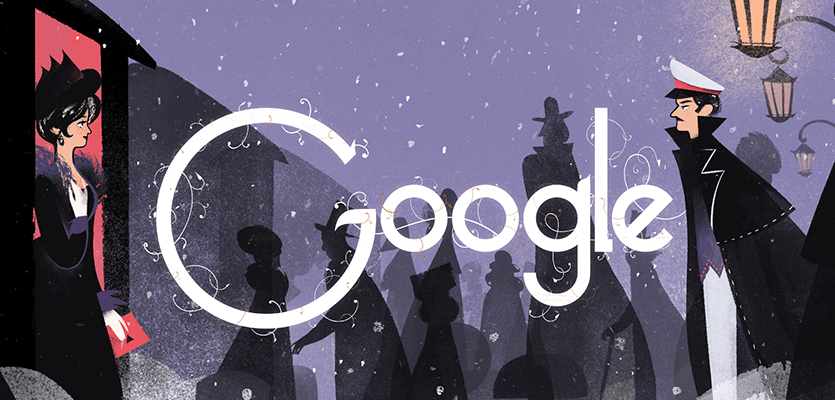
Leon Tolstoi Google Doodle
Leo Tolstoy's 186th Birthday
Google is celebrating, on this day, September 9th, the 186th anniversary of Leo Tolstoy, the Russian novelist and philosopher, with a slideshow doodle containing his greatest literary works.
Tolstoy was born on 9 September 1828. In November 1910, the stationmaster of a train depot in Astapovo, Russia, opened his home to Tolstoy, allowing the ailing writer to rest. Tolstoy died there shortly after, with pneumonia, on November 20, 1910.
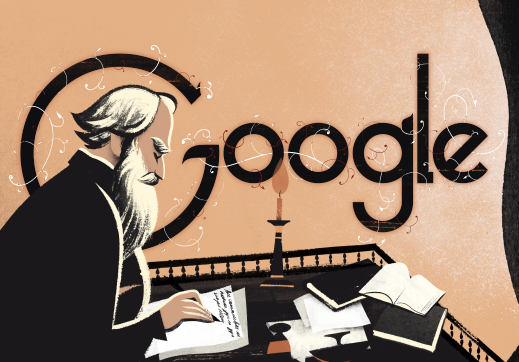
Tolstoy writing at his desk by candlelight
Google Doodle
Tolstoy writing at his desk by candlelight
Google Doodle
Leo Tolstoy's 186th Birthday
- Google Doodle
The slideshow doodle could be a wonderful digital resource to include into your school lesson.
The slideshow begins with an image of a bearded Tolstoy writing at his desk by candlelight before presenting scenes from his most famous works such as War and Peace, Anna Karenina and The Death of Ivan Ilyich.
The slideshow begins with an image of a bearded Tolstoy writing at his desk by candlelight before presenting scenes from his most famous works such as War and Peace, Anna Karenina and The Death of Ivan Ilyich.

Leo Tolstoy' War and Peace
Google Doodle
Leo Tolstoy's 186th Birthday
Cicking
next on Google's Leo Tolstoy doodle, we can see a slide of a
silhouetted couple dancing in a ballroom through a window, progressing
automatically to the 3rd slide with the title the most famous novel by the
author: War and Peace, and its central character Countess Natalya Ilyinichna
(Natasha) Rostova on a balcony.

Leo Tolstoy's Anna Karenina
Google Doodle
Leo Tolstoy's 186th Birthday
The next slide represents
a scene from the novel War and Peace, featuring "Pierre Bezukhov and the
comet". After another interstitial scene once again with silhouetted
people, we see the 6th slide with the title of the novel Anna Karenina,
depicting the scene where Anna and Vronsky met
for the first time.
The doodle's next slide depicts
another scene from Anna Karenina with Konstantin Levin sitting
alongside his future wife Ekaterina "Kitty" Alexandrovna
Shcherbatskaya.

Leo Tolstoy's The Death of Ivan Ilyich
Google Doodle
Leo Tolstoy's 186th Birthday
We
are lead through another interstitial slide before the doodle showcases the
novella 'The Death of Ivan Ilyich', a high-court judge, with the lead character
already lying on his death bed being comforted by his butler Gerasim,
and with special emphasis placed on the curtains that play a symbolic role.
The next slide shows another
scene from The Death of Ivan Ilyich, presumably showing Ilyich's
wife Praskovya Fedorovna Golovin with daughter Lisa
Golovin, alongside her fiancee Fedor Petrishchev.

The last slide features Leo Tolstoy standing in the forest of Yasnaya
Polyana, where he was born on September 9, 1828, with the Google logo in the
background between the trees.

Tolstoy photographed at his Yasnaya Polyana estate
in May 1908 by Sergey Prokudin-Gorsky
- Short bibliography:
Tolstoy's epic War and Peace is widely regarded as one of the most important masterpieces of world literature.
The novel tells of the events surrounding France’s 1812 invasion of Russia and documents life in the Tsariste society of the Napoleonic years through the eyes of five Russian upper class families.
"Among the ideas that Tolstoy extols in War and Peace is the belief that the quality and meaning of one's life is mainly derived from his day-to-day activities."

Anna Karenina
Leo Tolstoy
Leo Tolstoy
Tolstoy’s other great novel, Anna Karenina, follows the tragic life of the married aristocrat Anna and her affair with the affluent Count Vronsky.
The first sentence of Anna Karenina is among the most famous lines of the book:
"All happy families resemble one another, each unhappy family is unhappy in its own way."
The first sentence of Anna Karenina is among the most famous lines of the book:
"All happy families resemble one another, each unhappy family is unhappy in its own way."
Anna is vulnerable to the pressures of Russian social norms, her own insecurities, and Karenin's indecision.
The novel explores a diverse range of topics: evaluation of the feudal system that existed in Russia at the time but also the individual characters and families, religion, morality, gender and social class.
Education :
"Literature represents a language or a people: culture and tradition. But, literature is more important than just a historical or cultural artifact. Literature introduces us to new worlds of experience. We learn about books and literature; we enjoy the comedies and the tragedies of poems, stories, and plays; and we may even grow and evolve through our literary journey with books."
Esther Lombardi
Teaching Literature is one of the best lessons that a teacher who loves books and to read can do! This literary sensibility will enrich his/her teaching.
Learning Literature with one of those teachers will be a wonderful experience to any student - Humanities or Science.
New young readers will be fascinated, even the reluctant readers. And new young writers will born. Believe me!

Anna Karenina
Joe Wright, 2012
Joe Wright, 2012
Literature :
Literature curriculum about Jules Verne, Fernando Pessoa, Jorge Luís Borges, Charles Dickens or Leo Tolstoy are easier and so enriched. New tools, awesome devices, marvelous interactive educational resources.
In his Lectures on Russian Literature Vladimir Nabokov rather delightfully describes how Tolstoy "...unwraps the verbal parcel for its inner sense, he peels the apple of the phrase, he tries to say it one way, then a better way, he gropes, he stalls, he toys, he Tolstoys with words."
After Anna Karenina, Tolstoy continued to write fiction throughout the 1880s and 1890s. Among his later works' genres were moral tales and realistic fiction.

The Death of Ivan Ilyich
Leo Tolsty
One of his most successful later works was the novella The Death of Ivan Ilyich, written in 1886. In Ivan Ilyich, the main character struggles to come to grips with his impending death. The title character, Ivan Ilyich, comes to the jarring realization that he has wasted his life on trivial matters, but the realization comes too late.
Students can read online some pages if the book doesn't into your lessons.

Leo Tolstoy, 1910
credits: Getty Images
via Biography
- Some thoughts :
My usual readers know what I think about Google Doodles as a pedagogical interactive resource in any curriculum: literature, science, arts, music, zoology, even sports.
All along those years, I wrote about Literature and some interesting interactive resources exploring Google doodles, and movies based on great world writers or novels.
Tolstoy's novels are considered among the finest achievements of literary work. War and Peace is, in fact, frequently cited as the greatest novel ever written.
I am delighted to write about Leo Tostoy and his original and complexe books - Google slideshow - including into Languages & IT curriculum. We must not forget the importance of films in Literature lessons (high-school education).
Many classics in children's and teens' literature or young adults (Higher Education) have been made into good films.
So, we can captivate new readers, presenting literature books trough movies. Gorgeous digital educational resource!
So, we can captivate new readers, presenting literature books trough movies. Gorgeous digital educational resource!
Books based on the gripping real-life stories of an author as Leo Tolstoy are a great experience to students.
"When I started rereading Tolstoy, it struck me how robust and modern his style is. The use of repetition, colloquialisms, and unorthodox syntax, as well as the extraordinary control over time and pacing are as potent and urgent as they were more than a century ago."
Of course, Tolstoy's books are known for being long and complex to read, while the author’s own complicated and extreme moralistic views also proved influential.
"When I started rereading Tolstoy, it struck me how robust and modern his style is. The use of repetition, colloquialisms, and unorthodox syntax, as well as the extraordinary control over time and pacing are as potent and urgent as they were more than a century ago."
Of course, Tolstoy's books are known for being long and complex to read, while the author’s own complicated and extreme moralistic views also proved influential.
However if you display the splendid movie Anna Karenina (2012) - it's gorgeous - students will be ready to start reading the long book.
Reading a book and after, in a comparative process of learning, displaying the movie in the classroom, or go to the movies with our students, are interesting strategies that educators can't throw way.
Students can explore the official website Anna Karenina. There are good literary websites containing interesting articles on War and Peace as well.
Leo Tolstoy’s Anna Karenina is set for another small-screen with the writer Gwyneth Hughes who is developing an adaptation (BBC)
- Social media:
Facebook, Twitter, Instagram and other social media are now include into school curricula (schools accounts) by some teachers. I agree.
Students will develop critical thinking. They also can be involved on good projects with students and teachers from different schools and countries.
Dare to use social networking in your lessons. Students will be enthusiastic.
Of course, don't forget school libraries and public libraries. Modern libraries are a great value to read and to do scholar research. There are now fantastic digital tools in our days in modern libraries.
"If we admit that human life can be ruled by reason, then all possibility of life is destroyed.”
Leo Tolstoy, War and Peace
G-Souto
09.09.2014
Copyright © 2014G-Souto'sBlog, gsouto-digitalteacher.blogspot.com®

Schools : Teaching Leo Tolstoy novels : resources ! by G-Souto is licensed under a Creative Commons Attribution-NonCommercial-NoDerivatives 4.0 International License.