Showing posts with label book. Show all posts

Saturday, November 8, 2025

International Day Against Violence & Bullying at School including Cyberbullying : Screen smart !


https://www.facebook.com/unesco


On 6 November, the world marked the International Day against Violence and Bullying at School, including Cyberbullying. This day is celebrated on the first Thursday of November every year.


UNESCO Member States declared the first Thursday of November as the International Day against Violence and Bullying at School, Including Cyberbullying, recognizing that school-related violence in all its forms is an infringement of children’s and adolescents’ rights to education and their health and well-being.


  • Theme 2025 :

“Screen smart: Learning to be safe in the digital era.”


Every month, 1 in 3 learners experiences bullying and at least 1 in 10 faces cyberbullying. Children who are bullied are twice as likely to feel lonely or have trouble sleeping. Some even have thoughts of suicide. 


Online abuse creates a 24/7 loop of fear that follows learners from screens into classrooms. The risks are even greater for some learners: 58 % of girls and young women have faced online harassment, about 50 % more likely to be cyberbullied than their peers.


Across Europe, more than 20% of 15-year-old students reported being frequently bullied, affecting students and schools irrespective of their socio-economic profile.


A joint effort is crucial when it comes to addressing violence at school emphasising prevention, support, and community. Building educators’ capacity to prevent it, and implementing a whole-school approach are essential.

Bullying in schools has negative impacts on the wellbeing and mental health of learners, their school’s climate and their educational outcomes. It increases the risk of early school drop-out, with long lasting effects on the quality of life.


Online violence is not just a digital safety issue, it strikes at the very heart of education, undermining learners' health, well-being and participation, threatening their future and that of societies.


credits : UNESCO


Education must be our frontline defence. UNESCO works with governments, schools and teachers to foster safe learning environments free from violence, train educators to recognize and respond to online violence, and strengthen policies so that learning spaces — physical and digital — are safe and healthy for all. 


credits . UNESCO IITE


Yet according to 2024 Global Education Monitoring Youth Report, only 16% of countries have adopted legislation to prevent cyberbullying through education.


credits: UNESCO

https://www.unesco.org/


Education


On this International Day against violence and bullying at school, including cyberbullying, the schools are encouraged to conduct activities to enhance awareness on prevention of violence and bullying in Schools, and work together to make our schools and educational institutions more safe and vibrant for all learners. 


  • Here are five ways we teach the young child the power of inclusivity.


Explain to your young learner what bullying is. Use actual examples from their life. Point out when people say and do things that are mean, and give them practical examples of what they can do to stand up for their peers who are left out or bullied.


Everyone has feelings and needs, just like you. Colour blindness has never solved discrimination. Acknowledge the differences of appearance, nationality and skin colour that your child notices in others. And at the same time talk to them about our shared humanity and that everyone wants to be loved and happy, just like them.


Encourage collaborative learning. As young children develop a sense of agency, they discover that they have the power to invite others into their circle and experience the joy of collaboration. Inclusivity requires an opening of the heart and an act of generosity but the returns are enormous: an exchange of ideas, fresh perspectives and shared energy as young children work together to find a creative solution for a problem or project. Collaborative learning – when facilitated skillfully – enhances academic progress. Inclusivity helps the young child to develop flexibility and openness to new experiences and this in turn promotes their creativity.


You Can’t Say You Can’t Play
Vivian Gussin Paley


Teach “you can’t say you can’t play” One of the most heart-felt descriptions of the young child’s journey into a shared world is found in Vivien Paley’s award-winning monograph You Can’t Say You Can’t Play. 


Published in 1993, the book is a reflection upon the forces of social inclusion and exclusion that operate throughout preschool and in the early years of primary education. It was in an attempt to create a classroom grounded in inclusivity that Vivian Paley introduced her kindergarteners to a new rule: 

“You can’t say you can’t play.” Hers was a bold attempt to foster a habit of inclusivity in her young students.


Kindness is even more important online. The Internet is another shared world, infinitely vaster than the classroom, and it exposes the young child to people and diversity that they would never encounter IRL. Of everything we teach young children, kindness and inclusivity have the greatest potential to head off the growth of online bullying and hate in the tween and teen years.


"Education is a frontline defense – safe classrooms must extend to safe screens. And learning to be safe online or ‘screen smart’ is essential to safeguarding the quality education children and young people deserve."


Our role into our school curricula since the first lessons including media is to teach curricula but at the same time teach students always to be safe at school life and to be smart on screen.


Resources: Young teachers :

European Education Area : Preventing and addressing bullying in schools

https://education.ec.europa.eu/education-levels/school-education/preventing-and-addressing-bullying-in-schools


We have in our hands an entire 'wired' generation. Children and young people who are all day connected on their cellphones and tablets. At school, at home, in a bus or just walking, even between friends or just strangers. 


"You Can’t Say You Can’t Play !"

Vivian Gussy Paley


G-Souto 


08.11.2025
Copyright © 2025G-Souto'sBlog, gsouto-digitalteacher.blog


International Day Against Violence & Bullying at School including Cyberbullying : Screen smart ! by GinaSouto is licensed under a Creative Commons Attribution-NonCommercial-NoDerivatives 4.0 International License.


Sources : UNESCO / European Commission - European Education Area

Wednesday, April 2, 2025

Schools & families : World Autism Awareness Day ! "Advancing Neurodiversity and the UN Sustainable Development Goals"


https://www.un.org/


April 2 is the World Autism Awareness Day. The United Nations General Assembly unanimously declared 2 April as World Autism Awareness Day to highlight the need to help improve the quality of life of those with autism so they can lead full and meaningful lives as an integral part of society.


"Throughout its history, the United Nations family has celebrated diversity and promoted the rights and well-being of persons with disabilities, including learning differences and developmental disabilities."

United Nations


The theme for World Autism Awareness Day 2025 is "Advancing Neurodiversity and the UN Sustainable Development Goals (SDGs)."


The 2025 observance, under the theme "Advancing Neurodiversity and the UN Sustainable Development Goals (SDGs)", highlights the intersection between neurodiversity and global sustainability efforts, showcasing how inclusive policies and practices can drive positive change for autistic individuals worldwide and contribute to the achievement of the SDGs.


This year’s discussion explores the role of neurodiversity in shaping policies that promote accessibility, equality, and innovation across multiple sectors. Discussions focus on inclusive healthcare, quality education, workplace accessibility, reducing inequalities, and designing autism-friendly cities and communities.


Goals of World Autism Awareness Day :

  • To educate people about autism and its impact on individuals and families
  • To promote understanding and acceptance of people with autism
  • To support individuals with autism in the community
  • To encourage scientific research to develop effective treatments

The term Autism Spectrum refers to a range of characteristics. Appropriate support, accommodation and acceptance of this neurological variation allow those on the Spectrum to enjoy equal opportunity, and full and effective participation in society.


Google Images Archive


Autism is mainly characterized by its unique social interactions, non-standard ways of learning, keen interests in specific subjects, inclination to routines, challenges in typical communications and particular ways of processing sensory information.


The rate of autism in all regions of the world is high and the lack of understanding has a tremendous impact on the individuals, their families and communities.


The stigmatization and discrimination associated with neurological differences remain substantial obstacles to diagnosis and therapies, an issue that must be addressed by both public policy-makers in developing nations, as well as donor countries.


Autism-friendly events and educational activities take place all month, aiming to increase understanding and acceptance of people with autism, foster worldwide support and inspire a kinder, more inclusive world. 


Google Images Archive


  • Strategies For Parents To Help Children With Autism Thrive :


Autistic children may present with skills, talents and abilities that seem well developed in some areas but may have challenges in other areas of life. This may make it difficult for parents So, here some strategies for parents:


  • Be patient and positive

  • Seek support

  • Establish a routine

  • Encourage social skills
  • Take your time

Note: These strategies provide generic information only. It is in no way a substitute for a qualified medical opinion. 


Google Images Archive


  • Teachers and parents:


Autism is mainly characterized by its unique social interactions, non-standard ways of learning, keen interests in specific subjects, inclination to routines, challenges in typical communications and particular ways of processing sensory information.


Autism-friendly events and educational activities take place all month, aiming to increase understanding and acceptance of people with autism, foster worldwide support and inspire a kinder, more inclusive world. 


Memoirs if an imaginary friend
Matthew Green


My name is BUDO.

I have been alive for 5 years.

5 years is a very long time for someone like me to be alive.

MAX gave me my name. Max is 8 years old.

He is the only human person who can see me.

I know what Max knows, and some things he doesn't.

I know that Max is in danger.

And I know that I am the only one who can save him.


Memoirs of an Imaginary Friend was the 2014 Dolly Gray Award winner and a finalist for the 2017 Nutmeg Award. And Goodreads finalist 2012 as voted by over 1 million readers.


Memoirs of an imaginary friend
Matthew Green


"Memoirs of an imaginary friend" by Matthew Dicks is told from the point of view of an imaginary friend who has been created in the mind of an eight year old autistic boy named Max.  


The reader learns that imaginary friends can see one another and that who they will see is what their friend has imagined them to be. They are also limited by what their friend imagines that they can do.  


Budo, Max's friend can walk through doors and is smart and imaginative himself.  Those qualities are important to the story, as they will allow Budo to save Max in the end.  


"The readers learn about real love (a man lays down his life for another) and real evil (manipulate others until you get what you want) while reading this engaging and truly imaginative story."


Matthew Green is a teacher so the school setting of most of this book feels natural and real (at least for this former teacher. 


In the midst of chaos, reading to a child autist or not can create a small oasis of calm, for both kids and parents. If the one thing this awful crisis has given us, it’s time. Books and children respond well to that.


"When we read, our minds grow wings.

When we write, our fingers sing.


(...)

Words invite us to dance - rhythms, rhymes, heartbeats,

hoofbeats, and wingbeats, old tales and new ones,

fantasies and true ones."


Margarita Engle, in The music of words


G-Souto


02.04.2025

Copyright © 2025G-Souto'sBlog, gsouto-digitalteacher.blogspot.com®


Schools & families : World Autism Awareness Day  !  "Advancing Neurodiversity and the UN Sustainable Development Goals" by G-Souto is licensed under a Creative Commons Attribution-NonCommercial-NoDerivatives 4.0 International License.


Wednesday, February 21, 2024

Schools . International Mother Language Day : “Multilingual education is a pillar of intergenerational learning"


International Mother Language Day

https://www.unesco.org/


Multilingual and multicultural societies thrive through the preservation of their languages, which serve as conduits for traditional knowledge and cultural heritage. 

However, linguistic diversity faces increasing threats as more languages vanish. Currently, 40% of the global population lacks access to education in their native language, a figure that exceeds 90% in certain regions. 

Research underscores the benefits of using learners' native languages in education, fostering better learning outcomes, self-esteem, and critical thinking skills. This approach also supports intergenerational learning and cultural preservation.


  • Theme 2024:

Multilingual education – a pillar of learning and intergenerational learning”.


Today, 250 million children and young people still do not attend school and 763 million adults do not master basic literacy skills. Mother tongue education supports learning, literacy and the acquisition of additional languages.


Multilingual education – a pillar of learning and intergenerational learning”, are crucial for inclusive education and the preservation of indigenous languages. 

By starting education in the learner's mother tongue and gradually introducing other languages, barriers between home and school are bridged, facilitating effective learning.


Technology has the potential to address some of the greatest challenges in education today. It can accelerate efforts towards ensuring equitable and inclusive lifelong learning opportunities for all if it is guided by the core principles of inclusion and equity.

Multilingual education based on mother tongue is a key component of inclusion in education.


  • What is Intergenerational learning ?


Intergenerational learning is defined as learning that happens across different age groups and generations. Integral to concept is the multi-directionality of learning: children can learn from adults, adults from children, younger children from older siblings, and from other relatives. It is a collective learning process in which the whole family learns together.


What makes us human
Victor D.O. Santos
credit: cover photo  Eerdmans/UNESCO, USA. 
Release data March 4, 2024


  • Book

A book that, before its first release in Brazil, was selected in 2022 by the specialized jury of The Unpublished Picture Book Showcase by dPICTUS for the dazzling illustrations by Italian artist Anna Forlati and the powerful text by Brazilian author and linguist Victor D.O. Santos. 

The book was furthermore selected for the 2023 Bologna Children’s Book Fair exhibition "Beauty and the World: The New Nonfiction Picture Book".


What Makes Us Human has also been included in The White Ravens 2023 selection as one of the 200 best publications for children released worldwide this year.


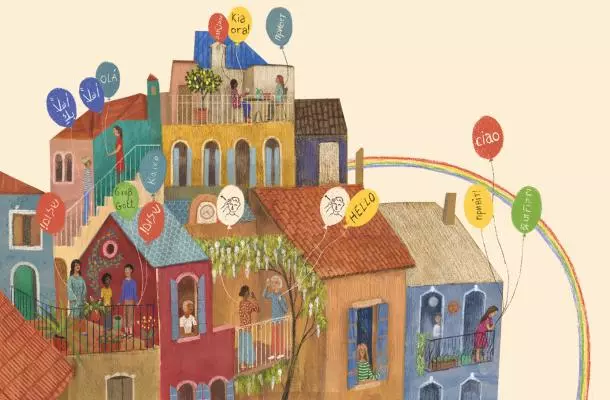
Illustration for “What Makes Us Human”. 
© Anna Forlati


The book is published in several languages. For the moment 12 languages. Look here the countries where What makes us human is translated in mother languages.


  • The role of teachers:

The overall aim of IMLD 2024 is to contribute to the achievement of Sustainable Development Goal 4 by recognizing the role of teachers in promoting multilingual teaching and learning through reading and technology. in different languages


Students : Share key messages via this social media pack.


"The scientific studies are clear: learning in one’s mother tongue is essential to success at school. (...) "Advocating multilingualism in schools also means preserving and promoting linguistic plurality, especially with regard to languages which have only a few remaining speakers."

Ms. Audrey Azoulay, Director-General of UNESCO, message 2024


G-Souto

21.02.2024

copyright © 2024G-Souto'sBlog, gsouto-digitalteacher.blogspot.com®


Schools ! International Mother Language Day : “Multilingual education is a pillar of intergenerational learning" by GinaSouto is licensed under a Creative Commons Attribution-NonCommercial-NoDerivatives 4.0 International License.