My thoughts about Education Humanities, Technology and Digital Culture. Interested on social media tools in educational contexts and
gamification in education.
Today’s generation of girls is disproportionately affected by global crises of climate, conflict, poverty and pushback on hard won gains for human rights and gender equality. Too many girls are still denied their rights, restricting their choices and limiting their futures.
Yet, recent analysis shows that girls are not only courageous in the face of crisis, but hopeful for the future. Every day, they are taking action to realize a vision of a world in which all girls are protected, respected and empowered.
But girls cannot realize this vision alone. They need allies who listen to and respond to their needs.
credits: UN Women
Theme 2024:
"Girls' vision for the future."
This year’s theme, “Girls’ vision for the future,” seeks to empower girls, amplify their voices and support their agency to shape strategies and policies that ensure a better future for us all. Despite progress, 122 million girls remain out of school.
Despite progress, 122 million girls remain out of school. It is time to listen to girls, to invest in proven solutions that will accelerate progress towards a future in which every girl can fulfil her potential.
Key data on girls and women’s right to education
Many girls and women cannot exercise their right to education due to gender inequality and discriminatory practices. Poverty, early marriage, and gender-based violence are just some of the reasons behind the high percentage of out-of-school and illiterate girls and women globally.
""Even without legal barriers, many structural factors can hinder girls’ education, development and civic participation. To achieve gender equality in education across the globe, we must sustain our efforts, equipping girls with tools and fostering environments conducive to their success."
Audrey Azoulay, Director-General of UNESCO
Time to share with youthe rundown of the most read posts in March.
For Activities, please search on all the publications here mentioned.
Resources:
HerAtlas: UNESCO’s interactive tool monitoring girls and women’s right to education worldwide. The graphics are updated regularly to reflect the latest data from the tool.
Make this Atlas yours and join us in shaping a world where education knows no bounds.
Hashtag :#HerEducationOurFuture
Well, I will be back posting some ideas and educational resources very soon.
Hope you are doing well at your schools and doing interesting things with your students. Don't loose the power and hope to be a great teacher!
Reducing food losses and waste is essential in a world where the number of people affected by hunger has been slowly on the rise since 2014, and tons and tons of edible food are lost and/or wasted every day.
Theme2024:
"Stop Food Waste ! For the Planet and People."
International Day of Awareness of Food Loss and Waste
While an estimated 735 million people go hungry globally, food loss and waste generate 8 to 10 percent of GHGs and is a methane hotspot.
Households waste over 1 billion meals worth of edible food every day, the equivalent of 1.3 meals every day for everyone in the world affected by hunger
Opportunities to finance food loss and waste reduction and low-carbon diets remain untapped, with only USD 0.1 billion invested annually in 2019/20. This represents a minor fraction of annual needs, estimated at USD 48 to 50 billion.
UN
Education: Inform, engage, educate !
Reducing food loss & waste is a key #ClimateActionstep that can contribute to the protection of our planet, while helping tackle hunger around the world.
Teachers as consumers from across the food systems, must teach their students at school to cut food loss and waste to enhance the use of natural resources, mitigate climate change and support food security and proper nutrition for all.
Students have the power to raise awareness about food loss and food waste. By recognizing why food waste matters, students can take action to reduce the amount of food being wasted in their schools.
They can recover, reduce, and recycle the food that goes uneaten at their schools.
They can reduce food waste through improved ordering, prepping, and storage techniques, they can recover wholesome uneaten food and donate it to feed people in need, and they can recycle discarded food for other uses, including animal feed, compost, and energy generation.
Activities:
One way to reduce food loss and waste, supported by your teachers in a cross-curricular, start a food recovery program at your school.
This program involves collecting unused, unopened, and unexpired food from the cafeteria for example, and donating it to local food banks and shelters.
To start a food recovery program, supported by a teacher, talk to your school direction and cafeteria staff to get their support. You can also reach out to local food banks and shelters to see if they are interested in partnering with you.
Many students are unaware of the impact of food loss and waste. By educating your peers, students can help raise awareness and encourage them to take action.
Students can also create posters or infographics to display around the school to remind students to reduce food waste.
If you have a school newspaper or website, you can write an article about food waste and how students can help, asking the responsible teachers of the school newspaper or the webmaster.
By encouraging sustainable eating habits, you can help reduce food waste and promote healthier lifestyles.
You can organize a food challenge or competition to encourage other students to eat more plant-based foods.
You can also work with your school cafeteria to promote sustainable eating habits, encourage them to use reusable or compostable food containers and utensils, or offer smaller portion sizes.
Resources:
The International Food Loss and Waste: Get Involved guide offers key messages, facts and figures, and actions that stakeholders can take to help reduce food loss and waste. You can download it here
Reducing food waste is an important issue that requires everyone’s attention and effort, and schools, teachers and students can make a difference and contribute to a more sustainable future.
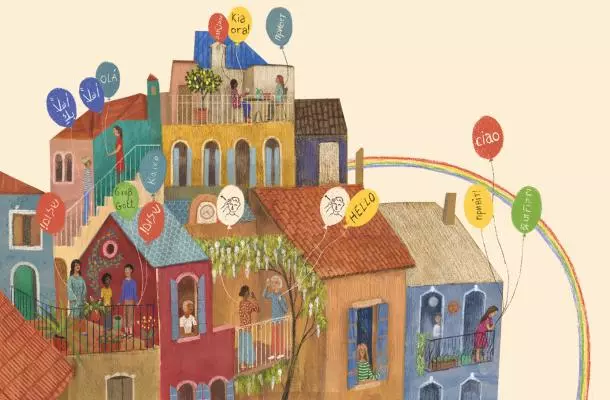
Multilingual and multicultural societies thrive through the preservation of their languages, which serve as conduits for traditional knowledge and cultural heritage.
However, linguistic diversity faces increasing threats as more languages vanish. Currently, 40% of the global population lacks access to education in their native language, a figure that exceeds 90% in certain regions.
Research underscores the benefits of using learners' native languages in education, fostering better learning outcomes, self-esteem, and critical thinking skills. This approach also supports intergenerational learning and cultural preservation.
Theme 2024:
Multilingual education – a pillar of learning and intergenerational learning”.
Today, 250 million children and young people still do not attend school and 763 million adults do not master basic literacy skills. Mother tongue education supports learning, literacy and the acquisition of additional languages.
Multilingual education – a pillar of learning and intergenerational learning”, are crucial for inclusive education and the preservation of indigenous languages.
By starting education in the learner's mother tongue and gradually introducing other languages, barriers between home and school are bridged, facilitating effective learning.
Technology has the potential to address some of the greatest challenges in education today. It can accelerate efforts towards ensuring equitable and inclusive lifelong learning opportunities for all if it is guided by the core principles of inclusion and equity.
Multilingual education based on mother tongue is a key component of inclusion in education.
What is Intergenerational learning ?
Intergenerational learning is defined as learning that happens across different age groups and generations. Integral to concept is the multi-directionality of learning: children can learn from adults, adults from children, younger children from older siblings, and from other relatives. It is a collective learning process in which the whole family learns together.
The book was furthermore selected for the 2023 Bologna Children’s Book Fair exhibition "Beauty and the World: The New Nonfiction Picture Book".
What Makes Us Human has also been included inThe White Ravens 2023 selection as one of the 200 best publications for children released worldwide this year.
The overall aim of IMLD 2024 is to contribute to the achievement of Sustainable Development Goal 4 by recognizing the role of teachers in promoting multilingual teaching and learning through reading and technology. in different languages
"The scientific studies are clear: learning in one’s mother tongue is essential to success at school. (...) "Advocating multilingualism in schools also means preserving and promoting linguistic plurality, especially with regard to languages which have only a few remaining speakers."
Ms. Audrey Azoulay, Director-General of UNESCO, message 2024