Showing posts with label Human Rights. Show all posts

Monday, January 27, 2025

History in School : The 80th Anniversary of the Liberation of the Auschwitz Birkenau !


credits: © Olivier Mériel/Mémorial de la Shoah


"At a time when survivors and direct witnesses of the Holocaust are growing fewer, it is vital to further invest in education to pass on memory to younger generations.  as well as to combat contemporary forms of antisemitism. Since it’s creation, UNESCO has been resolutely committed to carrying out this mission. Over the past ten years, we have led such actions in 85 countries."

Audrey Azoulay, UNESCO Director-General


Every year around 27 January, UNESCO pays tribute to the memory of the victims of the Holocaust and reaffirms its unwavering commitment to counter antisemitism, racism, and other forms of intolerance that may lead to group-targeted violence. The date marks the anniversary of the liberation of the Auschwitz Birkenau German Nazi Concentration and Extermination Camp by Soviet troops on 27 January 1945. It was officially proclaimed, in November 2005


credits: Memorial & Museum Auschwitz-Birkenau


27 January 2025 will mark the 80ᵉ anniversary of the liberation of the Auschwitz-Birkenau Nazi concentration and extermination camp. On the occasion of the International Day dedicated to the memory of the victims of the Holocaust, more than 250 students from middle schools in Paris and the Paris region joined together at UNESCO for a significant and meaningful event. 


Education


Almost one million men, women and children were killed there because they were Jewish mostly as soon as they arrived. In total, Nazis murdered 1,100,000 people at Auschwitz-Birkenau.


As genocide and atrocity crimes keep occurring across several regions, and as we are witnessing a global rise of antisemitism and hate speech, this has never been so relevant. 

Marking the 80th Anniversary of the liberation of Auschwitz-Birkenau German Nazi Concentration and Extermination Camp, UNESCO is launching a guide for teachers and a set of lesson activities to support countering Holocaust denial and distortion through education.


UNESCO also published three new sets of guidelines for teachers and journalists to combat Holocaust denial and disinformation, while supporting the creation of a new center for research and education on extremism in the former house of the Auschwitz commander.


Lesson activities for Secondary Education
credits: UNESCO


The Guide for teachers and the Lesson activities for secondary education delve into the specifics of how Holocaust denial and anti-Semitic discourse appear online and in the classroom, while also offering survivor testimonies and lessons plans to help teachers develop their pupils' knowledge and critical thinking skills in the face of disinformation about the Holocaust.


Useful links for teachers and students : 

The Wiener Holocaust Library

 Memorial & Museum Auschwitz-Birkenau

Beyond the Abyss – 80th anniversary of the liberation of Auschwitz-Birkenau

Survivors and World Leaders Gather to Commemorate 80th Anniversary of Auschwitz Liberation


"Memory work is about rediscovering for yourself the history of people who may have lived near you. It’s about reconstructing their journeys so that their stories are never forgotten."

Florence Gastaud

G-Souto

27.01.2025

Copyright © 2025G-Souto'sBlog, gsouto-digitalteacher.blogspot.com®


History in School: The 80th Anniversary of the Liberation of the Auschwitz Birkenau ! by G-Souto is licensed under a Creative Commons Attribution-NonCommercial-NoDerivatives 4.0 International License

Thursday, May 30, 2024

Education : Best of 2023 : semester 2


credit: Image generated by AI from a text prompt (Michael S. Helfenbein)
via YaleNews


Well, as you know artificial intelligence was the topic of 2024 and lot of students began to use it before schools. Teachers needed to think how schools would to adapt and prepare students for a future filled with all kinds of capable A.I. tools 

My usual readers remember that I introduced the theme on my publication Education: Best of 2023 : semester Education: Best of 2023 : semester 1.


illustration Nata Metlukh


ChatGPT, the buzzy chatbot developed by OpenAI is capable of writing essays, solving science and math problems and producing working computer code. Impossible to bam it from schools 

But there are legitimate questions about the ethics of A.I.-generated writing, and concerns about whether the answers ChatGPT gives are accurate. (Often, they’re not.) 

And teachers feel that they have enough to worry about, without adding A.I.-generated homework to the mix.

However they understood that ChatGPT in the classroom, with the right approach, it could be an effective teaching tool.


credit: Image courtesy of MidJourney
via Paul Cancelliari/ LinkeIn


Well, if you haven't take a decision why not read The Pros and Cons of Chat GPT for Students (May 2024) ? Or 3 ChatGPT Prompts for Extending Learning with Successful Students (August 2023). They could be very useful to you.


Looking back 2023 I've come up with a roundup of what's been the best posts of my blog The Digital Teacher G-Souto. 

Below you’ll find the top posts of 2nd semester 2023 containing different themes: science, human rights, French literature, children's literature, languages, science-fiction, environment, elimination of violence against women and girls, traditions and other themes.

As my usual readers know my posts can be written in English, French and Portuguese (my mother language).


The selection is based on page views but also based on pedagogical relevance of the most-read posts.

I kept the order of the most viewed, and eliminated the posts that seemed less relevant. The main reason? Sometimes some posts acquire too much visibility, not for their value but for the keywords that the search engines "like" indexing.


Here are the most popular posts 2nd semester 2023:


Le Top des billets 2e semestre 2023:


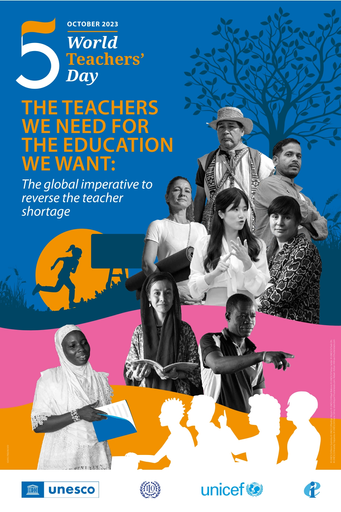
World Teacher's Day 2023


My special choice of the #2nd semester 2023 ? Teacher's Day ! The teachers we need for the education we want ! 


"The teachers we need for the education we want: The global imperative to reverse the teacher shortage". 


World Teachers’ Day theme 


The 2023 celebrations aimed to put the importance of stopping the decline in the number of teachers and would star to increase that number.


Through various activities, all the countries would advocate for a dignified and valued teaching profession, analysing their challenges, and showcase inspiring practices to attract, retain and motivate teachers and educators.

Without teachers, there is not education. Being a teacher provides a unique opportunity to make a transformative impact on the lives of students, and contribute to shaping sustainable futures. 

In different European countries. these last two years, there was a big lack of teachers.

Hoping to have inspire you, as my readers and teachers in your lessons all over the last year.

May 2024 be year of Peace for all the countries, Praying for the end of wars in the world, and all the big tragedy and dead  people and so many children due these terrible wars.

May the humanity continue to search for Peace.

Teachers and students fight for peace, development, and climate change. Countries need tranquility. Earth need help.

Teachers continue to teach with passion, inspiring your students to be better citizens in the future searching for humanity, to live in peace. Earth need young environmental defenders. 

Teachers continue preparing the new generations to this new world and a a different new future. Give them hope, joy, serenity. 

Your mission from the heart!


G-Souto

30.05.2024
Copyright © 2024G-Souto'sBlog, gsouto-digitalteacher.blogspot.com®


Education : Best of 2024 : Semester #2 by G-Souto is licensed under a Creative Commons Attribution-NonCommercial-NoDerivatives 4.0 International License.


Friday, December 4, 2020

November in Review & Intl Day of Persons with Disabilities


"As the world recovers from the pandemic, we must ensure that the aspirations and rights of persons with disabilities are included and accounted for in a -inclusive, accessible and sustainable post COVID-19 world." 

Antonio Guterres, UN Secretary General 

The 3 December was the International Day of Disabled Persons. The annual observance of the International Day of Disabled Persons was proclaimed in 1992. 

It aims to promote the rights and well-being of persons with disabilities in all spheres of society and development, and to increase awareness of the situation of persons with disabilities in every aspect of political, social, economic and cultural life.

  • Five things we need to know:

Ahead of the International Day of Persons with Disabilities, celebrated every year on 3rd December, here are five things you need to know about living with a disability during COVID-19:

Here are five things you need to know about living with a disability during COVID-19:


  • Persons with disabilities: Did you know?


Of the one billion population of persons with disabilities, 80% live in developing countries.

An estimated 46% of older people aged 60 years and over are people with disabilities.


credits: Getty Images

One in every five women is likely to experience disability in her life, while one in every ten children is a child with a disability.

Persons with disabilities in the world are among the hardest hit by COVID-19.


credits: Brian Mitchell / Getty Images

Education:

Disability inclusion is an essential condition to upholding human rights, in education and of course in school curricula. 

Of the 100 million or so children around the world with a disability, 80% of them are in developing countries. In these countries, 40% of children with disabilities don't go to primary school and 55% are not in secondary education.

Beyond those stark facts are millions of other children with disabilities who are in classrooms but are left feeling excluded, intimidated and unvalued by the failings of school systems.

"For most people, technology makes things easier. For people with disabilities, technology makes things possible,"

Vibhu Sharma


via The Hindu

The tools for identifying learning difficulties such as dyslexia, dysgraphia, and dyscalculia. These manifest as problems with listening, speaking, reading, writing, reasoning, or mathematical abilities.

"A lot of young people feel dumb or stupid. Dyslexia can affect different aspects of their life besides reading, from being able to tell from left and right, or reading a map,” 

Shae Wissell, Dear Dislexy Foundation

Prominent young Australians who have dyslexia are Jessica Watson, who sailed around the world solo when she was just 16, and Alex Edmondson, an Olympic medal-winning cyclist.


Dyslexia

My goal is to demonstrate to teachers, parents that  inclusion is possible for kids and citizens with disabilities and to highlight actionable opportunities in the different curricula in school. Sport, music, art are offering excellent opportunities for inclusion. I wrote many posts about persons with disability on this blog.

There is a special one. The most read all over the years: Schools :The Present, a short animation on teens disabilities !

As a teacher, I had a lot of students with different disabilities and always in inclusive classes along my career.

Of course, we must prepare a common core standards-based curriculum and resources list that helps us weave ability awareness-themed activities and inclusion education into our classroom throughout the year.
Of course, I prepared my students to respect the rhythm of their peers with disabilities. They could understand their disabilities and helped their 'different' classmates in their learning.
On the other hand students with disabilities learned to work in group and they did enormous progress in their own learning.

We need to strengthen our collective efforts for universal access to essential services, including immediate health and social protection, education, digital infrastructure, accessible information, employment and other socio-cultural opportunities in order to ensure that persons why disabilities are not left behind in times of crisis and beyond.

And now let's write about the posts of November. About 70% of us are affected by restrictions in Portugal. 


Here are the most popular posts of the last month:

There are measures to deal with coronavirus outbreaks are in place across Europe. Many involve the reintroduction of restrictions that had been eased after initial lockdowns.

Here in Portugal, schools are working but there are two special measures for two long week-ends, the 1st December, Independence Restoration Day and next Thursday a Catholic holiday. We are under a third national lockdown until at least 17 December. And there is a curfew from movement between country's municipalities is prohibited. 

Be safe! Take care!

G-Souto

04.12.2020
Copyright © 2020G-Souto'sBlog, gsouto-digitalteacher.blogspot.com®


November in Review & Intl Day of Persons with Disabilities by G-Souto is licensed under a Creative Commons Attribution-NonCommercial-NoDerivatives 4.0 International License.

Monday, January 27, 2020

Schools : Auschwitz-Birkenau 75 years after : new resources


Camp of Auschwitz-Birkenau
credits: Getty

27 January 2020 marks the 75th anniversary of the liberation of the Nazi German concentration and extermination Camp of Auschwitz-Birkenau by Soviet troops on 27 January 1945. In 2005, the date was officially proclaimed International Day of Commemoration in Memory of the Victims of the Holocaust by the United Nations General Assembly. 


International Holocaust Remembrance Day
credits: UNESCO


"Seventy-five  years  ago,  the  100th  and  322nd  divisions  of  the  Soviet  Army’s “1st Ukrainian  Front”  reached  the  Nazi  concentration  and  extermination  camp  of  Auschwitz-Birkenau,  whose  very  name  symbolizes  the  barbarism  of  the  killing  centres and concentration camps (...)

Audrey Azoulay, Director-General of UNESCO, message

The Holocaust profoundly affected countries in which Nazi crimes were perpetrated, but also had universal implications and consequences in many other parts of the world.


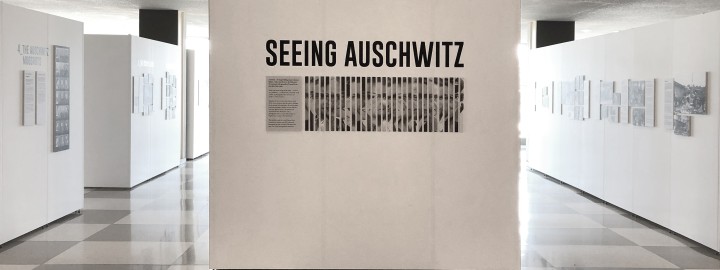
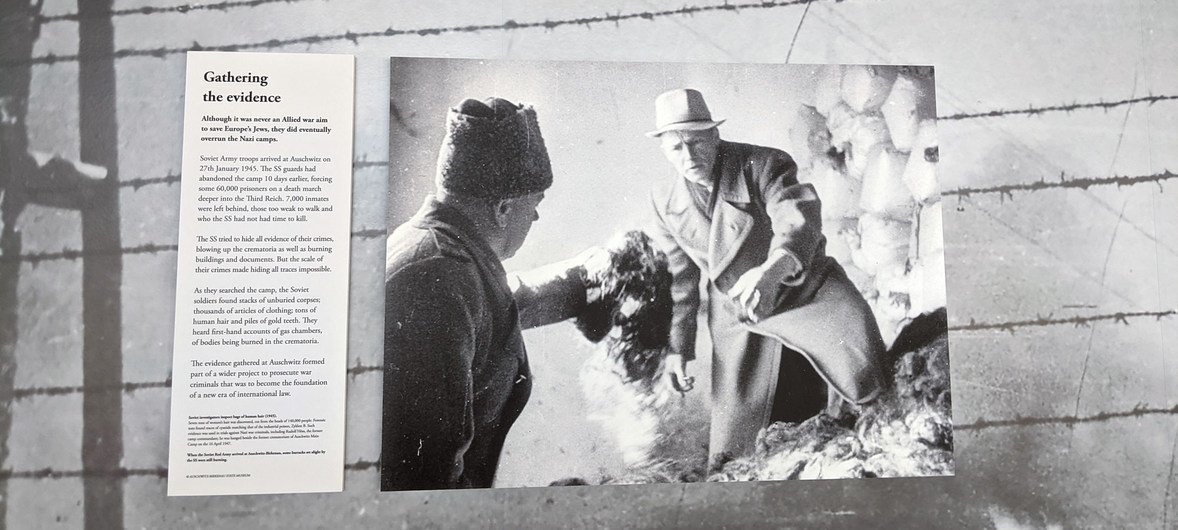
Exhibition: Seeing Auschwitz
credits: Katia Pizzi
@KatiaPORT

Education:

Educational approaches to the History of Auschwitz, ways to sustain the interest of new generations and raise awareness of its relevance in addressing contemporary issues is an important issue to teach in schools curricula.

Education has a vital role to play in fostering a culture of prevention, undermining prejudice, promoting peaceful co-existence and human rights, and cultivating respect for all peoples. 


UNESCO recognizes that teaching about the History of the Holocaust is fundamental to establishing respect for human rights, basic freedoms and the values of tolerance and mutual respect.


credits: UNESCO

  • Exhibitions:

Two exhibitions linked to the site of Auschwitz-Birkenau, the history of the Holocaust, and related research are displayed at UNESCO Headquarters offered visitors new perspectives on approaching the history of the Holocaust: 


Exhibition: Crimes Uncovered: The First Generation of Holocaust Researchers

  • The first exhibition "Crimes Uncovered: The First Generation of Holocaust Researchers", developed by the Wiener Holocaust Library, the House of the Wannsee Conference and Touro College Berlin focuses on the beginnings of Holocaust research starting with the first courageous individuals who documented the Nazi crimes at the time of the Second World War. 


Exhibition: Seeing Auschwitz

  • The second "Seeing Auschwitz", conceived by Musealia and the Auschwitz-Birkenau Memorial specifically for UNESCO and United Nations Headquarters, invites visitors to take a closer look at photographs of Auschwitz-Birkenau and those who perished there. 
  • Both exhibitions remain on show at UNESCO Headquarters until 5 February 2020.

School visits:

If you teach in Paris or near by, don't miss a school visit with your students. Do you want a better lesson? Authentic documents, photos, videos, and other staff.


credits: UN


Resources:


Almost one million men, women and children were killed there because they were Jewish mostly as soon as they arrived. In total, Nazis murdered 1,100,000 people at Auschwitz-Birkenau.


  • Video:


I wrote several posts on this blog. Teachers and students will find:


Books: Diary: 


Reading the diary of a person muddling through that history is jarringly different, more like the confusing experience of actually living it. In real time, people are slow to recognize events taking place around them, because they have other priorities; because these events happen invisibly; because changes are incremental and people keep on recalibrating. 


The shock of Renia’s diary is watching a teenage girl with the standard preoccupations—friends, family, schoolwork, boyfriend—come to an inescapable awareness of the violence that is engulfing her.


A replica of Anne Frank's Diary is displayed 
at the Indianapolis Children's Museum in Indianapolis
Michael Conroy/APvia nprEd

You know Anne Frank's Diary of course. A Diary is an interesting part of the Narrative text. Students love to read a diary written by young people.


The Diary of Anne Frank is at once exceedingly special and totally normal. Her circumstances, her writing skill, and her insight make the diary extraordinary. 

How do a diary helps us teach about this special narrative text ? Let's know a new diary written for another young girl. Renia Spiegal!


Renia's Diary
A Holocaust Diary
Renia Spiegal


The long-hidden diary of a young Polish woman's life during the Holocaust, translated for the first time into English.

Hidden for 70 years, a new invaluable contribution to Holocaust literature, the Renia's Diary was rediscovered inside a desk in New York (2018).

The shock of Renia’s Diary is watching a teenage girl with the standard preoccupations - friends, family, schoolwork, boyfriend - come to an inescapable awareness of the violence that is engulfing her.


Renia's Diary
A Holocaust Diary
Renia Spiegal


Renia Spiegel was born in 1924 to an upper-middle class Jewish family living in southeastern Poland, near what was at that time the border with Romania. At the start of 1939 Renia began a diary. 


“I just want a friend. I want somebody to talk to about my everyday worries and joys. Somebody who would feel what I feel, who would believe me, who would never reveal my secrets. A human being can never be such a friend and that’s why I have decided to look for a confidant in the form of a diary.” 


Renia Spiegal [1924-1942]


And so begins an extraordinary document of an adolescent girl’s hopes and dreams. By the fall of 1939, Renia and her younger sister Elizabeth (née Ariana) were staying with their grandparents in Przemysl, a city in the south, just as the German and Soviet armies invaded Poland. Cut off from their mother, who was in Warsaw, Renia and her family were plunged into war. Read some notes here


Some thoughts:


Diarists are among the most honest writers you'll ever know!  Very few lies exist in a diary that carries the expectation of being private forever. 


Also, a diary is written in a way that is characteristic of an era.  One can learn about speech patterns, syntax, and changes in language from reading a diary.


Teachers will develop some good projects and activities with your students. They love History  and Literature.


You don't have to do it in a week. Give some time to your lessons to really help your students to understand the values of human rights and never accept horrendus historic facts to be repeated. 


"Understanding our history connects us to the essential human values of truth, respect, justice and compassion."

António Guterres, UN Secretary-General 


G-Souto

27.01.2020
Copyright © 2020G-Souto'sBlog, gsouto-digitalteacher.blogspot.com®

Creative Commons License
Schools :  Auschwitz-Birkenau 75 years after : new resources by G-Souto is licensed under a Creative Commons Attribution-NonCommercial-NoDerivatives 4.0 International License.