Showing posts with label origin. Show all posts

Friday, January 3, 2025

Science : Here they are ! The Quadrantids !


                                                  credits: FreePik

Whether you’re an astronomy enthusiast or simply looking for a peaceful night of stargazing, the Quadrantids Meteor Shower is an event that promises to captivate and inspire. 

This yearly occasion presents the ideal chance to engage with the wonders of the night sky and experience a cosmic sight that is both quick and majestic.

Stargazers can ring in the beginning of 2025 by witnessing the first meteor shower of the year.

The Quadrantids, one of the "strongest" displays of the year, are expected to peak Thursday night through early Friday morning, according to the American Meteor Society (AMS).


                    A view of stargazing as Quadrantids meteor showers peak,                   at Pigeon Point Light Station in Pescadero, Calif., Jan. 4, 2024.                             credits: Tayfun Coskun/Anadolu via Getty Images
                                                    via ABC


For the first astronomy event you can see this year, there’s a meteor shower to look for. The Quadrantids, the first meteor shower of the year, is expected to peak in the morning of January 3rd.

That morning, look for a maximum of 80 meteors per hour radiating from a point in the northern sky. It’s important to note that the Quadrantids, while an active shower, may see maximum activity for only a few hours on the peak night – or in this year’s case, morning.

For many years, the origin of the Quadrantids remained unknown. Though the Quadrantids were first seen in 1825, it wasn't until 2003 that an astronomer at Lowell Observatory in Arizona, Petrus Jenniskens discovered a small asteroid, 2003 EH1, was the source of the shower.


via Google Images Archive

Here are some general viewing tips from NASA :

◾ Find an area well away from street lights and the light pollution of cities.

◾ Come prepared for winter temperatures with a sleeping bag, blanket, or lawn chair.

◾ Lie flat on your back with your feet facing northeast and look up, taking in as much of the sky as possible.

It should take less than 30 minutes for your eyes to adapt so that you can see streaking meteors.


via The Universe Space Tech

Education:

This time of the year, some teachers and students are not yet starting school after Christmas season.

However, once again, science curriculum will be enhanced with the help of the awesome event in the sky. The Quadrantids!

Do you want a better science lesson ? A live lesson of science. Wow!

The winter, cold temperatures contribute in making this shower neglected by the public, while it offer bright, very enjoyable meteors. 

Most of us are excited about the Quadrantid shower, specially if you teach sciences or you are science students. Of course, stargazers as well. 

My usual readers know I don't teach sciences. I'm a Humanities person and former teacher of Humanities. But I'm a passionate of science and all the high technology near science.

Do you remember the Wow! The Geminids shower 2022. Kids, let's go ! Time to watch to the sky ! Just awesome! A sky full of stars. 

This time, the European teachers and students are not in school. Only next week. 

But the Quadrantids 2025 will be a good natural resource from the sky to enhance the first day of Science lesson! 


credits: Lamberto Sassoli

Wow! Even on the first day of school time after the Christmas holidays. Our students will be happy with this new event.

The winter, cold temperatures contribute in making this shower neglected by the public, while it offer bright, very enjoyable meteors. 

Most of us are excited about the Quadrantid shower, specially if you teach sciences or are science students. Of course, stargazers as well. 

My usual readers know I don't teach sciences, but humanities. But I'm a passionate of science and all the high technology near science.

Do you remember another event Hello Science ! Here come the Perseid meteor shower ! Look up the sky ! Just another awesome event with the sky full of stars. 

This time, the European teachers and students are out of school as i said. But prepare a one or two good natural lessons to talk and show some videos to enhance the first day of Sciences lesson! The Quadrantids 2025.

Who knows if you will have some stargazers in your class that will be happy to talk about their experience and show your and classmates a video or two made with their smartphones?


Resources:

video NASA : What's up for January ?


Some useful links :

The Quadrantids 2022

The Quadrantids 2016


Here you have all the resources a beautiful lesson of science course to start 2025! 

But! Firs of all, don’t miss this rare opportunity to connect with the wonders of the universe!


G-Souto

03.01.2025
Copyright © 2025G-Souto'sBlog, gsouto-digitalteacher.blogspot.com®


Science : Here they are ! The Quadrantids ! by G-Souto is licensed under a Creative Commons Attribution-NonCommercial-NoDerivatives 4.0 International License.

Sources: NASA/ Space.com

Tuesday, April 1, 2014

Schools : April Fools' Day : origin & traditions !


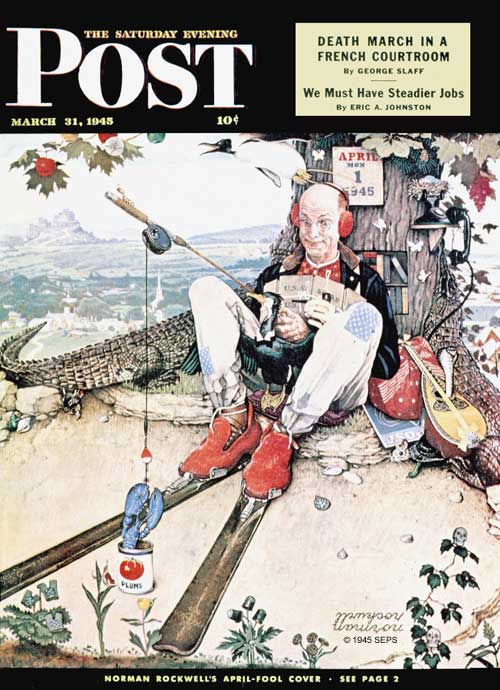
Norman Rockwell’s 1945 April Fools’ Saturday Evening Post Cover


April the first stands mark'd by custom's rules,
A day for being, and for making fools: —
But, pray, what custom, or what rule supplies
A day for making, or for being — wise?


 Rev. Samuel Bishop, 1796


Wow! Today April 1st is April Fools' Day. Do your students know the origin?


An observance which takes place in western countries on 1st April, traditionally known as April Fools' Day or All Fools' Day


In France we call it Poisson d'Avril — "April Fish") during which merriment is supposed to reign and pranks, practical jokes, and hoaxes are socially sanctioned. 


Poisson d'Avril in France
credits:  C. Gonthier/20 Minutes

Customary practices range from simple tricks played on friends, family, and coworkers to elaborate media hoaxes concocted for mass consumption.


  • Theory of origin:
The origins of April Fools' Day are obscure. The most commonly cited theory holds that it dates from about 1582, the year France adopted the Gregorian Calendar, which shifted the observance of New Year's Day from the end of March - around the time of the vernal equinox - to the first of January.
However, the earliest known historical reference to April Fools' Day occurs in a Dutch poem published in 1561, which predates the adoption of the Gregorian calendar by some 21 years.
The ancient Romans, for example, celebrated a festival on March 25 called Hilaria, marking the occasion with masquerades and "general good cheer."


Holi Hindu Festival of Colors
credits: unknown
Holi, the Hindu "festival of colors" observed in early March with "general merrymaking" and the "loosening of social norms," is at least as old.
The Jewish festival of Purim has a long history, as well. Coinciding with the advent of spring, it's celebrated annually with costume-wearing, carnivals, and pranks.


Poisson d'Avril / April Fools Day
via © French Moments 


Education:
"Being funny can also be a useful way to point out what is wrong with the world."
Time | Science
What a good activity to propose to your students! The study of the origin of this traditions in different countries and civilizations.
  • Ask your students to make a serious research about the theory of origin of April Fools' Day;
  • Search for countries where April Fools' Day is celebrated with pranks and jokes;
  • For the oldest - Secondary Education - there is an interesting article on Science section of Time: April Fool's Day in not Joke that I really recommend in Humanities lessons.
It's a good resource to start a rich and enjoyable debate between students and teachers about the humorist side of people in our  days.
Curricula : History ; Languages ; Philosophy ; Sociology ; Arts.
Levels : All levels
Every teacher must adapt the activities to the level they are teaching.
Each 1st April Google, Microsoft, media and dozens of other tech companies deliver a flood of gags to the web. 

This year, there’s plenty to make you laugh, from Nintendo-infused mobile maps to a couple of ways to capitalize on the selfie craze.
I really like the April Fools' Day joke from the European Organization for Nuclear Research, (CERN) :


So, as you see, there are a good number of digital resources that you could explore in your class. 
Hope you enjoy to explore traditions with humor and some good laughs in your classroom.
"Comedy challenges assumptions and humor broadens perspectives, thus enhancing creativity".
Time | Science


Note: Cancelled in 2020: Given the current predicament with everyone socially distancing themselves to avoid the spread of Covid-19 and people already unable to discern what is real and fake on the news around the subject, it just feels that now is not the time to be making silly pranks (at least online).
G-Souto
01 April 2014
updated: 01.04.2023

Copyright © 2023G-Souto'sBlog, gsouto-digitalteacher.blogspot.com®

Creative Commons License
Education : April Fools' Day : origin & traditions ! bG-Souto is licensed under a Creative Commons Attribution-NonCommercial-NoDerivatives 4.0 International License.