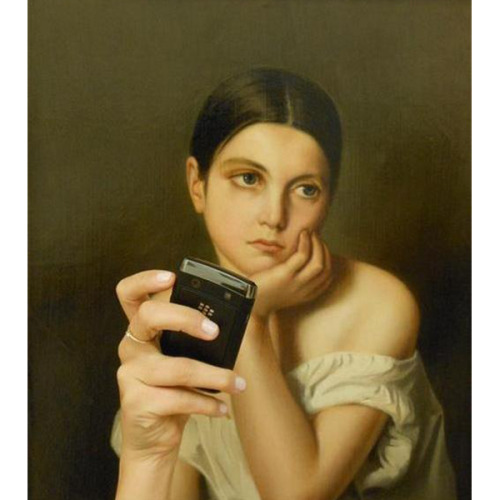
Junges Mädchen (Melancholie), von Théodore Chassériau (1835)
credits : Kunsthalle Bremen
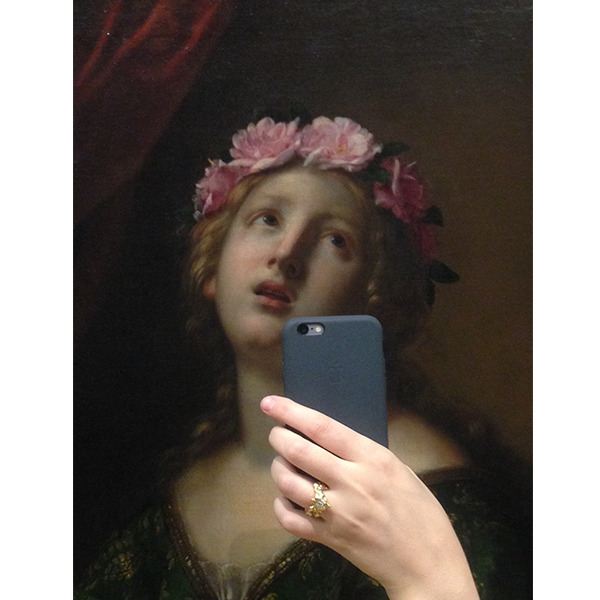
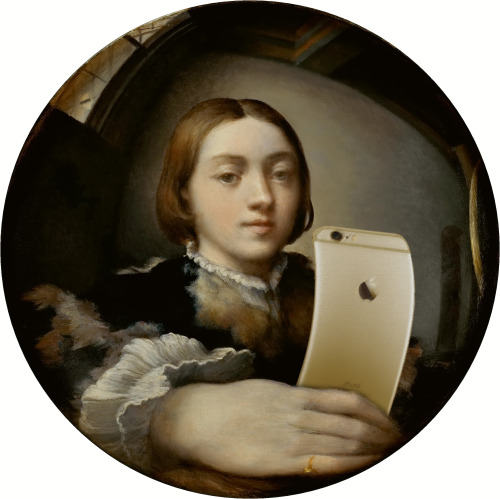
"Welcome to the Museum of Selfies.
This is a project that started when my friend aka. right hand and I went to the National Gallery of Denmark in Copenhagen.
I took a picture for fun and liked how this simple thing could change their character and give their facial expression a whole new meaning."

Of course, you read about the Olivia Muus project on the media a few days ago.
Art director Olivia Muus had the incredible idea while wandering through a museum and now she's curating the tumblr called Museum of Selfies .
Art director Olivia Muus had the incredible idea while wandering through a museum and now she's curating the tumblr called Museum of Selfies .
"This is a project that started when my friend aka. right hand and I went to the National Gallery of Denmark in Copenhagen. I took a picture for fun and liked how this simple thing could change their character and give their facial expression a whole new meaning."

She was inspired to start the series after taking a photo of her friend Sophie Hotchkiss’s hand in front of a painting at the National Gallery of Denmark in Copenhagen.
“I took a picture for fun and liked how this simple thing could change their character and give their facial expression a whole new meaning,”
“I think it’s interesting how we get a whole new perception of a person, as soon as there is a smartphone in front of their face.”
Olivia Muus

credits: Olivia Muus
Anything that can be learned by a normal young people on a trip to a foreign country can be learned more quickly, cheaply, and easily by visiting a museum.
And museums are no longer lonely spaces without a new fresh air. People circulate, talk, ask, take pics hear music. Museums changed definitely. For good.
Watching the Museum of Selfies, we can understand that arts is no more 'untouchable' in the good sens of the word.


credits: Albertina Museum @albertina_museum
Education :
Why not adapt this event to a pedagogical project into your lessons to enhance curriculum? Students will be so excited!
Art & Selfie coul be an interesting activity to motivate the youngest to admire classical painting, don't you think?

Cindy Sherman
credits: Serralves Museum
There are things that can happen in a museum that can’t happen in a classroom. Students love to visit museums with their teachers, believe me.
I can give you two good examples:
Students love pop art, I could explore an interesting exhibition The 80's : A Topology in 2006 at Serralves Museum in Porto. They learn incredible things about the 80's throught art and relating objects. It was a two hours lesson outside the school where students learned much more about the history of the 80's than a full day in the classroom.

Paula Rego exhibition | Serralves Museum (2004)
credits: Serralves Museum
Paula Rego's Exhibition was another good lesson at the museum, in 2004. This live lesson captivated the interest of the students and introduced the narrative text.
A fantastic pedagogical project enchanced writing skills through Paula Rego's paintings in cross-curricular activities:
A fantastic pedagogical project enchanced writing skills through Paula Rego's paintings in cross-curricular activities:
- Languages,
- Arts,
- History,
- ICT
Students were so excited! For the most part, it was the first time they went to a museum. They felt happy, curious about art, made a lot of questions, took incredible notes that we discussed after the school visit. It gave the students the chance to learn better by enjoying art.
They learned a lot, the creativity they expressed in the classroom was amazing. They developed awesome projects (storytelling, drawing) with the help of technology.

credits: Matthias Eichele
We can adapt the Museum of Selfies project . Moblie phones, tablets, are now allowed at the museums. Yes, all the museums go digital.
Activities:
- Invite your students to admire online the Museum of Selfies. Let them start a discussion on the theme.
- Students must choose a 'selfie' to make some reseach ;
- Organize a school visit at a museum ;
- Check to see if photography is allowed. Ask for permission to take photos during the visit ;
- Remember the students not to touch/accidentally fall into the painting and/or annoy the custodians or other visitors ;
- Invite the students to take a selfie in front of a painting. Let them free to choose one painting;
- Students must get some information about the painting they chose at the museum;
- After the school visit, students get their selfie in the classroom an make their own research on the painting : painter, title, year, collection/museum.
- Present an exhibition from your class at the school library. It will be a success!
Of course you can develop some other activities:
- Storytelling;
- Biography;
- Diary.
Curricula : Cross-curricular - Languages ; Arts ; History ; ICT.
Level : Secondary Education, Further Education.
Finally, choose the best 'selfies' to submit at Olivia Muus Museum by email. Every student send the email in the classroom, and the teacher can help the youngest.
Young people are great on the internet, texting, chating, tweeting, but sometimes they don't have the digital skills to send an email.
Being involved in this Museum of Selfies help the younger generation to understand the painters of the past.

credits: Olivia Muus | National Gallery of Denmark
Some thoughts :
Being in the presence of a palpable object and being told it's a 200 or 300 years old is really motivating.
 Schools : Take s Selfie with a Painting by G-Souto is licensed under a Creative Commons Attribution-NonCommercial-NoDerivatives 4.0 International License.
"Museums are wonderful for school groups because you get something that goes far beyond information transmission – the possibility of enthusiasm and motivation."
Daniel Willingham , Professor of Psychology, University of Virginia
There are things that can happen in a museum that can’t happen in the classroom, be sure. And you know it. There's a difference between seeing a great work of art at the museums, and looking at a picture in a book or online, or listening a teacher tell students about it.
There's something about being in the presence of a physical painting or object that is real. They can't touch, but they feel different at a museum. It's real interactivity.
Being in the presence of a palpable object and being told it's a 200 or 300 years old is really motivating.
We can make museum visits part of the curriculum, and have broader goals than particular content knowledge. For example, helping students understand what excites and motivates and interests them can be part of the curriculum.
So it’s really about how we are creating a curriculum that is going to meet standards and goals for a particular school.
A lot of educators are worried that their goals for education are being overwhelmed by standards that are being set externally.
A lot of educators are worried that their goals for education are being overwhelmed by standards that are being set externally.
Well, face this special adventure. A wonderful learning experience to your students.
Young people need to feel free to express own choices and opinions when creating and sharing digital media content.
You will feel happy with the enthusiasm of your students.
Young people need to feel free to express own choices and opinions when creating and sharing digital media content.
You will feel happy with the enthusiasm of your students.
"If a child sees and gets excited about a work of art or a science demonstration, or discovers an interest in animals, the teacher will want to pursue that and figure out how to help the child continue to pursue that interest, and how that interest can be leveraged in other content areas."
Daniel Willingham , Professor of Psychology, University of Virginia
G-Souto
20.11.2014
Copyright © 2014-Souto'sBlog, gsouto-digitalteacher.blogspot.com®
Schools : Take s Selfie with a Painting by G-Souto is licensed under a Creative Commons Attribution-NonCommercial-NoDerivatives 4.0 International License.