Showing posts with label teaching. Show all posts

Tuesday, December 13, 2016

Arts Education : Thyssen Museum apps, discover the museum in your hands


Thyssen-Bornemisza Museum apps


“El arte pone a prueba la tecnologĂ­a y la tecnologĂ­a inspira al arte” 

John Lasseter

Let's speak about Arts in Education and Museums. Here a new tool ! A cultural app for students and teachers.

The Thyssen-Bornemisza Museum enables people to explore the art collection and galleries of the musem by using the app. The museum launched its new free app some time ago. 

Information:

This is a free application for mobiles that offers us a practical calendar of exhibitions and events at the museum. 


screenshot Museum Thyssen

It provides detailed information about the works of art on display. The app also includes thematic route suggestions allowing us to get to know the museum through a special selection of paintings.


screenshot Museum Thyssen


It is also ideal for those of us who want to prepare our visit in advance. If you are connected to the Internet the app allows us to buy tickets and access other great services such as our online shop, all from your mobile phone.

This is an optimised version of the museum’s web content thanks to the agreement signed in January 2013 between the Museum and the Fundacion BBVA to develop a Programme of applications, digital publications and educative knowledge of the Thyssen-Bornemisza Museum.


screenshot Museum Thyssen

The app introduces us to hand-picked and beautiful collections from Museo Thyssen-Bornemisza allows students and teachers to explore them.

Discover what the museum has on offer for mobile device. Take a look at museum activity and collection-related content, all specially designed for smartphones, tablets and electronic books. 

The app includes information about the museum, educational projects and research publications and will appeal to a wide range of audiences. 


credits: Thyssen Museum


Download:

The Thyssen app can be download for free:


screenshot Thyssen Museum
https://www.amazon.com/


Education:

My usual readers know that I love art and think education is incomplete without arts and music. So every time I found a theme or a digital resource to enhance school curriculum, I write about it.
Thyssen Museum enables students and teachers to explore the museum collections. 

It promotes discoveryering in bilingual space where we can engage, share in and be inspired by the rich diversity of a cultural space. A museum.


credits: Thyssen Museum


Teachers and students can discover all the beautiful artworks. Ask your students to start their searching of the collections by downloading the app.

View the museum from a different angle with just a single click. Prepare your visit or learn about the best works of art with our apps.


screenshot Second Canvas Thyssen


Last 30 November, Thyssen Museum launched the educational app Second Canvas Thyssen. A tool for getting closer to the secrets of Thyssen-Bornemisza museum and discover their impressive masterpieces in super high resolution, like never before. 

Let's students e
xplore, interact, learn from stories told by Thyssen experts or choose their favorite detail and share it with other students on social media, including the option of hooking it up to their TV screen at home or at school. 

Created by Thyssen-Bornemisza museum and Madpixel, Second Canvas Thyssen the apps allows students to explore 8 masterpieces from the museum’s collection, including Caravaggio, Carpaccio, van Gogh, Kandinsky, with the best quality and resolution. Also including 20 additional pieces in an alternative itinerary that provides context to the masterpieces.


Download from Apple Store or Google Play. The app is free.


Curriculum: Almost all curricula, specially Arts, History, Literature, Languages, Civics, Open Culture.

Levels: All levels (some levels need teachers tutoring)


Free App?

  • Yes, the app is free of charge.

Languages:

  • English
  • Spanish

Curricula: Cross-curricular specially Arts, History, Literature, Languages, Civics, Open Culture.

Levels: All levels 

Teachers will prepare different activities to the different classes they are teaching.

Some thoughts:

The Internet no longer plays just a minor role in diffusing museum knowledge. It has become a major force, allowing museums to expand and strengthen their reach. 

Museums see digital media as core to their mission of education and inspiring people about art and culture.


In recent years  museums began to re-examine what education means for them and there has been a growing emphasis on the importance of all kinds of learning within museums

The world is changing faster than ever. New technology delivers new ideas, gigabytes of information, news of art and museums shared by social media. 

Increasing numbers of museums are experimenting with digital learning. This issue of Museum Practice looks at how museums are exploring the potential of digital technology to offers  visitors and schools personalised learning experiences with a focus on collaboration and participation.

Modern museums must compete for an audible voice against the furious pace of this background.

Museums in a changing world is recognition that institutions are faced with interpreting, and existing in, a field that is becoming increasingly fluid. Each may face a unique set of goals, interests and audiences."

Museums  have an a attractive impact in the curriculum. Students love school visits to museums. Students can appreciate there is history all around them.

There is nothing to stop any school enjoying trips to educational historic sites if their pupils will benefit.


G-Souto

13.12.2016


Monday, October 5, 2015

World Teacher's Day : Education is our goal


"We will ensure that teachers and educators are empowered, adequately recruited, well-trained, professionally qualified, motivated and supported within well-resourced, efficient and effectively governed systems. ... "

Incheon Declaration, WEF 2015


The Incheon Declaration at the World Education Forum (WEF) in May 2015 clearly recognized the importance of empowerment. 


At the forum 1600 participants from 160 countries committed to “ensure that teachers and educators are empowered, adequately recruited, well-trained, professionally qualified, motivated and supported within well-resourced, efficient and effectively governed systems”.

World Teachers' Day is celebrated since 5 October 1994. The United Nations Education, Scientific and Cultural Organisation (UNESCO) joint signing of the UNESCO/ International Labour Organisation (ILO) recommendation concerning the status of teachers. This recommendation is morally binding for all countries.

However, local events may be on some other date close to October 5, so that they do not fall during fall (northern hemisphere) or spring (southern hemisphere) school vacations. 


“Empowering teachers, building sustainable societies” is the World Teachers' Day slogan for 2015.

The UNESCO Institute for Statistics estimates that to achieve the goal of universal primary education by 2020 countries will need to recruit a total of 12.6 million primary teachers.


World Teachers’ Day on October 5 highlights the fact that teachers must be empowered as a critical step towards quality education and sustainable societies.

In 2013, on the World Teacher's Day, Unesco claimed for quality education provided by well trained, valued, supported and motivated teachers.


http://naee.org.uk/

This year, the Day comes just after the adoption of the new Sustainable Development Goals by the United Nations’ General Assembly.


It represents the first opportunity to set out a roadmap for teachers in the new Education 2030 agenda.

Education is the 4th goal after growth and employment, sustainable consumption and production, and climate change. The Incheon Declaration, which constitutes the commitment of the education community to Education 2030, entrusts UNESCO to lead, coordinate and be the focal point for education within the overall SDG coordination.


Despite global recognition of the importance of teachers in changing children’s lives and building sustainable and prosperous societies, they are all too often undervalued and under-empowered.

Today, 5 October 2015, UNESCO, the Education For All Global Monitoring Report, and Education International are launching a sign up campaign for teachers willing to become advocates for education and help lobby for progress towards the new sustainable development agenda. 
Teachers signing up will receive advocacy toolkits, and country specific information to help them lobby for change in their country.


credits: Unesco

Worldwide there is a growing shortage of quality teachers and inadequate professional training. The UNESCO Institute for Statistics estimates that to achieve universal primary education by 2020 countries will need to recruit a total of 10.9 million primary teachers as I wrote above.

All these factors result in equity gaps in access and learning which mostly affect the poorest regions and schools and the earliest grades. This is particularly damaging, as there is clear evidence that the earliest years of a child’s development are the most critical.


Education and the Global Goals
infographic

Education is essential to the success of every one of the 17 new goals. Sustainable development post-2015 begins with Education.

The international community must create a space to re-consider its commitments and obligations to the young and the marginalized in the world, whose voices are often muted. Working together it is imperative that all interested stakeholders recommit themselves to unlocking the transformative power of education.


UIS infographics

Activities : 

  • Register your celebration for World Teachers' Day 2015 and share your plans with other teachers who may wish to participate or promote your event! 

  • Send an e-card and find out more about WTD


My thoughts:


It's true that teachers are too often undervalued and under-empowered. But if we  love to be a teacher, the most important are our students.

I was a teacher for the 30 years in different schools. The first students I taught are now teachers, doctors, lawyers, engineers, journalists. Others quit higher education and prefered to follow further education and they are excellent professionals on their work.

The last generation I taught in secondary education, high-schools, started university last September.

It is such a mixed feeling of pride and joy to think of my students as young adults. The children that I helped to educate. I remember every new school year, the new students, their fears and joy. I was excited every year and prayed to be the best teacher for all of them, to be able to satisfy the needs and expectations of every student, no matter their capacities.

I'm happy of my career as a teacher. For more than 30 years I had a new group of students. They came from different backgrounds, cultures, and had different experiences to share with me and classmates.

Today, I'm still teaching online. And I write on my blog to share some experiences and educational resources with teachers in the world. 

"Teachers are the key in changing children's lives and building sustainable and prosperous societies."

I'm proud to be a teacher.

"An education system is only as goog as its teachers"

G-Souto 

05.10.2015
Copyright © 2015G-Souto'sBlog, gsouto-digitalteacher.blogspot.com®

Creative Commons License
World Teacher's Day : Education is our goal bGinaSouto is licensed under a Creative Commons Attribution-NonCommercial-NoDerivatives 4.0 International License.

Monday, May 4, 2015

Schools : Bartolomeo Cristofori, the piano inventor, resources


Bartolomeo Cristofori 1655-1731


You may have never heard of Bartolomeo Cristofori, but you definitely know his invention. 

Cristofori was an Italian musical instrument maker credited with inventing the pianoforte on the XVIII century.

Today, May 4, Google celebrates the 360th birthday of Bartolomeo Cristofori who has been widely credited for the invention of the piano


Google doodle Bartolomeo Cristofori
Doodler : Leon Hong

  • Google Doodle:

You know me. Love Google doodles. And Piano is one of my two Master degrees. I have a Master in Piano at High School of Arts (Portugal) and a Master in Linguistics and Literature at the University of Porto. 

What can I do? As a teacher who loves the piano, I can't miss to write 
about the creative Doodle, of course. 


Bartolomeo Cristofori 1655-1731
credits: Wiki Commons / LPLT)

On the blog dedicated to its doodles, Google wrote that one of Cristofori’s “biggest innovations was creating a hammer mechanism that struck the strings on a keyboard to create sound. The use of a hammer made it possible to produce softer or louder sounds depending upon how light or hard a player pressed on the keys”


The interactive Doodle highlights this breakthrough of being able to change the volume. 

“My favorite part of the doodle is the animation of Cristofori playing when the volume is set on forte. If I had more time I would have put even more bounce to his bottom. I hope people decide to do more research after playing with the doodle and learn more about him" 
Doodler Leon Hong

  • What music is playing in the doodle ?

The melody is from Johann Sebastian Bach's Jesus, Joy of Man's Desiring. It was important to have a piece that was from the same time period as Cristofori's life. 


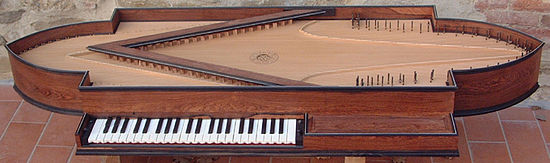
Replica of 1690 oval spinet 
by Tony Chinnery and Kerstin Schwarz

  • Some biographical notes:
Cristofori was born in Padua on May 4, 1655 in what was then the Republic of Venice.


A portrait of Ferdinando de' Medici with his musicians
credits: Getty Images

At the age of 33 he was employed by Prince Ferdinando de Medici, son of the duke of Tuscany. Ferdinando, a lover and patron of music, was the son and heir of Cosimo III, Grand Duke of Tuscany. Tuscany was at a time still a small independent state.

Ferdinando de Medici hired Cristofori to take care of his menagerie of musical instruments, and probably, because he’d heard that Cristofori was a pretty cracking inventor too.


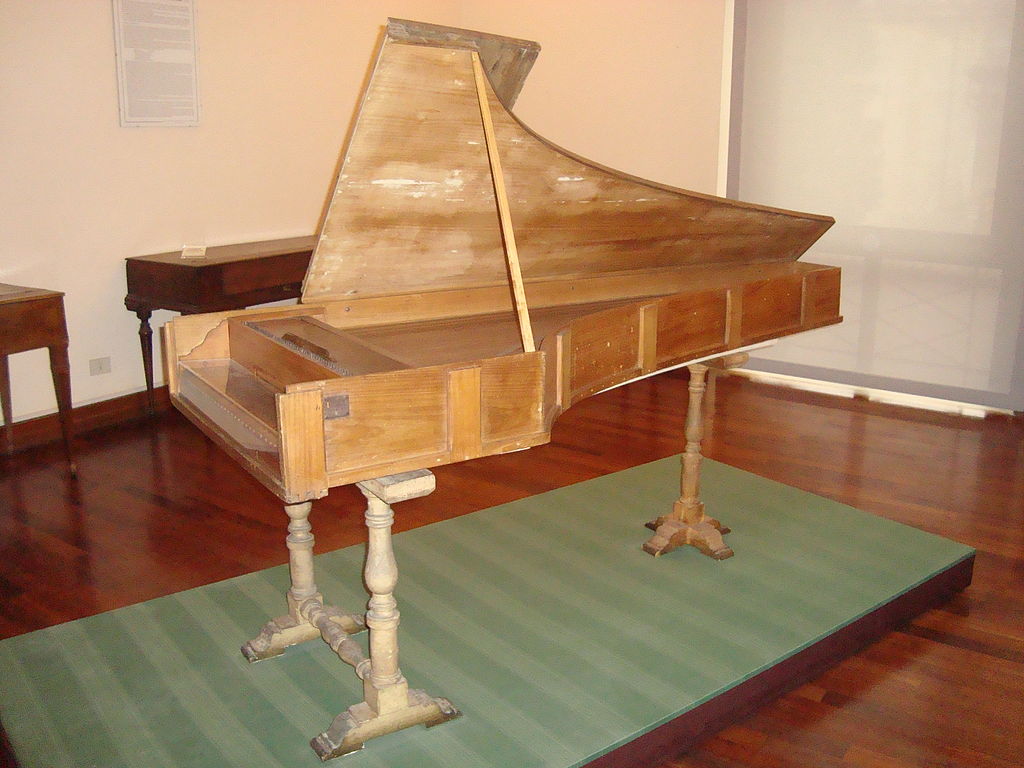
The 1722 Cristofori piano 
in the Museo Nazionale degli Strumenti Musicali in Rome

He is believed to have started work on what would become a piano in the 1690s and the first one is thought to have been made in 1709.


Prior to inventing the piano, Cristofori invented two other keyboard instruments. The first was a the spinettone, a kind of harpsichord. The second was the more original oval spinet, invented in 1690.
He called is invention a "gravicembalo col piano e forte" – a clavichord with soft and loud. The name was shortened to pianoforte and then simply piano.
"Un Arpicembalo di Bartolomeo Cristofori di nuova inventione, che fa' il piano, e il forte, a due registri principali unisoni, con fondo di cipresso senza rosa..."


Gran Piano, 1720
Bartolomeo Cristofori
The Metropolitain Museum of Art

The very first pianos look quite different to modern instruments – there are no pedals, the keyboard is much shorter and the whole instrument is much smaller. If you heard one of these early pianos it would also sound very different – much quieter and much less resonant than a modern piano, such as a Steinway.

Considered the "great" among musical instruments, the piano has proved a key vehicle for the genius of FrĂ©dĂ©ric Chopin, Claude Debussy, Ludwig van Beethoven, Franz Lizt and many other great piano composers.

However, the piano was not popular at first and many felt it was too difficult to play. Cristofori died largely uncelebrated for an invention that would later change the musical world in 1731 – a year before the first sheet music for the piano appeared.


Cristofori’s design was largely ignored in 
Italy, but it soon became known and adopted in Germany through articles in dictionaries of music.


No one is sure how many pianos Cristofori built, but today only three survive that were made by him personally. 


They were all built in the 1720s and are found at the Metropolitan Museum of Art on Google Cultural Institute or at the museum in New York City, at the Museo Strumenti Musicali in Rome, and at the Musikinstrumenten-Museum of Leipzig University in Germany.


Education:


As a teacher in Literature and former teacher in Piano, I must write about my favorite musical instrument. The piano.

Today I have a different sensibility looking to the world, no doubt.

I teached Piano at Voccational Music schools for ten years and at the same time teach Literature & ICT and 
Digital Literacy at official schools for more than 30 years.

I teached my students to love Literature and love Music at the same time in different curricula. Music and Literature are so similar.


True. Playing the piano is not easy but when we able to play piano is a wonderful experience. 


You must include the doodle of Cristofori into your school curriculum, Literature or Music, even better a cross-curricular project Music & Literature.

Let your younger students go on Google website and try playing the piano: forte, mezzo forte and piano or pianissimoAwesome, isn't it? They will love to play!

Ask them if they know the melody? I f not, play Bach's piece on YouTube (must prepare your lesson in advance to have all the material you need).


"Birthdays are not only celebrations, they are milestones that offer a chance to look back and re-evaluate our past with the clarity of hindsight. Perhaps they can reveal where we may want to go next, or insights into why we are here, or maybe just help us ask better questions."
Christine Jowers

Hoping you will share this celebration with your students!  Piano students and other. 

And of course you could share with them the love of piano music, playing if you are a piano teacher or listening the great composers on their smartphones or tablets. 

Why not watching some videos of young pianists?


Remember the young pianist I wrote about some years ago, Jan Lisiecki? Now he is recording at the Deutsche Grammophon. Wow!

I know! First steps are always the hardest, with the piano as with anything else.

It takes time! Many hours studying every day. But at end it's a wonderful sensitive liberty when we are playing the piano.

Encourage the pianist inside your students and their cultural development. And don't forget to cross piano teaching with some good writers in Literature.

Finally, watch and listen this rare piano music lesson by Alfred Cortot:


Wow! Leaves us breathless. Such a beautiful piano lesson!

Alfred Cortot was 84 in this video. So this rare video was taken in 1961, a year before his death. He was a Franco-Swiss pianist and conductor. 

Alfred Cortot one of the most renowned 20th-century classical musicians, especially valued for his poetic insight into Romantic period piano works, particularly those of Chopin and Schumann.

My piano teacher studied with Cortot, and she introduced him to me about his writing notes about Chopin. His books were wonderful. Cortot wrote not just about technical ideas and exercises, but of inspiring suggestions as well. How to do exactly in playing the piano, music, literary connotations and other insights. 

Cortot helped me to touch the piano differently, feeling what I was playing, and not be discouraged by technical difficulties.

Hope you will be inspired with all of these digital resources and share them in your next piano lessons.


G-Souto

04.05.2015