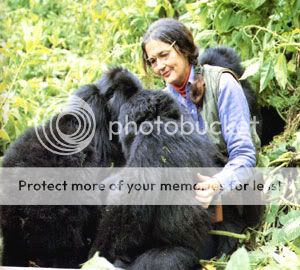
Dian Fossey
credits: Robert M. Campbell
Wow! Another great woman breaking gender barrier? Remember Amelia Earhart or Jane Goodall?
Dian Fossey was an American primatologist and conservationist known for undertaking an extensive study of mountain gorilla groups from 1966 until her murder in 1985.
Dian Fossey was an American primatologist and conservationist known for undertaking an extensive study of mountain gorilla groups from 1966 until her murder in 1985.
Yes, great women who broke gender barrier following their dreams on dangerous careers. Women who deserve our respect!
Google is celebrating the 82nd birthday of the American zoologist Dian Fossey. The doodle features a group of gorillas, with one touching Dian Fossey’s hair while she takes notes.
- Google Doodle:

Google doodle Dian Fossey's 82nd birthday
Here I am writing about a new Google Doodle! A pedagogical digital resource that we can't miss to include into our school lessons
Teachers can include it, just to surprise students with something different as a motivation to know more about a special woman they saw on Google homepage - you know students are the Google Gen - but don't have a clue. Or may be yes, they have. Who knows? We always have the smartest kids in our classroom, right?
So Google is celebrating the 82nd birthday of the American zoologist Dian Fossey. The doodle features a group of gorillas, with one touching Dian Fossey’s hair while she takes notes.
Another great woman breaking gender barrier! Yes, great women that broke gender barrier following their dreams on dangerous careers.


Gorillas in the Mist
Michael Apted, 1988
Teachers, do you know the film Gorillas in the Mist. The Story of Dian Fossey (1988) starring Sigourney Weaver as the naturalist Dian Fossey.
A biopic of Dian Fossey, the scientist who came to Africa to study the vanishing mountain gorillas, and later fought to protect them.
A biopic of Dian Fossey, the scientist who came to Africa to study the vanishing mountain gorillas, and later fought to protect them.
It tells the true-life story of her work in Rwanda Mountain Gorillas. The movie was nominated for five Academy Awards.

Gorillas in the Mist
Dian Fossey, 1983
Based on the book Gorillas in the Mist (1983) by Dian Fossey and the Hayes article. The book covers Fossey's scientific career in great detail. The extraordinary efforts of the primatologist Dian Fossey to ensure the future of the rain forest and its remaining mountain where gorillas are captured in her own words and in candid photographs of this fascinating endangered species. As only she could.
- Some biographic information:
Dian Fossey an American zoologist studied gorillas living in the mountain forests of Rwanda, Africa, in great depth over a period of almost 20 years.
Her extensive research greatly enriched the scientific community’s understanding of mountain gorillas.
Among the most legendary scientists of our time, Dian Fossey went to Africa at the urging of famed anthropologist Louis Leakey and began her groundbreaking studies of gorilla behavior. She faced and overcame many obstacles and ultimately gave her life to gorilla protection. She was murdered in 1985 in Rwanda. Her body was found in her cabin on the morning of Dec. 27, 1985.

Dian Fossey
credits: Europe1.fr
According to the Dian Fossey Gorilla Fund International, dedicated to the conservation and protection of gorillas, Dian Fossey's early interest in animals and her childhood dream of becoming a veterinarian.
After studying the subject at San Jose State College, she changed her major to occupational therapy.
However, her love for animals never faltered, and she was at the same time becoming increasingly interested in Africa.
However, her love for animals never faltered, and she was at the same time becoming increasingly interested in Africa.

National Geographic magazine, 1970
Revealed in 1970 by National Geographic cover, which shows Fossey touching the hand of a wild gorilla, she obtained her Ph D. in Zoology from the University of Cambridge in 1974, aged 42.
By 1966, she had won funding from the National Geographic Society and the Wilkie Brothers’ Foundation to begin a research project in the Congo. She had to move the study to Rwanda due the political situation.
Fossey is considered as a reference in the defense of animal rights, and was one of the first Americans to settle in Africa, adapting to the lifestyle and local traditions.
In 1967, she founded the Karisoke Research Center in Rwanda's Parc National Des Volcans.

credits: Reuters
via Europe1.fr
Fossey died in 1985 when she was killed in her cabin in Karisoke. Theories about Dian Fossey’s murder are varied but have never been fully resolved.
The Digit Fund, which she created to finance her anti-poaching patrols (1978), was renamed the Dian Fossey Gorilla Fund International following her death.
The Digit Fund, which she created to finance her anti-poaching patrols (1978), was renamed the Dian Fossey Gorilla Fund International following her death.
Thirty years later, Dian Fossey was laid to rest in the graveyard behind her cabin at Karisoke, among her gorilla friends and next to her beloved Digit.
Just three years after her death, her life story was made into the 1988 film Gorillas in the Mist starring Sigourney Weaver.

Education:
“When you realize the value of all life, you dwell less on what is past and concentrate on the preservation of the future.”
Dian Fossey, Gorillas in the Mist
“When you realize the value of all life, you dwell less on what is past and concentrate on the preservation of the future.”
Dian Fossey, Gorillas in the Mist
As my usual readers, teachers and parents, know, I plead for Environmental education in every school curriculum.
My goal? Helping students to appreciate and understand the science of ecology, and subsequently gain the capacity to apply it to their lives becoming a new generation of environmentalists.
And here they are! The new generations fighting for climate change.
My goal? Helping students to appreciate and understand the science of ecology, and subsequently gain the capacity to apply it to their lives becoming a new generation of environmentalists.
And here they are! The new generations fighting for climate change.
Linking school success with individual student growth controls for factors outside the classroom that may affect an individual student’s ability to learn. I write about it since the beginning of this blog.

Dian Fossey
However, Dian Fossey is more than an ecologist. She was woman researcher (there are not many in the field) who gave her life to save gorillas.
She can be a good reference for girls at school. Later, in college, young women can become scientists and researchers in the fields of Ecology and Zoology and other fields in science.
This effort will translate into a citizenry that is more motivated, competent and confident to protect and improve the quality of the environment and wild animals.
She can be a good reference for girls at school. Later, in college, young women can become scientists and researchers in the fields of Ecology and Zoology and other fields in science.
This effort will translate into a citizenry that is more motivated, competent and confident to protect and improve the quality of the environment and wild animals.

Dian Fossey
credits: The Dian Fossey Gorilla Fund International
via National Geopgrahic/ Archive
My post celebrates Dian Fossey. I expect to help improve the understanding and appreciation of science, ecology and zoology in education.
As teachers, we can create a customized program that focuses on activities and research to enhance students enthusiasm and understanding for ecology and zoology.
The centerpiece is motivating students for the resources studies: documents, maps, newspaper articles, oral histories or photographs, videos, films, from which students are asked to gather, examine, analyze information, discuss and synthesize insights.
Other resources:
Other resources:
- Video Dian Fossey& Bob Campbell (photographer)
Useful links:
Making Friends with Mountain Gorillas| National Geographic: In remote African highlands, a daring American woman studies some of man's closest nonhuman relatives in their aged-old environment.
https://www.nationalgeographic.com/magazine/1970/01/mountain-gorillas-study-dian-fossey-virunga/
Multimedia | Videos
https://gorillafund.org/video-vault/

A very early concept sketch
credits: doodler Mike Button
"One of the most amazing humans ever to have lived: Dian Fossey. I was incredibly honored to create a Google Doodle for her."
Mike Button
Fossey criticized touristic programs, often paid by international conservation organizations, because those programs interfere with both research and tranquility wild animals.
G-Souto
16.01.2014
update: 23.09.2022
update: 23.09.2022
Copyright © 2014G-Souto'sBlog, gsouto-digitalteacher.blogspot.com®

Schools : Dian Fossey, a great woman in the mist by G-Souto is licensed under a Creative Commons Attribution-NonCommercial-NoDerivatives 4.0 International License.