
Le Voyage dans la Lune, Georges Méliès
Credits : Copyright 2011 Lobster Films/ Fondation Groupama Gan/ Fondation Technicolor
"My friends, I address you all tonight as you truly are; wizards, mermaids, travelers, adventurers, magicians... Come and dream with me."
Georges Méliès
Wow! Visiting the Google home page today, May 3rd, I found an unusual but 'magnifique' Doodle of man with a pristine suit.

A work of science fiction, inspired partly by stories by people like Jules Verne. In the almost 13-minute film below, a group of space explorers travel to the moon, encounter a tribe of strange beings, capture one, and return to Earth. Méliès himself played the crew’s leader, Professor Barbenfouillis.
"Méliès’ contribution to the seventh art was revolutionary. In a time when cinematography was nascent and almost exclusively documentary-style, Méliès single handedly opened the doors of the dream, the magic, and the fiction. He accomplished this fundamental act by uniting the universes of Robert Houdin with the chronophotography and cinematography of Marey and the Lumière brothers."


Other resources:
Wow! Visiting the Google home page today, May 3rd, I found an unusual but 'magnifique' Doodle of man with a pristine suit.

Georges Méliès in 1938
He is French filmmaker Georges Méliès (1861-1938), an illusionist and stage magician before he turned his hand to cinema in its earliest days in Belle Epoque Paris. Méliès was an extraordinary visual stylist and technician who is still much admired a century on.
Google Doodle VR:
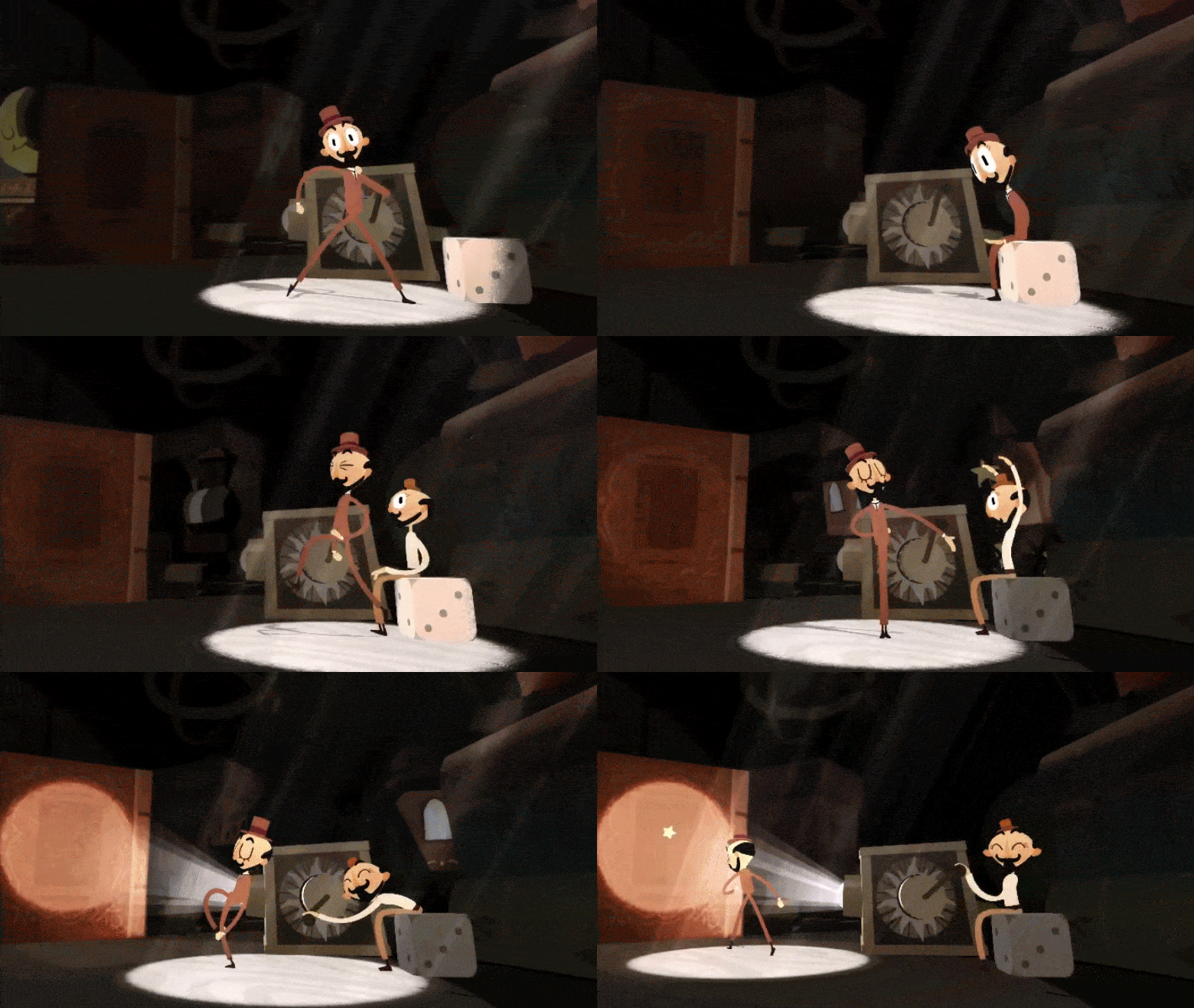
The video celebrates magic and cinema and explores Méliès’ work in illusions like duplication tricks and double exposures, a replacement trick, and a cache illusion where elements look like they’re disappearing.
“In addition to being a magician, Méliès was an expert storyteller, so it was important for the Doodle to have a clear story. We approached it as if it were a ballet or play you watch at the theatre, where you get to choose where to look. In these situations, the spectator becomes the camera, editing their own film,” said Hélène Leroux, project art lead of the Doodle.

Google Doodle Celebrating Georges Méliès
Best known for the unforgettable image of a scowling celestial body
annoyed that a rocket ship has crashed into its eye
in A Trip to the Moon (1902), Méliès was most recently seen
in Martin Scorsese's film Hugo (2011) where he was played in old age by Sir Ben Kingsley.
A work of science fiction, inspired partly by stories by people like Jules Verne. In the almost 13-minute film below, a group of space explorers travel to the moon, encounter a tribe of strange beings, capture one, and return to Earth. Méliès himself played the crew’s leader, Professor Barbenfouillis.
"Méliès’ contribution to the seventh art was revolutionary. In a time when cinematography was nascent and almost exclusively documentary-style, Méliès single handedly opened the doors of the dream, the magic, and the fiction. He accomplished this fundamental act by uniting the universes of Robert Houdin with the chronophotography and cinematography of Marey and the Lumière brothers."
Google Doodle Celebrating Georges Méliès
"Over a hundred years later, we can thank the pioneering mind of Georges Méliès for much of the cinematographic wonder and special effects we see today."
The Doodle? The first ever presented as a 360 degree VR animation. Melies is an entirely fitting subject for this innovative new approach.
Google Doodle Celebrating Georges Méliès
A charming illusionist, an adventurous queen of hearts and an evil green man journey through early cinema, film magic and love.
Georges Méliès, 1861
https://prabook.com/
Some biographical notes:
Méliès was born in 1861, the son of luxury shoemakers who, after attending the prestigious Lycée Louis-le-Grand, completing military service and serving an apprenticeship as a clerk in London - hunned the family business to work as a conjurer at the Theatre Robert-Houdin in Paris.GoogleDoodle Celebrating Georges MélièsHere, Melies developed a fondness for stagecraft and visual effects, working with mechanical automata, trapdoors and lighting, eventually selling his boot factory shares to his brothers and buying the theatre outright.Méliès at his studio in Montreuil, FranceAfter seeing the Lumiere Brothers sensational moving picture camera in action in 1895, he rushed out to establish his own studio and began making films that featured clever illusions and tricks created by experimenting with double exposure, cutting and rewinding, building on his theatrical innovations.


Using elaborate painted sets akin to those of Paris's music halls, Méliès was a true pioneer who played a key role in the evolution of cinematic technique and the medium's storytelling grammar.

Google Doodle Celebrating Georges Méliès
Specialising in horror and steam punk science fiction, taking inspiration from the fiction of late Victorian visionaries Jules Verne and HG Wells, his most famous film remains A Trip To The Moon, which starred acrobats and dancers from the Folies Bergeres and the Chatelet ballet.
 Le Voyage dans la Lune/ A Trip to the Moon, 1902
Star Films/ Geo Méliàs, Paris
Other celebrated works including The Vanishing Lady, The Haunted Castle (both 1896), The Astronomer's Dream (1898), Bluebeard (1901), The Impossible Voyage(1904), The Merry Frolics of Satan (1906) and Baron Munchausen(1911).
Tragically, after more than 500 short films, Méliès's career collapsed with the onset of the First World War.


Google Doodle Celebrating Georges Méliès
Education:
Back to the Moon VR/ Voyage dans la lune is an animated Doodle, interactive short celebrating the artistry of French film director and magician Georges Méliès.
Invite your students to click on and they will be presented with a YouTube player that brings the quirky figure, French filmmaker Georges Méliès, and his creations to life in a wonderfully animated 360-degree short.
Wow! Teachers can't miss this lovely resource in VR. Include it into your school curriculum. Develop some interesting activities in a cross-curricular project.
Google Doodle Celebrating Georges Méliès
Other resources:
Google is calling it a VR Doodle, which it is, sort of. Back to the Moon will be part of the Spotlight Stories app, which works with Cardboard and Daydream headsets.

Games/ Apps:
Back to the Moon, a celebration of Georges Méliès
A charming illusionist, an adventurous queen of hearts and an evil green man journey through early cinema, film magic and love. Back to the Moon VR is an animated, interactive short celebrating the artistry of French film director and magician Georges Méliès.
Directed by Fx Goby and Hélène Leroux. Produced by Nexus Studios.
Back to the Moon
Games/ Apps:
Back to the Moon, a celebration of Georges Méliès
A charming illusionist, an adventurous queen of hearts and an evil green man journey through early cinema, film magic and love. Back to the Moon VR is an animated, interactive short celebrating the artistry of French film director and magician Georges Méliès.
Directed by Fx Goby and Hélène Leroux. Produced by Nexus Studios.
It will also be available for high-end VR headsets, such as the HTC Vive, through Steam and Viveport.
Explore original Georges Méliès memorabilia and discover the story behind the invention of the first cinema studio and special effects by visiting the new Google Arts & Culture exhibit, created in collaboration with The Cinémathèque Française in Paris, France.
Making of:
En français:
Les enseignants trouveront aussi d'excellentes ressources:
Parcours, Le Paris de Georges Méliès
http://www.pariscinemaregion.fr/paris-de-georges-melies
France Culture : 1902 Méliès 'le voyage dans la lune' (podcast)
https://www.franceculture.fr/emissions/breves-histoires-de-la-culture/1902-melies-le-voyage-dans-la-lune
Je suis émerveillée. Je n'arrête pas de revoir le Doodle. Époustouflant!
G-Souto

G-Souto
03.05.2018
Copyright © 2018G-Souto'sBlog, gsouto-digitalteacher.blogspot.com®
Copyright © 2018G-Souto'sBlog, gsouto-digitalteacher.blogspot.com®
Schools : Wow ! Georges Méliès in VR : a dream ! Resources by G-Souto is licensed under a Creative Commons Attribution-NonCommercial-NoDerivatives 4.0 International License
Sources: Google Doodle/ Wikipedia


